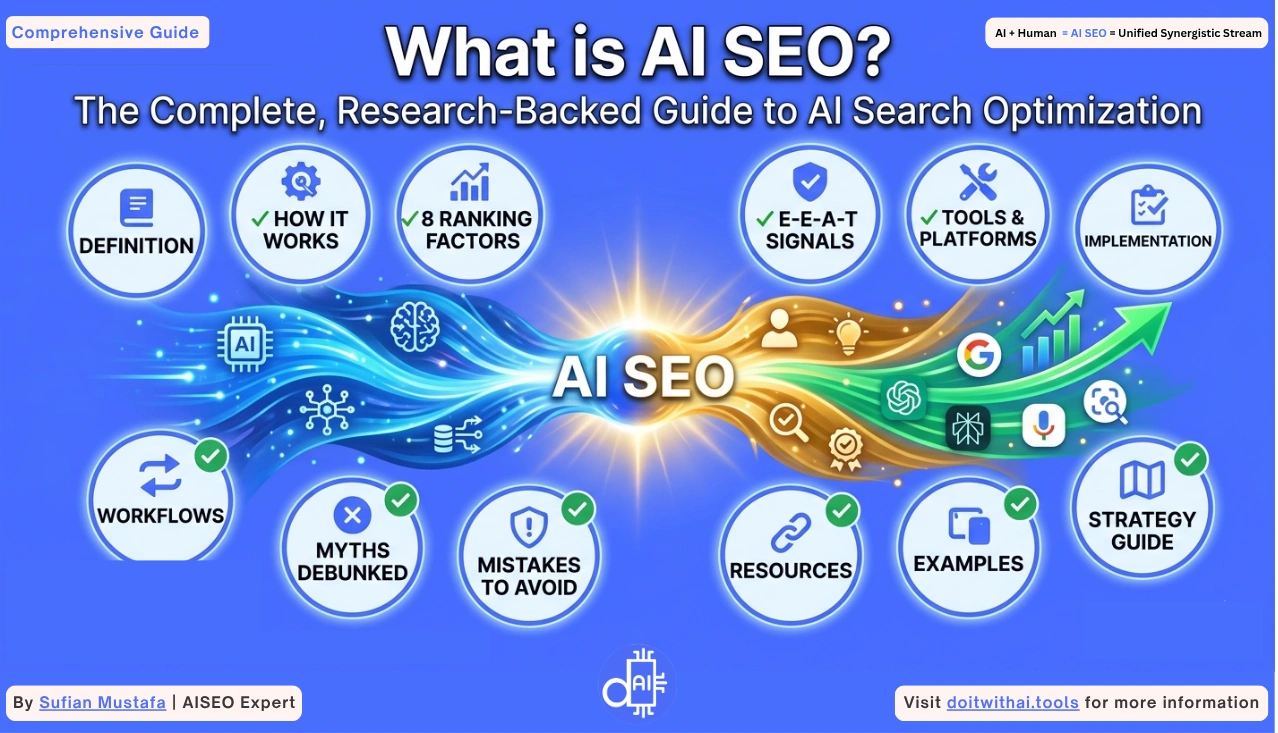

AI Tools Expert & Founder
Table of Contents
We have seen a huge change in how people look for information online in recent years.
You have probably noticed it yourself. You search on Google, and the answer appears directly on the results page. In many cases, you do not even need to visit a website.
Recent data underscores the scale of this change.
Studies from SparkToro, Datos, and Semrush indicate that approximately 58 to 60 percent of Google searches now end without a click to external sites (with some reports showing even higher rates on mobile and AI–triggered queries).
This change is often described as zero-click search because users increasingly get what they need without navigating away from the search engine results page.
But this does not mean traditional SEO is dead. It still matters a lot.
Technical foundations, search intent alignment, and quality content still matter. What has changed is where and how your content appears. You can't just chase blue-link rankings anymore. Your content must now be structured so AI systems can understand it, trust it, and potentially cite it.
That is exactly why AI SEO has become so important.
AI SEO goes beyond just using tools like ChatGPT to write content faster.
The bigger shift is about optimizing your content for answer engines and generative systems, not just traditional rankings. This includes AEO for AI-driven results like AI Overviews, and GEO for platforms such as ChatGPT, Perplexity AI, and Google Gemini.
In this guide, we'll dive deep into AI SEO from every angle.
You will learn what AI SEO really means, why it matters now more than ever, and how it connects to answer engines, generative search, content structure, and topical authority.
By the end, you will have a clear and practical understanding of how to adapt your SEO strategy for this new search environment.
A Note Before We Begin
I’m Sufian Mustafa, founder of Do It With AI Tools.
I write about AI SEO and help creators understand how search is evolving in the AI era.
This guide took several weeks to complete.
Not because the information is hard to find.
But because most content around AI SEO lacks depth and clarity.
A lot of what you see online follows the same pattern:
- Generic definitions
- Repeated ideas
- No clear connection between concepts
I wanted to approach this differently.
So I went deeper.
I explored how AI SEO actually evolved.
I studied how search behavior changed with AI systems.
I analyzed how platforms interpret and rank content differently.
I also tested workflows and broke down real use cases.
Instead of treating AEO, GEO, and AI-assisted SEO as separate ideas, I focused on how they connect into one structured system.
This guide is not a quick overview.
It is a complete breakdown designed to help you understand how everything fits together.
If you have read other AI SEO guides and still feel confused, this will give you a clearer direction.
Now, let’s move forward.
As the founder of Do It With AI Tools, I designed this guide to bridge the gap between complex technical theory and practical AI SEO execution for modern creators.
What Is AI SEO? Definition, Meaning, and Why It Matters in 2026
To understand AI SEO, you must go back to a time when artificial intelligence and search engine optimization were largely treated as separate disciplines.
AI was its own world.
It powered tools like ChatGPT generating human-like text, tools like Midjourney creating visuals, and a growing ecosystem of AI design tools such as infographic generators that helped turn ideas into visual content. It was fast, innovative, and largely separate from search marketing.
SEO was its own world, too.
It focused on ranking in Google Search. It involved keyword research, backlink building, technical audits, and content optimization. It was structured, strategic, and primarily human-driven.
For years, these two worlds ran in parallel.
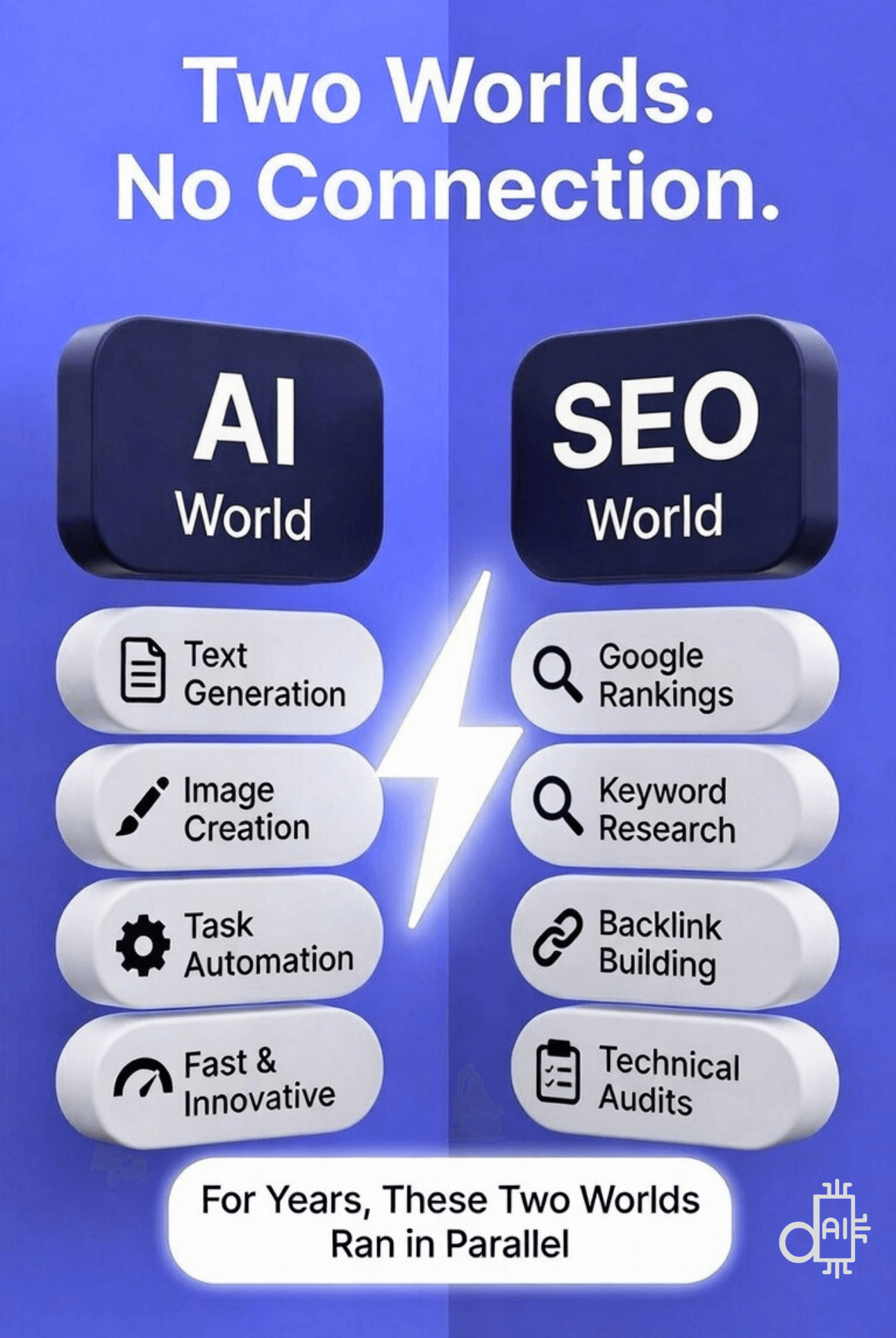
For a long time, the "AI World" and "SEO World" never spoke the same language, but as you can see here, they were secretly preparing for the massive transformation we are living through today.
How AI Tools and SEO Merged Into One Discipline
As generative AI tools became accessible, marketers and SEO professionals began integrating them into daily workflows.
Not because they were told to. Because the efficiency was undeniable.
Why spend hours building a content brief when AI could generate one in minutes? Why manually analyze competitors when AI could process patterns at scale? Why guess search intent when machine learning could model it precisely?
Adoption was organic and industry-wide.
Practitioners simply started doing SEO with AI.
And when a behavior becomes universal, language adapts. The industry stopped saying “using AI for SEO” and started saying AI SEO.
It was not a boardroom invention. It was the natural label for a new reality.
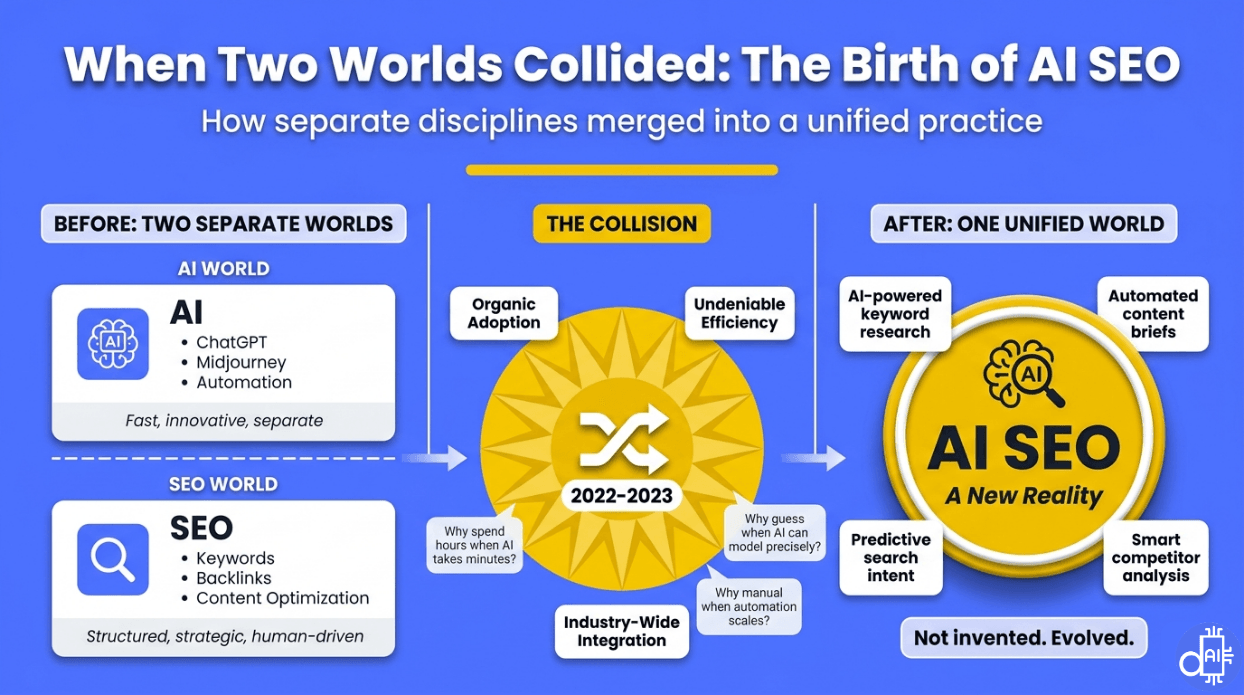
This timeline visualizes the pivotal moment when AI tools and traditional SEO collided through organic, efficiency-driven adoption, naturally giving rise to the unified discipline now known as AI SEO.
The Two Revolutions That Created AI SEO (And Why Most People Only Know One)
Most explanations treat AI SEO as a single evolution.
Humans adopted AI tools. SEO became smarter. End of story.
That is only half of the picture.
AI SEO emerged from two revolutions happening at the same time. Most discussions explain the first. Very few explain the second. Almost none explain how both combined created a new discipline.
The First Revolution: Practitioners Using AI
The first shift happened on your side.
SEO professionals began using AI tools for:
- Content creation
- Keyword research
- Technical audits
- Automation
- Content scaling
This revolution is controlled by you.
You decide whether to use AI tools. You choose how deeply to integrate them. You control the workflow transformation.
But something else was happening at the same time.
Revolution 2: Search Engines Became AI-Powered
This shift had nothing to do with your decisions.
Search engines were being rebuilt.
Google AI Overviews began placing AI-generated answers at the top of search results. Users started receiving complete, synthesized responses directly on the results page.
Sometimes no click was required.
Then behavior shifted further.
Perplexity AI emerged as a standalone answer engine. ChatGPT evolved into a search destination. Gemini and Claude expanded conversational search even further.
Now an entirely new search layer exists.
AI systems read your content. They interpret it. They synthesize it. They deliver answers directly to users.
Sometimes with citations. Sometimes without it.
This revolution was not optional.
You did not choose it. It arrived. It changed user behavior. It redefined where discovery happens.
One revolution you drove. The other drove you.
Together, they created something new.
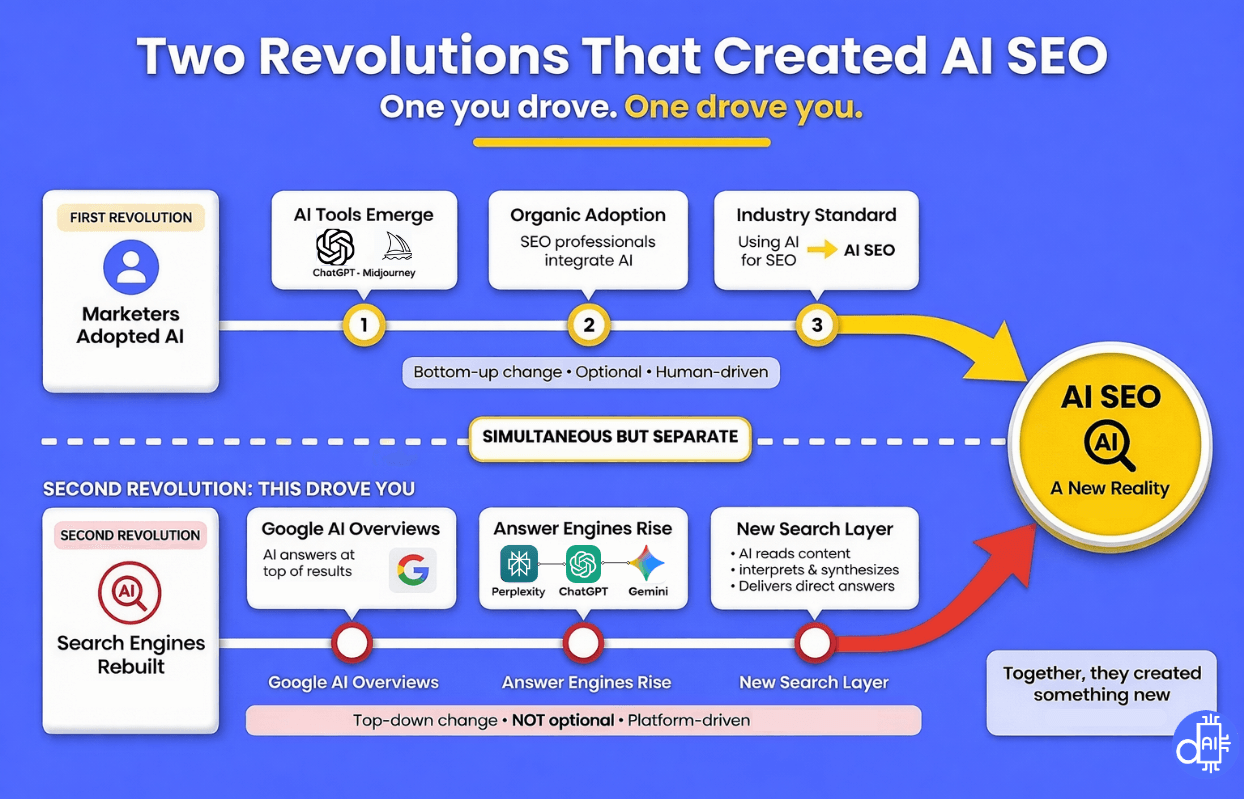
This diagram illustrates the dual origins of AI SEO: the practitioner-driven first revolution where you adopted AI tools for workflows, running parallel to the unavoidable second revolution where search engines rebuilt themselves with AI Overviews and answer engines.
So What Exactly Is AI SEO? (Simple Definition)
If we condense everything into a clear definition:
AI SEO refers to the strategic use of artificial intelligence to research, create, and optimize content, while also structuring that content so it can be understood, selected, summarized, and cited by AI-powered search engines and generative platforms.
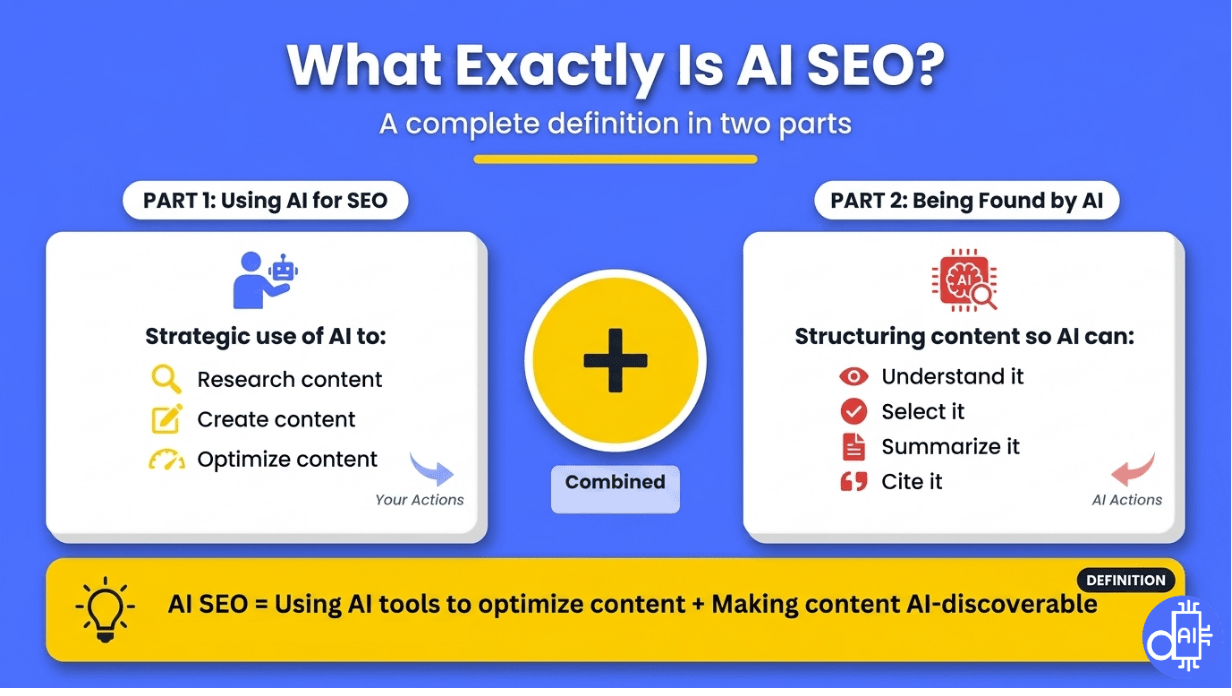
Defining AI SEO requires looking at both sides of the coin: it is simultaneously the strategic use of AI for content research and creation, as well as the technical necessity of making your content discoverable by modern AI systems.
The Two Sides of the Same Coin
Think of AI SEO as a coin.
One side represents what you control:
- AI-assisted research
- AI-generated content
- AI-powered optimization
- Workflow automation
The other side represents the evolving search ecosystem:
- AI answers appearing before organic results
- Generative engines citing your content
- Conversational platforms are replacing traditional search behavior
You cannot hold one side of a coin without the other.
And you cannot practice AI SEO by optimizing your workflow while ignoring how search itself has changed.
This dual structure is also why AI SEO naturally gave rise to two specialized disciplines beneath it.
Each emerged as a response to the second revolution. Each deserves deeper exploration.
But before going there, it helps to understand the full hierarchy of how AI SEO is structured today.
The AI SEO Framework: AEO, GEO, and AI-Assisted SEO Explained
Now that you understand what AI SEO is and how it evolved, the next step is to break it down into its core layers.
AI SEO is not a single tactic.
It is a structured ecosystem.
At the top sits AI SEO as the parent discipline. Beneath it are specialized branches that respond to different AI-driven search behaviors.
As search shifted from traditional blue links to direct answers and generative summaries, new optimization approaches emerged. These approaches are often discussed separately, but they all belong to the same hierarchy.
Three Practical Layers of AI SEO
AI SEO can be structured into three interconnected layers:
- AEO (Answer Engine Optimization) — focuses on direct answers within search results.
- GEO (Generative Engine Optimization) — focuses on generative AI systems outside traditional search.
- AI-Assisted SEO — focuses on using AI tools to improve traditional SEO workflows.
Each layer serves a distinct purpose:
- Some help your content become the chosen answer.
- Others help your content become a cited source in AI-generated summaries.
Together, they form the operational framework of modern AI SEO.
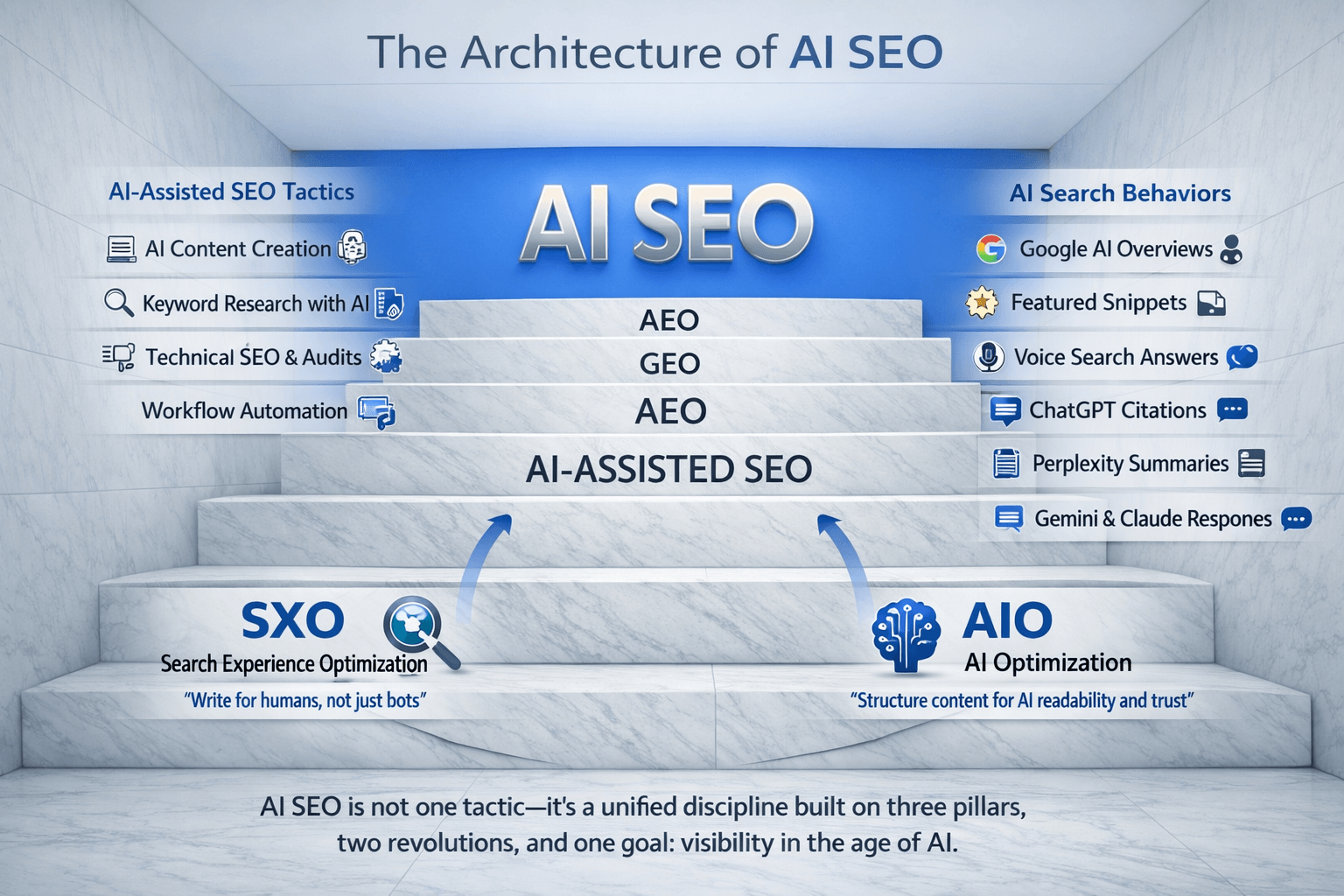
Modern AI SEO is not a single tactic but a structured ecosystem where AEO, GEO, and AI-Assisted SEO work together to ensure maximum visibility in the age of AI.
AI SEO: The Unified Discipline
AI SEO sits at the top of the hierarchy as the unified discipline that brought everything together. It is the umbrella covering:
- The tools you use
- The platforms your content must perform on
When someone says they are “doing AI SEO,” they are not referring to one tactic. They are operating across this entire architecture, whether consciously or not.
What Is AEO (Answer Engine Optimization) and Why It Matters for AI SEO
Directly beneath AI SEO is AEO.
AEO emerged from a simple shift in user behavior: people stopped wanting to search and started wanting answers.
It is the practice of structuring and optimizing content to directly answer specific questions:
- Clearly
- Concisely
- In a format AI systems can read and surface instantly
AEO is about becoming the answer, not just appearing as a result.
Examples of AEO in Action
- Featured Snippets: Google pulls your content directly to the top of the page.
- Voice Search: Your answer is read aloud on phones and smart devices.
- AI Overviews: Generative AI synthesizes top sources at the top of SERPs—no click required.
AEO is no longer optional. Every evolution in Google Search—from featured snippets to AI Overviews—points to the same goal: be the answer.
Be readable. Be trustworthy.
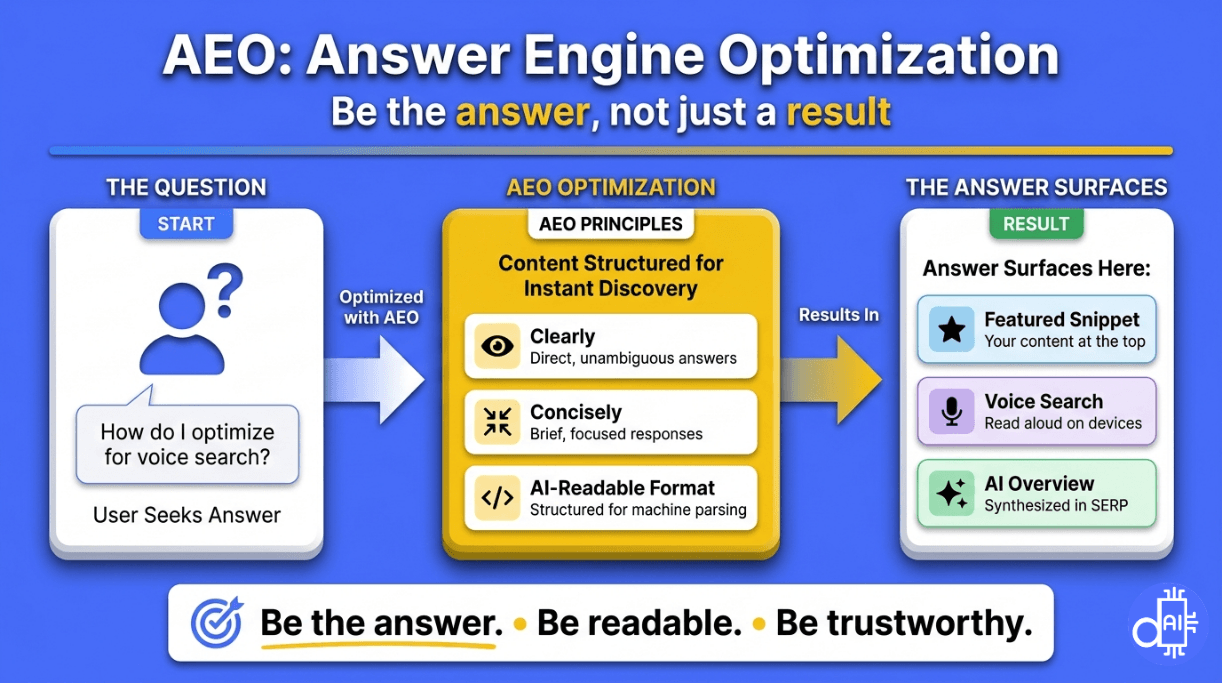
By mastering these AEO principles—clearly providing direct answers, keeping responses brief, and utilizing AI-readable structures—you increase your chances of surfacing in high-visibility areas like Google AI Overviews, Featured Snippets, and Voice Search.
What Is GEO (Generative Engine Optimization) and How Does It Differ from AEO
If AEO is about winning within Google, GEO is about winning beyond it.
GEO — Generative Engine Optimization — focuses on ensuring your content is discovered, understood, cited, and referenced by standalone AI engines, such as:
- ChatGPT
- Perplexity AI
- Gemini
- Claude
These platforms are built to read the web, synthesize information, and deliver direct responses—often with citations linking back to trusted sources.
GEO is your strategy for becoming one of those trusted sources. It focuses on:
- Content authority
- Entity clarity
- Structural credibility
Where AEO keeps you visible inside Google, GEO keeps you relevant in a world where Google is no longer the only destination.
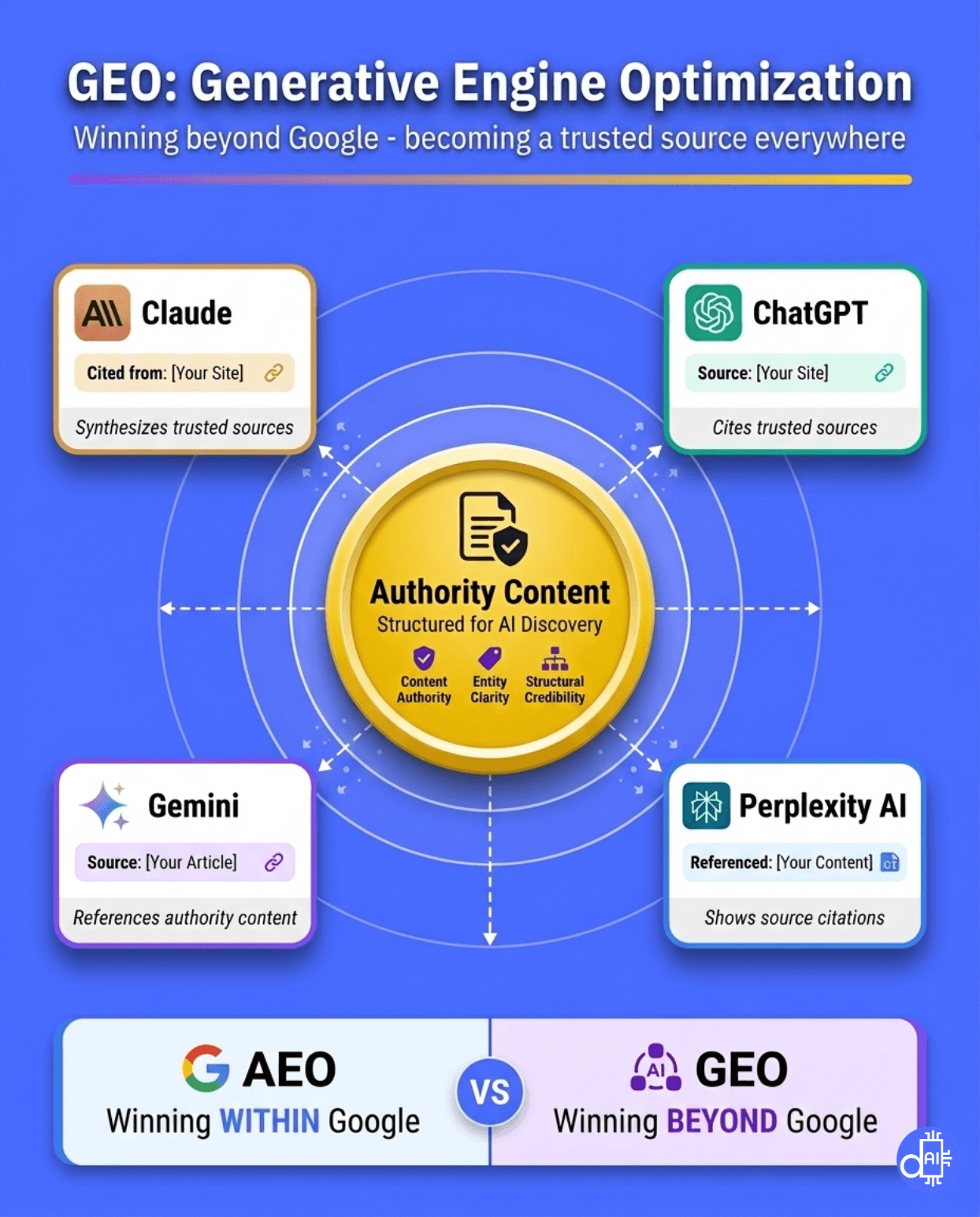
Unlike Answer Engine Optimization (AEO), which focuses on winning within Google, GEO is your strategy for winning beyond Google by ensuring your content is discovered, understood, and cited by standalone AI engines.
AI-Assisted SEO: Using Artificial Intelligence to Power Your Traditional SEO Workflow
The third layer represents the first revolution—the one driven by practitioners.
AI-Assisted SEO uses generative AI tools to enhance traditional SEO workflows, including:
- Content creation
- Keyword research
- Competitor analysis
- Technical audits
- Internal linking strategies
- Meta optimization
This pillar is about how efficiently and intelligently you create and optimize content, rather than where it ranks. It is the engine room of AI SEO, powering everything else at scale.
The Full Picture
AI SEO
├── AEO (Answer Engine Optimization)
│ ├── AI Overviews (Google)
│ ├── Featured Snippets
│ └── Voice Search Answers
├── GEO (Generative Engine Optimization)
│ ├── ChatGPT Search Citations
│ ├── Perplexity Answers
│ └── Gemini, Claude & Emerging AI Engines
└── AI-Assisted SEO
├── AI Content Creation
├── Keyword Research with AI
└── Technical SEO & Audits
Summary:
- Three pillars: AEO, GEO, AI-Assisted SEO
- Two revolutions: Search changed without asking, AI tools empowered practitioners
- One unified discipline: A coordinated approach to visibility in the age of AI
AEO and GEO respond to the changing search landscape.
AI-Assisted SEO responds to the opportunity AI tools provide.
Together, they are not separate strategies—they are three dimensions of a single, coherent AI SEO approach.
SXO and AIO — Two More Signals Showing Where Search Is Heading
AI SEO did not stop evolving after AEO and GEO.
Two more important terms have quietly joined the discussion. They may feel new, but both connect directly to concepts you already know.
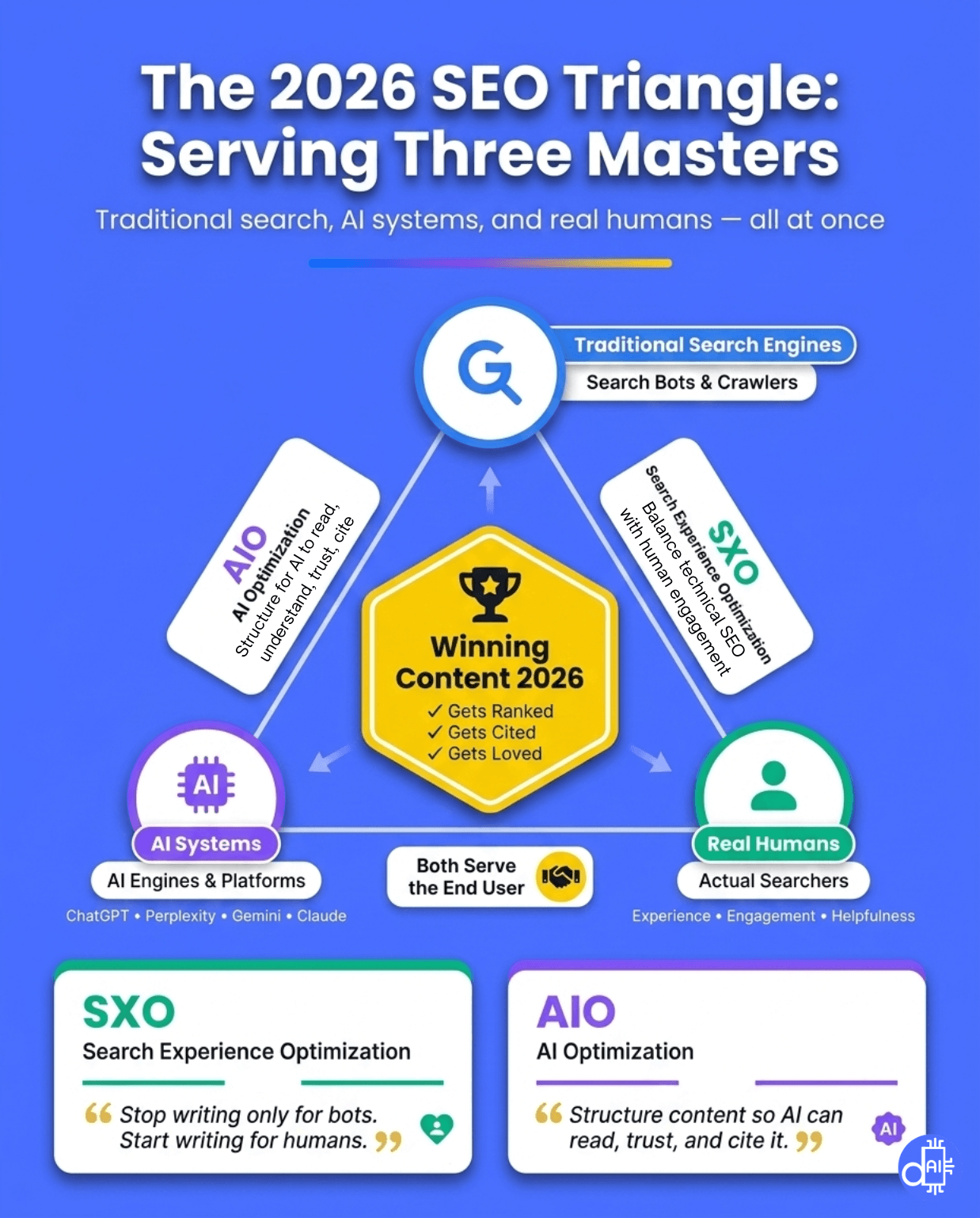
Modern search success is defined by how well you balance your strategy across three distinct masters: traditional search engines, modern AI systems, and the real humans behind the screen.
SXO ( Search Experience Optimization)
SXO is modern SEO when you shift focus from Google’s crawlers to the actual humans searching.
Here is the simple logic:
- User lands on your page
- Reads for a few seconds
- Hits the back button → Google notices that signal
Perfect keywords and clean meta tags do not save you here.
A high bounce rate tells Google your page failed the person it was meant to help.
The winning approach combines:
- Solid technical SEO basics
- A genuinely helpful and engaging experience for real readers
That balance is SXO.
Keywords still matter. Site structure still matters. But now the human reader matters just as much as the bot.
AIO ( AI Optimization )
AIO is not really a brand-new idea.
You have already seen it throughout this article — just under slightly different names.
AIO means building your content, brand, and website so AI systems can easily:
- Read it
- Understand it
- Trust it
- Cite it
This applies to Google AI Overviews, ChatGPT Search, Perplexity, Gemini, and similar tools.
In short: AIO is the practical side of everything GEO and AEO have been pointing toward.
SXO + AIO Together Tell the Full Story for 2026
These two concepts arrive at the same truth — just from opposite directions:
SXO: Stop writing only for bots. Start writing for humans. AIO: Structure your content so AI systems can read, trust, and cite it.
In 2026, neither Google nor any major AI engine rewards content that pleases only one side.
The content that ranks and gets cited is the content that serves all three masters well:
- Traditional search engines
- Modern AI systems
- Most importantly, the real person sitting behind the screen
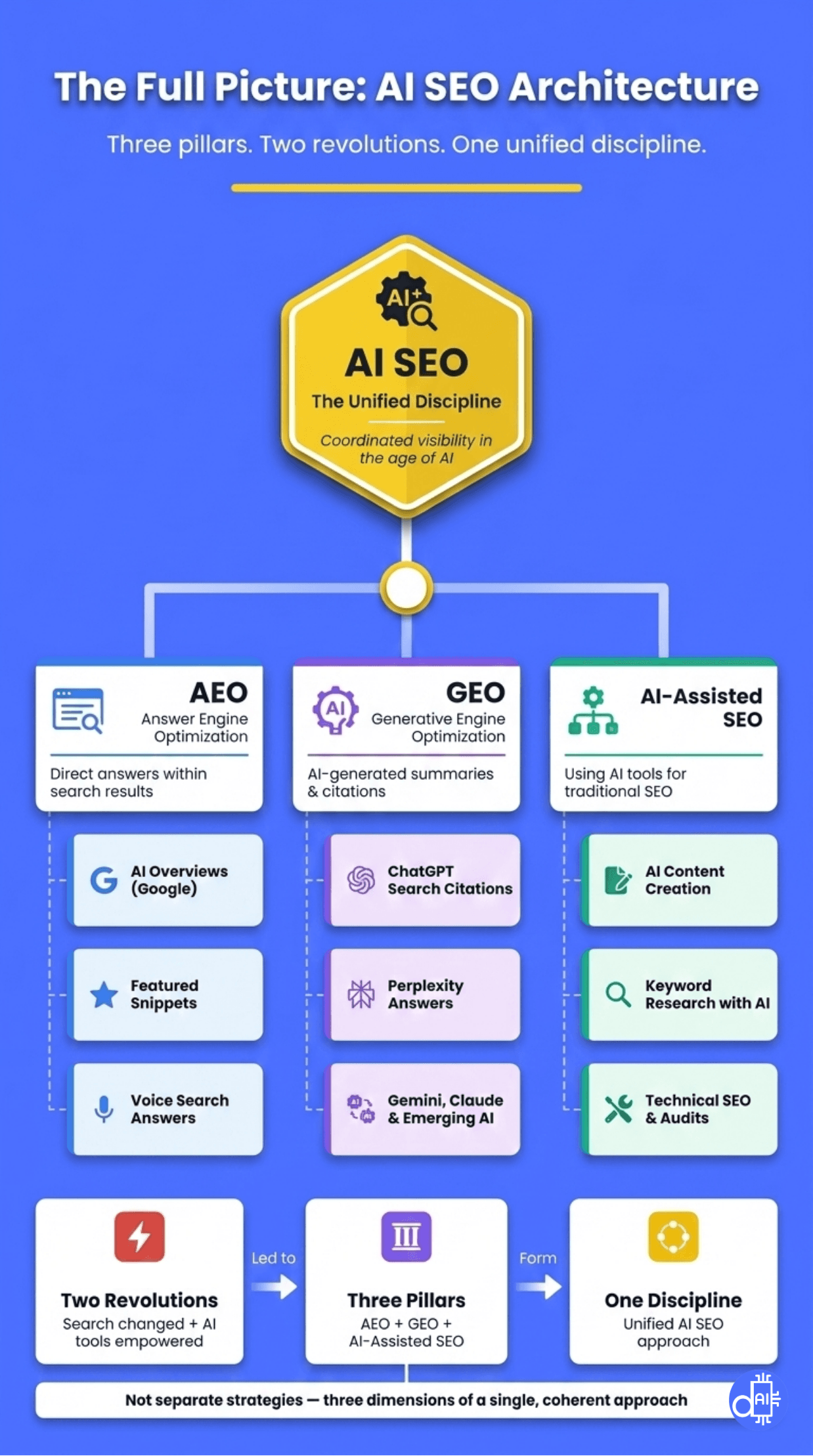
Success in 2026 relies on mastering this AI SEO architecture, as it bridges the gap between Answer Engine Optimization (AEO), Generative Engine Optimization (GEO), and AI-Assisted SEO to create a unified strategy that drives sustainable visibility across all generative platforms.
The Evolution of Google Search: From Keyword Matching to AI-Generated Answers
To understand AI SEO today, you need to understand the journey that led here.
Search engines did not become AI-driven overnight. The shift happened gradually through several phases. Each phase changed how search engines interpret content and how users search.
Over time, the rules evolved so much that modern SEO barely resembles its early days.
Phase 1 (2010–2014): The Keyword Era
In the early days, SEO revolved around exact match keywords.
You found the phrases people searched for. Then you placed those phrases across your page to improve rankings. Search engines matched words, not meaning.
For example:
The system did not understand intent. It only matched patterns of text.
This made SEO very mechanical.
If you understood the keyword formula, rankings were often predictable.
Because of this limitation, many websites manipulated rankings by repeating keywords unnaturally across their content.
Phase 2 (2015–2019): The Rise of Semantic Search
A major shift began in 2015 with the introduction of RankBrain
RankBrain was Google's first large-scale AI system designed to understand search intent, not just match keywords.
For the first time, Google attempted to interpret what users meant, not only what they typed.
The BERT Breakthrough
In 2019, Google introduced BERT , which dramatically improved natural language understanding.
BERT helped Google interpret:
- Sentence structure
- Context between words
- Subtle differences in meaning
For example:
- "How to change a tire"
- "Tire replacement steps"
Google could now recognize these as the same intent, even though the wording differs.
This shift marked the beginning of a new era.
SEO was no longer about repeating keywords. It was about proving relevance and answering intent.
Phase 3 (2020–2023): Neural Matching, Context, and E-E-A-T
The next major evolution came with MUM (Multitask Unified Model).
MUM pushed Google's understanding much further by analyzing information across:
- Multiple languages
- Different formats
- Complex topic relationships
This changed how content was evaluated.
Key Ranking Shifts During This Phase
Search engines began evaluating websites as entities, not isolated pages.
The Rise of E-E-A-T
During this period, E-E-A-T became central became a central quality framework.
It stands for:
- Experience
- Expertise
- Authoritativeness
- Trust
Content quality was no longer about how often keywords appeared.
Instead, Google evaluated:
- Credibility of the author
- Depth of expertise
- Real-world experience
- Overall trust signals
Phase 4 (2024–2026): The Multi-Platform AI Search Era
This is where the second major search revolution arrived.
Generative AI began appearing directly inside search results.
AI-Powered Search Interfaces
Platforms started presenting AI-generated summaries before traditional links.
Examples include:
- Google AI Overviews (formerly SGE)
- ChatGPT with live search
- Perplexity AI answer-based search
These systems generate responses using multiple sources and then cite those sources.
This changed the nature of search visibility.
The blue link was no longer the only destination. Being cited inside AI answers became the new visibility layer.
For creators and SEO professionals, this shift changed the goal.
You are no longer competing only for Position #1.
You are also competing to become a trusted source AI systems reference.
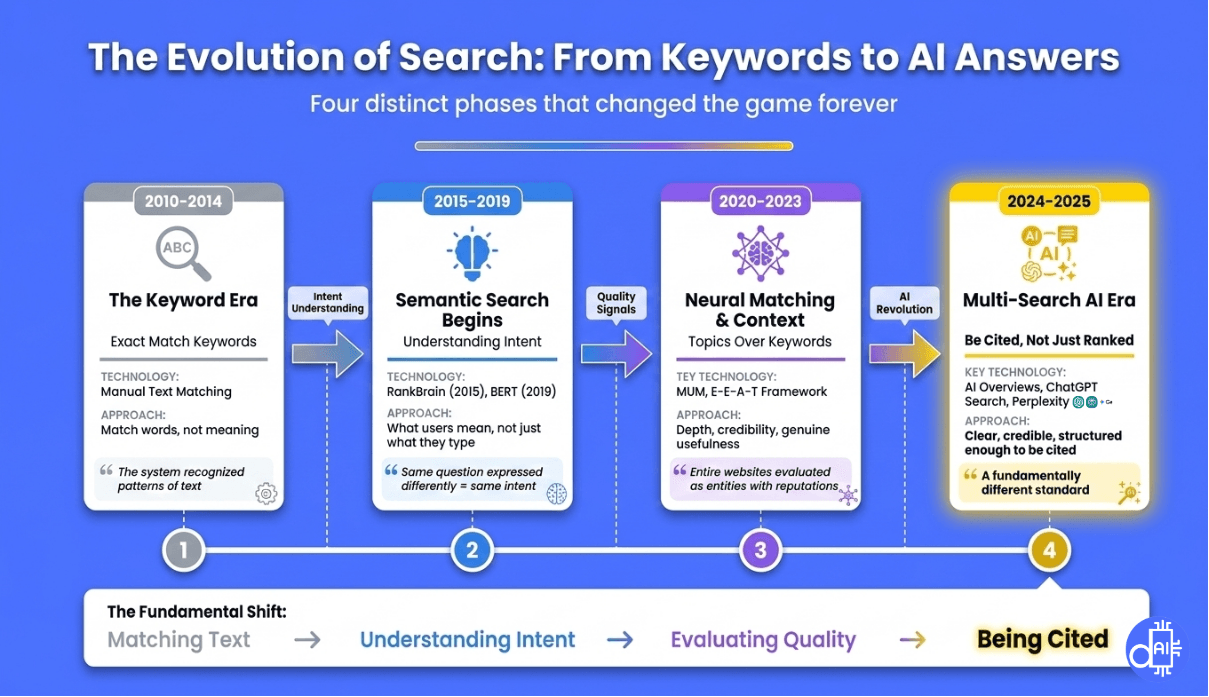
We have traveled from the Keyword Era, through Semantic Search and Neural Matching, to our current Multi-Search AI Era, where the primary objective is to be cited rather than just ranked.
How User Search Behavior Has Changed in the AI Era: Longer Queries, More Questions
User behavior evolved alongside search technology.
Search queries today look very different from those a decade ago.
Key Behavioral Changes
1. Longer queries
Users now search in complete phrases.
Average query length has grown from 2 to 3 words to 5 to 7 words.
2. Conversational search
People increasingly search the way they speak.
Instead of short fragments, queries now resemble full questions.
Examples:
- "How do I start learning SEO?"
- "Which AI tools help with keyword research?"
3. Question-driven searches
A large portion of queries now start with:
- What
- How
- Why
- When
- Where
These queries signal clear informational intent.
4. Multi-step search journeys
Users rarely stop after one query.
They ask follow-up questions expecting systems to remember context.
Example search journey:
- "Best AI SEO tools"
- "Which one is cheapest?"
- "Does it support keyword clustering?"
Modern search engines and AI systems now track these conversations.
Why This Shift Created AI SEO
The move from 10 blue links to AI-generated answers with sources changed the rules of visibility.
Your content now competes in two ways:
- Ranking inside traditional search results
- Being cited inside AI-generated responses
This is why new disciplines emerged:
- Answer Engine Optimization (AEO)
- Generative Engine Optimization (GEO)
Both focus on one goal:
Create content that AI systems trust enough to summarize, cite, and recommend.
The New Standard for Content
In the AI search era, the winning content is not the page that repeats keywords.
It is the page that:
- Answers questions clearly
- Provides complete explanations
- Demonstrates real expertise
- Builds credibility through evidence
AI systems prioritize sources they can confidently rely on.
That is the standard AI SEO now demands.
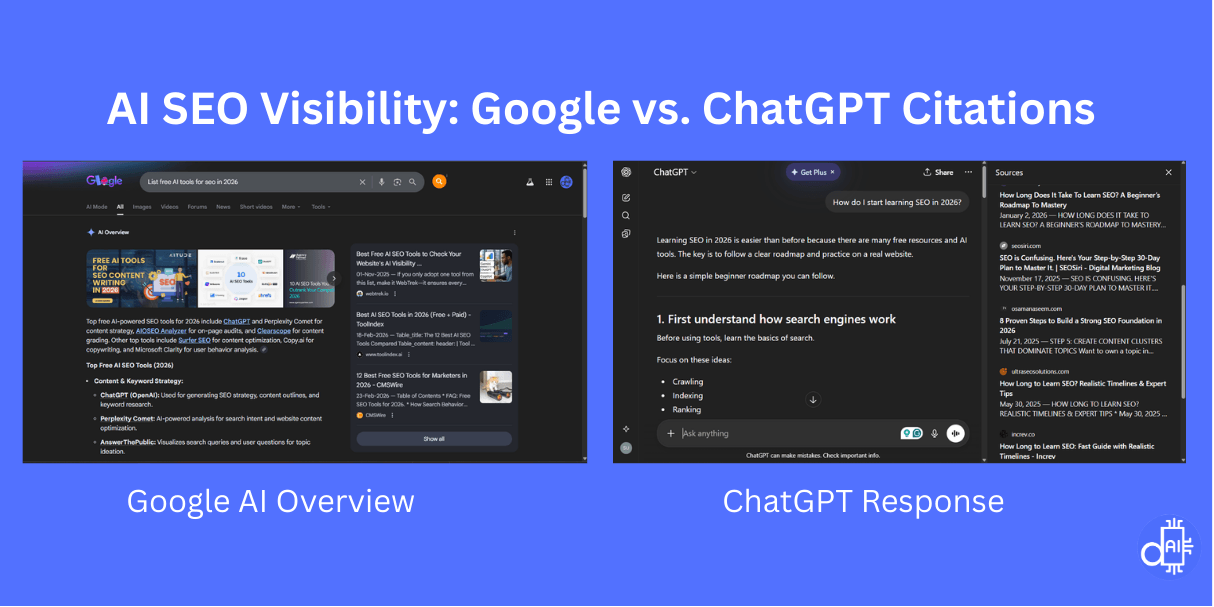
This side-by-side shows AI SEO visibility in action: Google AI Overviews summarize results instantly, while ChatGPT delivers cited conversational answers—highlighting the need for AEO and GEO optimization.
How AI Evaluates Content: Traditional SEO vs AI SEO Ranking Factors
Most SEO guides oversimplify this topic.
Backlinks, keywords, and page speed still matter. They did not disappear.
What changed is how AI-powered systems interpret and prioritize these signals.
Modern search engines combine classic algorithms with advanced AI models.
To win in 2026, you must optimize for both.
The Core Reality: Traditional SEO and AI SEO Work Together
You are not choosing one system over the other.
For example, Google still evaluates backlinks and technical SEO signals.
At the same time, its AI models such as Gemini analyze semantic meaning and topical depth.
Traditional signals establish credibility.
AI signals determine whether your content deserves to be cited as the best answer.
The difference lies in weighting and interpretation.
Traditional SEO Ranking Factors That Still Matter in the AI Search Era
These signals have powered search for more than two decades.
They still form the technical backbone of visibility.
1. Backlinks and Link Authority
What it measures: External validation.
When authoritative websites link to you, search engines interpret that as trust.
Links from publications like Forbes or TechCrunch carry strong authority signals.
Why it still matters:
AI systems use backlinks as credibility indicators. If trusted domains reference you, your content appears citation-worthy.
2. Keyword Matching and Relevance
What it measures: Topical alignment.
Traditional algorithms scan your:
- Title tag
- Meta description
- H1
- First 100 words
- Subheadings
Exact and related keyword placement helps define topic clarity.
Why it still matters:
Even advanced AI models need clear topic signals. If your page never mentions “AI SEO tools,” it cannot rank for it.
3. User Experience and Behavioral Signals
Search engines analyze how users interact with your page:
- Bounce rate
- Dwell time
- Click-through rate
If users stay, engage, and do not return to search results, the system learns your content satisfies intent.
Why it still matters:
AI models process engagement data at scale. If users ignore your page, AI assumes it is not the best answer.
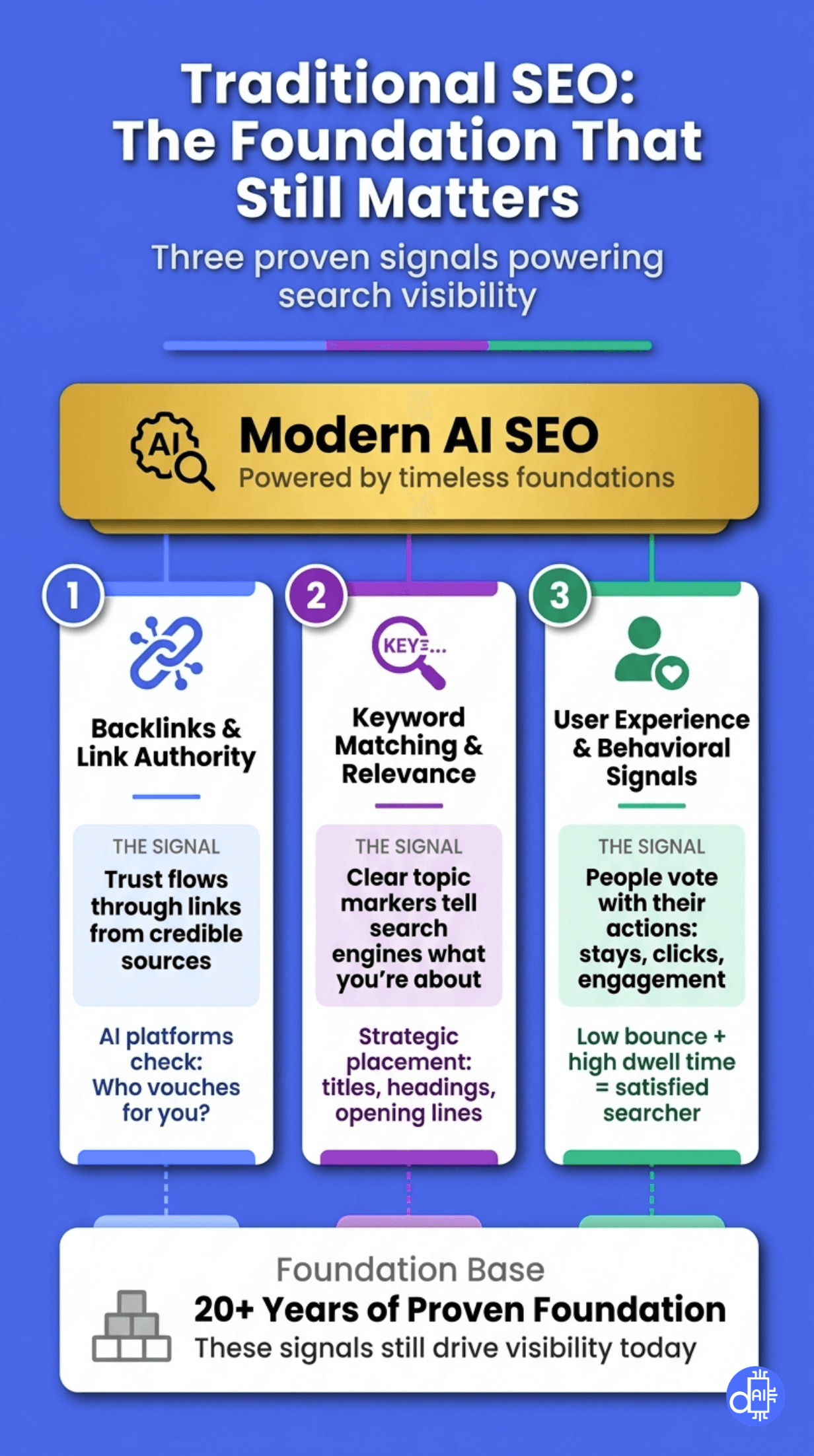
While the search landscape is evolving, Modern AI SEO remains powered by timeless foundations that have defined digital visibility for over two decades.
8 AI SEO Ranking Factors That Determine Whether AI Systems Cite Your Content
1. Topical Depth and NLP Evaluation
AI evaluates whether you covered a subject comprehensively.
Mentioning a term is not enough.
If you write about AI SEO, you should naturally include semantic SEO, entity optimization, search intent, and topical authority.
Optimization strategy:
Cover the topic from multiple angles with practical examples.
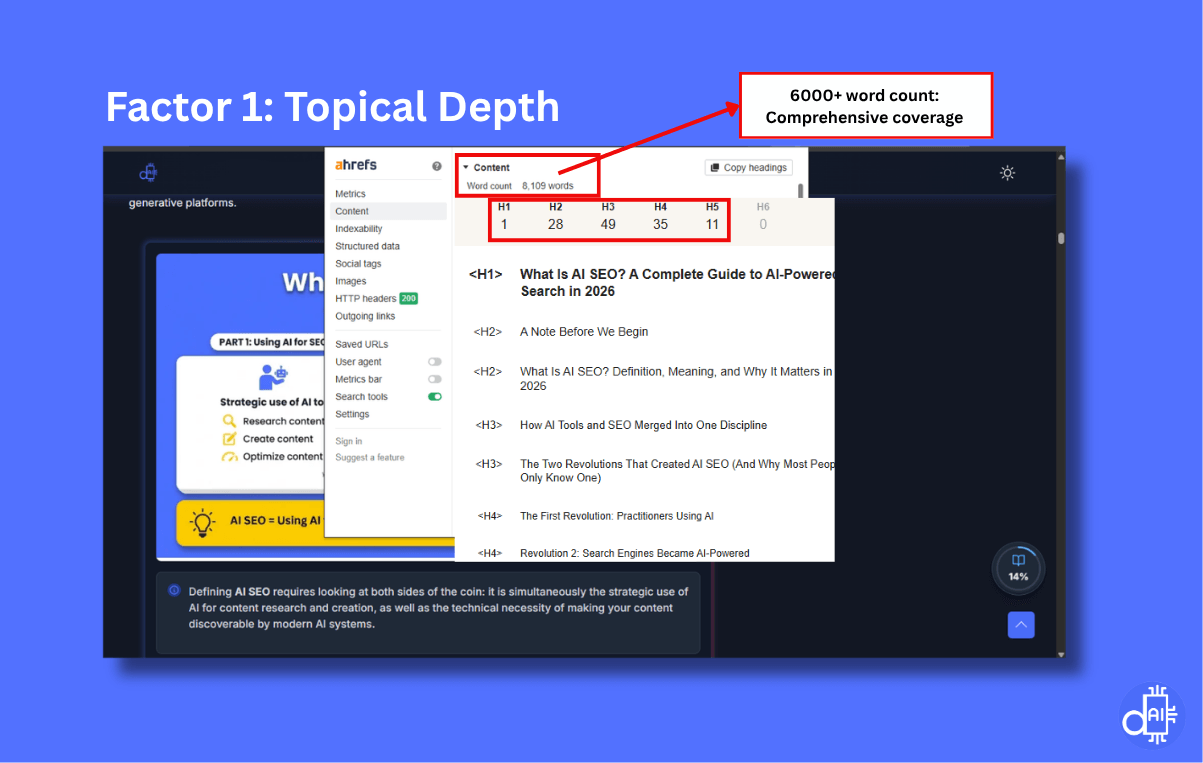
Achieving topical depth isn't just about length; it's about building a comprehensive content hierarchy that covers a subject from every angle to satisfy complex NLP evaluations.
2. Entity Recognition and Knowledge Connections
AI connects people, brands, and concepts.
For example, when mentioning OpenAI, AI understands its relationship with ChatGPT and Sam Altman.
Optimization strategy:
- Use consistent naming
- Clearly define relationships
- Implement a structured schema
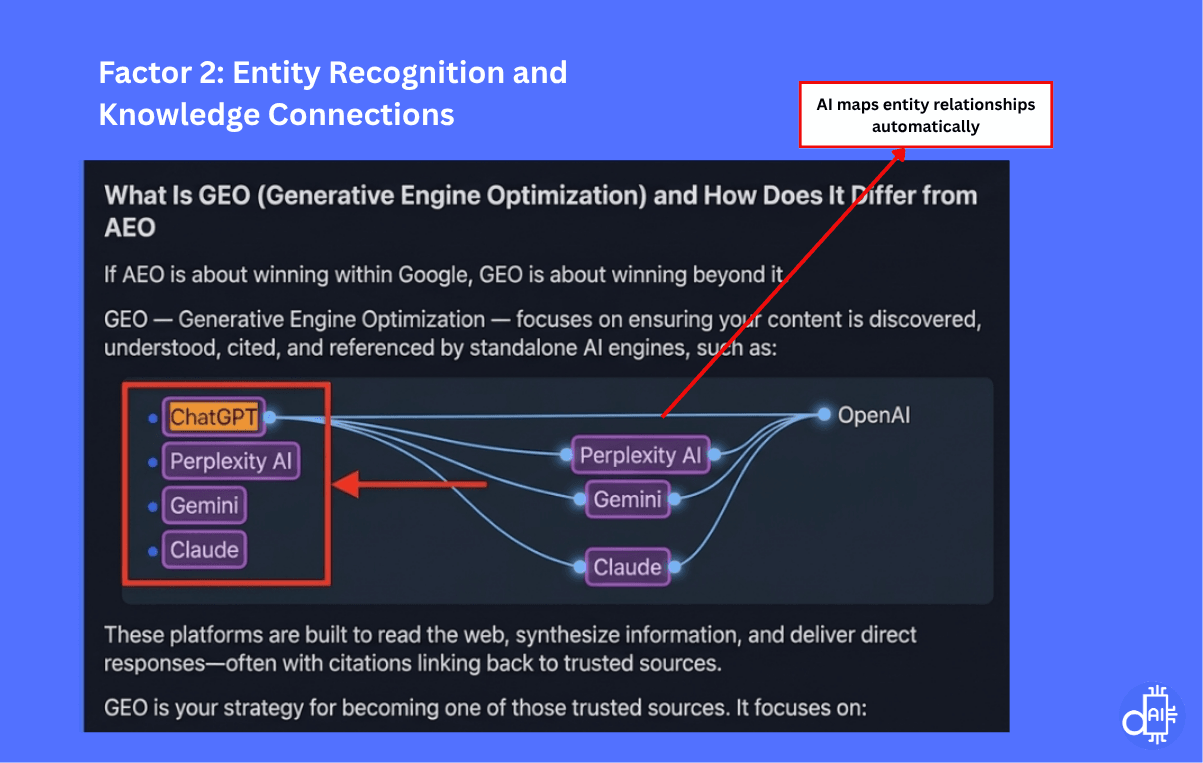
In the era of Generative Engine Optimization (GEO), success depends on how effectively AI systems can map the entity relationships between your brand, your experts, and your core topics.
3. Original Insights and Unique Value
This is one of the most important AI ranking factors.
AI can summarize existing content.
It cannot replicate real-world testing, personal data, or firsthand results.
What stands out:
- Case studies
- Proprietary research
- Unique frameworks
- Contrarian insights
Real experience becomes your competitive advantage.
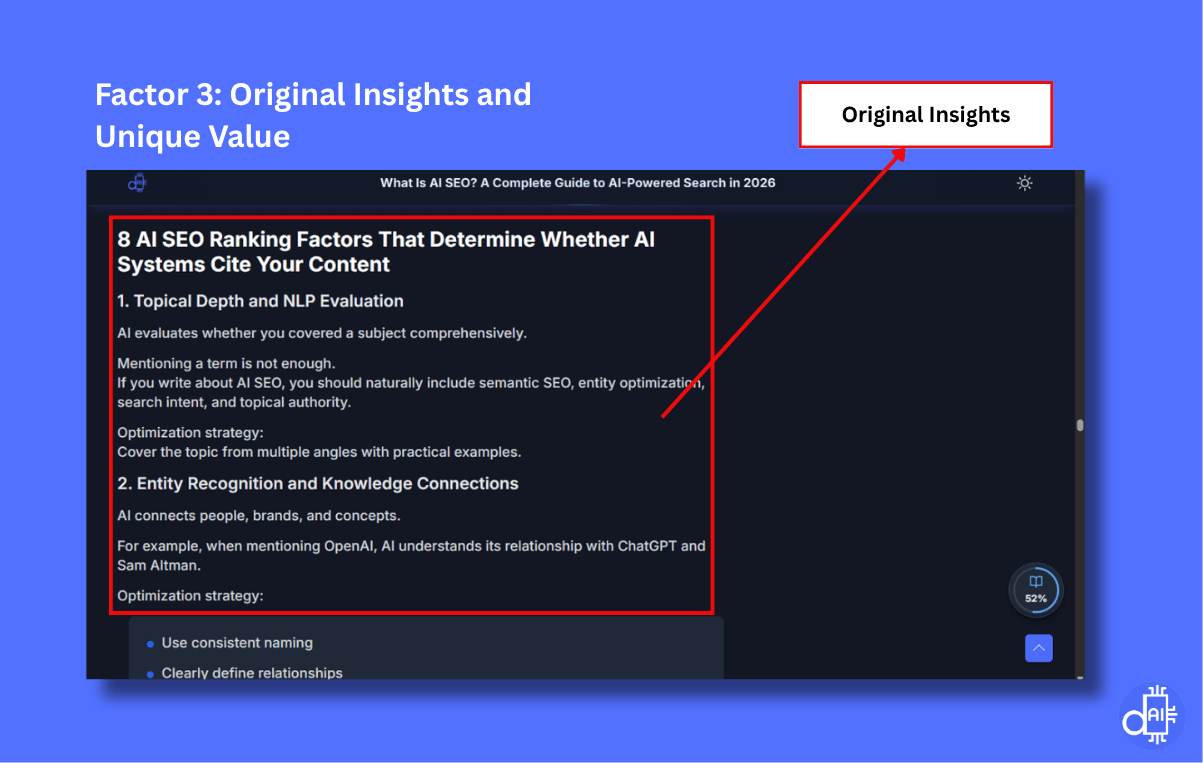
The most critical AI SEO ranking factor today is the inclusion of original insights—real-world testing and proprietary data that AI engines cannot simply replicate or summarize from other sources.
4. Direct Answers to Long-Tail Queries
AI platforms prioritize conversational, specific queries.
Instead of targeting “AI SEO tools,” consider:
“What is the best AI SEO tool for small businesses with limited budgets?”
Optimization strategy:
- Add clear Q&A sections
- Provide 40 to 60-word direct answers first
- Expand with a deeper explanation afterward
This improves citation potential in AI responses.
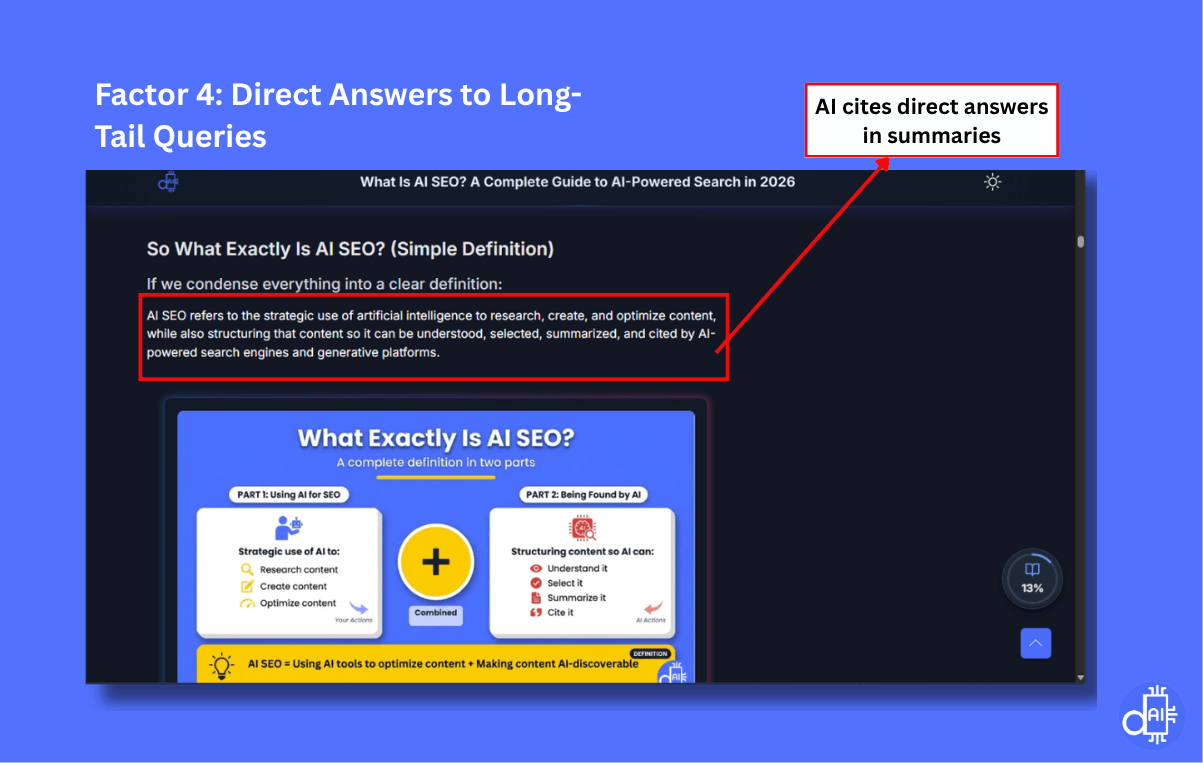
To win in AI-powered search, your content must prioritize long-tail queries by providing direct, 40–60 word answers that machines can easily extract and cite in summaries.
5. Brand Mentions and Digital Footprint
AI tracks brand presence beyond backlinks.
Mentions on platforms like Reddit or LinkedIn contribute to perceived authority.
Traditional SEO counted links.
AI SEO evaluates conversations.
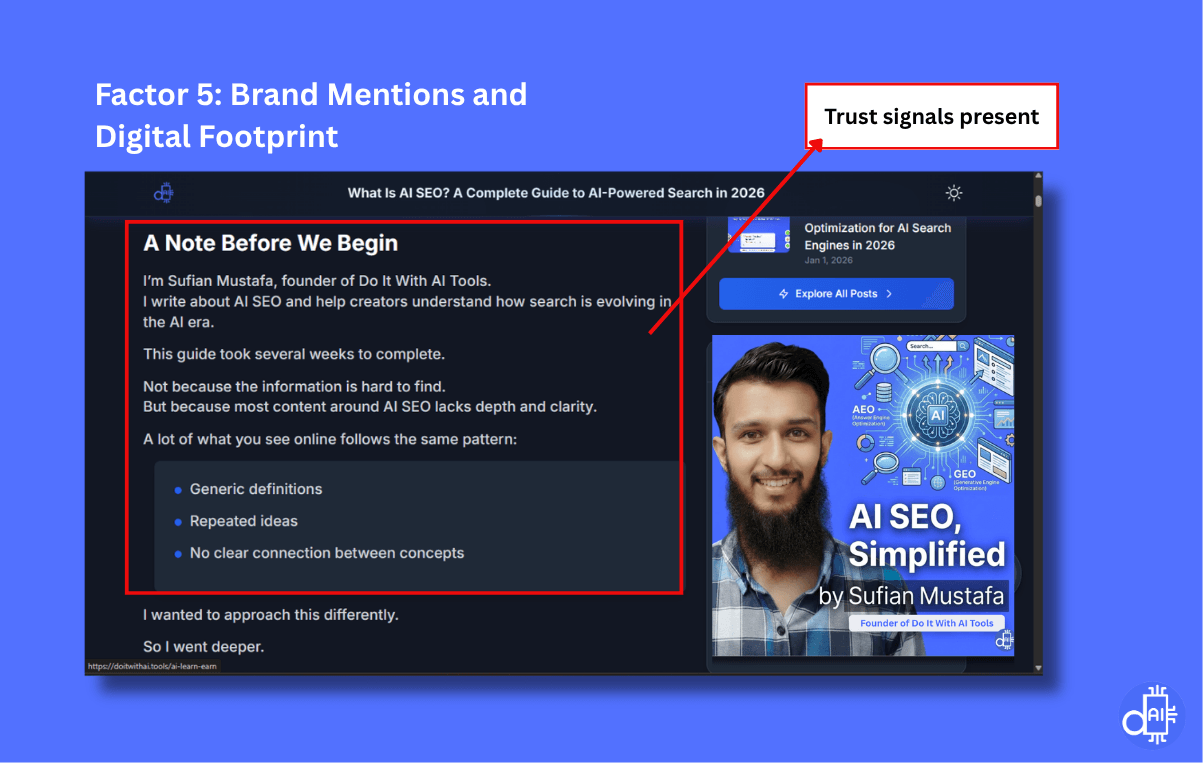
In 2026, your digital footprint extends far beyond your website; AI systems now track brand mentions across Reddit, LinkedIn, and specialized forums to verify your real-world authority.
6. Structured Data and Schema Markup
Structured markup reduces ambiguity.
Using Schema.org vocabulary helps AI understand:
- Article type
- Author
- Publish date
- FAQs
- How-to steps
Machine-readable clarity increases AI citation probability.
If you want a deeper breakdown of implementation, you can explore our detailed guide on schema markup optimization for AI SEO.
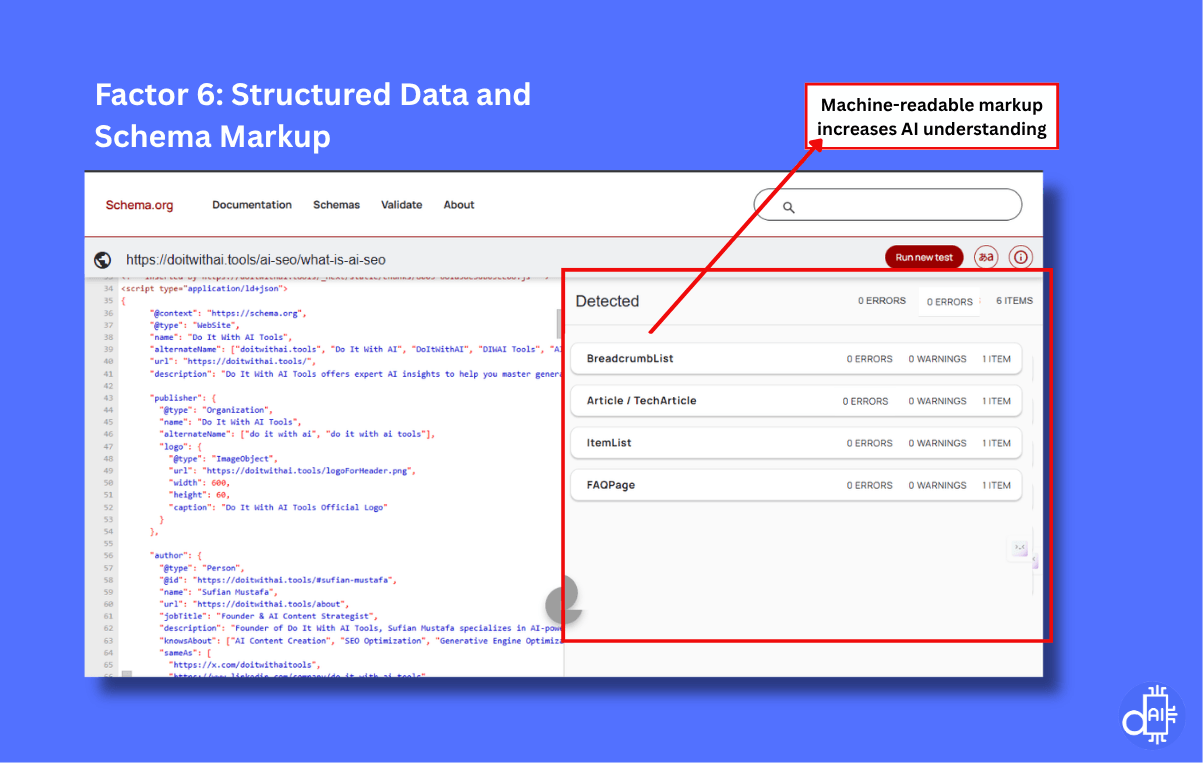
Implementing structured data and schema markup is essential for reducing technical ambiguity, allowing AI systems to immediately identify article types and author credentials.
7. Page Speed and Technical Efficiency
Speed now impacts AI crawl efficiency.
If your page loads slowly, AI crawlers may skip it and cite faster alternatives.
Benchmarks to aim for:
- Under 2 seconds load time
- Strong Core Web Vitals scores
- Minimal render-blocking scripts
Speed affects discoverability, not just user experience.
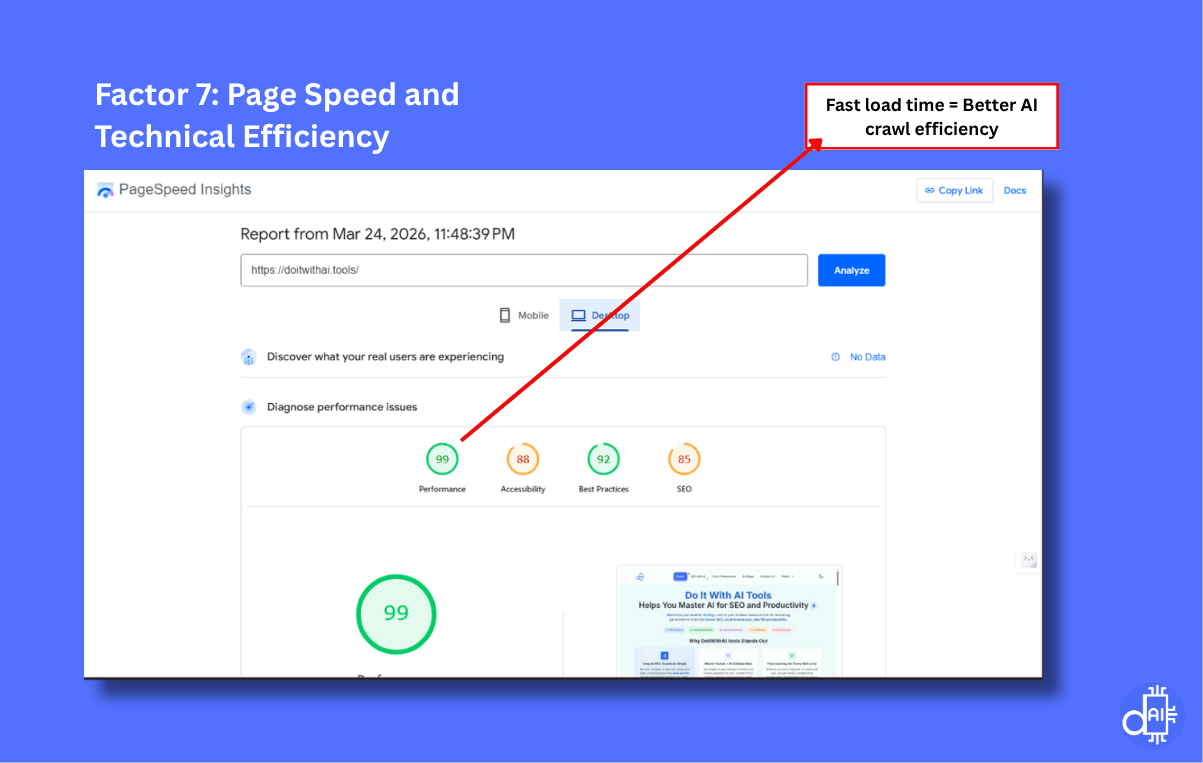
In the AI search era, speed directly impacts crawl budget; a fast, technically sound website is a prerequisite for being included in high-value generative answer summaries.
8. Semantic Relevance and Topical Authority
AI evaluates your entire domain context.
If your site consistently publishes about AI and SEO, it builds authority.
If you suddenly publish unrelated topics, semantic clarity weakens.
Optimization strategy:
- Build content clusters
- Create pillar pages
- Use strategic internal linking
Focused expertise outperforms general coverage.
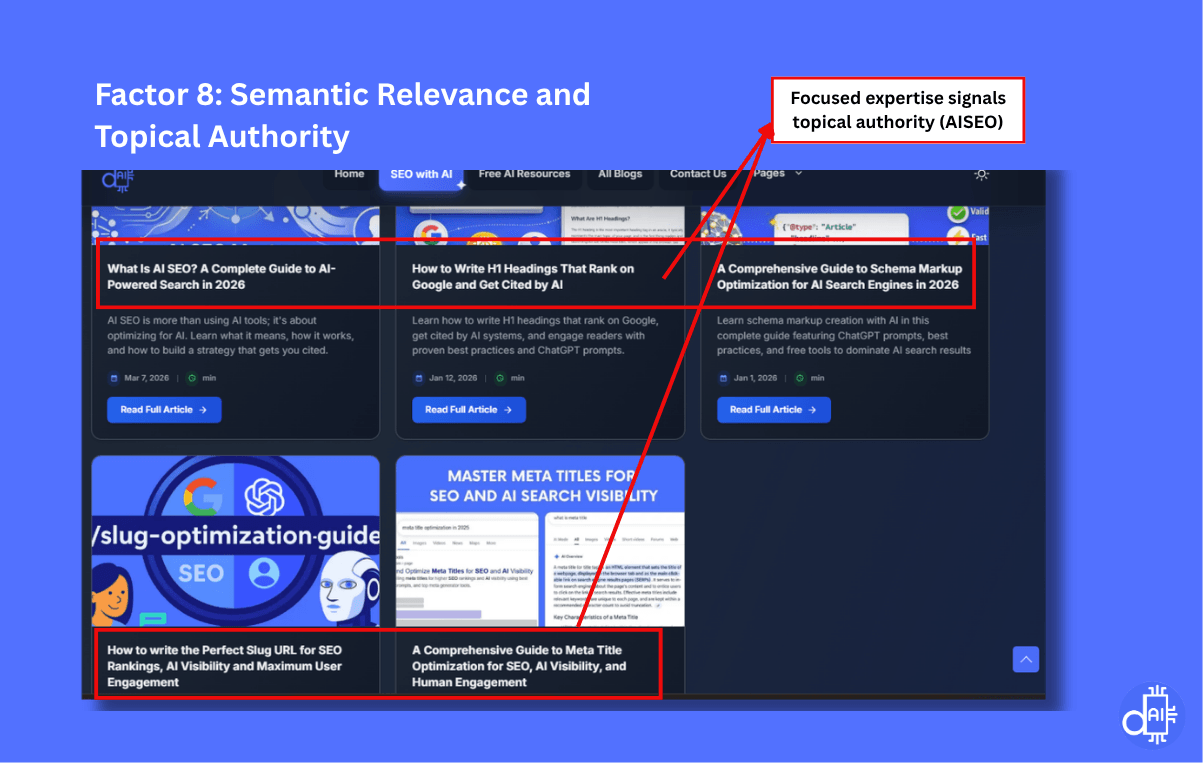
In the world of AI SEO, your domain's topical authority is built by consistently publishing deep-dive content within a specific niche rather than chasing broad, unrelated keywords.
We have now demonstrated all eight ranking factors through real-world examples from this AI SEO guide.
These strategies provide a transparent, live-action view of how to earn citations and build long-term authority in the generative era.
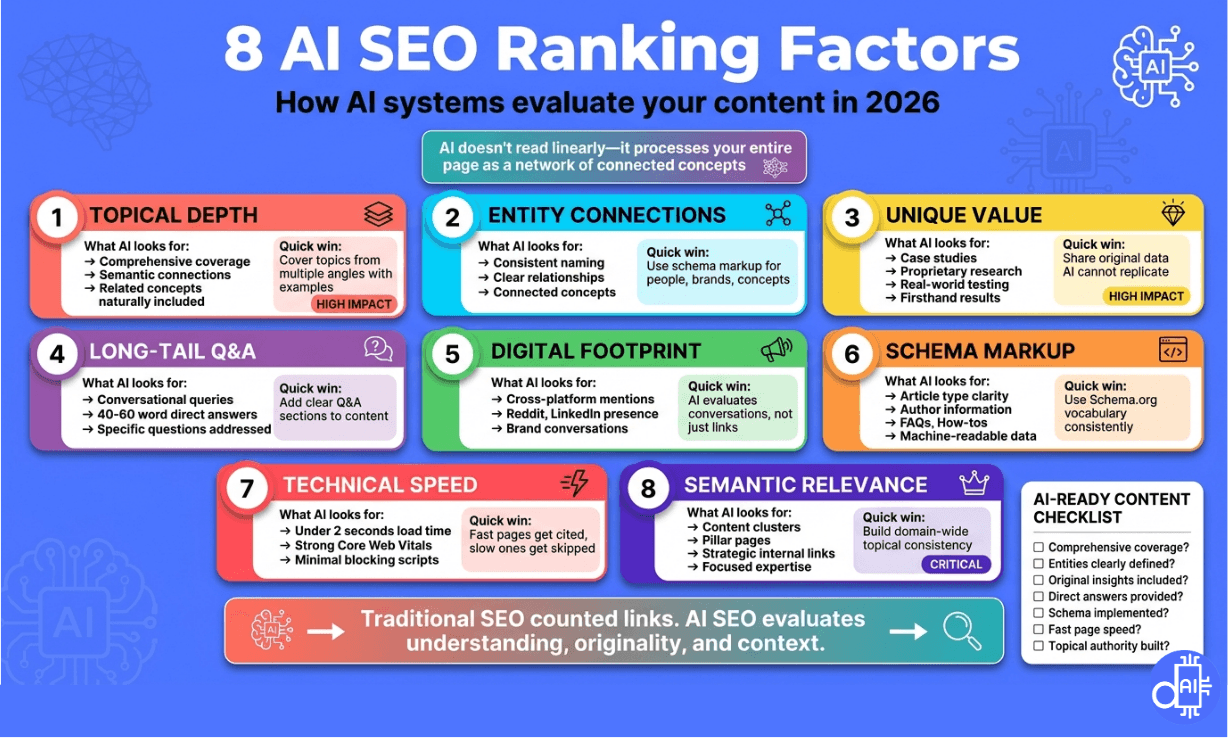
This visual, "8 AI SEO Ranking Factors," breaks down the specific criteria used by modern AI engines to evaluate your content, from Topical Depth and Semantic Relevance to your broader Digital Footprint.
E-E-A-T: The Universal Quality Standard That Connects Traditional and AI SEO
You now understand two critical layers:
- Traditional SEO focuses on backlinks, keywords, and engagement signals.
- AI SEO prioritizes semantic depth, entity relationships, and originality.
But one key question remains:
How does Google decide whether you executed all of this well?
The answer is E-E-A-T.
E-E-A-T is not a separate tactic.
It is the quality framework Google uses to evaluate everything else.
It acts as the evaluation standard behind both traditional ranking systems and AI-driven analysis.
What E-E-A-T Actually Represents
E-E-A-T stands for:
- Experience
- Expertise
- Authoritativeness
- Trustworthiness
These principles come from the Quality Rater Guidelines published by Google.
Human evaluators use these guidelines to assess content quality.
AI systems learn patterns from millions of these evaluations.
In simple terms:
Traditional SEO and AI SEO are performance signals.
E-E-A-T determines whether those signals reflect genuine quality.
You can optimize every technical factor correctly.
If your content lacks credibility, it will not sustain rankings or earn AI citations.
The Four Pillars of E-E-A-T and Their Dual Impact
1. Experience
Core question: Does the author demonstrate firsthand involvement?
Experience signals include:
- Real testing
- Case studies
- Screenshots
- Specific results
- Personal insights
AI systems learn to recognize language patterns that reflect real-world usage.
How Experience Influences Rankings
Traditional SEO impact:
- Higher dwell time
- Lower bounce rate
- Better engagement metrics
AI SEO impact:
- Higher citation probability
- Preference over generic summaries
Firsthand experience differentiates your content from automated output.
2. Expertise
Core question: Does the author show deep subject knowledge?
Expertise signals include:
- Detailed author bios
- Relevant credentials
- Published work
- Demonstrated industry knowledge
AI models detect consistency in terminology, accuracy, and topical depth.
How Expertise Influences Rankings
Traditional SEO impact:
- Attracts higher-quality backlinks
- Builds domain authority
AI SEO impact:
- Expert sources receive stronger weighting in citation selection
Clear expertise increases trust across both systems.
3. Authoritativeness
Core question: Is this source recognized by others?
Authoritativeness is measured through:
- Brand mentions
- Citations from reputable websites
- Media references
- Industry recognition
AI systems analyze how often credible sources reference you.
How Authoritativeness Influences Rankings
Traditional SEO impact:
- Natural backlink growth
- Stronger brand signals
AI SEO impact:
- AI engines default to citing established authorities when multiple options exist
Recognition across the web reinforces credibility.
4. Trustworthiness
Core question: Can users verify and rely on this content?
Trust signals include:
- Clear authorship
- Transparent information
- Secure website infrastructure
- Citations to primary sources
AI cross-references facts against known data patterns.
How Trustworthiness Influences Rankings
Traditional SEO impact:
- Stable engagement metrics
- Strong user retention
AI SEO impact:
- Higher likelihood of being cited
- Reduced risk of devaluation
Trust is the foundation of long-term visibility.
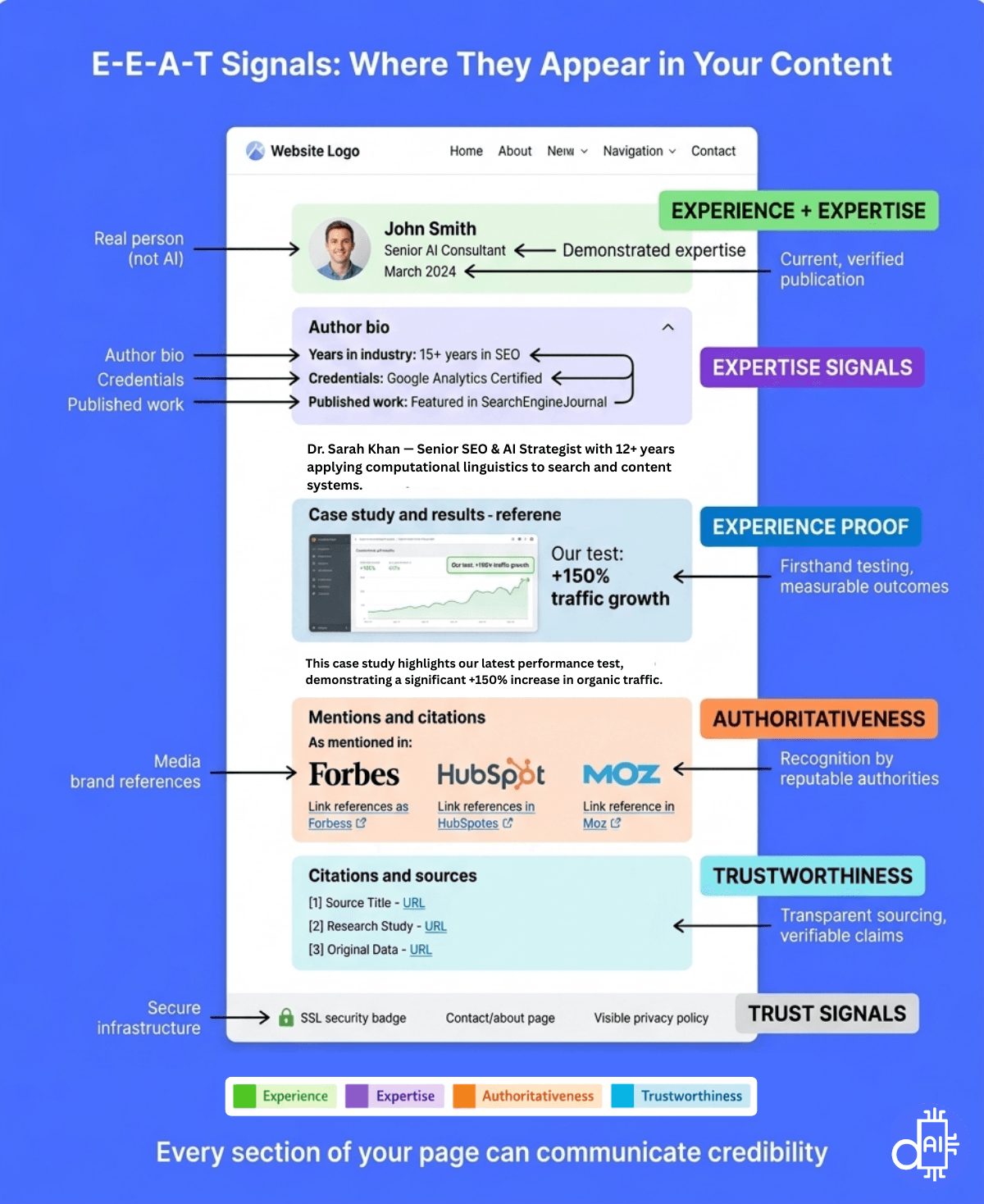
Mastering AI SEO in 2026 requires more than technical optimization; it demands the clear communication of E-E-A-T signals across every section of your page to prove credibility to both human readers and search algorithms.
Why E-E-A-T Is Even More Important for AI SEO Than Traditional Search Rankings
As AI-generated content increases across the web, differentiation depends on demonstrable quality. E-E-A-T acts as the validation layer that confirms your optimization efforts reflect genuine expertise.
You may implement schema perfectly — without expertise, AI will not prioritize your content. You may earn strong backlinks — without trust, engagement signals will weaken.
The integrated framework for 2026:
Traditional SEO establishes visibility. AI SEO increases citation potential. E-E-A-T validates your credibility across both systems.
When all three align, rankings become more stable, defensible, and future-proof.
How to Optimize Content for AI SEO: A Practical Strategy for Google, ChatGPT, and Perplexity
You now understand what AI systems evaluate and how these signals differ from traditional SEO ranking factors.
The next step is execution.
This section converts theory into a structured optimization approach. The goal is not just to rank in search results.
The real objective is to become citation-worthy across the AI search ecosystem, including platforms like:
- Google AI Overviews
- ChatGPT Search
- Perplexity
- Voice assistants
AI SEO is no longer platform-specific.
It is ecosystem-driven.
The AI-First Content Mindset
Before applying tactics, you need a shift in perspective.
Traditional SEO asks:
How do I rank for this keyword?
AI SEO asks a different question:
How do I become a source AI systems trust enough to cite?
This difference completely changes how content should be created.
Instead of focusing only on keywords, focus on three core qualities:
- Clarity
- Authority
- Structure
When your content is easy to understand, well organized, and clearly credible, AI systems prefer it.
AI models are trained to detect patterns of quality.
When your content meets strong editorial standards, you are not manipulating the system.
You are aligning with how it works.
Turning Ranking Factors Into Practical Action
The ranking signals discussed earlier must now translate into consistent content execution.
Every article should intentionally address several important elements, including:
- Topical depth and comprehensive coverage
- Clear heading hierarchy and logical flow
- Direct answer formatting for extractability
- Structured data implementation
- Original insights and firsthand experience
- Strong entity clarity and relationship mapping
- E-E-A-T signals
- Long tail query targeting
- Technical performance and page speed
- Semantic consistency across your domain
- Brand presence beyond your website
This is not a checklist to review once.
It should become a repeatable framework applied to every article you publish.
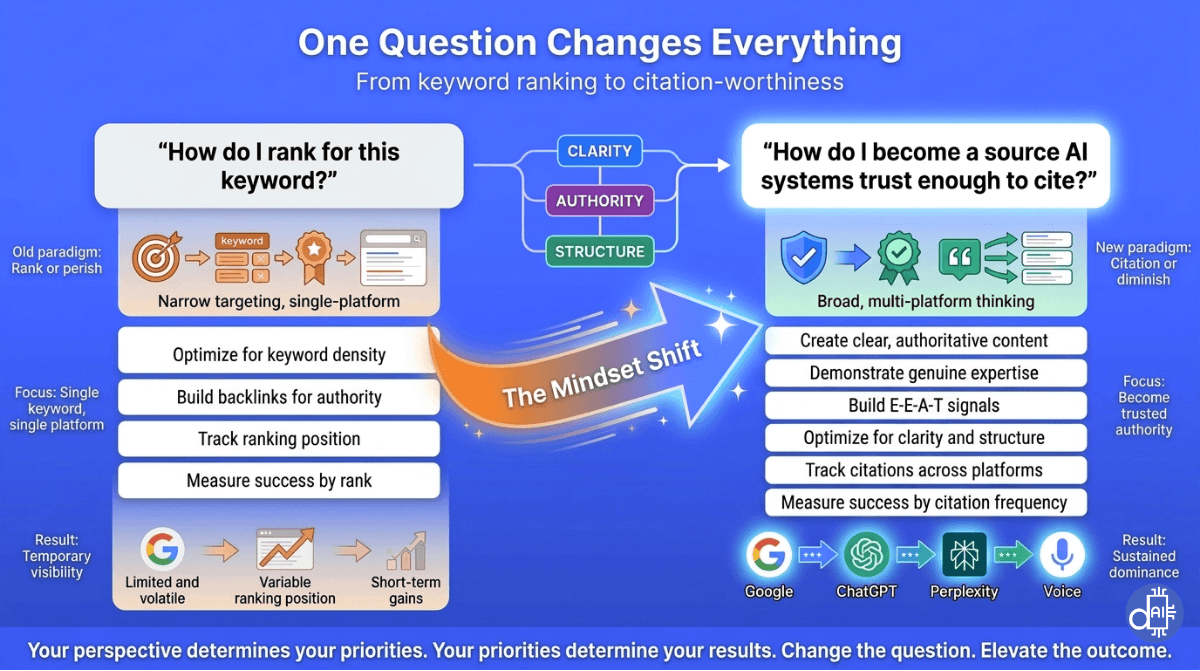
By prioritizing topical depth and entity mapping over isolated keywords, you create a modular content ecosystem that AI models can easily parse, understand, and recommend to users across multiple platforms.
Beat AI With AI: The Complete Strategic Workflow
Most marketers misunderstand AI SEO at a basic level.
They treat AI as a writing tool.
The real advantage comes when you treat AI as an intelligence layer.
Instead of only generating content, you use AI to understand what AI-powered systems reward.
Then you build content that goes beyond those standards with human expertise.
That is the real edge.
You use AI to decode AI, then outperform it where automation fails.
Here is how that workflow moves from idea to published content.
Phase 1: Foundation Research
Every strong article starts with clarity.
Before writing, you need to understand your audience, their intent, and where your content fits in your overall strategy.
Target Audience and Topic Ideation
Start with the audience.
Use tools like ChatGPT to:
- Build simple buyer personas
- Identify real pain points
- Generate topic ideas based on intent
Keyword research without audience clarity leads to weak content.
This step should always come first.
If you want a deeper, step-by-step breakdown of this process, you can explore our detailed guide on target audience research using ChatGPT.
Semantic Keyword Research
Modern SEO goes beyond search volume.
You need to understand intent and context.
Use AI to:
- Generate long-tail keywords
- Group them by intent
- Identify content gaps
- Discover related concepts
Focus on informational, navigational, and transactional intent.
If you want a complete walkthrough of this process, you can explore our detailed guide on keyword research using ChatGPT, where we break down prompts, clustering, and real examples.
Topical Authority Mapping
Do not think in single articles.
Think in systems.
Ask AI to create:
- A pillar page
- Supporting cluster topics
- Internal linking ideas
This builds long-term authority instead of isolated rankings.
Phase 2: Competitive and Citation Intelligence
This is where most creators stop.
This is where you move ahead.
Competitor Analysis
AI can analyze competitors in minutes.
Feed top-ranking pages into ChatGPT and ask it to extract:
- Common sections across competitors
- Unique angles from specific pages
- Missing topics no one covered
This shows what you must match and where you can stand out.
Citation Pattern Analysis
Now study how AI systems cite content.
Search your query inside:
- ChatGPT
- Perplexity AI
- Google AI Overviews
Observe:
- Which sources are cited
- How answers are structured
- What formats are preferred
- Which sections get attention
This reveals real citation behavior.
Gap and Differentiation Strategy
Combine everything.
Use AI to identify:
- Topics you must include
- Questions still unanswered
- Weak areas in competitor content
- Opportunities to add unique value
Match expectations first.
Then exceed them.
Phase 3: Content Planning and Brief Creation
Now turn research into execution.
Use tools like ChatGPT to create a structured content brief.
Include:
- Target keywords
- Search intent
- Heading structure
- Semantic coverage
- Depth requirements
A strong brief prevents generic content.
This step connects strategy with writing.
Phase 4: Content Creation
Now you start writing.
But AI and human roles must stay clear.
Use AI to generate drafts section by section.
Then refine heavily.
AI handles speed and structure.
You handle meaning and clarity.
Semantic Expansion
During writing, expand your topic coverage.
Ask AI to generate:
- Related questions
- Supporting concepts
- Comparisons
- Real-world scenarios
This builds depth and signals authority.
Phase 5: Optimization
Once the draft is ready, optimize it for visibility and AI readability.
Use AI to:
- Generate meta titles and descriptions
- Create FAQ, Article, or How-To schema
- Improve heading structure
- Shorten long paragraphs
- Suggest lists or tables
- Generate alt text for images
- Recommend internal links
- Verify factual claims
Each step improves clarity and extractability.
This increases your chances of being selected in AI-driven results.
Phase 6: The Human Layer AI Cannot Replace
This is your real advantage.
AI can scale content.
It cannot create true originality.
To stand out, you need:
Firsthand Experience
Share real use cases and results.
Do not rely only on summaries.
Original Research
Add your own data and insights.
Even one unique stat increases credibility.
Expert Interpretation
Challenge common ideas.
Explain concepts in a new way.
Unique Frameworks
Create your own models and systems.
For example, the “two sides of AI SEO” framework you used earlier.
Real Case Studies
Show measurable results.
Avoid generic examples.
AI helps you produce content.
Human insight makes it worth citing.
Phase 7: Maintenance and Growth
Publishing is just the start.
Content needs updates to stay relevant.
Performance Analysis
Use data from Google Search Console.
Ask AI to find:
- Declining pages
- Missing sections
- Outdated content
- New topic opportunities
Content Repurposing
Turn one article into multiple formats.
Use AI to create:
- Social posts
- Email content
- Video scripts
- Infographics
Authority grows across platforms, not just your website.
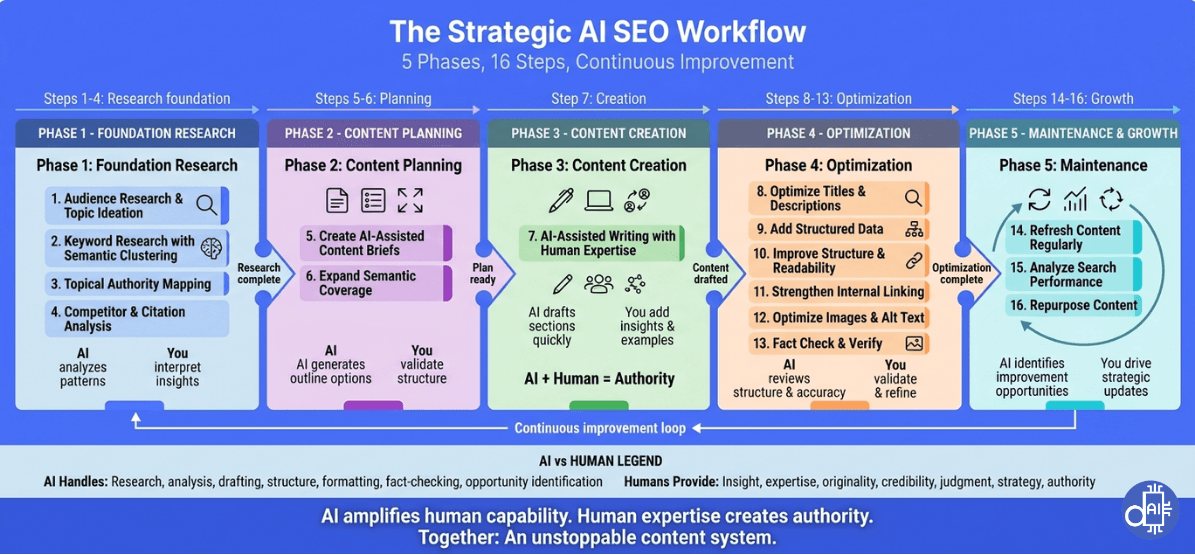
This process flowchart illustrates the "AI + Human = Authority" model, where AI handles semantic clustering and drafting while human experts provide the original insights and strategic judgment necessary to earn citations.
AI SEO Myths, Mistakes, and Best Practices: Navigating the Reality
Several misconceptions continue circulating in the AI SEO space. Clearing them up is essential before building any strategy.
AI SEO offers an enormous opportunity. However, it also creates confusion, unrealistic expectations, and costly mistakes when used carelessly.
This section separates myth from reality and provides practical guidance you can apply immediately.
Debunking Common AI SEO Myths
Several misconceptions continue circulating in the AI SEO space. Clearing them up is essential before building any strategy.
Myth 1: AI Content Automatically Triggers Google Penalties
Reality: Google does not penalize content because AI helped create it.
What Google evaluates is content quality, not the method used to produce it.
Google's official guidance states that their focus remains on helpful content, reliable information, and content that serves people rather than manipulates rankings.
In simple terms, you can use AI tools however you prefer. The only requirement is that the final result must be accurate and provide real value to readers.
Low-quality content fails whether a human or AI created it.
Myth 2: AI Has Killed Content Writing
Reality: Demand for written content has increased, not decreased.
Think about your daily content consumption today compared to five years ago. Most people now read blog articles, email newsletters, LinkedIn posts, case studies, and documentation.
AI can sometimes answer simple questions directly. However, this does not eliminate the need for authoritative, well-researched content. Instead, AI raises the quality standard.
According to a 2025 report from the Content Marketing Institute, 78 percent of marketers now produce more written content than before the AI era. AI tools allow teams to scale production while human expertise provides differentiation.
AI did not kill content writing. It eliminated lazy content writing.
Myth 3: AI Has Killed Jobs
Reality: AI changes jobs more often than it eliminates them.
The World Economic Forum's Future of Jobs Report 2025 shows a consistent pattern. Automation removes repetitive tasks while creating new roles that require AI fluency.
Roles disappearing often involve routine work. Roles emerging require strategic thinking, creative problem-solving, and AI tool proficiency.
Professionals who adopted AI tools for keyword research, optimization, and workflow automation now outperform competitors who still rely on manual processes.
AI rarely replaces capable professionals. It replaces professionals who refuse to adapt.
Myth 4: AI Has Killed Productivity
Reality: AI amplifies how you already work.
A Harvard Business School productivity study found a striking pattern.
Top performers using AI increased productivity by around 40 percent. Low performers showed little improvement and sometimes produced worse work.
AI handled repetitive tasks such as research, drafting, and data analysis. Top performers used the saved time to focus on strategy, insights, and refinement.
The tool itself is neutral. Your working style determines the outcome.
Myth 5: You Can Publish AI Content at Scale Without Editing
Reality: Unedited AI content creates thin pages that fail quickly.
Mass-publishing generic AI text leads to low-value pages, poor engagement signals, and algorithmic demotions.
Quality consistently beats quantity.
A single well-researched guide that demonstrates expertise and earns backlinks will outperform dozens of shallow AI-generated posts.
Search systems easily detect patterns associated with low-effort content farms. Scaling poor content simply scales poor results.
Myth 6: AI SEO Tools Guarantee Top Rankings
Reality: Tools assist strategy. They do not replace it.
No AI platform can guarantee rankings.
Successful SEO still depends on strategic topic selection, strong domain authority, valuable content, and consistent optimization.
AI tools accelerate research and execution. They cannot replace subject expertise or editorial judgment.
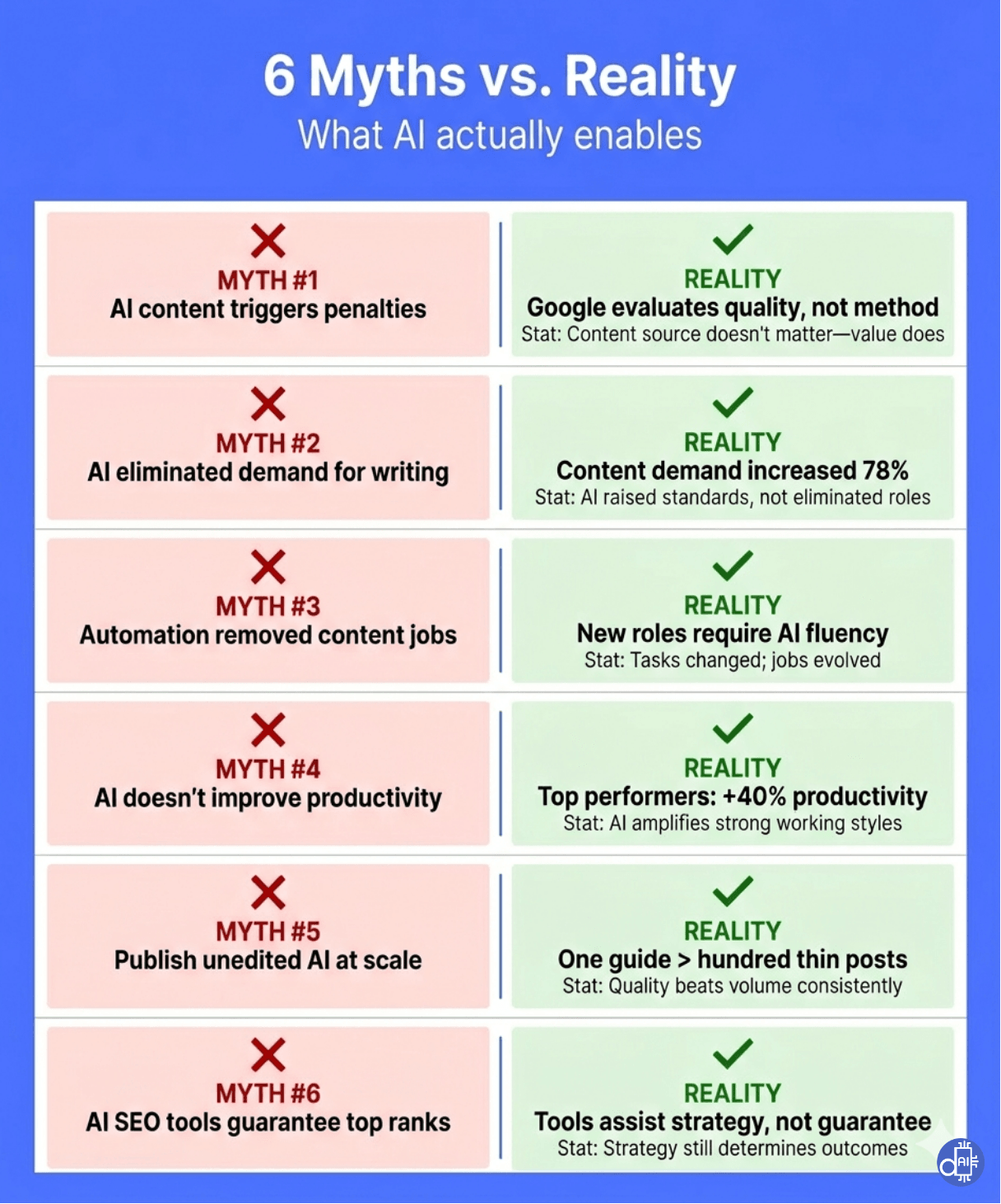
Debunking these common AI SEO myths is essential for any brand; success in 2026 depends on understanding that quality beats volume every time, regardless of whether you use automation or manual workflows.
Common AI SEO Mistakes and How to Avoid Them
After myths are removed, the real risks become clear. Many sites lose performance not because they use AI, but because they misuse it.
Below are the most damaging mistakes and how to avoid them.
Mistake 1: Over-Relying on AI Without Human Editing
The Problem:
AI drafts content quickly but has clear limitations. It lacks personal experience, may generate incorrect information, often produces generic explanations, and may misunderstand your audience's context.
Without editing, AI-generated content rarely stands out.
The Solution:
Treat AI as a research assistant and drafting partner, not a replacement for expertise.
Practical Implementation:
A reliable workflow looks like this:
- Use AI to generate a content outline and brief
- Let AI draft initial sections based on the outline
- Add original insights, examples, and case studies
- Fact-check every claim before publishing
- Refine tone to match your brand voice
Human expertise should always shape the final version.
Mistake 2: Publishing Thin AI Content at Scale
The Problem:
Some websites generate hundreds of pages targeting minor keyword variations. This strategy attempts to dominate search results through volume.
In reality, this approach often triggers algorithmic quality filters.
Google's helpful content systems are designed to detect large volumes of low-value pages.
The Solution:
Focus on depth and usefulness, not page count.
Practical Implementation:
- Publish fewer articles with higher value
- Build comprehensive pillar content
- Include real examples and practical insights
- Address questions competitors ignore
A single high-value article can outperform many shallow pages.
Mistake 3: Ignoring E-E-A-T Signals
The Problem:
AI can generate content about almost any topic, including medical, financial, or legal subjects. However, search systems evaluate whether the author is credible.
This is especially important for YMYL (Your Money or Your Life) topics, where incorrect information could cause real harm.
The Solution:
Demonstrate genuine expertise that AI cannot fake.
Practical Implementation:
Strengthen trust signals across your site:
- Add detailed author bios with credentials
- Link to social profiles and professional portfolios
- Include real case studies and examples
- Cite authoritative sources and research
- Demonstrate firsthand experience
- Display trust signals: secure site (HTTPS), clear contact information, privacy policy
For more on demonstrating E-E-A-T, see Google's Quality Rater Guidelines.
Mistake 4: Not Fact-Checking AI Outputs
The Problem:
AI sometimes generates incorrect information confidently. These errors are commonly known as hallucinations.
Examples include fabricated statistics, misattributed quotes, and nonexistent studies.
Publishing incorrect information damages credibility quickly.
The Solution:
Verify all important facts before publishing.
Practical Implementation:
Follow a verification workflow:
- Run AI fact-checking tools as a first pass
- Locate original sources for statistics
- Cross-reference information with trusted publications
- Link to primary research whenever possible
- Remove claims you cannot confirm
Trust is difficult to rebuild once lost.
Mistake 5: Using AI to Manipulate Rankings
The Problem:
Some marketers use AI for questionable tactics such as keyword stuffing, creating doorway pages, generating fake reviews, and publishing deceptive content.
These practices violate Google's spam policies.
The Solution:
Use AI to enhance quality, not manipulate algorithms.
Practical Implementation:
- Create content that genuinely helps users
- Follow Google's webmaster guidelines
- Prioritize long-term authority over quick wins
Shortcuts almost always fail over time.
Mistake 6: Writing Poor AI Prompts
The Problem:
Many users treat AI tools like simple search engines. They enter vague prompts and expect detailed results.
For example: "Write an article about AI SEO."
This type of prompt produces generic content with little strategic value.
The Solution:
Provide detailed instructions and context. Think of AI as a skilled assistant who requires a clear brief.
Practical Implementation:
Instead of writing "Write about AI SEO tools," provide a structured prompt such as:
"Compare the top five AI SEO tools for small businesses with budgets under $100 per month. Focus on usability, ROI potential, and features helpful for non-technical users. Include pros, cons, and practical use cases. Target audience: solopreneurs and small marketing teams with basic SEO knowledge."
The quality of output improves when you include audience details, clear objectives, specific constraints, tone preferences, and key topics to emphasize.
Better prompts produce better content.
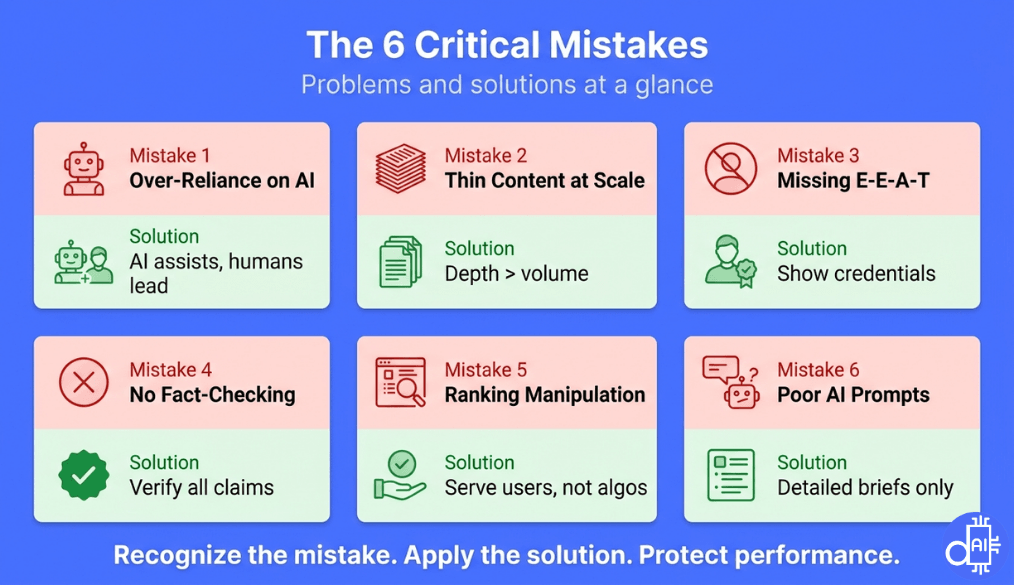
Using AI for SEO can be a massive advantage, but only if you avoid the common traps that lead to algorithmic devaluation.
How to Use AI Responsibly: Best Practices for Sustainable Success
Here is a strategic overview of the practices that separate successful AI SEO from failed attempts:
AI SEO Tools and Resources
Here are some useful tools and resources to help you learn and implement AI SEO. This is a quick, practical list you can explore based on your needs.
Learning and Core Resources
- DoItWithAI.tools
A complete hub to learn AI SEO with practical guides and strategies. - AI SEO Section
Focused content specifically on AI SEO topics and frameworks. - Free AI Resources
Includes high-quality images, videos, prompts, AI SEO tools, and documents. - AI Keyword Research Tools
A curated collection of the best AI-powered tools specifically designed for deep keyword discovery and search intent analysis.
Core AI Tools for AI SEO
- ChatGPT
A complete AI SEO assistant for research, content creation, on-page SEO, and technical tasks. - Gemini
Strong for content generation, image creation, and alt text optimization. - Claude AI
Great for generating full-length, high-quality AI SEO articles with detailed prompts. - Perplexity AI
Best for real-time research and discovering AI SEO topics with citations. - Grok
Another AI tool you can explore based on your workflow needs. - Merlin AI
An all-in-one AI chrome extension that combines the power of top models like GPT-4, Claude, and Gemini into a single workspace for faster SEO research and execution.
SEO and Keyword Research Tools
- AI Keyword Research Tools
A curated collection of the 9 best tools to find high-traffic keywords doing it with AI. - Ahrefs
Useful for backlink analysis, keyword research, and competitive insights. - Semrush
Includes AI features like AI Search Visibility and Brand Narrative Tracking. - Ubersuggest
Helps with keyword ideas and SEO analysis. - Google Keyword Planner
Free tool for keyword research and search volume insights. - Google Trends
Useful for finding trending topics and seasonal keyword patterns.
AI-Powered Content and Keyword Tools
- AI Readability Tools
A dedicated list of tools to ensure your content is easy to understand, human-friendly, and optimized for both readers and search engines. - Junia AI
AI-powered blog and SEO content generation tool. - Rytr AI
Quick AI writing assistant for content creation. - Twinword AI
Focuses on keyword intelligence and semantic analysis. - RightBlogger
Helps with blog writing and SEO optimization. - Keyword Insights
Advanced keyword clustering and content planning. - SEO Writing AI
Generates SEO-optimized articles. - SEO.ai
Focused on AI-driven SEO content creation. - Semrush SEO Writing Assistant
Helps optimize content for SEO directly while writing.
Technical AI SEO Tool
- Adamigo A
Use its crawler accessibility analysis to ensure your site is visible to AI systems. It helps you:- Check your robots.txt file
- Detect blocked AI crawlers like GPTBot
- Identify technical issues affecting AI visibility
These tools cover everything from learning AI SEO to full implementation.
You do not need to use all of them.
Start with a few core tools, build your workflow, and expand based on your needs.
Final Thoughts on AI SEO
AI SEO is not a fixed strategy.
It is an evolving system.
What you explored in this guide goes beyond a simple definition.
It connects the full picture, from how AI entered SEO workflows to how search itself transformed into an AI-driven ecosystem.
You have seen both sides.
Using AI to improve how you create and optimize content.
And optimizing your content for AI-powered search and generative systems.
That combination is what defines AI SEO today.
This guide was built to give you more than theory.
It brings together practical workflows, real examples from our own website, useful AI tools and resources, and actionable strategies that you can apply step by step.
If you follow this approach, you are not just learning AI SEO.
You are building a system that adapts as search continues to evolve.
At DoItWithAI.tools, the focus is always on depth over volume.
Each topic is explored with care, tested ideas, and real-world application.
That is why new content may not appear frequently.
But when it does, it is designed to give you complete clarity on the subject.
AI SEO will continue to change.
New tools will emerge.
Search behavior will shift further.
But the core idea will remain the same.
Create clear, helpful, and structured content.
Use AI intelligently.
And align your content with how modern search systems work.
If you want to go deeper, explore more AI SEO guides on DoItWithAI.tools.
More in-depth resources are on the way.
Stay tuned.