
AI Tools Expert & Founder
Table of Contents
If you've been in the SEO world for any length of time, you already know the meta title is one of the most powerful elements of on-page optimization—but in 2025, its role has expanded far beyond traditional ranking.
It's no longer just about securing Google's #1 position; it's about whether AI search engines trust your content enough to cite it as a credible source in their generative answers.
Traditionally, your meta title — often called the SEO title or HTML <title> tag — helps search engines understand what your page is about, and acts as the clickable blue headline in SERPs. Optimizing it with target keywords boosts both visibility and CTR.
These fundamentals haven't disappeared—they're still the non-negotiable foundation of visibility.
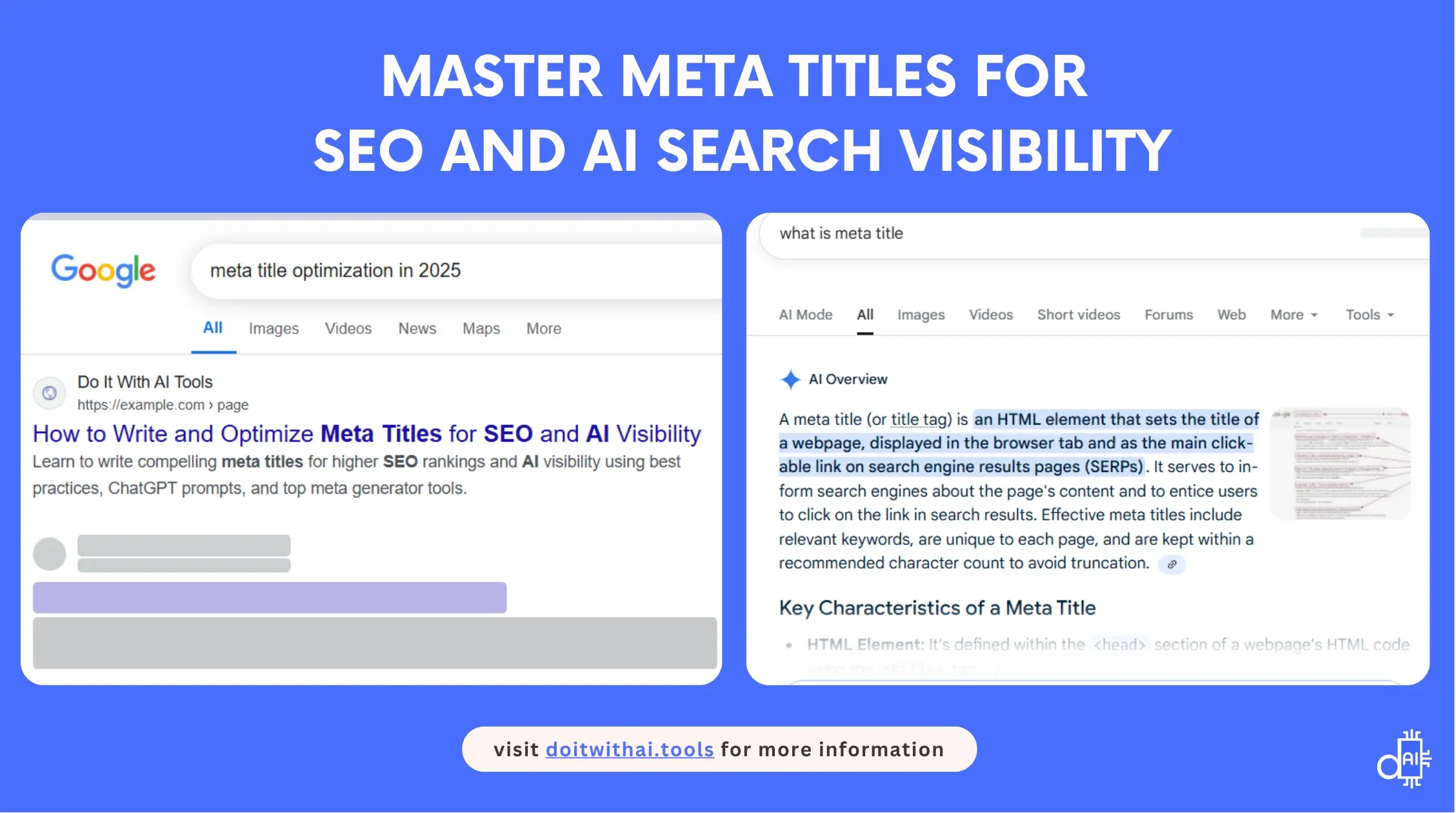
But the mechanics of search have evolved. With the rise of Generative AI—powered by Large Language Models (LLMs) like ChatGPT, Perplexity, and Google’s AI Overviews (formerly SGE— search results now synthesize information directly from multiple trusted sources into AI-generated summaries.
In this new AI-first search environment, optimizing your meta title isn't just about higher rankings or stronger CTR anymore. It’s about citation likelihood—the probability that AI engines will reference your content as an authoritative source.
By the end of this article, you’ll have all the essential knowledge and tools to craft meta titles that achieve traditional SEO excellence while also building the AI trust signals needed to earn citations in generative search results.
What is a Meta Title? (A Dual Perspective from Code to Clicks)
So let's establish the foundation: what exactly is a meta title, and why does it carry this much weight?
At its core, the meta title is an HTML element—specifically the <title> tag—that defines a page’s title inside the browser tab, in the search engine index, and importantly, when your content is shared on social media platforms.
It’s part of your page’s metadata (data about data), and the <title> tag is considered the single most critical element within the broader family of meta tags. It’s one of the first elements search crawlers read when understanding your site’s structure and content relevance.
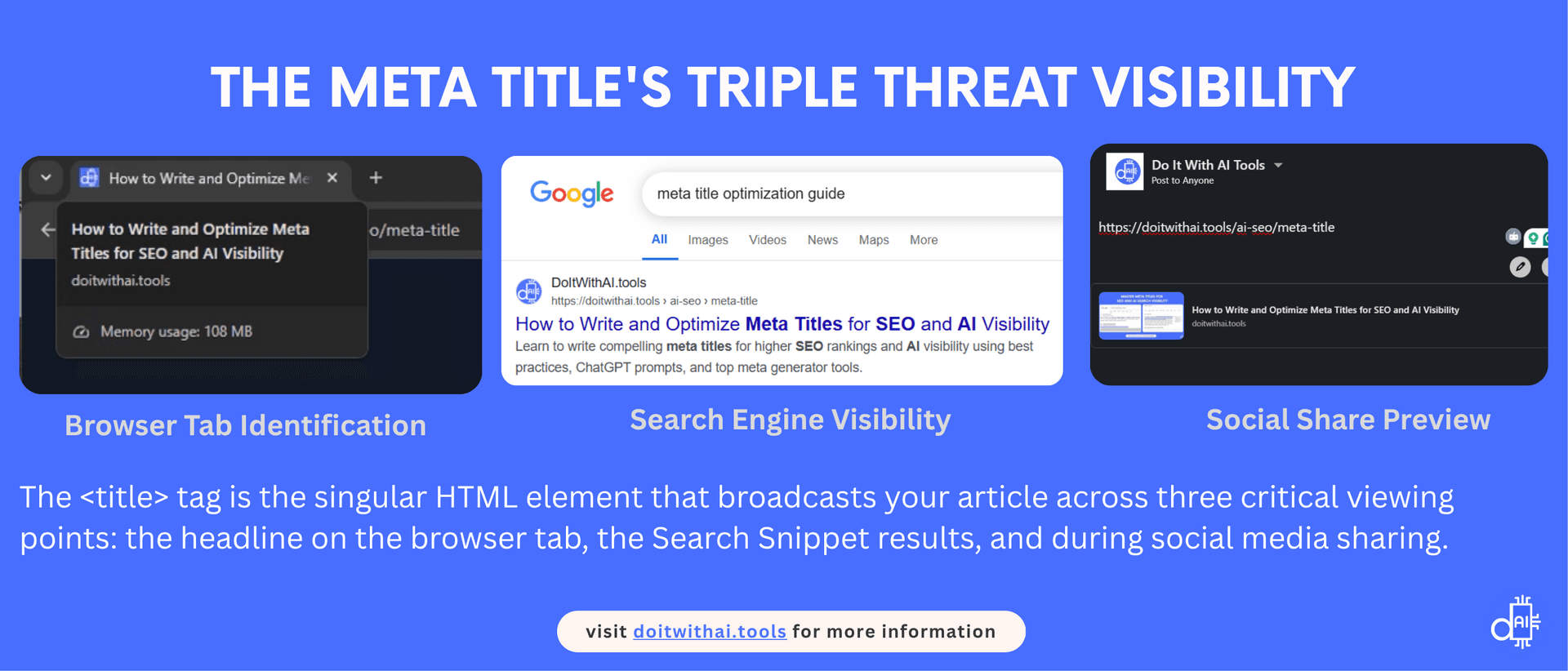
As you can see here, the <title> tag is the singular HTML element that broadcasts your article across three critical viewing points: the headline on the browser tab, the search snippet results, and during social media sharing.
From an SEO point of view, though, the meta title is far more than a line of code. It’s your page’s headline in the search ecosystem — a signal that speaks to two main audiences:
- For algorithms, which include both Google’s search engine and modern AI systems like Bing Copilot, Perplexity, or Google’s AI Overviews. Your title informs them about what your content is, why it’s relevant, and if it shows enough authority to be cited or ranked.
- For users, it’s the first impression — the clickable promise that convinces them to choose your result over dozens of others.
A well-crafted meta title satisfies both: the technical precision algorithms demand and the clarity and value proposition that earns human clicks.
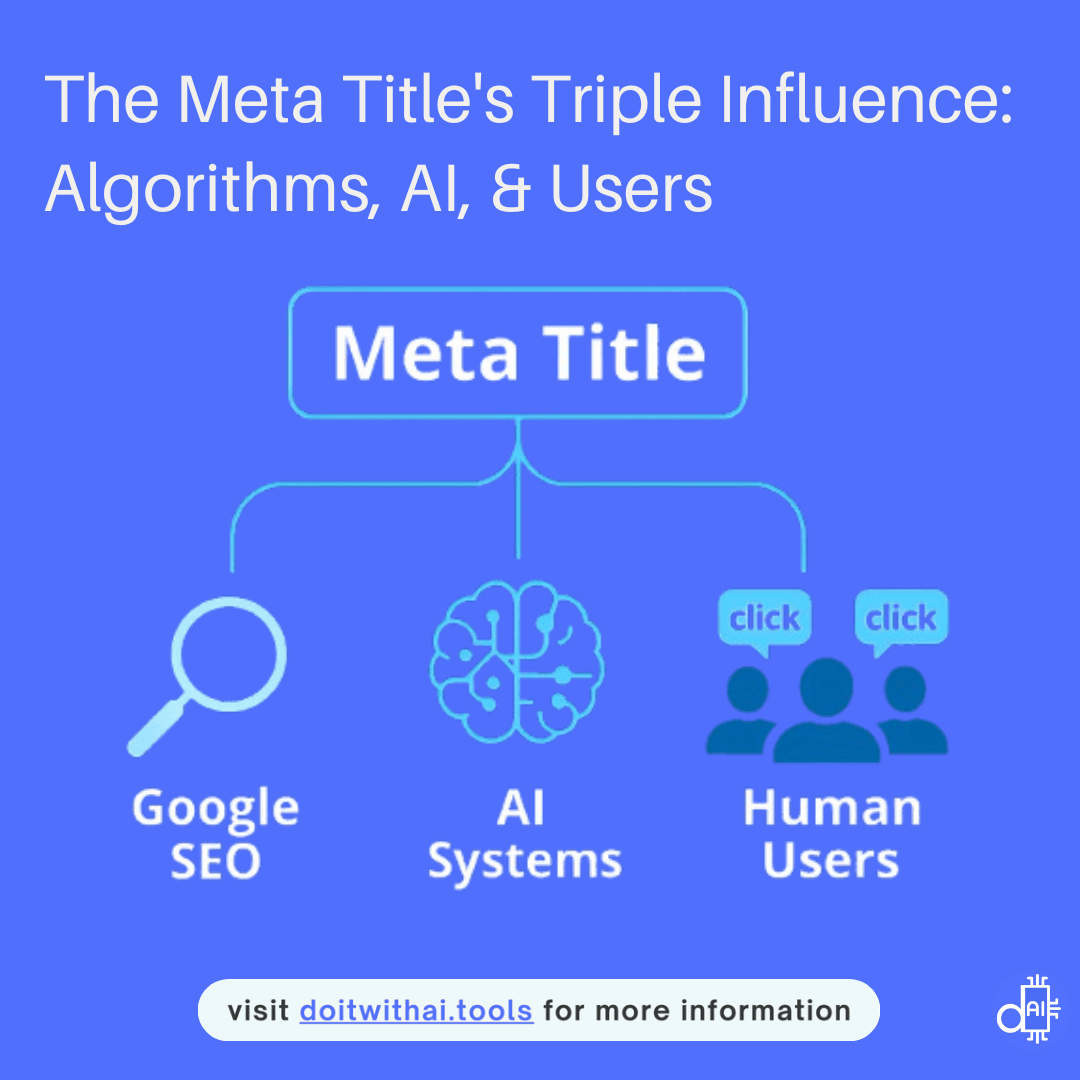
The meta title is a powerful, multi-purpose signal—it must appeal both to technical algorithms (including AI) and the human user who is ultimately deciding whether or not to click.
Importance of Meta Titles in Today's AI-First Search Landscape
In the dynamic landscape of modern search, the meta title's role has expanded beyond its foundational duties.
Understanding its impact on traditional rankings, user engagement, and cutting-edge AI systems is paramount to achieving visibility and citation. Here’s why your meta title holds unprecedented importance:
- Foundation for Traditional SEO & Ranking: The meta title remains a cornerstone for Google's traditional ranking algorithms. It's a primary signal for relevance, helping your page appear for targeted keywords and secure foundational visibility in the SERPs.
- First Impression & Handshake for Both Algorithms and Users: The meta title is the initial point of contact—a digital handshake—for both human users and sophisticated search algorithms (including traditional Google and modern AI systems). A compelling title immediately communicates value, encouraging clicks from users and signaling relevance to all algorithmic processes.
- Catalyst for Higher Click-Through Rate (CTR): An optimized meta title directly influences how many users choose your link over others in the SERP. By accurately reflecting content value and appealing to user intent, it drives crucial traffic to your page, a strong signal for all search systems.
- Building E-E-A-T (Experience, Expertise, Authoritativeness, Trustworthiness): A well-crafted meta title significantly contributes to establishing your content's E-E-A-T. By clearly stating the subject and often including author or brand signals, it subtly tells both search algorithms and users that the information is credible and from a knowledgeable source.
- Fueling AI Citation Likelihood in Generative Answers: In the era of AI Overviews and generative search, the meta title acts as a key trust signal for Large Language Models (LLMs). A precise, authoritative, and relevant title increases the probability that AI will identify your content as a prime source, citing it in its synthesized answers.
- Enhancing Content Disambiguation and Specificity: For broad or ambiguous search queries, the meta title provides essential clarity. It helps all search engines accurately differentiate between similar topics or entities, ensuring your content is served for the most precise user intent.
- Optimizing for Rich Results and Enhanced SERP Features: A concise and well-structured meta title aids in qualifying for various rich results and enhanced SERP features, which are increasingly powered by sophisticated algorithms and AI. These prominent displays are driven by the ability to quickly extract precise answers, and your title's clarity is paramount for this identification.
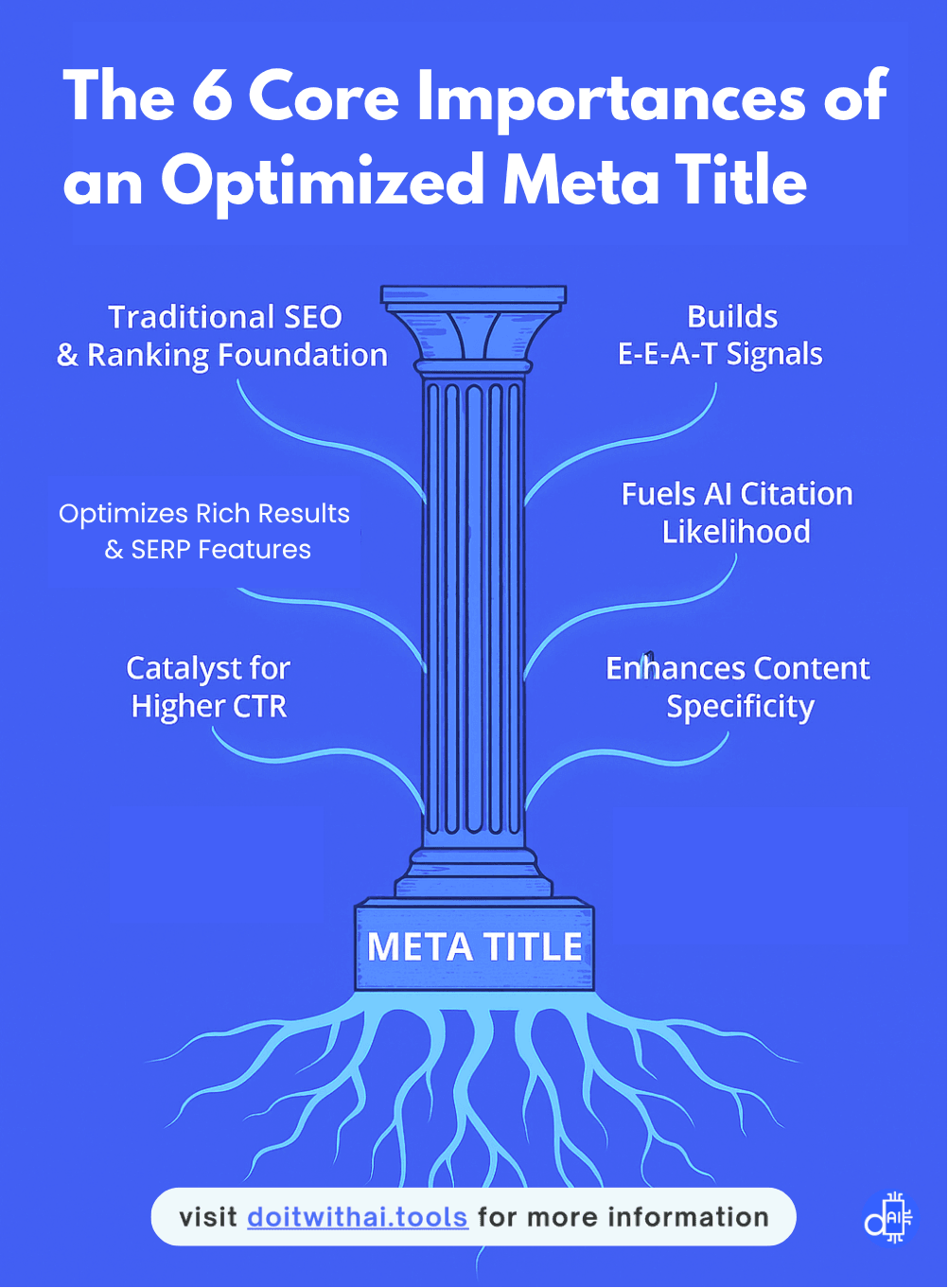
You can see how the meta title is the foundation for everything—it doesn't just help you rank, it actively fuels your E-E-A-T signals and increases the likelihood of being cited by generative AI.
Best Practices for Crafting Effective Meta Titles
Crafting a truly effective meta title in 2025 means thinking beyond just a single keyword.
You need a dual optimization approach: satisfying the technical demands of search algorithms (both traditional and AI) while simultaneously capturing the attention and intent of human users.
The meta title is the single most important element within the broader category of HTML metadata. These meta tags provide information about your page, and mastering the title tag is step one to superior on-page optimization.
Master the Meta Title Length: Pixel-Perfect for Every Device
This is perhaps the first and foremost technical aspect you need to master for effective on-page SEO: meta title length. Our primary goal here is simple: we want your title tag to appear uncut on all devices and search engines.
No one wants a vital part of their headline cut off by an ellipsis (...), which harms the user experience. This lack of clarity could also signal to AI search engines that your content is less reliable, potentially reducing your chances of being cited.
Now, here’s a crucial insight I want to share with you: forget about rigid character counts (e.g., 50-60 characters) for a moment. While helpful as a rough guideline for title tag optimization, different search engines and devices (desktop, mobile, tablet) have varying limits for how much of your title they display. The real trick? It’s all about pixels, not just characters.
- Understanding Pixels for Meta Titles: Imagine your meta title as text drawn on a canvas with a fixed width. Each letter, number, or symbol takes up a certain amount of horizontal space, measured in pixels. A narrow letter like 'i' or 'l' might use fewer pixels, while wider letters like 'M', 'W', or even capital letters (like 'A' or 'B') and camel case (e.g., DoItWithAITools) consume significantly more space. This means a 50-character title with many wide or capitalized letters will take up more pixel width than a 60-character title dominated by narrow, lowercase letters. This pixel-based measurement truly defines your title's visibility in real-time search engine results pages (SERP).
- Prioritizing Mobile-First for Universal Visibility: Once you grasp the pixel concept, the next strategic step is to think mobile-first. Why? Because mobile screens offer significantly less horizontal pixel space than desktops. If you optimize your title to fill the maximum pixel length for a desktop, there's a very high risk it will be truncated on a mobile device. By crafting a title that fits perfectly on mobile, you inherently ensure maximum visibility across all screen sizes, from the smallest smartphone to the largest desktop monitor.
- For instance, take a look at this title: "Your Modern New Blog for SEO, GEO and Scale Do It With AI Tools" (which is 50 characters, including spaces, but uses many capital letters and longer words). This will often exceed the pixel limit on mobile, even at just 50 characters. This real-world example perfectly illustrates why character counts alone can be misleading for meta title optimization.
Now the Question is: How do you ensure your titles are pixel-perfect and mobile-friendly without guessing? This is precisely where tools like a SERP simulator become indispensable.
I've personally been using the Mangools SERP Simulator from day one, and I can tell you it’s incredibly useful and easy to use. Just enter your proposed meta title in the "Title" field, switch to the "Mobile" tab, and start crafting until you achieve that perfect display without truncation – typically aiming for around 600 pixels. This visual feedback is invaluable for getting your meta title length just right every time.
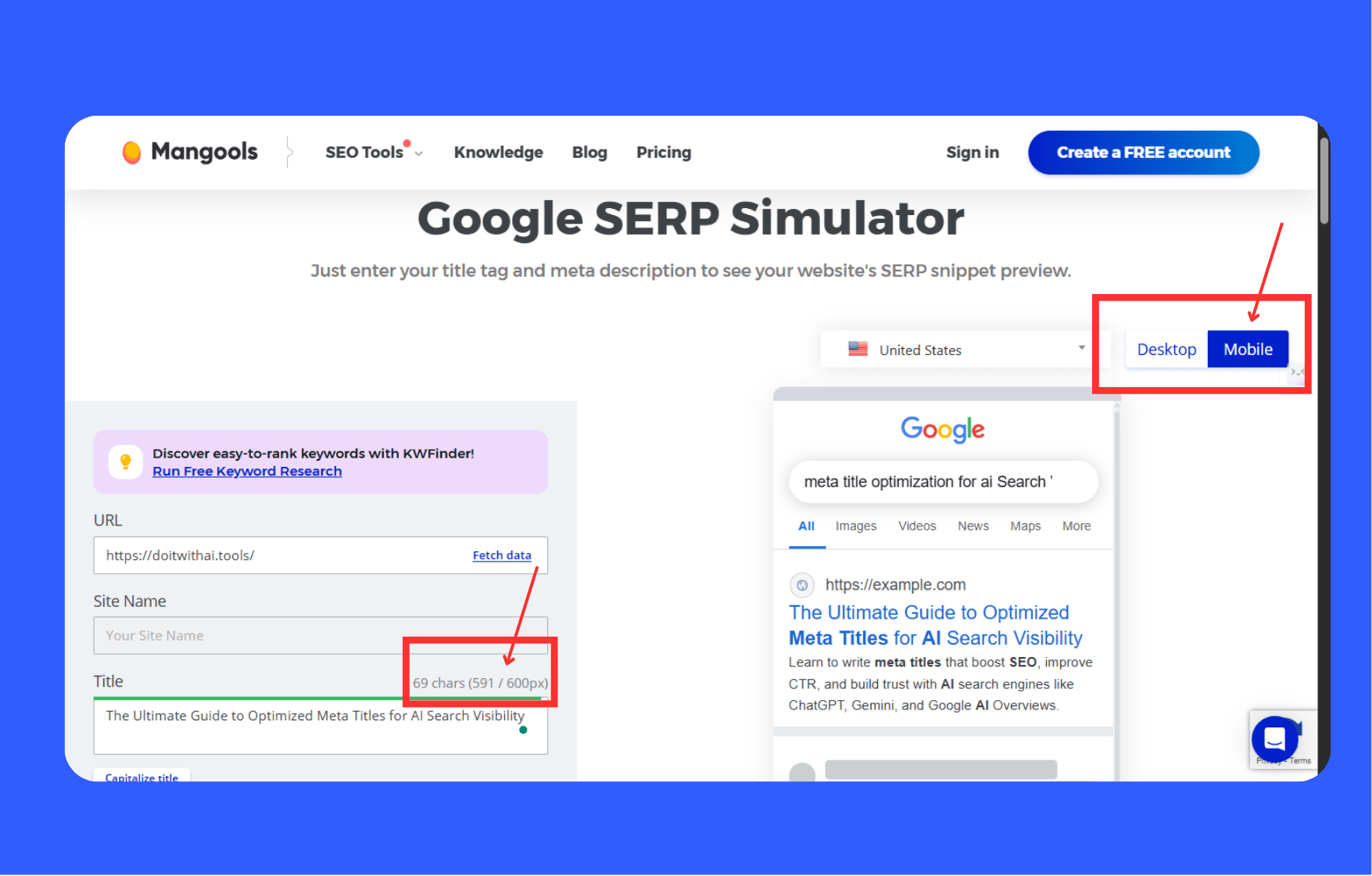
To truly master meta title length, use a SERP simulator like this one to ensure your titles are pixel-perfect and won't be cut off on any device, especially mobile!
What to Include in a Meta Title
Crafting a compelling meta title means speaking simultaneously to Google's core ranking algorithms, the end user, and sophisticated AI systems. Here's a breakdown of what each entity values most in your title.
What Google's Core Algorithms Prioritize in Your Meta Title
These are the foundational elements that Google's core ranking algorithms analyze when determining your page's relevance, indexing priority, and overall quality signals within the traditional search ecosystem.
- Primary & Secondary Keywords (Optimized for Relevance): Strategically incorporating your main target keyword, along with relevant secondary terms, is crucial for crafting effective meta titles. This helps Google categorize your page accurately and improves visibility for the right search queries. To fully leverage this step, master keyword research with AI for deeper insights and stronger targeting.
- Example: Instead of "SEO Guide," use "Advanced On-Page SEO Techniques 2025 | Content & Technical Audit."
- Semantic Breadth & Content Type Signals: Google's algorithms analyze your title to infer the precise nature and purpose of your content (e.g., informational, transactional, conversational). This information, along with other metadata in the
<head>section, helps Google match your page to the most appropriate user intent, impacting your page's ranking for diverse queries.- Example: "Ultimate Guide to Keyword Research Strategy" clearly indicates a comprehensive, informational resource, while "Buy SEO Tools Online: Best Deals" signals a transactional intent.
- Brand Name (for Authority & E-E-A-T): Including your brand name, especially for established or authoritative sites, helps Google associate the content with your entity. This directly contributes to building brand equity in search results and enhances overall E-E-A-T signals across your domain.
- Example: "SEO Content Writing Tips | RankRight Agency Blog" reinforces the brand's expertise in marketing topics for Google's evaluation.
- Accurate Intent Representation: Your title must honestly reflect your actual content. Misleading titles might initially boost CTR but inevitably lead to high bounce rates, which Google interprets as a negative user experience signal, ultimately harming your ranking.
- Example: If the content is a beginner guide to SEO, the title should say "Beginner SEO Guide," not "Mastering Advanced SEO Tactics," to ensure Google delivers it to the right audience.
What Human Users Respond to When Evaluating Your Meta Title
These elements tap into human decision-making psychology, compelling users to click your result over competing headlines in the SERP, and are foundational for positive user signals that indirectly influence rankings.
- Benefit-Oriented Language: Titles that clearly articulate a direct benefit or solution to a user's problem are highly attractive. Users are inherently looking for answers or advantages, so focusing on what they will gain by clicking is paramount.
- Example: "Boost Organic Traffic: 5 Proven Content Marketing Hacks" is more compelling than "Content Marketing Methods," directly appealing to a user's desire for improvement.
- Numbers & List Formats: Users are instinctively drawn to numbers in titles (e.g., "Top 10," "5 Ways," "20 Tips") because they promise easily digestible, structured information. This creates an expectation of specific takeaways, making the content feel less overwhelming and more actionable.
- Example: "7 Easy Steps to Create an SEO Content Plan" feels more approachable and goal-oriented than a general "SEO Content Planning Guide."
- Timeliness & Freshness (for Immediate Relevance): Indicating that your content is current and up-to-date (e.g., with "2025," "Latest," "New Update") assures users they are getting the most relevant information. This is particularly important for rapidly evolving topics like SEO and content marketing, and builds immediate trust with the human reader.
- Example: "Latest SEO Trends 2025: What Marketers Need to Know" strongly appeals to users seeking current industry insights.
- Emotional Triggers (Where Appropriate): Depending on the topic, titles that evoke curiosity, urgency, or aspiration can significantly increase user engagement. Tapping into relevant emotions makes your title more memorable and prompts a deeper connection with the user.
- Example: "Avoid These Common SEO Mistakes That Are Killing Your Rankings" leverages fear of loss to encourage a click by highlighting a potential negative outcome.
- Natural Language & Smooth Flow: While functional symbols (like pipes or colons) have their place, users generally prefer titles that read like a natural sentence or a compelling headline rather than a fragmented list of terms. A conversational flow feels more inviting and improves immediate comprehension, making the title feel more human.
- Example: "Master content marketing to boost leads and build brand authority" flows more smoothly than "Content Marketing: Leads, Authority, Brand Building Explained."
- Clarity & Readability: Readability and clarity are key when crafting a meta title—use precise, descriptive language that instantly conveys your page’s purpose and topic. This makes titles easier to scan and understand, improving both user experience and click-through rate.
- Example: Vague - "Content Secrets Revealed"; Clear - "Content Strategy: 7 Proven Tactics for B2B Growth."
- Scannable, Front-Loaded Structure: Place your most critical information (main keyword + core benefit) at the beginning of the title. While algorithms can read your full title regardless of length, truncations in the SERP directly affect user decision-making, so leading with impact is vital for human clicks.
- Example: "SEO Ranking Factors 2025: A Comprehensive Guide" is more effective than "A Comprehensive Guide to SEO Ranking Factors in 2025," ensuring the core topic is always visible.
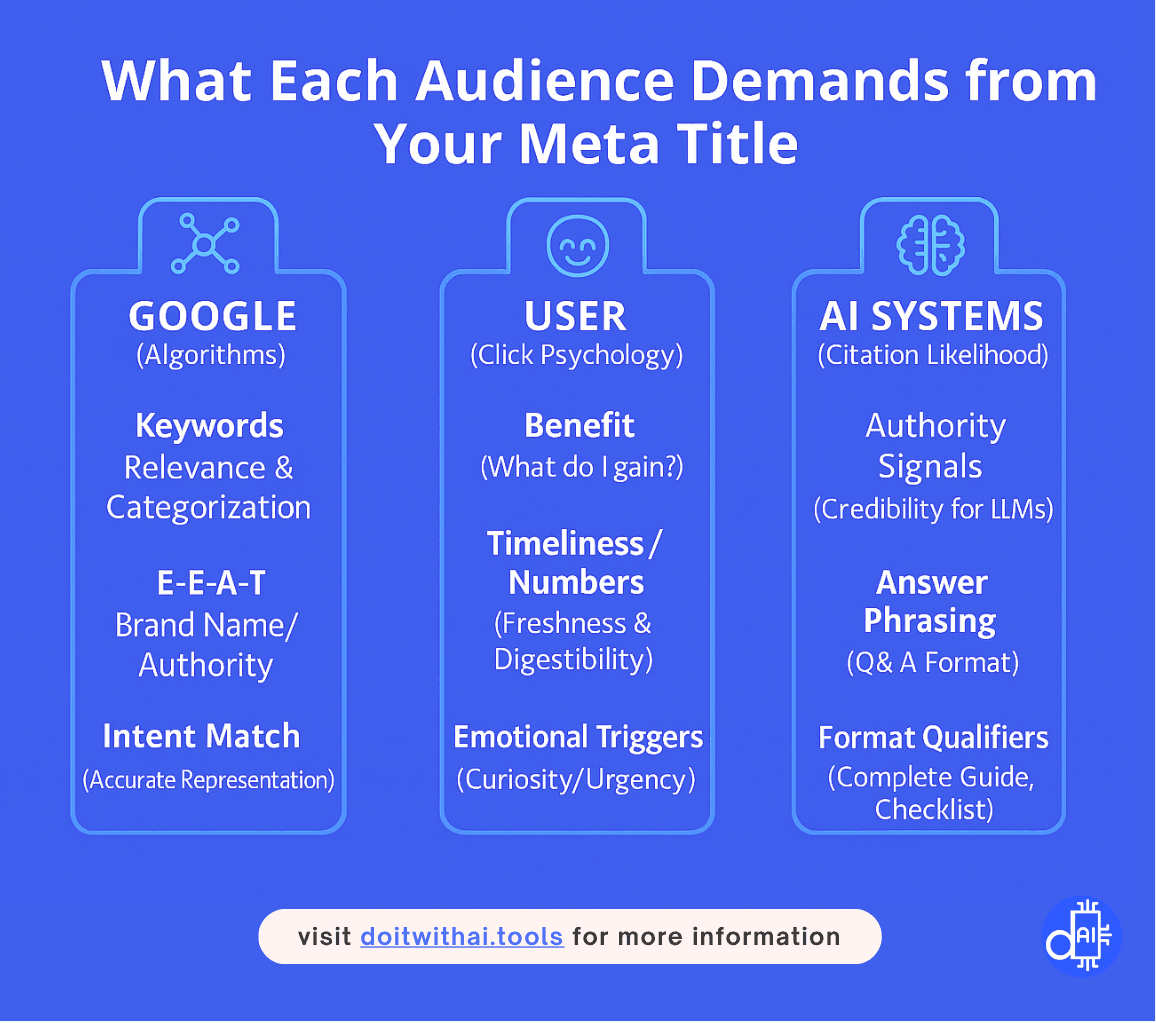
When crafting your meta title, remember you're speaking to three audiences: Google algorithms need clear relevance signals, human users look for value and benefit, and AI systems require authority and answer-oriented phrasing for citation. Never forget to balance the technical with the human.
What AI Systems Evaluate for Meta Title Citation Likelihood
Modern AI-powered search platforms (like ChatGPT, Perplexity, and Google AI Overviews) analyze these signals when deciding whether your content deserves citation as a trusted, high-quality source in generative answers and for advanced Generative Engine Optimization (GEO).
- Authority & Credibility Signals: AI systems are trained to identify and prefer content from authoritative sources. A title that implicitly or explicitly suggests expertise (e.g., "Expert Guide," "Research-Backed," "Study by [Institution]") directly influences AI's trust, increasing your content's likelihood of being cited.
- Example: "AI in SEO: A Data Scientist's Perspective" signals high authority to AI for technical queries, making it a strong candidate for citation.
- Answer-Oriented Phrasing (for Informational Content): For content designed to answer specific questions, using direct "How to," "What is," or "Why" phrasing helps AI recognize it as a valuable informational resource. This directly aids AI in generating accurate snippets and authoritative answers, as it precisely matches common user query patterns.
- Example: "How to Conduct a Technical SEO Audit: Step-by-Step Guide" directly answers a common problem, making it highly AI-citable due to its explicit Q&A format.
- Comprehensive & Format-Indicating Signals: Using qualifiers like "Complete Guide," "Ultimate Review," "Step-by-Step Tutorial," or "Definitive Checklist" in your title helps AI understand both the depth and structure of your content. AI models favor titles that clearly articulate comprehensiveness and useful formats when selecting authoritative, all-encompassing sources for complex queries.
- Example: "The Complete Guide to Local SEO Optimization (2025 Edition)" or "Content Marketing Checklist: 15-Point Strategy Audit Template" provides clear signals of thoroughness and utility to AI.
What to Avoid in Meta Titles (Common Mistakes That Kill Performance)
Optimizing your meta title also means understanding and steering clear of common pitfalls that can detract from its effectiveness. Avoiding these mistakes is crucial for maintaining good standing with search engines, attracting users, and earning AI citations.
- Keyword Stuffing: Repeating the same keyword or very similar phrases twice (e.g., "Best SEO Tips: Top SEO Strategies") sacrifices valuable space for additional value signals like numbers, benefits, or year markers. Every pixel should communicate something unique.
- Wasting Pixel Space on Redundancy: Do not dedicate valuable pixel space by repeating the same keyword or very similar phrases within a single title. This is inefficient, signals manipulation, and makes your title less impactful.
- Underutilizing Your Full Pixel Budget: Failing to take advantage of the available character/pixel space means missing an opportunity to craft a rich, engaging, and informative title. A well-utilized title can attract more clicks and provide more signals to search engines.
- Ignoring Mobile Pixel Constraints: Optimizing your title to perfectly fill desktop displays (which allow more pixels) virtually guarantees truncation on mobile devices, where the majority of searches now occur. Always validate your title in a mobile SERP preview first—if it fits on mobile, it will display perfectly across all devices.
- Using Generic AI-Generated Titles Without Refinement: Blindly accepting AI tool outputs without applying your strategic expertise, brand voice, or competitive analysis results in vague, templated titles that lack the specificity and authority markers needed to stand out. AI suggestions like "A Comprehensive Guide to Meta Titles" miss opportunities for differentiation, numbers, year markers, or unique angles that your human judgment would catch.
- Misleading or Clickbait Language: Never use titles that promise something the content doesn't deliver. This damages E-E-A-T, increases bounce rates, and makes your content unreliable for both users and AI systems.
- Duplicate Titles Across Multiple Pages: Using identical or nearly identical titles on different pages confuses search engines about which page to rank for specific queries, causes keyword cannibalization, and makes it impossible for users to distinguish between your pages in search results. Every page deserves a unique title that reflects its specific content focus and target keywords.
- Omitting Search Intent Signals: Writing a transactional title (e.g., "Buy Meta Title Services") for informational content (a how-to guide) or vice versa creates an intent mismatch that increases bounce rates and reduces relevance scores. Your title structure must align with whether users are seeking to learn (How to), compare (Best/vs), purchase (Buy/Get), or navigate (Brand Name).
- Using Excessive Punctuation or ALL CAPS: Titles loaded with exclamation marks (!!!), question marks (???), or written entirely in capital letters trigger spam filters, reduce professional credibility, and make your listing look low-quality compared to competitors' clean, properly formatted titles. Standard title case or sentence case with strategic capitalization for acronyms (SEO, AI) performs better across all metrics.
- Neglecting Freshness for Evergreen Topics: Failing to include year markers (2025) or update indicators (Updated, New) for topics where recency matters—like SEO, technology, or AI strategies—signals to both users and AI systems that your content may be outdated, reducing click-through rates and citation likelihood. Even evergreen content benefits from periodic title refreshes that add current year markers without changing the core content.
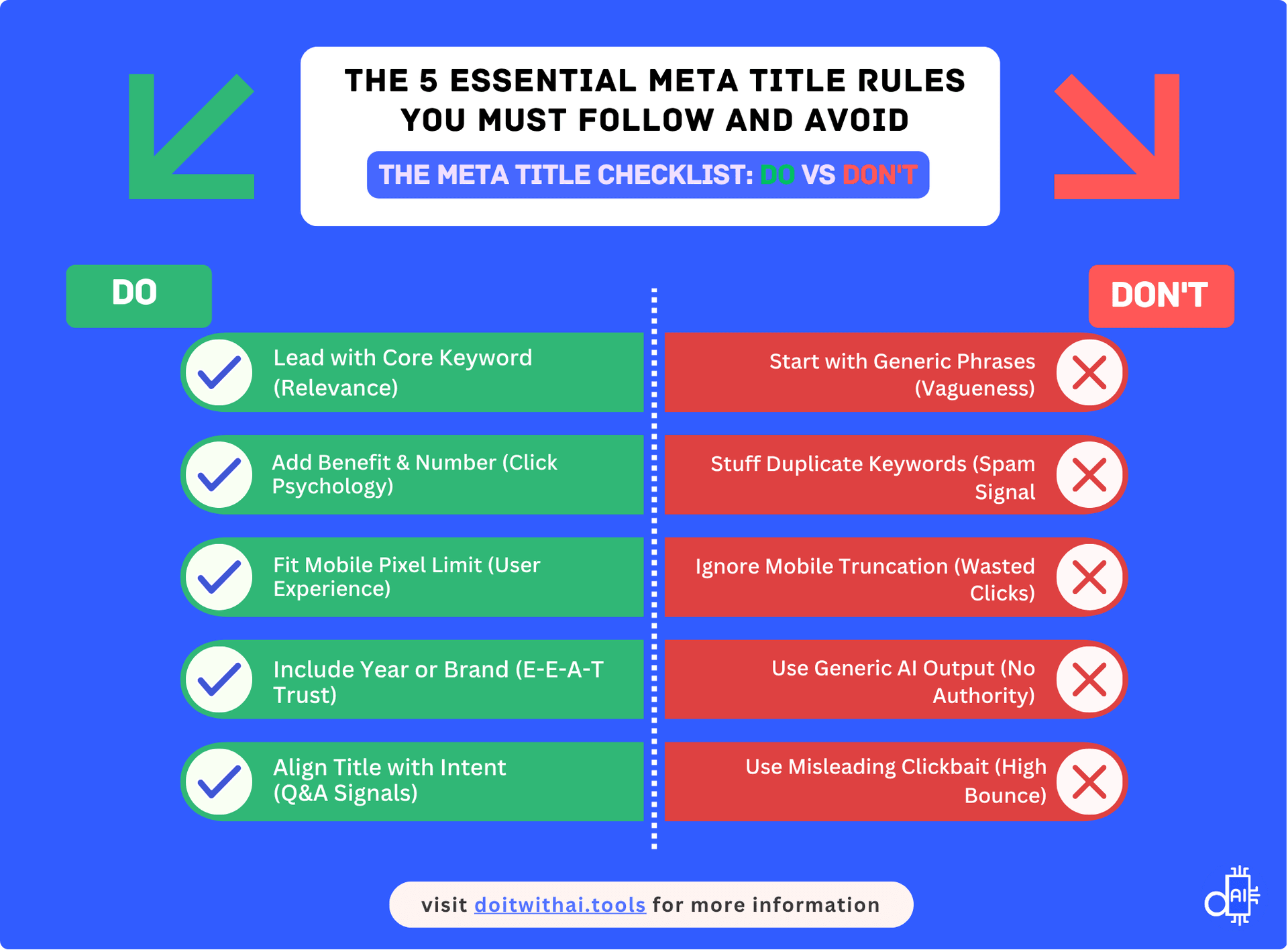
To summarize your Meta title strategy, use this checklist to ensure that every title is focused on core keywords, user benefits, and E-E-A-T signals, while avoiding common mistakes such as keyword stuffing or ignoring mobile truncation. We must always refine AI suggestions with human strategic oversight.
How to Optimize Meta Title for AI Search Engines & Write with AI
Think back to the last time you typed a question into Google. Chances are, you got your answer directly from an AI Overview at the top of the page—without ever clicking through to a website.
That's the reality of modern search: AI-powered systems are now the gatekeepers between your content and your audience.
That instant access to synthesized information is the burgeoning power of AI search engines, and it's sending a clear signal to every content creator: you no longer just optimize your meta title for human clicks or Google's traditional algorithms—you must also optimize for AI systems.
The good news? It's not rocket science, nor does it require mastering entirely new skills. In fact, ensuring your meta title is AI-optimized largely involves applying and emphasizing the best practices we've already discussed, viewed through the lens of AI's unique preferences.
The core principles remain clarity, natural keyword placement, honesty, and a focus on solving problems for the user. By integrating elements like clear authority signals, answer-oriented phrasing, and timeliness, you naturally enhance your meta title's appeal to AI for Generative Engine Optimization (GEO).
But here's even better news: you can use AI, specifically tools like ChatGPT, to help generate meta titles that are inherently AI-optimized (the kind of titles AI systems love). While many still prefer writing article content entirely in their own voice, no one can deny AI's immense power and usefulness when it comes to generating outlines, including meta titles.
Headlines (like titles) generated with AIoutperformed human-written ones in 46% of A/B tests conducted in one study
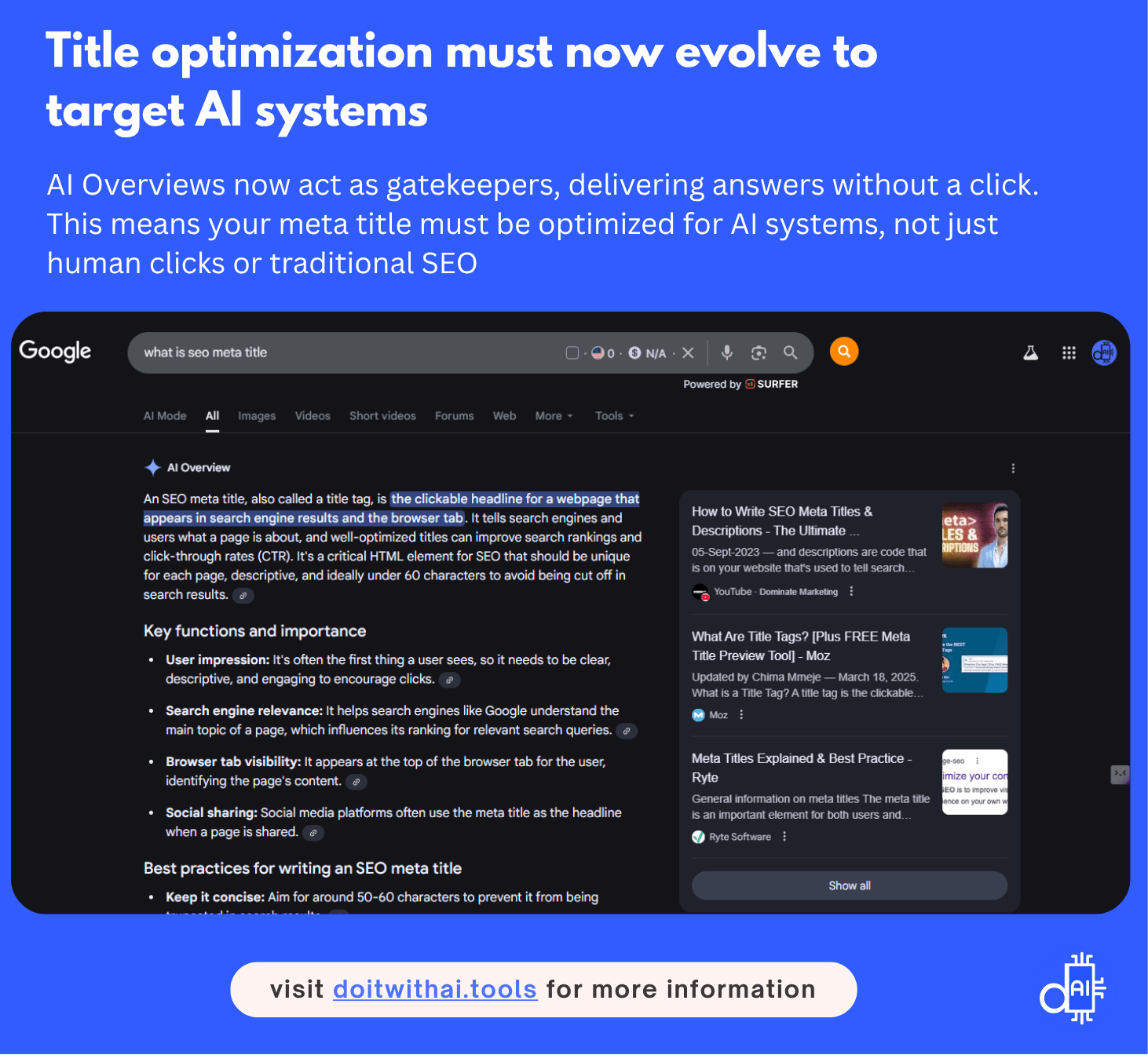
This is the new reality of search: an AI Overview now acts as a gatekeeper, proving that your meta title must be sharp enough to earn the algorithm's trust, not just a human click.
Should You Use AI for Generating Meta Titles?
Creating an effective meta title demands strategic thinking and critical analysis. You're balancing multiple complex variables: user psychology (what makes people click), algorithmic preferences (what Google ranks), and AI trust signals (what systems cite). You're optimizing for human emotion while satisfying machine logic. You're front-loading keywords while maintaining natural readability.
This limited string of 55-60 characters carries the weight of your entire article—like an aircraft tire. It looks small, almost insignificant compared to the massive structure it supports, but it handles an incredibly heavy job. All your content research, writing effort, and strategic planning heavily depend on the meta title.
You have to evaluate every word choice, every modifier, every structural decision. You're asking: Does this keyword placement feel natural? Does this benefit statement resonate emotionally? Will this authority marker pass AI trust filters? Does this format indicator match search intent? Is this specific enough to stand out but clear enough to understand instantly?
So here's the strategic question: Instead of manually juggling all these considerations—with the very real risk of missing the optimal combination—why not delegate this analytical heavy lifting to AI?
Let's dive into how you can effectively use AI, specifically ChatGPT, for creating highly optimized meta titles.
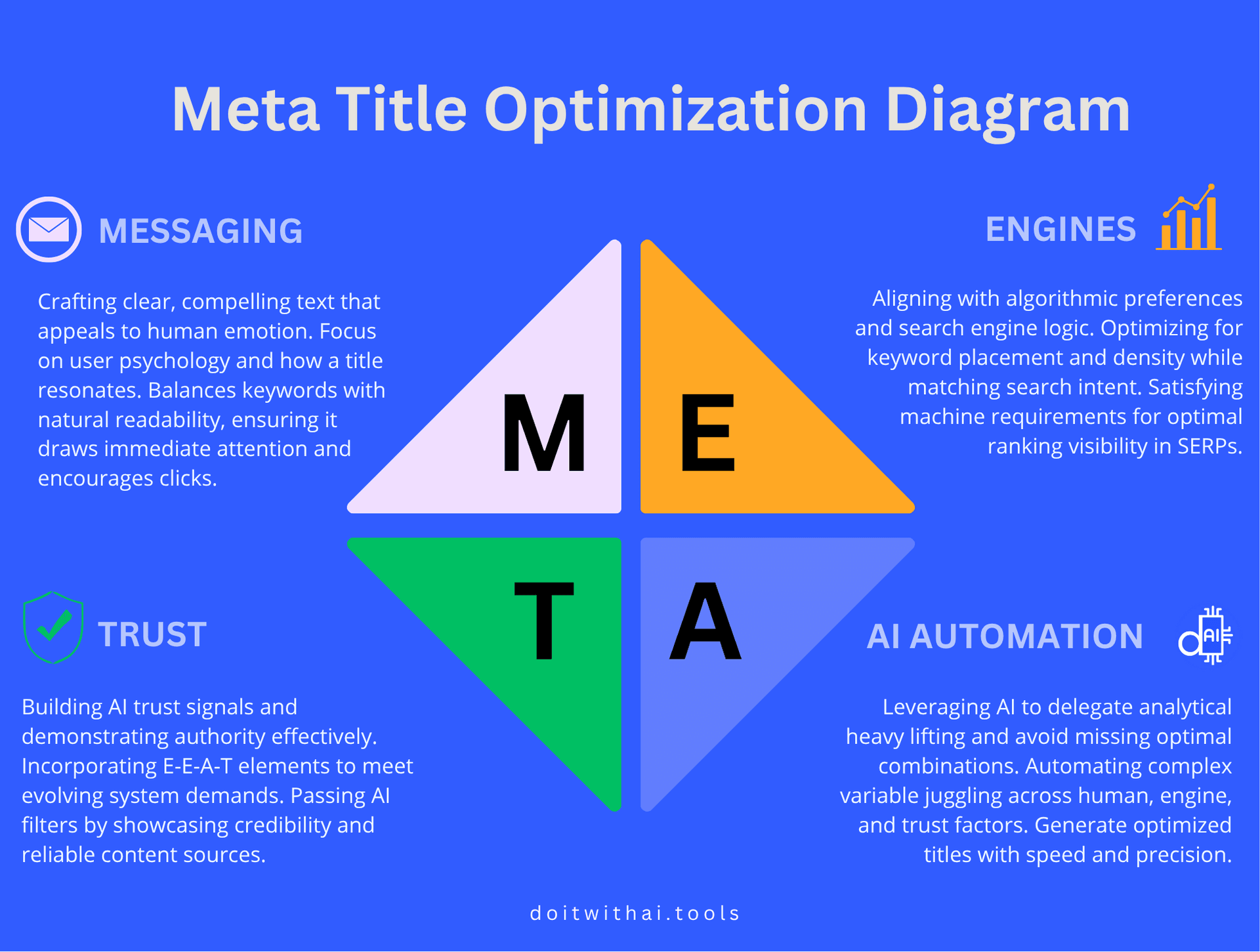
To truly succeed with modern SEO, you must balance the M.E.T.A. strategy—blending Messaging for users, Engine logic, Trust signals for AI, and Automation to find the perfect combination without manual heavy lifting.
How to Use AI (ChatGPT) for Creating Meta Titles
Creating meta titles with ChatGPT is straightforward. The simplest approach involves pasting your content or product description and asking ChatGPT to analyze it and generate, say, 10 meta title options. You can then review and edit these to your preference.
But here's where most people stop short—and miss the real power.
A basic prompt gets you basic results. To unlock ChatGPT's full potential for generating truly optimized meta titles, you need a detailed, well-structured prompt that explicitly instructs the model to consider every critical dimension: keyword placement, pixel limits, search intent alignment, emotional triggers, AI citation signals, E-E-A-T markers, and audience-specific language.
That's why we've created a comprehensive meta title generation prompt that does exactly this. This prompt incorporates all the best practices we've covered throughout this guide
And will generate 100 meta title options organized into 10 distinct strategic angles (10 titles per angle), making it easier to find the perfect option for your specific content and goals.
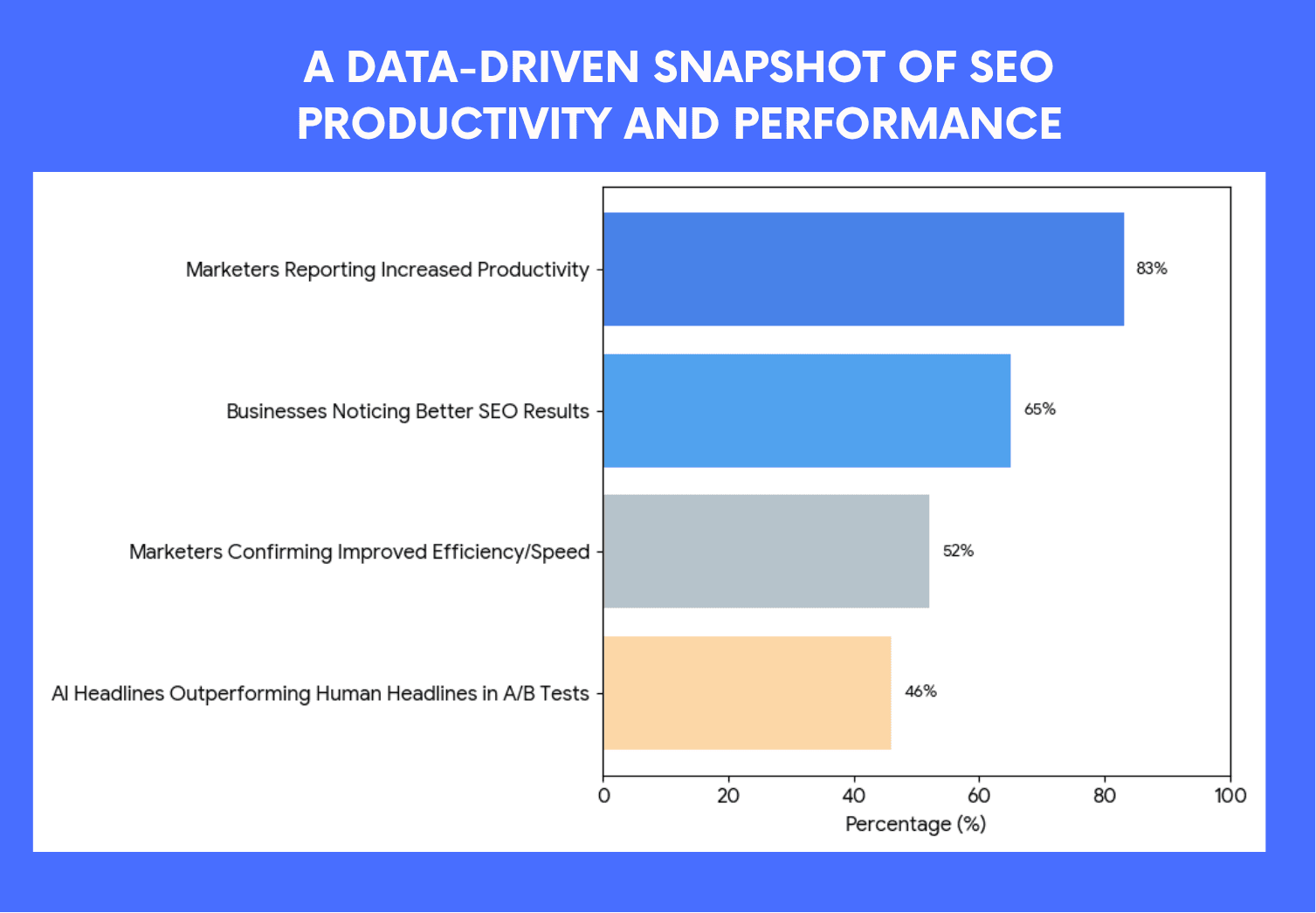
Real-world data compiled from trusted industry leaders, including SEOPROFY , SeoClarity, HubSpot, DemandSage validates the direct business impact of using AI tools to boost productivity, efficiency, and overall SEO results.
Prompt Start:
I need you to analyze the content I'm providing and generate 100 strategically optimized meta titles organized into 10 distinct categories. Additionally, I want comprehensive insights that will help me maximize this content's SEO potential, monetization opportunities, and strategic value.
**STEP 1: CONTENT ANALYSIS (Analyze First, Then Generate)**
Before creating any titles, analyze and identify:
1. **Content Type**: Is this a blog article, product page, service page, landing page, homepage, video transcript, or something else?
2. **Primary Intent**: What is the core search intent? (Informational: teaching/explaining | Commercial: comparing/researching | Transactional: buying/taking action | Navigational: finding specific brand/page)
3. **Target Audience**: Who is this content for? (Beginners, professionals, general consumers, niche experts, etc.) What's their likely expertise level and primary motivation?
4. **Primary Keyword/Topic**: What is the main keyword or topic this content targets?
5. **Semantic Breadth**: What related concepts, secondary keywords, or LSI terms does this content cover?
6. **Unique Value Proposition**: What makes this content different, better, or more valuable than competing content on the same topic?
7. **Tone & Brand Voice**: Based on the content, what tone is most appropriate? (Professional, casual, technical, friendly, authoritative, etc.)
**Present this analysis first in a brief summary before generating titles.**
---
**STEP 2: TITLE GENERATION REQUIREMENTS**
Now generate 100 meta titles following these strict constraints:
**Universal Constraints (Apply to ALL Titles):**
- Maximum 58 characters (strict pixel-safe limit for mobile)
- Include the primary keyword naturally within the first 5-8 words
- Must accurately represent the actual content (no misleading promises)
- Avoid keyword stuffing, excessive punctuation, or ALL CAPS
- Each title must be unique—no repetition or minor variations
- Optimize for three audiences simultaneously: traditional search algorithms (Google), human users (CTR), and AI systems (citation likelihood)
**Format Requirement:**
- First 5 titles in each category: Complete sentence format (no colons, pipes, or separators)
- Last 5 titles in each category: Use separator symbols (: or - or |) to structure the title
**What to Include (When Appropriate):**
- Numbers or list indicators (7 Tips, 10 Ways, 5 Steps)
- Year markers for freshness (2025, Updated 2025)
- Format indicators (Guide, Tutorial, Checklist, Template, Examples)
- Benefit statements (outcomes users will achieve)
- Authority markers (Expert, Proven, Data-Backed, Verified)
- Emotional triggers or power words (Ultimate, Complete, Essential, Quick, Simple)
- Question structures for informational content (How to, What is, Why, When)
**What to Avoid:**
- Duplicate or near-duplicate titles
- Generic or vague language ("Tips and Tricks," "Everything You Need")
- Clickbait that overpromises
- Redundancy (repeating the same concept twice)
- Wasting pixel space on unnecessary words
---
**STEP 3: THE 10 TITLE CATEGORIES**
Generate exactly 10 titles per category (5 complete sentences + 5 with separators):
**Category 1: Universal/Balanced Approach**
Titles that balance SEO keywords, user appeal, and AI clarity equally. These work across all three optimization goals without favoring one heavily.
**Category 2: Question-Based Problem-Solving**
Titles structured as direct questions (How to, What is, Why, When, Which) that match conversational search queries and optimize for Answer Engine Optimization (AEO).
**Category 3: SEO Keyword-Focused**
Titles that prioritize keyword placement and semantic relevance for traditional Google ranking algorithms, with the primary keyword front-loaded prominently.
**Category 4: Benefit-Driven Outcomes**
Titles that lead with clear, specific benefits or results users will achieve, emphasizing transformation, improvement, or value gained.
**Category 5: Number/List-Based**
Titles featuring specific numbers (7 Ways, 10 Tips, 5 Mistakes, 12 Examples) that signal structured, actionable content and boost credibility.
**Category 6: User Engagement & Emotional Priority**
Titles optimized for maximum click-through rate using power words, emotional triggers, curiosity gaps, and psychological appeal.
**Category 7: AI Citation & Authority-Focused**
Titles optimized specifically for AI search engines (ChatGPT, Perplexity, AI Overviews) with authority markers, comprehensiveness signals, and E-E-A-T indicators.
**Category 8: Freshness & Timeliness-Focused**
Titles emphasizing current year, recent updates, latest trends, or time-sensitive relevance to signal up-to-date information.
**Category 9: Beginner-Friendly & Accessible**
Titles using simple, clear language with indicators like "Beginner Guide," "Simple," "Easy," "Step-by-Step," "Explained" to attract and reassure new learners.
**Category 10: Advanced/Expert-Level**
Titles targeting experienced audiences with terms like "Advanced," "Pro," "Deep Dive," "Technical," "Mastery," or niche-specific jargon.
---
**STEP 4: PRESENTATION FORMAT**
Present all 100 titles organized by category with clear headings. For each category, briefly explain (1-2 sentences) why these titles follow that strategic approach and what makes them effective for their intended purpose.
**Example Format:**
**Category 1: Universal/Balanced Approach**
*These titles balance keyword relevance, user appeal, and AI clarity without over-optimizing for any single dimension. They perform consistently well across traditional search, human CTR, and AI citation likelihood.*
1. [Complete sentence title]
2. [Complete sentence title]
3. [Complete sentence title]
4. [Complete sentence title]
5. [Complete sentence title]
6. [Title with separator: format]
7. [Title with separator - format]
8. [Title with separator | format]
9. [Title with separator: format]
10. [Title with separator - format]
[Repeat for all 10 categories]
---
**STEP 5: SUMMARY ANALYSIS & RECOMMENDATIONS**
After generating all 100 titles, provide:
**1. Top 3 Overall Best Titles (Across All Categories)**
List your top 3 recommendations with specific reasoning for each:
- Why this title is effective
- Which audiences it serves best (algorithms/users/AI)
- What strategic strengths it demonstrates
- Any potential weaknesses or trade-offs
**2. Best Category Match for This Content**
Identify which of the 10 categories best aligns with this specific content's goals, audience, and strategic priorities. Explain why this category is the optimal strategic fit.
**3. Content-Specific Insights**
Share any unique observations about this content that influenced your title generation:
- Unique positioning opportunities you identified
- Competitive differentiation angles
- Audience-specific language or framing considerations
- Any challenges or limitations in the content that affected title options
---
**STEP 6: BONUS SEO & CONTENT EXPANSION OPPORTUNITIES**
Now provide these additional strategic insights to maximize this content's value:
**A. High-Value Related Keywords & Phrases (SEO Expansion)**
Identify 15-20 related terms, phrases, or long-tail keywords with strong search potential that naturally connect to this content. For each keyword/phrase, provide:
- The keyword/phrase itself
- Estimated search intent (informational/commercial/transactional)
- How it relates to the main content
- Strategic recommendation: Should this be targeted in the current content (as H2/H3 section), used for internal linking, or developed as separate new content?
**Example Format:**
1. **"meta title character limit"** - Informational intent | Directly related to technical optimization | *Recommendation: Add as H3 subsection within current content*
2. **"best meta title generator tools"** - Commercial intent | Tool comparison angle | *Recommendation: Create separate comparison article and link from this content*
**B. High-Volume Questions to Address (Content Gap Analysis)**
Based on this topic, identify 10-15 specific questions that users frequently search for. These should:
- Have measurable search volume
- Be directly answerable within your content scope
- Align with "People Also Ask" opportunities
- Optimize for featured snippets and AI Overview citations
For each question, indicate:
- The exact question as users search it
- Whether it's currently addressed in the content (Yes/Partially/No)
- Strategic value (High/Medium/Low for driving traffic or earning featured snippets)
- Suggested placement if not covered (which section it should be added to)
**Example Format:**
1. **"How long should a meta title be in 2025?"** - Currently: Partially | Value: High | *Add dedicated subsection with pixel-based explanation*
2. **"Does Google rewrite meta titles?"** - Currently: No | Value: High | *Add FAQ section or dedicated paragraph*
**C. Monetization & Revenue Opportunities**
Analyze this content for potential earning strategies. Provide specific, actionable recommendations:
**1. Affiliate Marketing Opportunities:**
- Identify 5-10 relevant products, tools, or services mentioned or related to this content
- For each, suggest specific affiliate programs with details:
- Product/Service name
- Affiliate network (Amazon Associates, ShareASale, Impact, CJ Affiliate, individual programs)
- Typical commission rate or structure
- How to naturally integrate into content (tool recommendation section, comparison table, tutorial example)
- Estimated conversion potential (High/Medium/Low based on content fit)
**Example Format:**
- **SEMrush (SEO Tool)** - Program: SEMrush Affiliate via Impact | Commission: $200/sale + recurring | *Integration: Add "Recommended Tools" section with feature comparison* | Potential: High
**2. Digital Product Creation Ideas:**
Based on this content's topic and audience, suggest 3-5 digital products you could create and sell:
- Product type (template, checklist, course, ebook, toolkit, etc.)
- Suggested pricing tier
- What it should include
- Why your audience would pay for it
**3. Service Offering Opportunities:**
Identify 2-3 service offerings you could promote based on expertise demonstrated in this content:
- Service type (consulting, implementation, audits, training, etc.)
- Target customer profile
- Pricing model suggestion (hourly, project-based, retainer)
**4. Sponsored Content/Brand Partnership Angles:**
Suggest 3-5 brands or companies in this niche that might sponsor content, with outreach angles:
- Company name and why they're a fit
- What value you offer them (audience reach, authority, alignment)
- Potential collaboration format (sponsored post, product review, case study, co-created content)
**D. Content Repurposing Strategy**
Provide 5-7 specific ways to repurpose this content into different formats to maximize reach and value:
**Example Ideas:**
1. **YouTube Video**: "Transform into 10-15 minute tutorial video with screen recordings"
2. **LinkedIn Carousel**: "Extract key points into 8-10 slide visual carousel"
3. **Twitter/X Thread**: "Break into 12-15 tweet thread with actionable tips"
4. **Email Newsletter Series**: "Split into 3-part email course delivered over one week"
5. **Infographic**: "Visualize the framework/process as shareable graphic"
6. **Podcast Episode**: "Expand key concepts into 20-minute audio discussion"
7. **Instagram Reel Series**: "Create 5 short-form videos, each covering one major point"
**E. Internal Linking Opportunities**
Suggest 8-10 potential internal link anchor texts and target topics that would:
- Support this content's SEO authority
- Create logical user navigation paths
- Build topical clusters around this subject**Example Format:**
- **Anchor text:** "how to optimize H1 tags" → **Target:** Create/link to article about H1 optimization best practices
- **Anchor text:** "URL slug best practices" → **Target:** Create/link to URL structure guide
**F. External Linking & Citation Strategy**
Identify 5-8 high-authority external sources you should link to or cite for:
- Building E-E-A-T credibility
- Supporting factual claims
- Providing additional reader value
- Signaling to AI systems that your content is well-researched
**Example Format:**
- **Google Search Central Documentation** (https://developers.google.com/search) - Link when discussing official title tag guidelines
- **Moz Title Tag Research** - Cite when referencing CTR data or character limits
---
**OPTIONAL: Additional Constraints (Include Only If Applicable)**
If any of these apply to your content, specify them:
- Brand name to include: [Brand]
- Must avoid certain words/phrases: [List]
- Specific tone requirement: [Professional/Casual/Technical/Friendly]
- Geographic focus: [Location for local SEO]
- Competitor titles to differentiate from: [Examples]
- Special compliance requirements: [Medical disclaimers, legal language, etc.]
---
**CONTENT TO ANALYZE:**
[Paste your content here]
Prompt End:
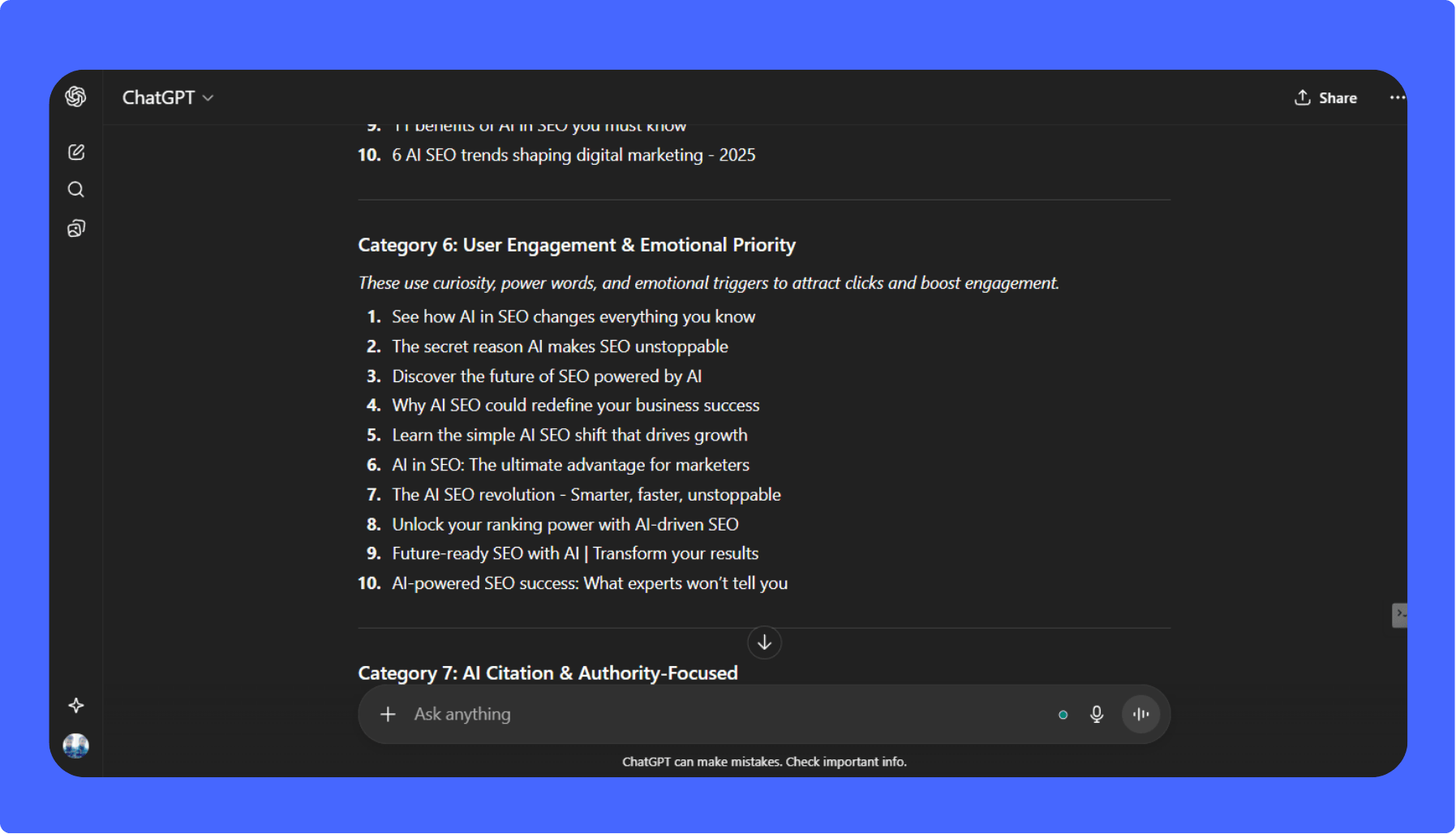
Don't settle for basic AI output; a powerful prompt can force ChatGPT to analyze your content deeply and strategically categorize 100 meta titles based on your specific goals, like boosting User Engagement or maximizing AI Citation likelihood.
Refining AI-Generated Meta Titles: Human Oversight is Key
While AI, especially tools like ChatGPT, is exceptionally powerful for brainstorming and generating a wide array of meta title options, its output is a starting point, not a final destination.
The creative finesse, nuanced understanding of your brand voice, and critical technical adjustments still require your expert human touch.
Here’s how to best refine your AI-generated meta titles:
- Edit, Tweak, and Personalize: Treat AI's suggestions as a rich pool of ideas. Select the strongest candidates, infuse your unique brand voice, and refine the phrasing to resonate perfectly with your content's specific message.
- Leverage Your Creativity: AI provides a foundation, but your creative insight is invaluable. This is where your deep understanding of your audience and niche transforms a good AI-generated title into an exceptional one, adding unique value that AI might miss.
- The Critical Pixel Check (AI's Blind Spot): A significant limitation of current AI models is their inability to accurately account for meta title pixel limits (approximately 600 pixels). An AI-generated title might be too long, leading to crucial words being cut off in the SERP. Always run your top meta title choices through a SERP simulator, like Mangools' SERP Simulator, to preview and ensure a perfect fit and full visibility.
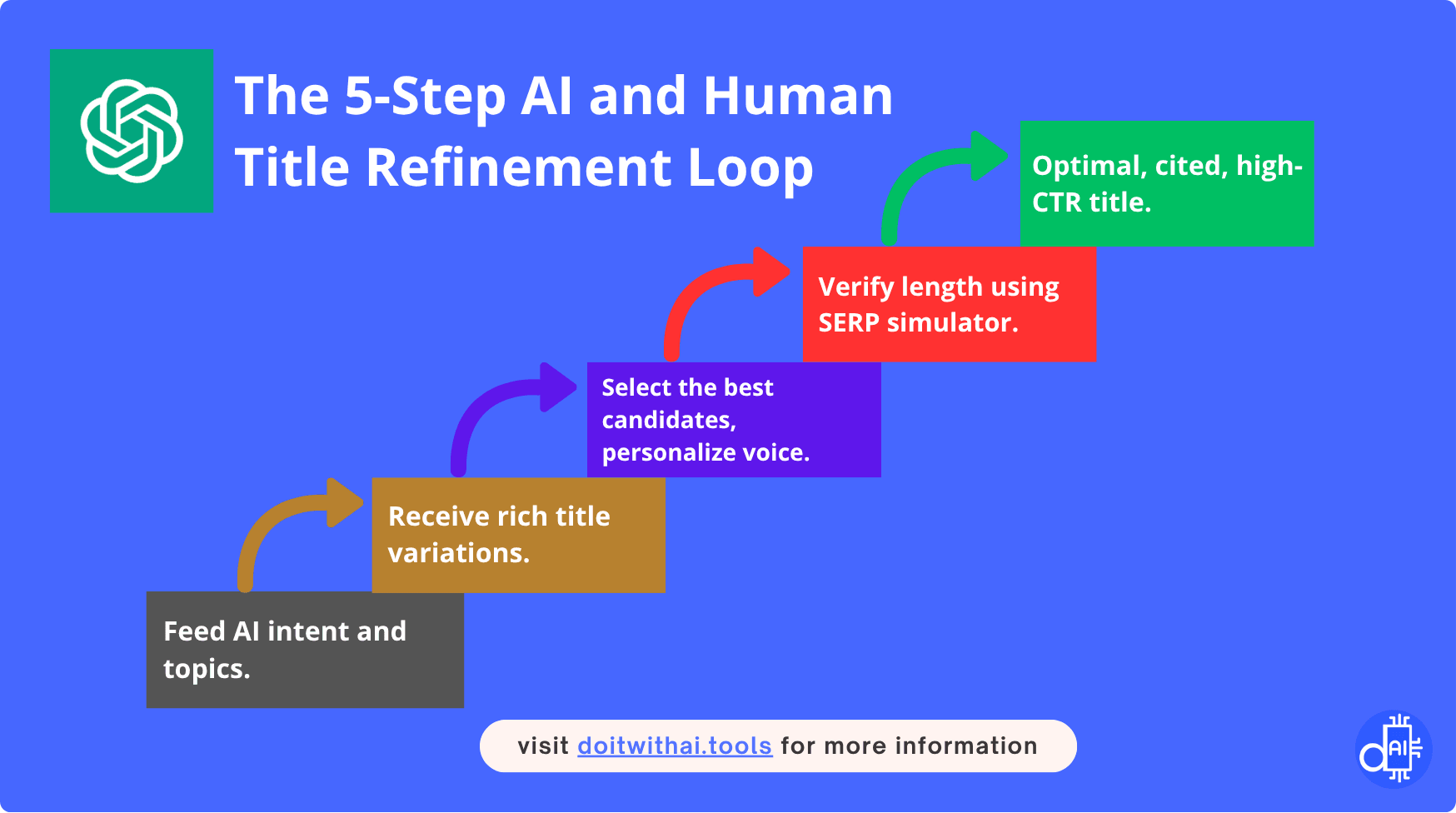
To move from a good AI-generated title to an optimal, high-CTR one, you must always close the refinement loop by adding your personal brand voice and critically verifying the final title length in a SERP simulator.
Best Tools for Meta Title Generation & AI Visibility
Beyond manual crafting and AI prompting, several specialized AI title generator tools can further enhance your meta title strategy, offering everything from broad idea generation to crucial AI visibility and performance analysis.
ChatGPT & Other Leading AI Models (Flexible Generation)
When it comes to meta title generation, AI models like ChatGPT, Gemini, Claude AI, Grok, and Perplexity AI remain top choices for their flexibility and the control they provide to refine outputs. Merlin AI bundles many of these models into a single Chrome extension, making it easy to test multiple approaches without switching tools.
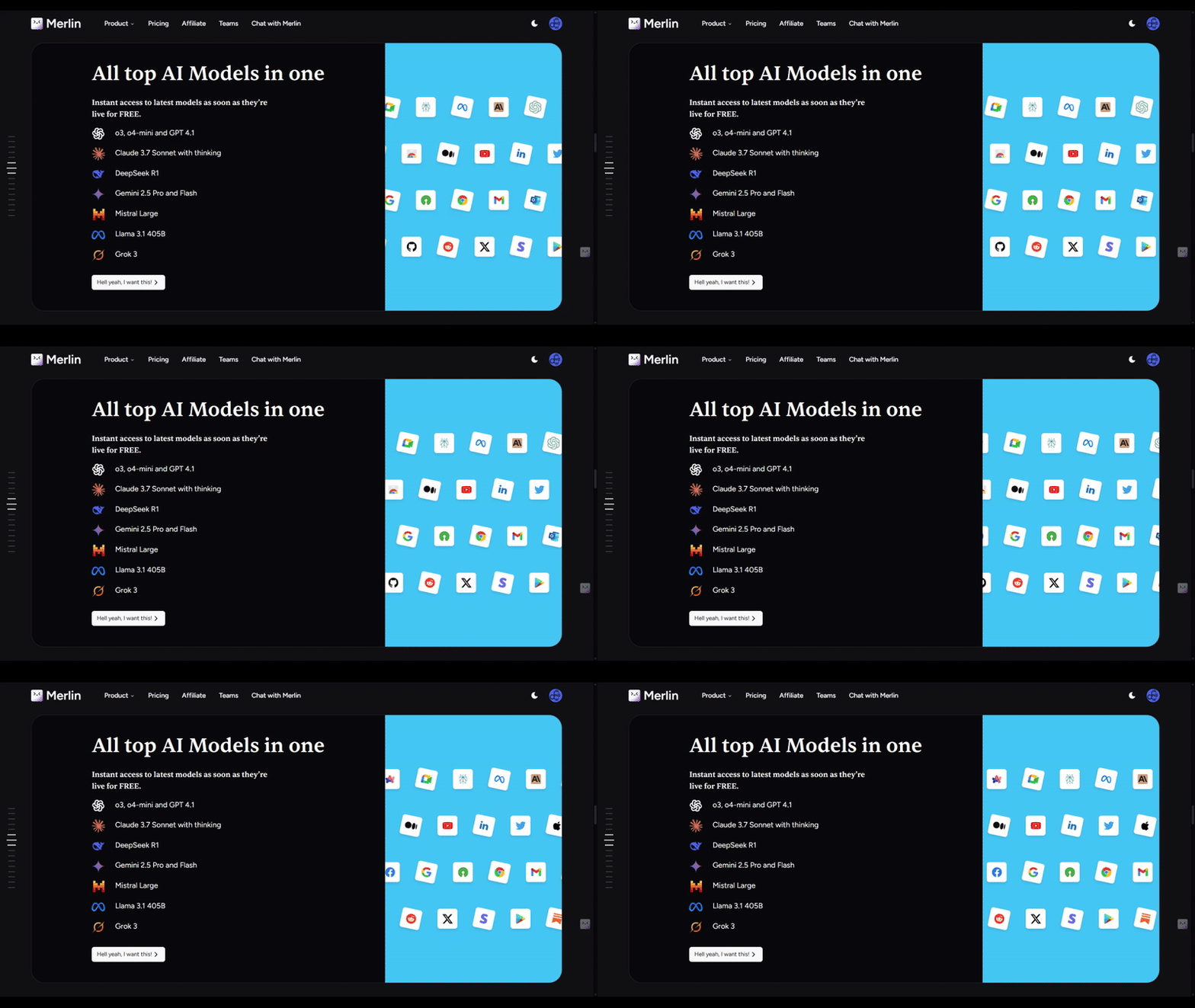
To truly leverage the power of AI Automation, use tools like Merlin AI that bundle major models (including Gemini, Claude, and GPT) into one easy-to-access interface, allowing you to test different title generation outputs quickly.
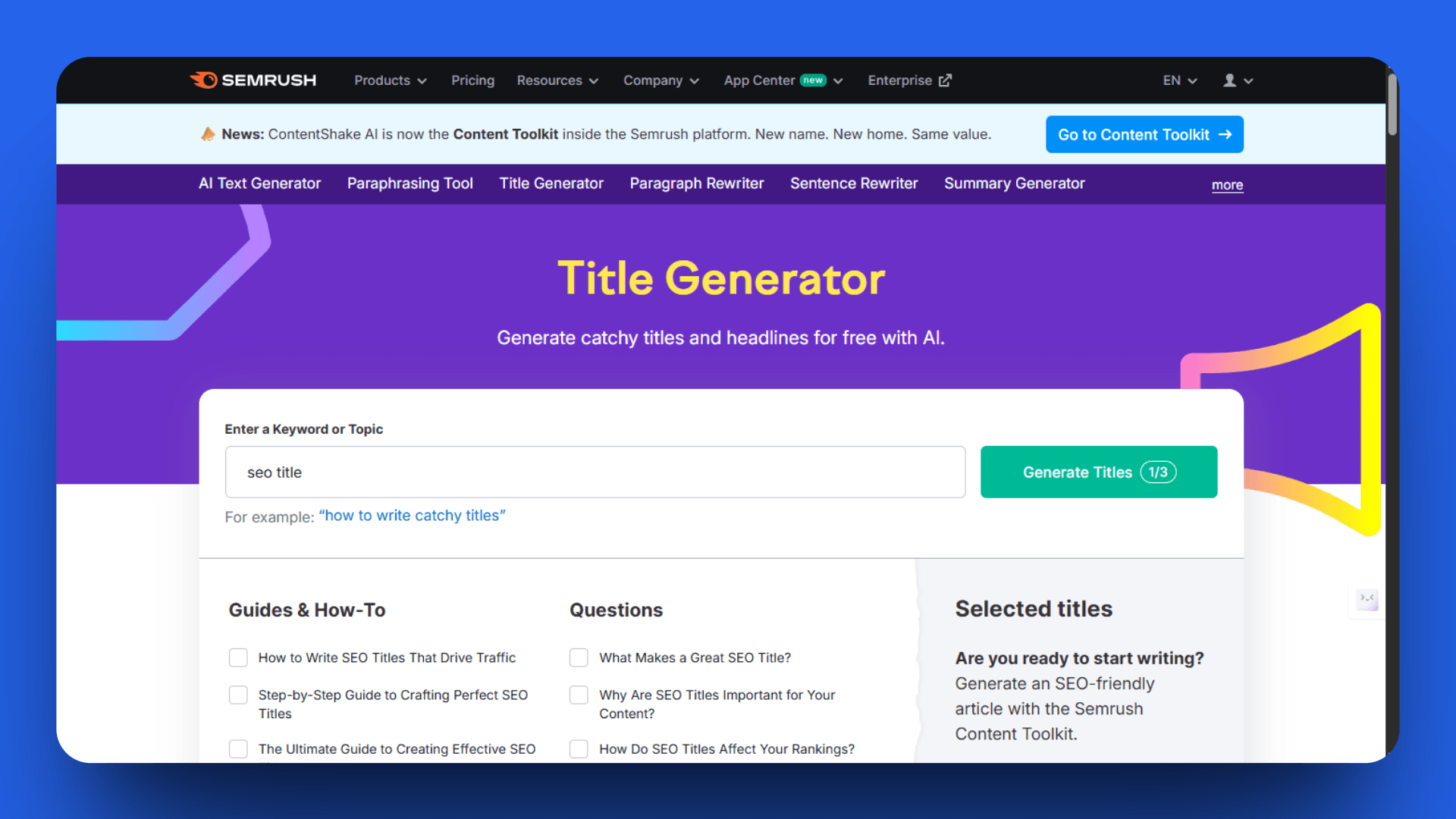
Semrush AI Title Generator (Categorized Ideas & Content Integration)
Semrush Free AI title generator provides diverse meta title options categorized by common user intent (e.g., Guides & How-To, Questions). It also suggests related topic ideas and offers direct integration for content creation, making it highly efficient for ideation and planning.
Ahrefs Free AI Title Generator (Tone Customization)
For those seeking to match specific brand tones, Ahrefs' Free AI Title Generator is excellent. It offers built-in tone selections—friendly, formal, casual, direct—and even custom options, ensuring meta titles align with your communication style.
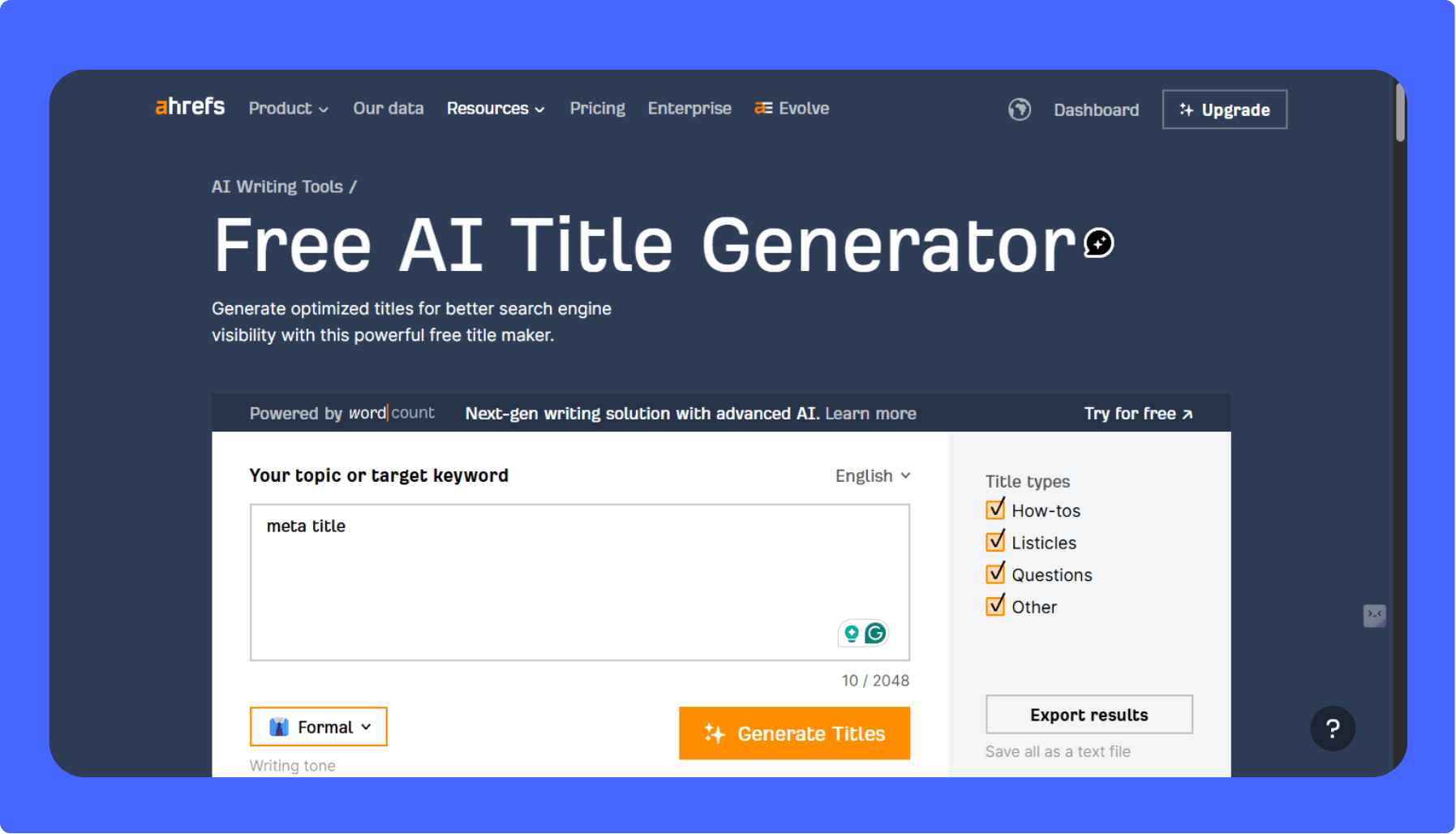
When you need a title to match your brand's unique voice, tools like the Ahrefs Free AI Title Generator allow you to customize the writing tone and title type to ensure consistency and strong E-E-A-T signals.
Grammarly Free AI Meta Title Generator (Length Control & Tone)
Grammarly's AI meta title generator stands out by offering precise control over the meta title's length, alongside tone selection. This unique feature helps ensure your titles meet pixel limits while still conveying the desired sentiment.
Mangools (SERP Simulator & AI Search Grader)
Mangools offers two essential features for optimizing your meta titles and AI visibility. The first is its Google SERP Simulator, which previews meta title display and prevents truncation. The second, the AI Search Grader. It analyzes your brand's performance across ChatGPT and other leading AI search engines, giving actionable insights into your visibility and competitive strengths.
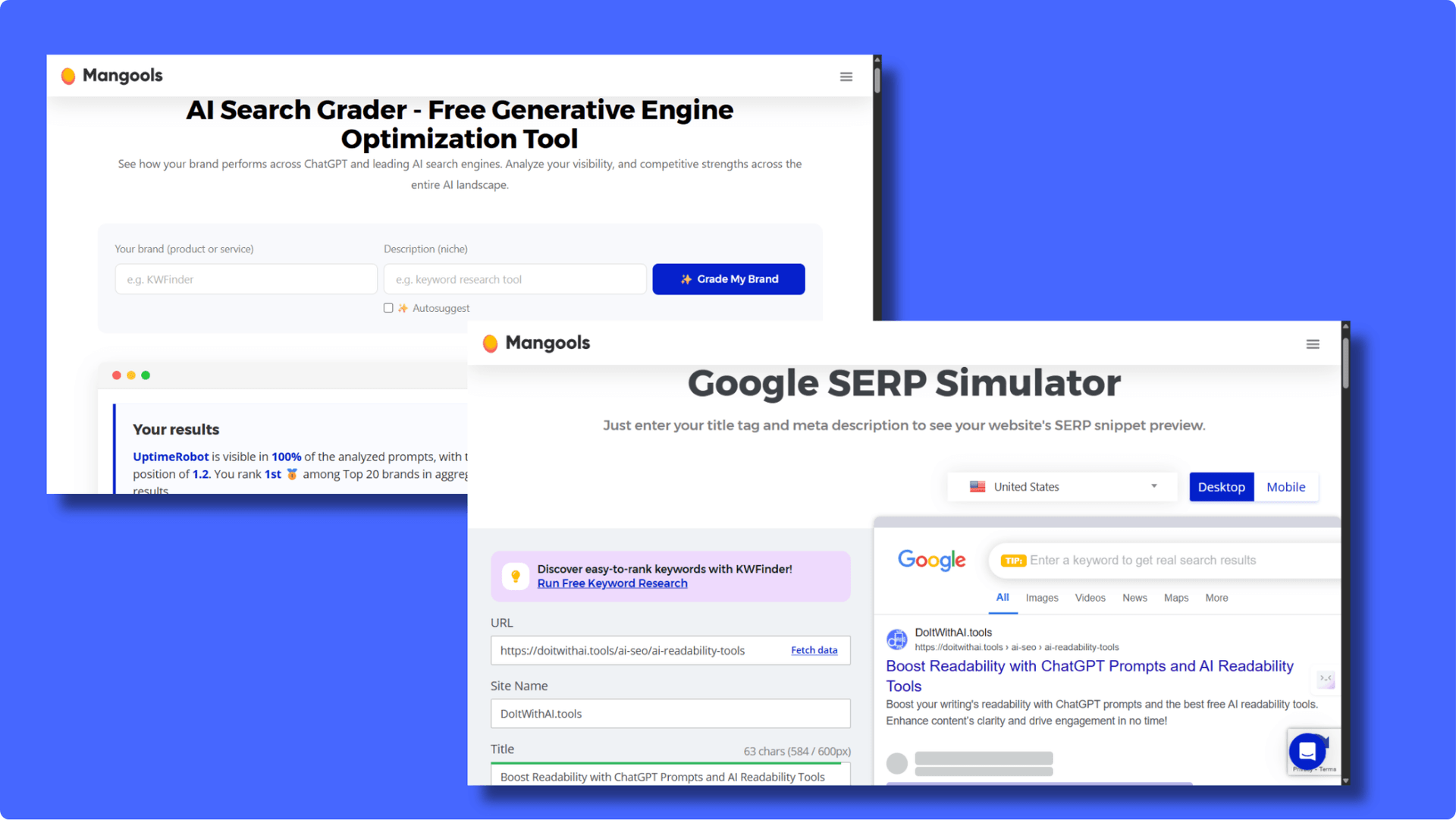
To truly master the technical and strategic elements, use the Mangools SERP Simulator for your crucial pixel check and leverage the AI Search Grader to analyze and boost your content's competitive strength and visibility in new generative AI search environments.
OpenGraph: Preview and Meta Tag Generator Tool
The OpenGraph preview tool is invaluable for seeing your meta title (and other meta tags) in action across search engines and social media. It ensures visual appeal and helps prevent truncation on diverse platforms.
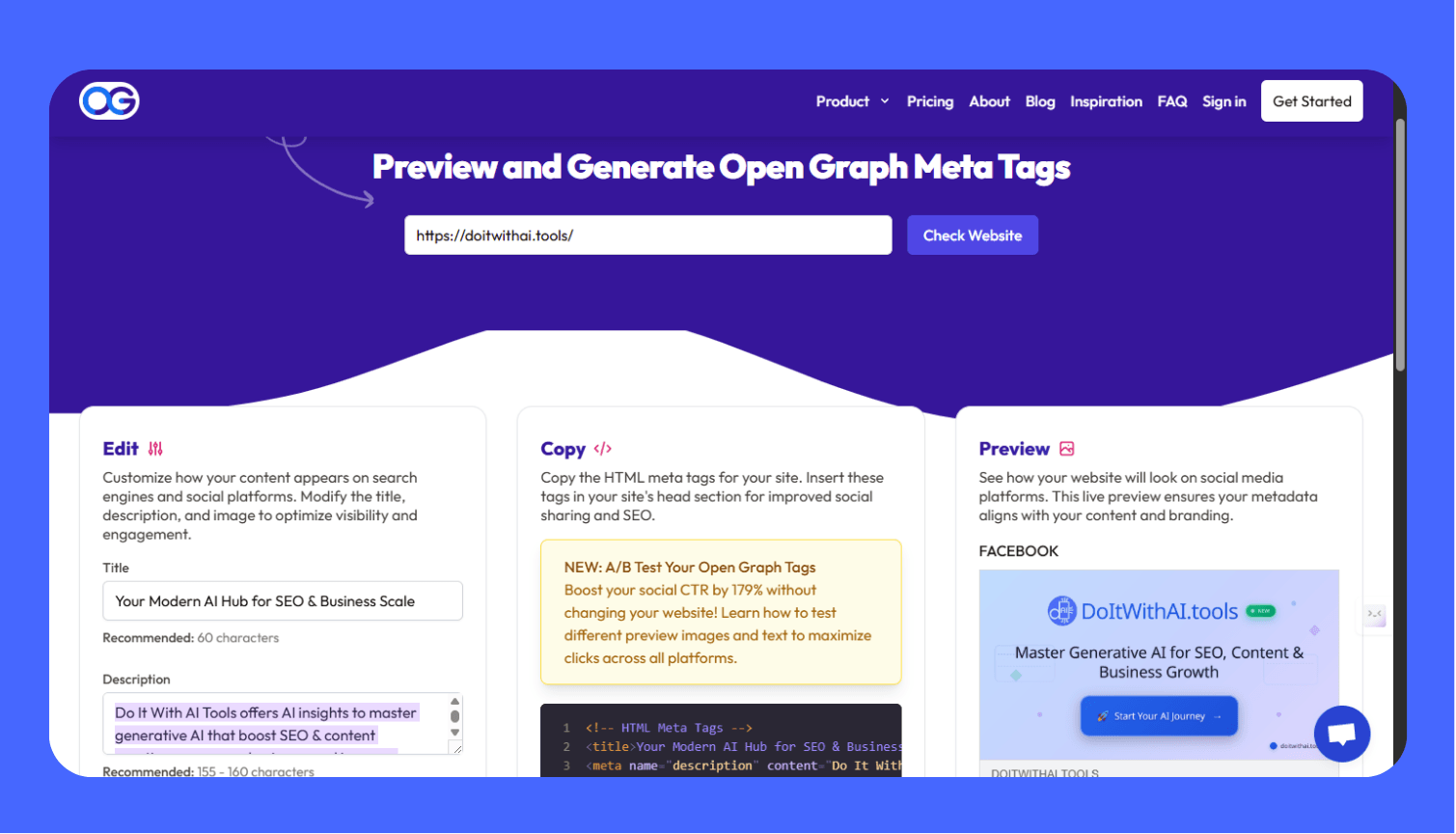
Since you promote your content across social platforms like Facebook and X, always use an OpenGraph preview tool to ensure your optimized meta title displays beautifully and isn't truncated when shared, maximizing your engagement and reach.
MonsterInsights Headline Analyzer
Headline Analyzer is highly useful for analyzing the effectiveness of your drafted meta titles. It scores your titles based on factors like common and uncommon words, emotional sentiment, and word balance, providing actionable insights to boost their overall clickability.
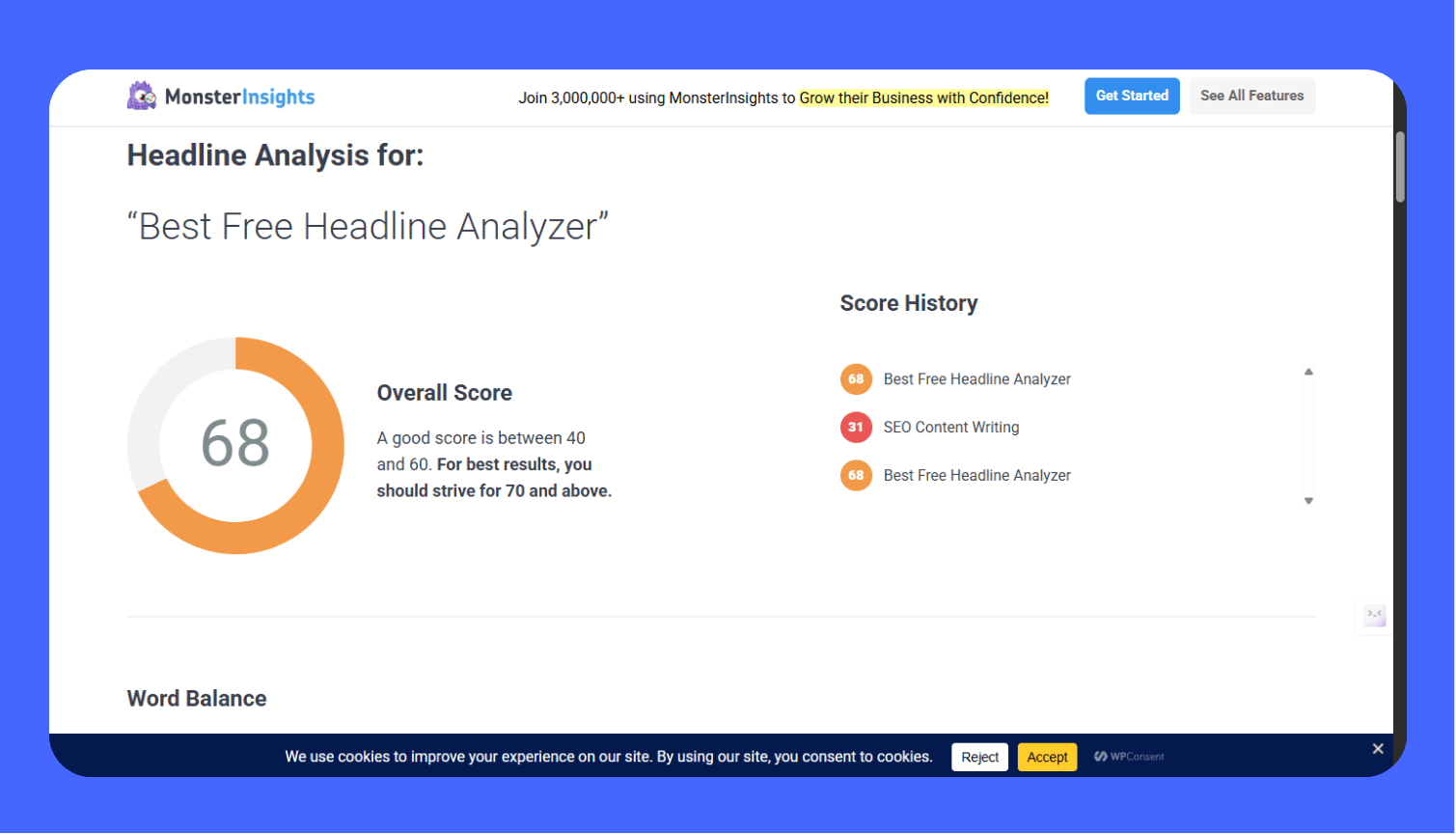
Before publishing your final meta title, run it through a headline analyzer like this one to get a score on its emotional resonance and word balance, ensuring you maximize its clickability and CTR potential with your human audience.
SEOptimizer Free Meta Tag Generator
Beyond just titles, SEOptimizer's meta tag generator can generate a complete set of meta tags, including descriptions and keywords, based on your provided content. This ensures comprehensive metadata creation, supporting your meta title with well-optimized accompanying tags for search engines.
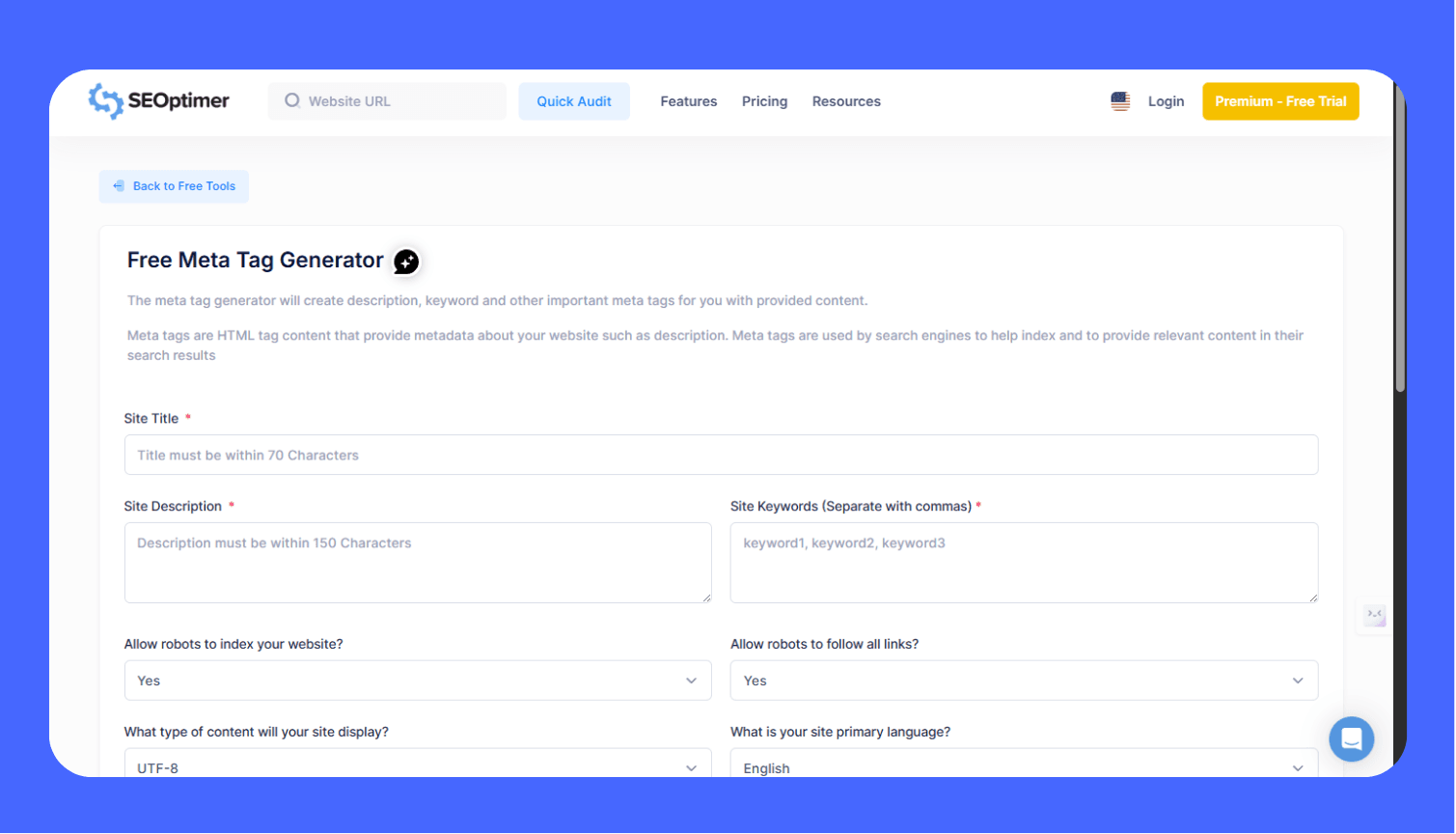
Remember, the meta title works best when supported by strong, clear accompanying metadata; use a full meta tag generator like SEOptimer's to ensure your entire <head> section is perfectly optimized for search engines.
Semrush AI Brand Narrative Tracking
Semrush’s AI Brand Narrative Tracking is a sophisticated tool that lets you see how AI platforms describe, position, and discuss your brand. It provides a comprehensive breakdown of your AI presence — including share of voice, narrative, and sentiment — across influential prompts and answers.
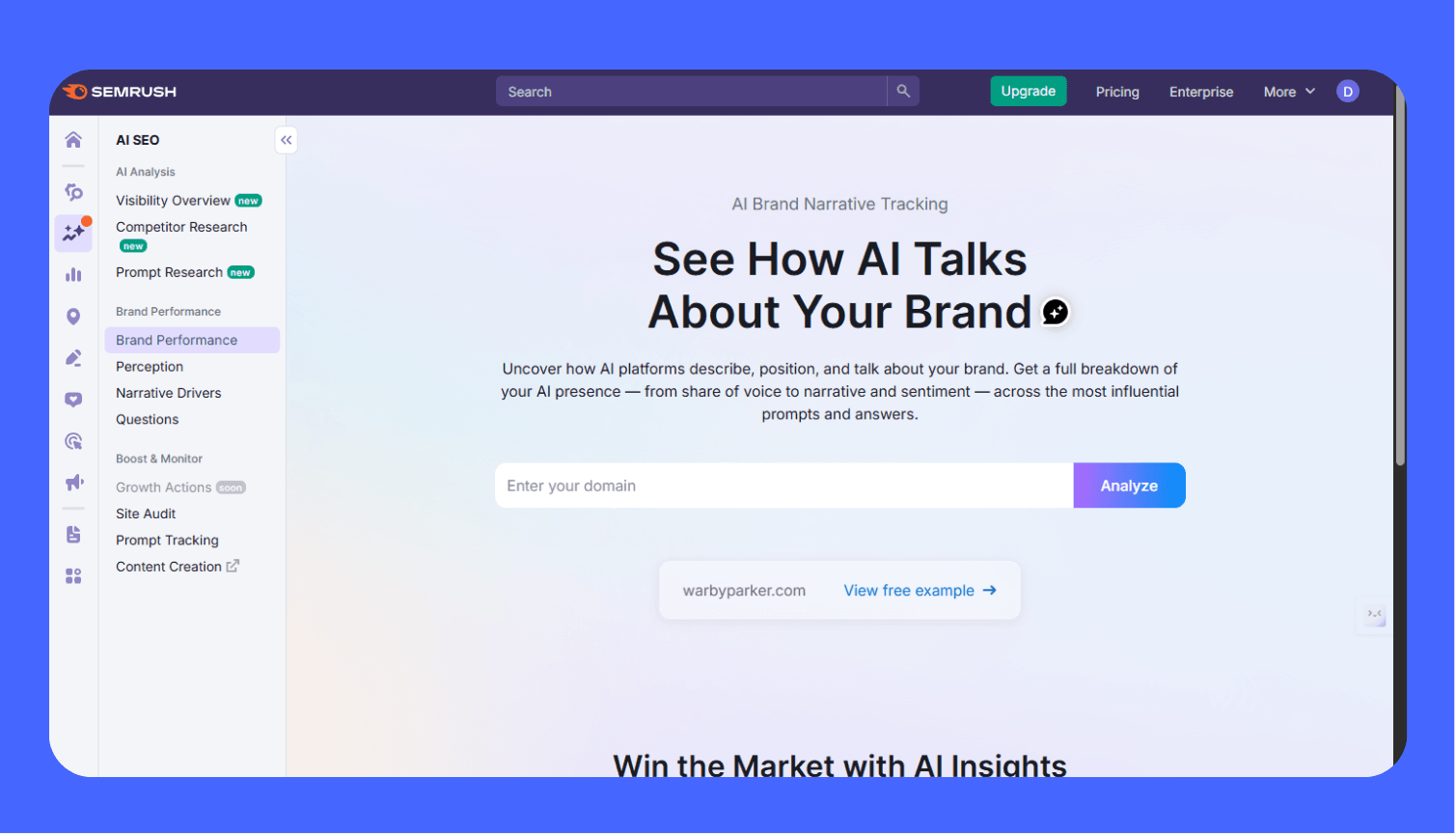
To truly master Generative Engine Optimization, you need to know how AI views your brand; use Semrush's AI Brand Narrative Tracking to analyze your AI presence and ensure the authority signals in your meta titles are translating into positive citation likelihood.
SEO Review Tools: AI Brand Visibility Tool 2.0
Enter your brand name or the page URL for which you’ve crafted a meta title in the AI Brand Visibility Tool 2.0 and get an "AI score" for your brand across top AI models like Gemini, ChatGPT, and Perplexity. It offers a quick snapshot of your brand's perception within the generative AI space.
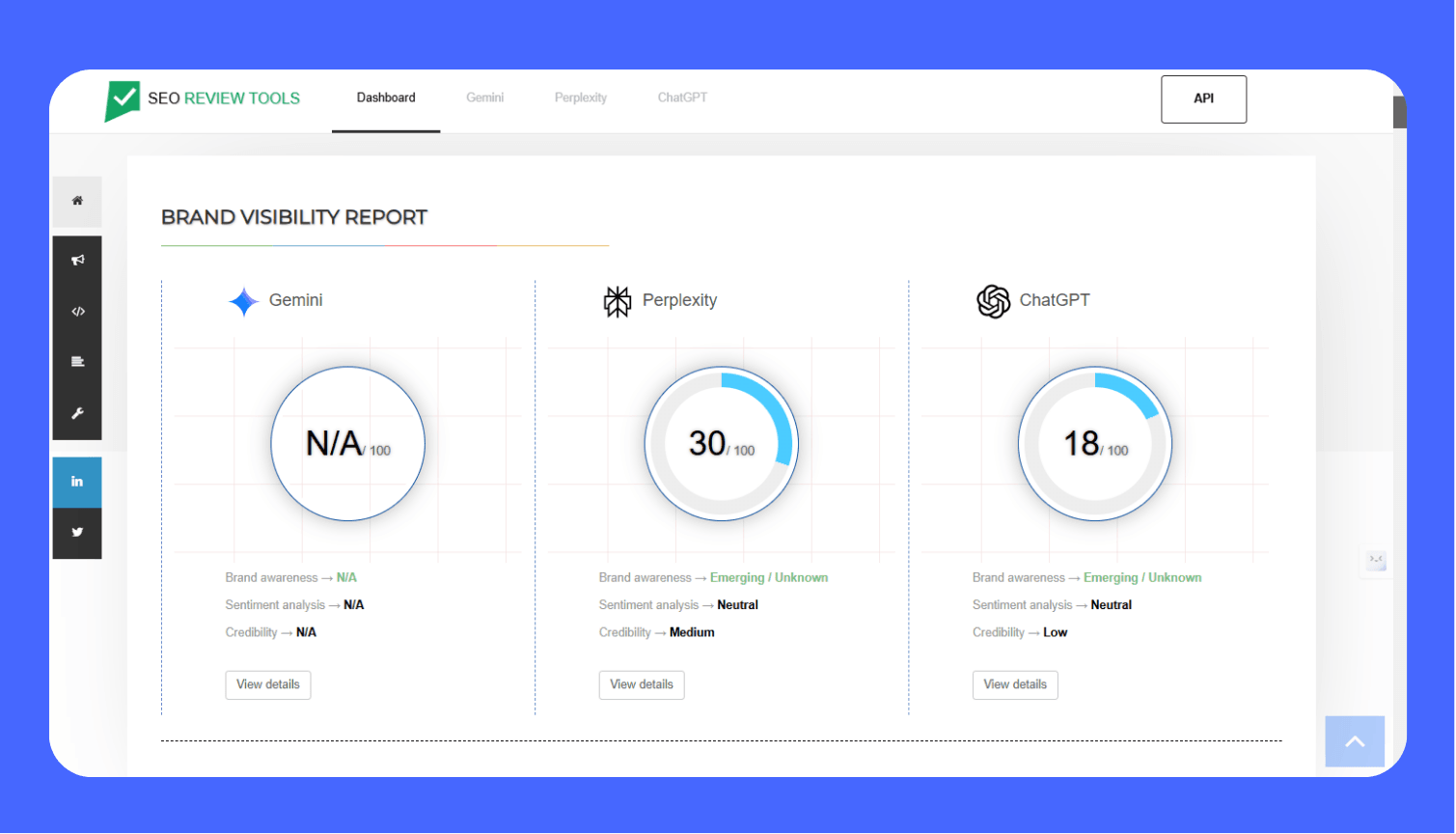
To know if your authority-focused meta titles are working, use a tool like the AI Brand Visibility Tool to score your brand's perception across generative systems like Gemini, Perplexity, and ChatGPT—that's how you measure true AI citation potential.
Sources
Ubersuggest AI Search Visibility (Opportunity Discovery):
Use Ubersuggest AI Search Visibility to track your ranking in AI platforms and discover opportunities within generative AI results. It’s designed to boost your brand’s relevance in the evolving AI search environment.
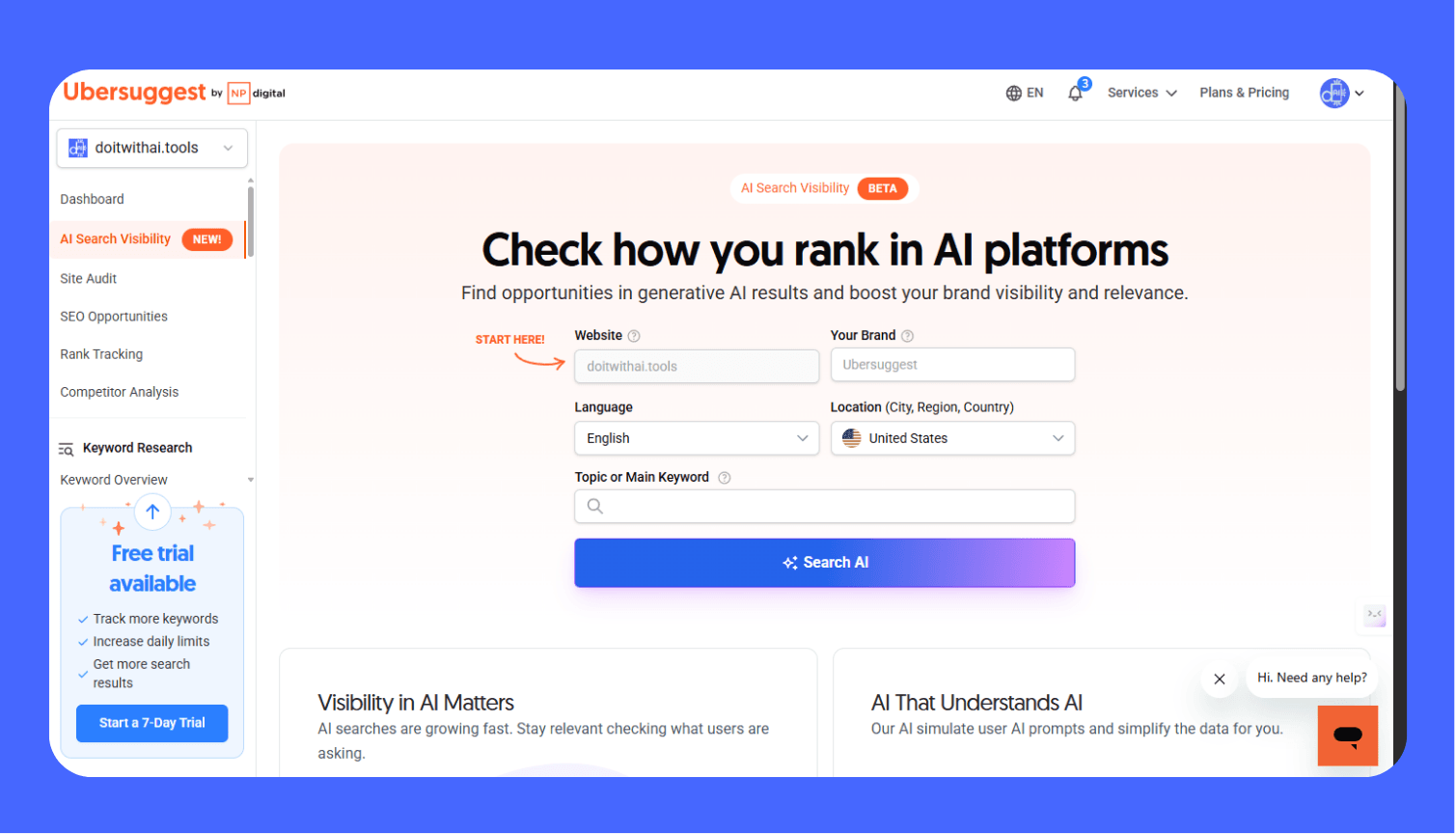
To proactively stay ahead of your competition, use Ubersuggest's AI Search Visibility tool to track your performance within AI platforms and discover actionable opportunities for boosting your brand's presence in generative AI search results.
Adamigo AI Technical Audit for Robots.txt
To ensure your site is fully accessible to AI, use Adamigo AI Crawler Accessibility Analysisat least once. This technical audit checks your robots.txt, detects whether GPTBot or other AI crawlers are blocked, and highlights other issues that could affect your site’s AI visibility.
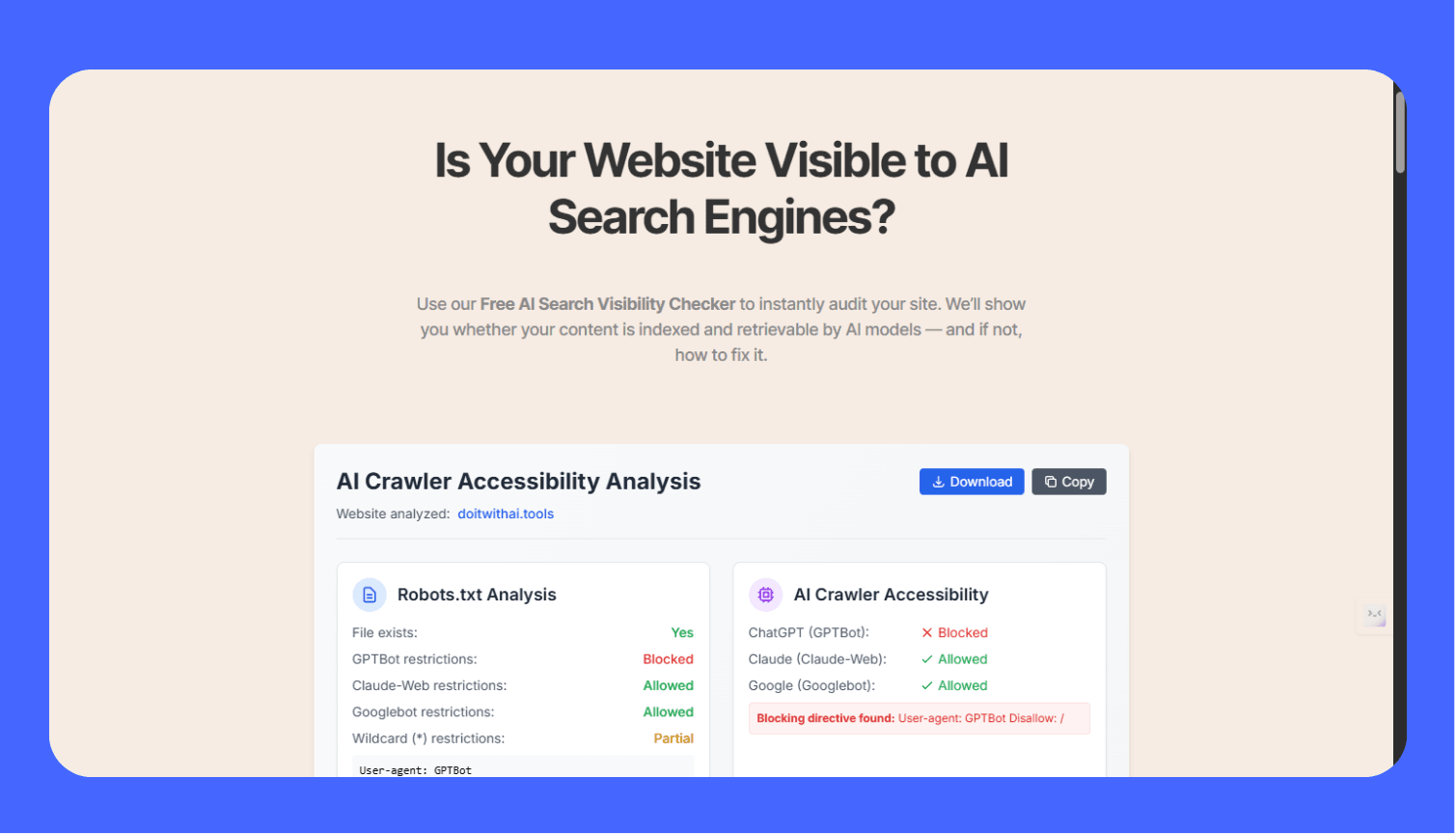
Even the perfect meta title is useless if AI can't read your page; use the Adamigo AI Crawler Accessibility Analysis tool for a technical audit of your robots.txt file to ensure AI crawlers like GPTBot are not blocked from accessing your content.
GoVisible.ai Free AI Visibility Audit
GoVisible.ai offers a Free AI Visibility Audit, instantly showing how AI engines like ChatGPT, Gemini, and Perplexity perceive your brand versus competitors. It's built on the "World's First AI Visibility Framework for Generative Engine Optimization (GEO)" and provides a detailed report directly to your inbox.
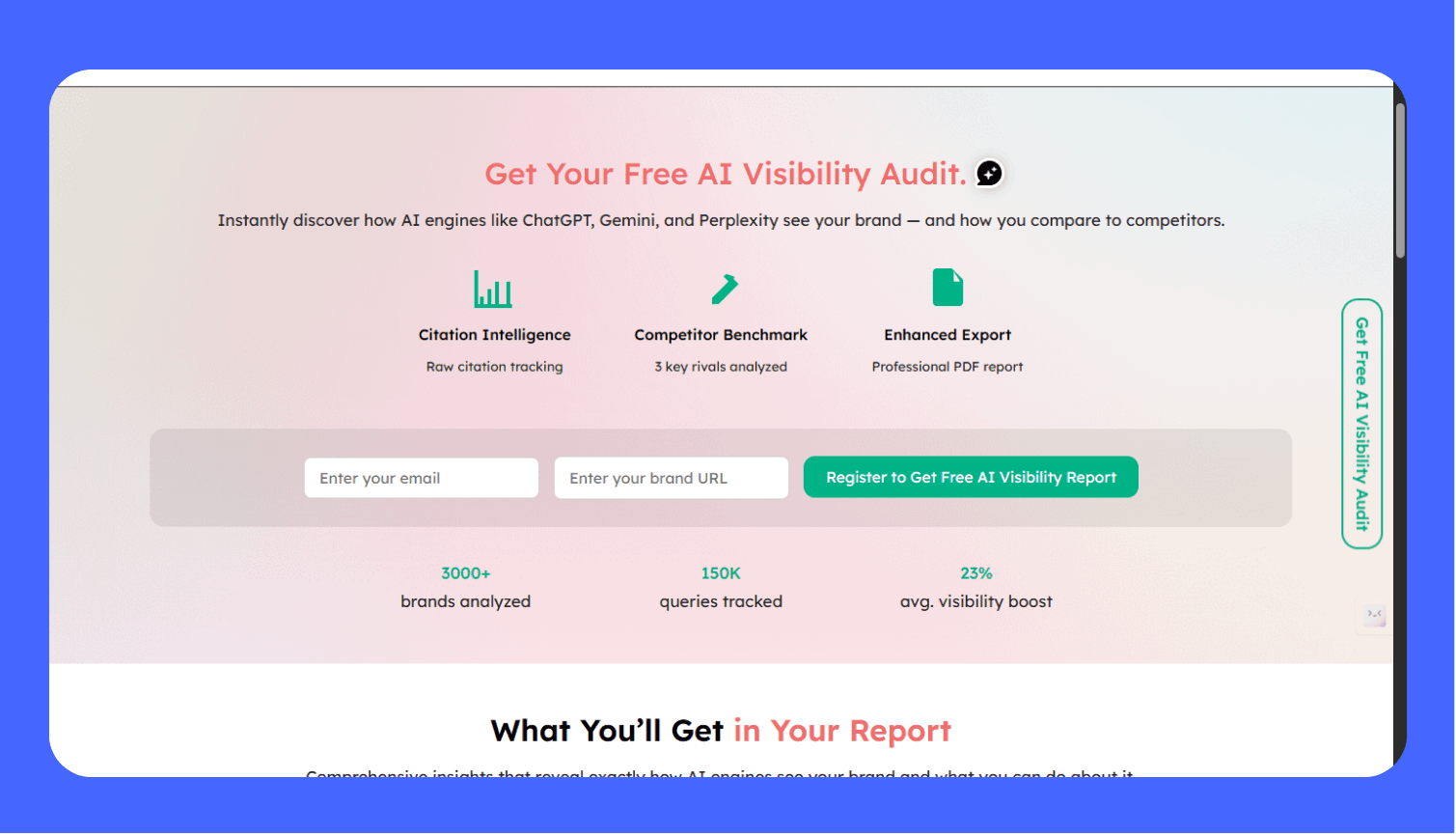
Maximize your AI Citation potential by getting a snapshot of your brand's authority across generative AI systems. The GoVisible.ai Free AI Visibility Audit instantly reveals how engines like Gemini and ChatGPT perceive you compared to your competitors.
SE Ranking: Deep Insights into AI Search Presence
Finally, SE Ranking AI Search Visibility Tools lets you comprehensively track your brand’s presence, mentions, and competitors across Google AI Overviews, AI Mode, ChatGPT, Gemini, and more. By analyzing LLM results for your prompts, it provides deep insights into brand positioning, website visibility, and source links in AI search performance.
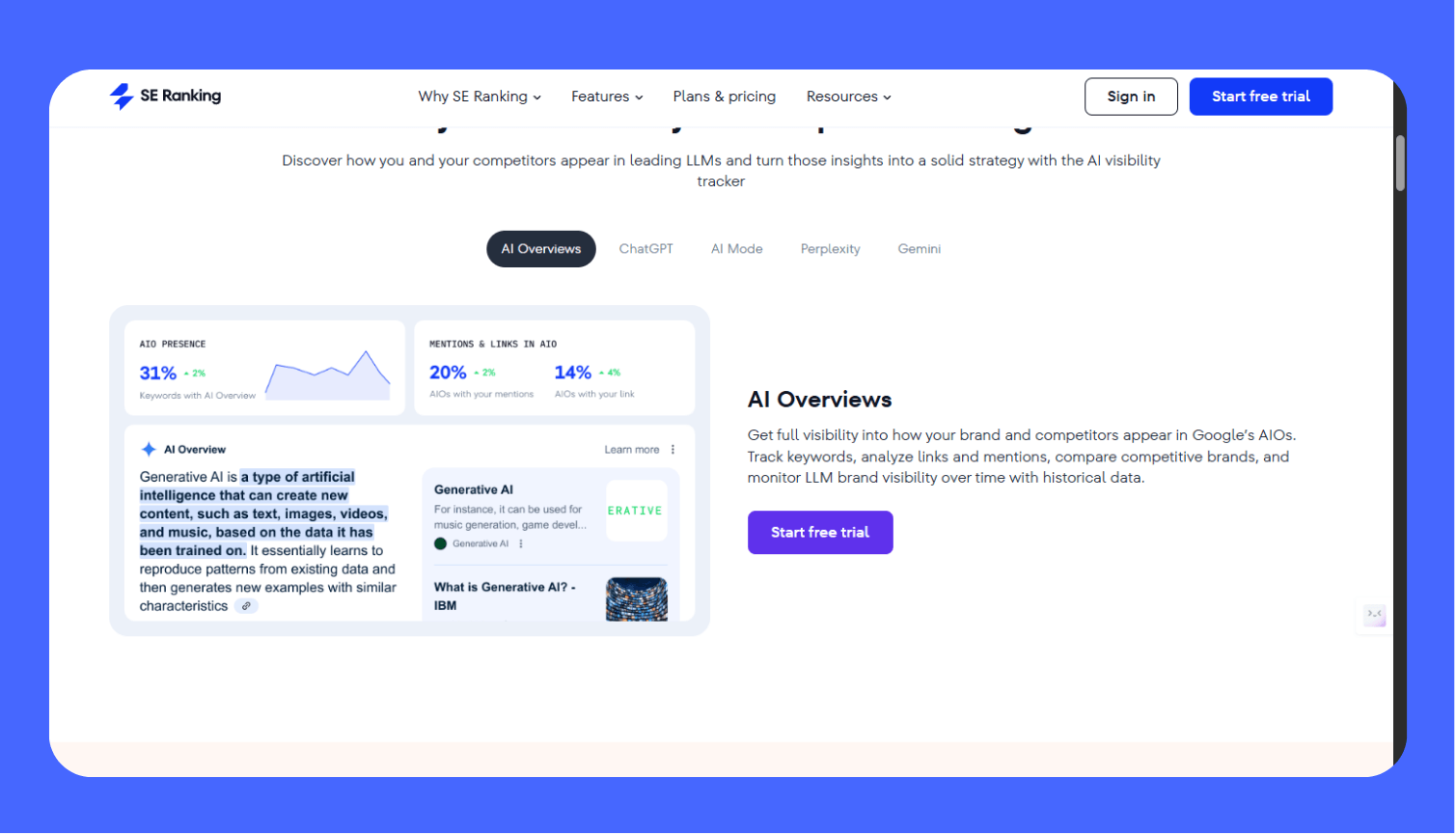
Gain full visibility into how your content performs across the new AI search landscape! SE Ranking's tools deliver deep insights into your brand's presence, mentions, and competitor performance within Google AI Overviews, ChatGPT, Gemini, and other leading LLMs.
Conclusion
As we conclude, it’s clear that the meta title has evolved from a basic SEO tag into a trust signal that influences how AI-powered search engines rank and reference your content.
In 2025 and beyond, your title affects not just visibility but credibility—determining whether platforms like ChatGPT or Google’s AI Overviews include your page in their summaries. To stand out, blend SEO precision with AI-friendly clarity: write titles that are human-centered yet algorithm-aware.
Apply the strategies from this guide, experiment with AI tools, and use meta generators to refine your approach.
Success now means earning trust and citations across both traditional and AI-driven search.
Start your title transformation today—and lead the shift toward AI-first visibility.