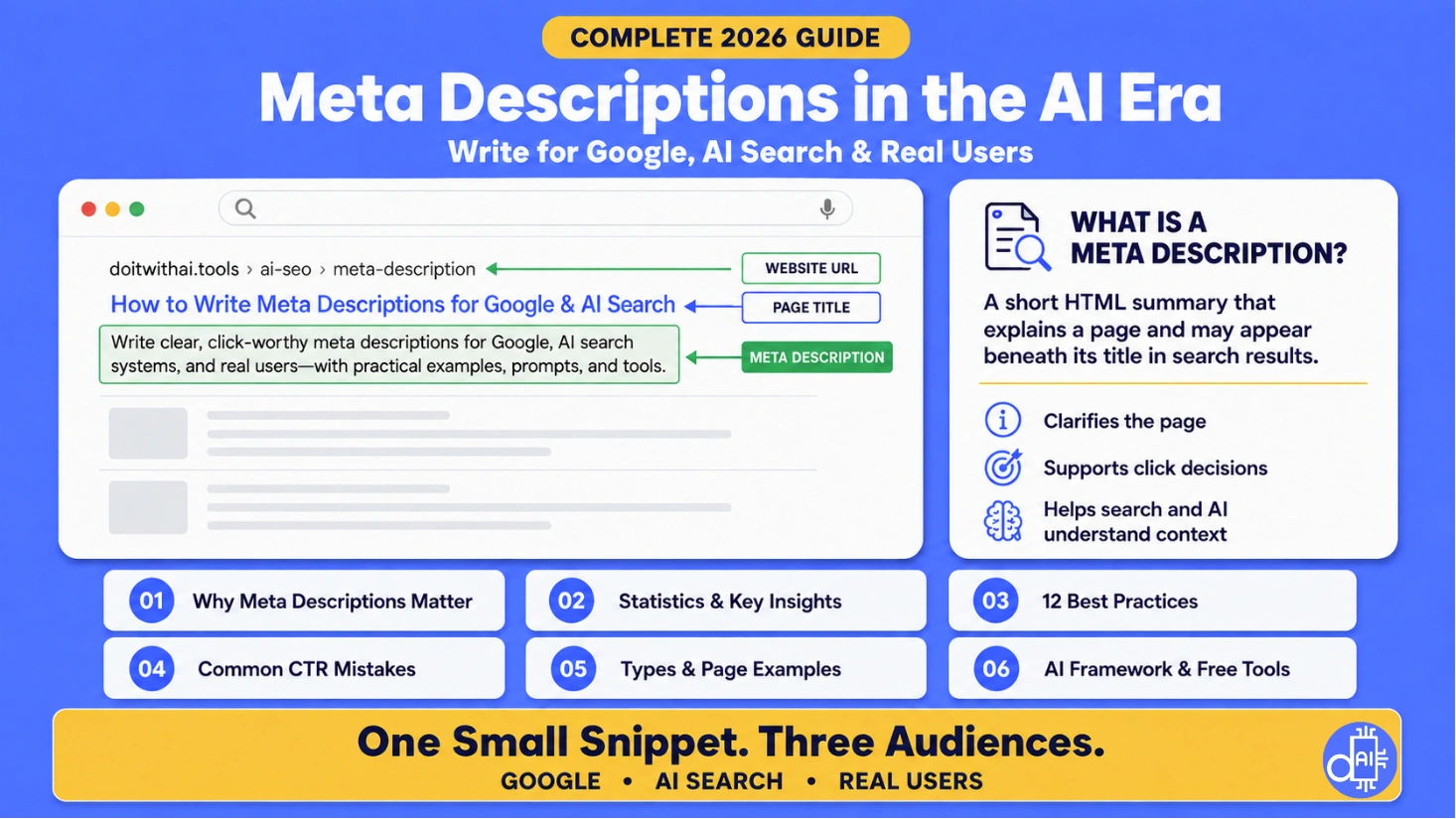

AI Tools Expert & Founder
Table of Contents
- 1. Master the Sweet Spot: It’s Not About Character Count — It’s About Pixel Width
- 2. Mobile-First Optimization: The 120-Character Rule Most People Break
- 3. Understand the Page Element Hierarchy: Give Your Meta Description a Distinct Job
- 4. Create Unique Variations: Don’t Copy-Paste Your Meta Title
- 5. Occupy 80–90% of Your Space: Don’t Waste the SERP Canvas
- 6. Readability: Write in a Smooth, Scannable Flow
- 7. Know Your Audience: Write for Them, Not for Google
- 8. Place Your Primary Keyword Strategically: Front-Load Relevance
- 9. Use Secondary and Related Keywords: Build the Semantic Layer
- 10. Write for Humans First: The Engagement Equation
- 11. Provide Direct Answers When Appropriate: The Search-Intent Strategy
- 12. Use Powerful, Benefit-Driven Language: The CTR Booster
- 1. The Keyword-Stuffing Hangover: Why Old SEO Tactics Backfire
- 2. Duplicate Meta Descriptions: The Quiet Relevance Problem
- 3. Neglecting the Zero-Click Reality: Why Vagueness Loses
- 4. Using Raw AI Output Without Refinement
- 5. Exceeding the Pixel Limit: The Truncation Trap
- 6. Leaving Too Much Space Unused
- AI Chatbots: Best for Flexibility and Control
- Mangools SERP Simulator: Best for Length Checking and Preview
- Ahrefs Free AI Meta Description Generator: Best for Fast Options
- Semrush Google SERP Simulator: Best for Visual SERP Testing
- Originality.ai Meta Description Generator: Best for Guided SEO Output
- Complete SEO Editor Tools: Best for Full-Page Context
- SE Ranking Meta Description Generator: Best for Existing Pages
Let’s start with one new truth that might surprise you:
Meta descriptions are not a direct ranking factor.
It’s not a rumour; it is an official fact.
Back in 2009, Google confirmed that meta descriptions do not directly influence rankings. You can add every high-volume keyword into your description, and your page will not magically jump from page two to page one.
So, if they do not improve rankings, why are we still talking about them in 2026?
Because ranking and winning are no longer the same thing.
We are now living in the AI Search era, where visibility is more competitive than ever. Millions of pages can rank, but only a few actually earn attention, clicks, trust, and citations.
This is where SEO-friendly meta descriptions quietly become powerful.
When someone searches on Google, users usually see two things first:
Your page title.
Your meta description.
In many cases, the description becomes a deciding factor.
Someone clicks. Or they do not.
That single decision matters more than most people realize.
Google watches user behaviour.
Higher click-through rates (CTR) often signal stronger relevance. And stronger relevance can indirectly support better search performance over time.
Here is the irony:
One agency improved only the meta descriptions across a website.
No content is rewritten.
No backlink campaign.
No technical SEO overhaul.
Just better descriptions.
The result?
A 32% increase in click-through rate within 60 days.
That translated into nearly 5,000 additional qualified visitors from the same search visibility.
Same rankings.
More clicks.
More traffic.
That is the idea behind marginal gains.
In this guide, you will learn how to write meta descriptions that work across three critical search layers:
For traditional SEO.
For AI-powered search systems.
And for real humans making split-second clicking decisions.
You will also learn practical frameworks, real examples, proven best practices, and AI-assisted workflows to write descriptions that actually earn clicks.
What Is a Meta Description? (And Why It’s Your Secret CTR Engine)
Before learning how to write a high-performing meta description, you first need to understand what it actually is—and why it matters so much in modern SEO, AI search, and click-through optimization.
Many beginners treat meta descriptions as optional secondary text.
They are not.
A well-written meta description is a multifaceted marketing asset. It influences human clicks, strengthens topical relevance, protects your brand voice, and provides a semantic roadmap for both search engines and AI crawlers.
In 2026, that makes it far more important than most websites realize.
What Exactly Is a Meta Description? (The 2026 Definition)
Traditionally, a meta description is a short HTML snippet that summarizes the content of a webpage.
It appears directly below your page title in search engine results, helping users quickly understand what they can expect before clicking.
But in the era of:
- AI SEO
- Generative Engine Optimization (GEO)
- Answer Engine Optimization (AEO)
- AI-powered search engines
…a meta description has evolved into something much bigger.
Today, it functions as a highly optimized “data snack” for AI systems.
When platforms like Google AI Overviews, Perplexity AI, OpenAI search integrations, or Anthropic Claude scan the web to answer user prompts, your meta description acts like an executive summary.
It helps large language models instantly understand:
✓ What your page is about
✓ Which search intent it satisfies
✓ Whether your content deserves citation
✓ How your content should be categorized semantically
That means your meta description can directly influence whether your page gets surfaced, summarized, or cited inside AI-generated answers.
Recommended Meta Description Length
In most cases, meta descriptions should remain around:
150–160 characters
This helps prevent truncation on both desktop and mobile search results.
If your description exceeds the visible display area, search engines may cut it off using an ellipsis (...), which can weaken:
- Message clarity
- CTR performance
- User trust
- Mobile readability
Where Meta Descriptions Actually Live
Unlike headings or body text, meta descriptions are completely invisible on your actual webpage.
They exist quietly inside your page’s HTML code and primarily appear in:
- Search engine results pages (SERPs)
- AI-generated search previews
- Social previews (sometimes)
- Search snippets across devices
In Simple Terms
- Your meta title grabs attention.
- Your meta description convinces both humans and AI to choose you.
- That single snippet often determines whether someone clicks your page—or skips it entirely.
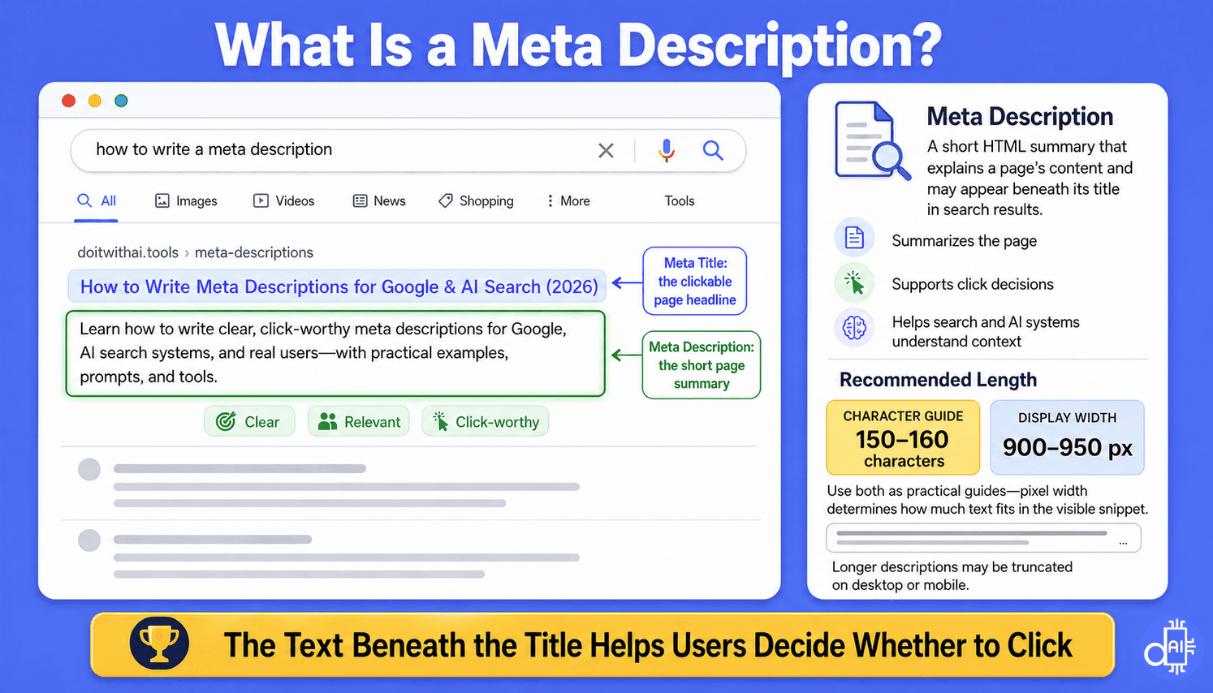
A well-crafted meta description serves as your page's organic ad snippet, summarizing content to improve click-through rates across traditional search and AI platforms.
How a Meta Description Appears in Search Results
When someone searches on Google, your result usually appears in three distinct layers:
| Search Result Element | Meta Title | URL / Breadcrumb | Meta Description |
|---|---|---|---|
| Purpose | The clickable headline that captures attention | Shows page structure and site hierarchy | The persuasive summary encouraging the click |
Together, these elements form your search result “storefront.”
And within seconds, users decide whether it feels trustworthy and relevant.
Example of a Search Result
To see exactly how this looks in the wild, let's look at a quick breakdown:
+------------------------------------------------------------+| How to Write Meta Descriptions with AI | DoItWithAI | <-- Meta Title+------------------------------------------------------------+| Learn proven strategies to write meta descriptions that | <-- Meta Description| boost CTR by 32%. AI prompts, examples, and more. |+------------------------------------------------------------+
The first line is your meta title.
The second line is your meta description.
Why This Small Snippet Matters So Much
This is where the real decision happens.
Within roughly:
1–2 seconds
…a user—or even an AI system scanning the SERP—decides:
“Is this the exact answer I need?”
That moment determines the following:
- Whether you earn the click
- Whether your content gets ignored
- Whether AI systems trust your relevance
- Whether your search impression becomes actual traffic
Meta Description in HTML (Technical Definition)
From a technical SEO perspective, a meta description is placed inside the HTML section of a webpage.
It uses the following structure:
1
2
3
4
<meta
  name="description"
  content="Learn proven strategies to write meta descriptions that boost CTR by 32%. AI prompts, examples, and step-by-step guide for blog posts, product pages, and more."
>
Search engines and AI crawlers use this snippet to quickly understand page context without immediately parsing thousands of words of body content.
That makes it one of the most important contextual signals in on-page SEO.
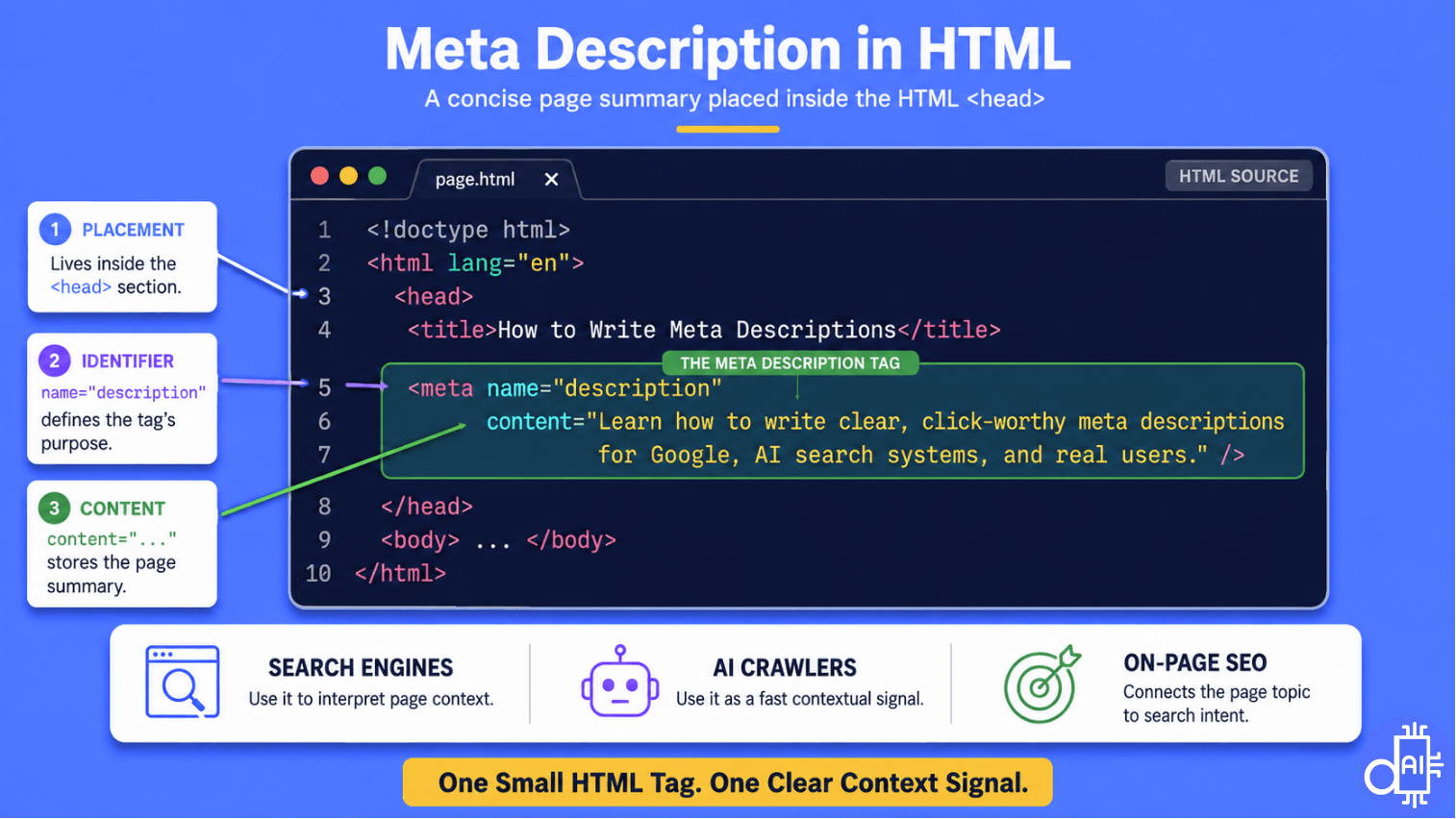
Placed inside the HTML head tag, a meta description provides a structured concise summary that search engines and AI crawlers use as an immediate contextual signal.
An Important Reality: Google Sometimes Rewrites Meta Descriptions
Google does not always show the meta description you wrote.
63% of meta descriptions get rewritten by Google's algorithm to better match the searcher's query.
But that does not make manual optimization pointless.
In fact, your original meta description still acts as:
- A foundational semantic signal
- A contextual anchor
- A topical relevance guide
- A baseline for AI interpretation
In other words:
Think of your meta description as reference material, not a guarantee.
Google uses it as a starting point.
If your description is vague, generic, keyword-stuffed, misleading, or poorly aligned with user intent, Google becomes far more likely to replace it with something extracted directly from your page.
But when your meta description is:
✓ Clear
✓ Natural
✓ Specific
✓ Closely aligned with search intent
Google often keeps your original wording intact.
And even when rewrites happen, strong metadata still helps Google understand the context of your content more accurately.
Why Meta Descriptions Matter for Google, Generative AI, and Humans
By now, you know what a meta description is. But the bigger question is:
if meta descriptions are not a direct ranking factor, why do experienced SEOs still care so much about them?
The answer becomes obvious when you view meta descriptions through three different lenses:
Google
AI systems
Human users.
meta descriptions do not directly improve rankings.
But they influence something equally powerful: visibility, clicks, trust, and citations.
And in 2026, those signals matter more than ever.
1. Google's Perspective: The Click-Through Rate Signal
From Google's algorithmic standpoint, meta descriptions play an indirect but important role.
Let's clear up the biggest misconception first:
Meta descriptions do not directly rank pages.
Google has used hundreds, possibly thousands, of ranking signals since 2009, and meta description quality itself is not one of them. Even Google's own documentation confirms this.
But here is what does matter:
Click-through rate (CTR).
Google closely monitors how users interact with search results. When more people click your page compared to competing results, Google interprets that as a relevance signal.
In simple terms:
If searchers consistently choose your result, Google assumes your page is valuable.
And this is exactly where meta descriptions matter.
A compelling description encourages more clicks. More clicks send stronger engagement signals. Stronger signals can gradually improve visibility over time.
2. AI’s Perspective: The Citation and Authority Signal
This is where meta descriptions become even more powerful in 2026.
Traditional search engines rank webpages.
AI-powered systems evaluate, summarize, verify, and cite them.
That changes everything.
Platforms like:
- Perplexity AI
- OpenAI search integrations
- Anthropic Claude
- Google DeepMind Gemini
- Google AI Overviews
…do not evaluate content exactly like classic search crawlers.
They prioritize:
- Context
- Clarity
- Semantic relevance
- Authority signals
- Answer quality
And your meta description helps establish all of them instantly.
AI Uses Meta Descriptions as Context Verification
When AI systems scan webpages, they often use the meta description as a fast validation layer.
Essentially, the AI asks:
"Does this page actually discuss what the headline claims?"
A strong meta description confirms:
- Topical relevance
- Search intent alignment
- Content clarity
- Semantic accuracy
A weak one creates uncertainty.
The “Citation Bonus” in AI Search
Being cited inside AI-generated answers is becoming one of the biggest visibility advantages in SEO.
Pages featured in AI Overviews or AI-generated summaries can experience higher exposure and CTR.
Why?
Because users increasingly trust AI-curated answers.
If your page becomes part of that response ecosystem, you gain:
- Authority
- Visibility
- More branded trust
- Higher click probability
And often, your meta description is the first contextual signal helping AI systems decide whether your content deserves inclusion.
The Human Perspective: The 1–2 Second Decision
Let’s not forget the most important part of search: the actual person deciding whether your result deserves a click.
Your meta description has a simple but critical job—it should quickly confirm, “Yes, this is the answer I’m looking for.”
It Reduces Zero-Click Abandonment
Many searches end without a click because users find enough information directly on the SERP. A direct, useful meta description may seem counterintuitive, but confirming that you understand the query can actually give users more confidence to click for the full explanation.
Give enough information to prove relevance—but leave enough value on the page to make the click worthwhile.
It Manages Expectations
Suppose someone searches for “how to rank blog posts” and sees this description:
“Learn the 5-step framework to rank blog posts in 60 days.”
The promise is immediately clear. The reader knows what the page covers, what format to expect, and what outcome the content is designed to help them achieve.
That clarity can lead to better-qualified clicks and stronger post-click engagement.
It Builds Trust Before the Click
A specific, benefit-driven meta description signals expertise before the visitor ever reaches your page.
Generic description → “Just another result.”Specific description → “This looks like the answer I need.”
Humans make that judgment incredibly quickly—often within 1–2 seconds—so every word has to earn its place.
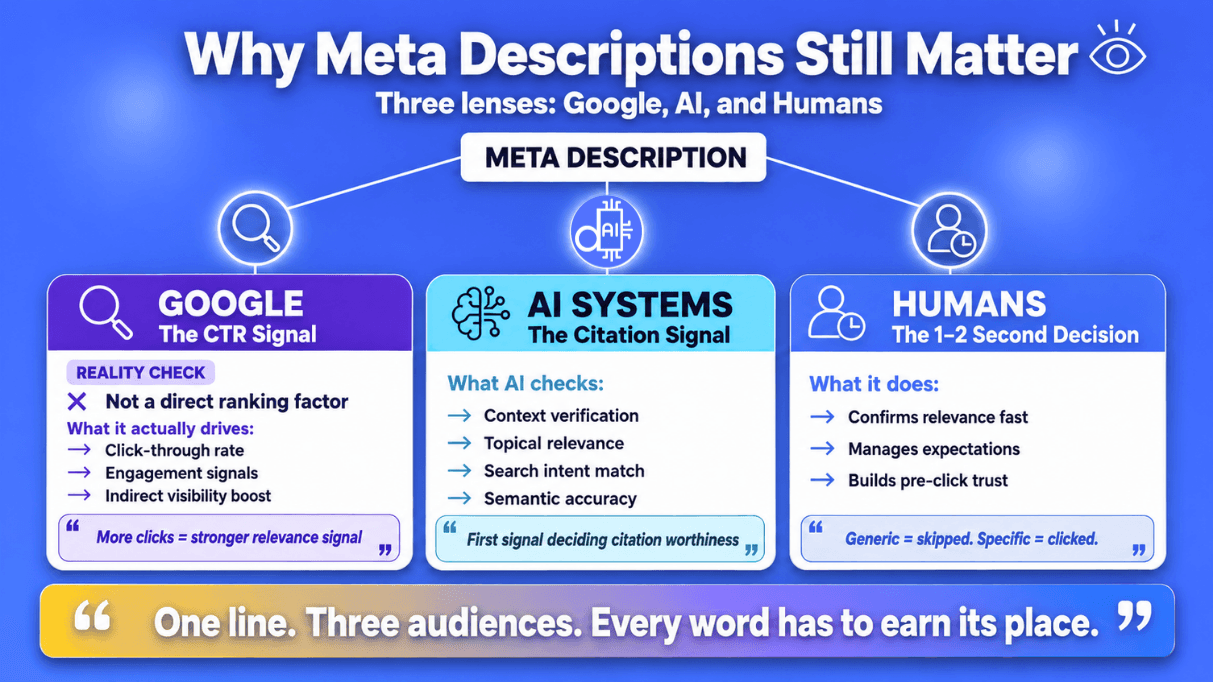
Meta descriptions serve three distinct audiences: driving CTR for Google, verifying context for AI citations, and building instant trust with human searchers.
Meta Description Statistics and Key Industry Insights
The three perspectives—Google, AI search, and human behavior—point toward the same conclusion: meta descriptions may be small, but their influence on visibility and click behavior can be significant.
Google & SEO Performance Statistics
| SEO Insight | Reported Impact |
|---|---|
| CTR-optimized meta descriptions | 5–30% higher click-through rates |
| Optimized title tags + meta descriptions | Up to 32% increase in organic-driven sales |
| Meta descriptions rewritten by Google | Approximately 63% |
| Mobile traffic share referenced in this guide | 63%+ |
AI Search & AEO Insights
| AI Search Insight | Why It Matters |
|---|---|
| Zero-click searches | Over 60% of searches may end without a click |
| AI Overview visibility | Featured pages have reported CTR increases of up to 35% |
| Contextual metadata | Clear metadata can help search systems interpret page context |
| Semantic relevance | Natural contextual language is more useful than forced exact-match repetition |
Human Behavior & CTR Statistics
| User Behavior Insight | Reported Impact |
|---|---|
| Benefit-driven descriptions | 20–50% higher CTR than generic or vague descriptions |
| Click decision window | Roughly 1–2 seconds |
| Early-message importance | Users often scan only the opening words before deciding |
| Direct-answer descriptions | Reported 30% higher click rates for some informational queries |
The Big Takeaway
When you combine all three perspectives, the role of a meta description becomes much clearer.
| Perspective | What the Meta Description Does |
|---|---|
| Helps shape the search snippet and influences the click decision | |
| AI Search | Provides contextual metadata that can support content interpretation |
| Humans | Communicates relevance, value, and trust within seconds |
A meta description is therefore not just “SEO metadata.” It is a search visibility, context, and conversion asset sitting directly between an impression and a click.
That brings us to the practical question: how do you write one well?
Meta Description Best Practices for 2026
Now that you understand why meta descriptions matter, let’s move into the part that actually determines performance: how you write them.
These are not isolated SEO tricks. Each practice connects technical search visibility, AI readability, human psychology, and CTR-focused copywriting.
1. Master the Sweet Spot: It’s Not About Character Count — It’s About Pixel Width
You have probably heard the classic rule:
“Keep your meta description under 160 characters.”
That is a useful guideline—but it is incomplete.
Search snippets are displayed within a limited visual space, and different characters occupy different amounts of width. An i is narrow, a w is wider, capitals consume more room, and punctuation may use very little.
So two descriptions can contain the same number of characters and still display differently.
Same character count ≠ Same visual width
That is why pixel width matters alongside character count.
Use a SERP Simulator Instead of Guessing
A practical way to check your snippet is with a SERP simulator such as Mangools.
It lets you preview how your description may appear across desktop and mobile search layouts.
Recommended Workflow
- Write your meta description naturally.
- Paste it into the SERP simulator.
- Check the desktop pixel width.
- Aim for roughly 900–950px as a practical safety range.
- Switch to mobile preview.
- Make sure the core message still works if the ending is truncated.
Pro Tip: Treat 950px as a safety buffer rather than an absolute law. The goal is not to hit a perfect number—it is to protect the message you actually want searchers to see.
2. Mobile-First Optimization: The 120-Character Rule Most People Break
Mobile users cannot always see the same amount of snippet text as desktop users.
That means a description written only for the full desktop space may lose its CTA, key benefit, or most persuasive phrase when shown on a phone.
When using Mangools or another SERP simulator, switch to mobile view and inspect what survives within roughly the first 120 characters.
You have two practical strategies.
Option 1: Desktop-First — Higher Risk
- Write for approximately 155–160 characters.
- Front-load the primary keyword and main value proposition.
- Accept that mobile users may see a shortened version.
- Make sure the truncated version still makes sense.
Best when: your core message is already delivered very early.
Option 2: Mobile-First — Recommended
- Start by writing for roughly 120 characters.
- Make that opening a complete and compelling thought.
- Put the keyword, benefit, and strongest context early.
- Use any remaining desktop space for supporting detail.
Best when: you want the safest message across devices.
| Optimization Approach | Likely Result |
|---|---|
| Desktop only | Mobile users may receive an incomplete message |
| Mobile first | Mobile receives the core message; desktop receives extra context |
The principle is simple:
If the mobile version works on its own, the desktop version becomes an upgrade—not a rescue.
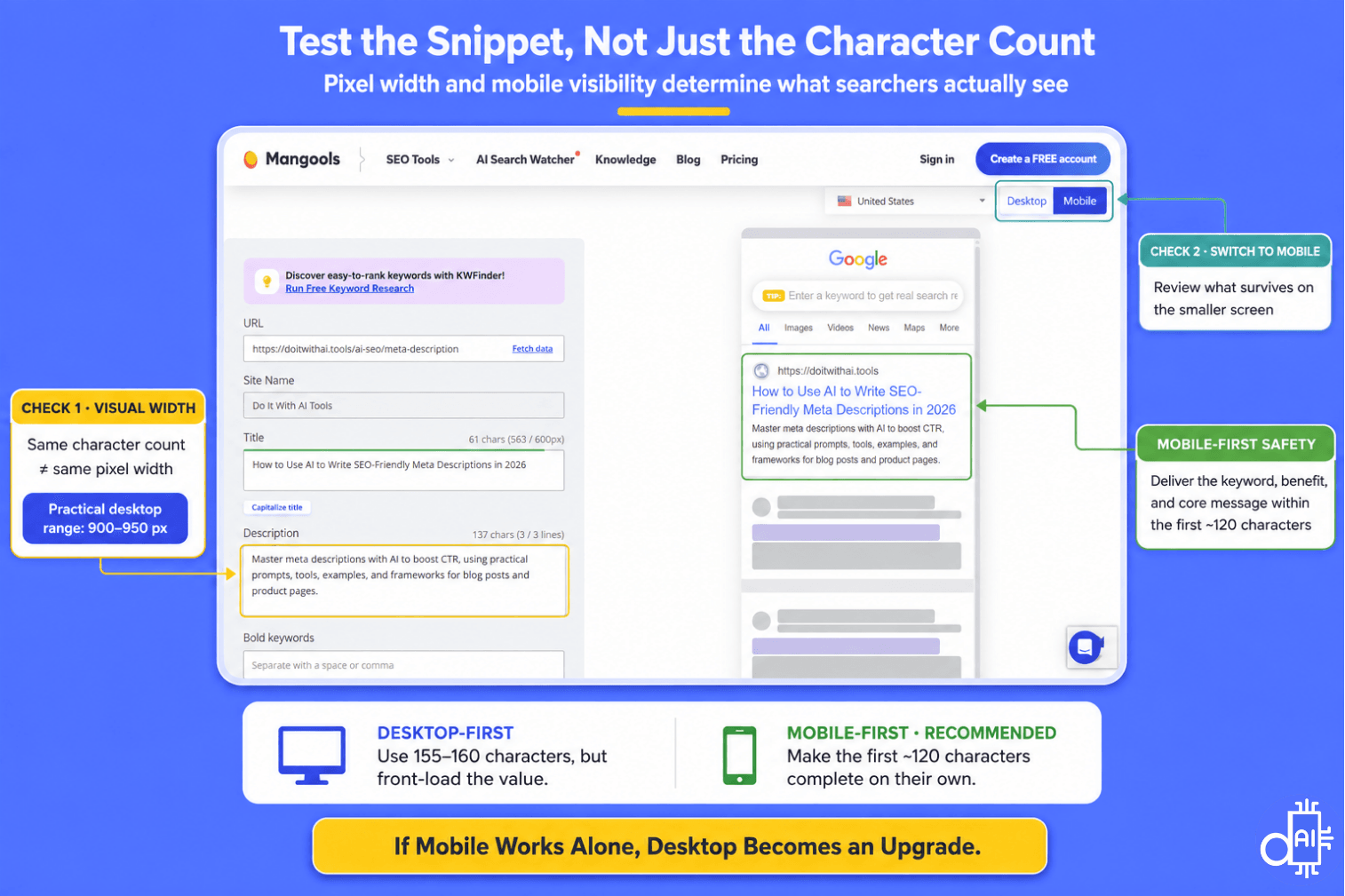
Testing your meta description in a SERP simulator ensures your key message stays visible across both desktop pixel limits and mobile screens.
3. Understand the Page Element Hierarchy: Give Your Meta Description a Distinct Job
A strong meta description becomes much easier to write when you understand what the other page elements already communicate—and what your description still needs to add.
Your URL slug, meta title, meta description, schema markup, and H1 all contribute context, but each serves a different purpose.
| Element | Primary Role |
|---|---|
| URL Slug | Establishes the page topic and URL structure |
| Meta Title | Captures attention and sets the search-result promise |
| Meta Description | Expands that promise with benefits, context, and a reason to click |
| Schema Markup | Provides structured, machine-readable information about the page |
| H1 Heading | Introduces the page topic visibly to readers after they arrive |
Understanding these differences helps you avoid wasting your meta description by simply repeating information that already appears elsewhere.
URL Slug: Establish the Topic
A clean URL slug gives users and search systems an immediate indication of what the page covers.
For example:
/how-to-write-meta-descriptions-with-ai/
The slug should stay concise and descriptive rather than trying to explain the entire page. Learn more about writing SEO-friendly slug URLs with AI.
Meta Title: Make the Initial Promise
Your meta title is the prominent clickable headline in search results. With limited space, its job is to communicate the primary topic and give searchers a compelling reason to notice your result.
See our complete guide to writing meta titles with AI.
Meta Description: Expand the Value
This is where you get more room to work.
While the slug and meta title must communicate their messages within relatively tight limits, the meta description gives you a slightly larger SERP canvas—typically enough for one concise sentence or roughly 1–1.5 short sentences.
Use that space to add what the title could not:
- A specific benefit or outcome
- Supporting context
- A differentiating feature
- Proof or specificity
- Your target audience
- A natural call to action
Think of the relationship like this:
URL Slug → What is the core topic?
↓Meta Title → What does this page promise?
↓Meta Description → Why is this result worth choosing?
For example, if your title already says:
How to Write Meta Descriptions with AI
your description does not need to repeat “Learn how to write meta descriptions with AI.”
Instead, use the additional space to expand the promise:
Boost CTR with practical AI prompts, real examples, and proven meta description strategies for blogs, products, and landing pages.
That is the real advantage of understanding the hierarchy: every element contributes something new instead of competing for the same job.
Schema Markup: Add Structured Context
Schema markup works differently from visible search copy. It provides structured, machine-readable information that can help search systems understand the page, its content type, and associated properties more precisely.
Depending on the schema type, it can contain properties such as titles, descriptions, authors, dates, and other contextual information.
Explore this further in our guide to schema markup optimization with AI.
H1 Heading: Continue the Promise on the Page
Your H1 is the main visible heading readers encounter after clicking.
Unlike the meta description, its primary job is not to persuade someone from the SERP. It should clearly introduce the page and naturally continue the expectation created by your title and description.
See our guide to writing SEO-friendly H1 headings with AI.
The Best-Practice Principle
These elements should align without becoming duplicates.
Slug → establishes the topic
↓Meta Title → creates the search promise
↓Meta Description → expands the value and earns the click
↓Schema → provides structured context
↓H1 → continues the promise for the reader
The goal is not to make every element say the same thing in slightly different words.
It is to make them work together—using the meta description as your key opportunity to expand the search-result message, communicate additional value, and give users a stronger reason to choose your page.
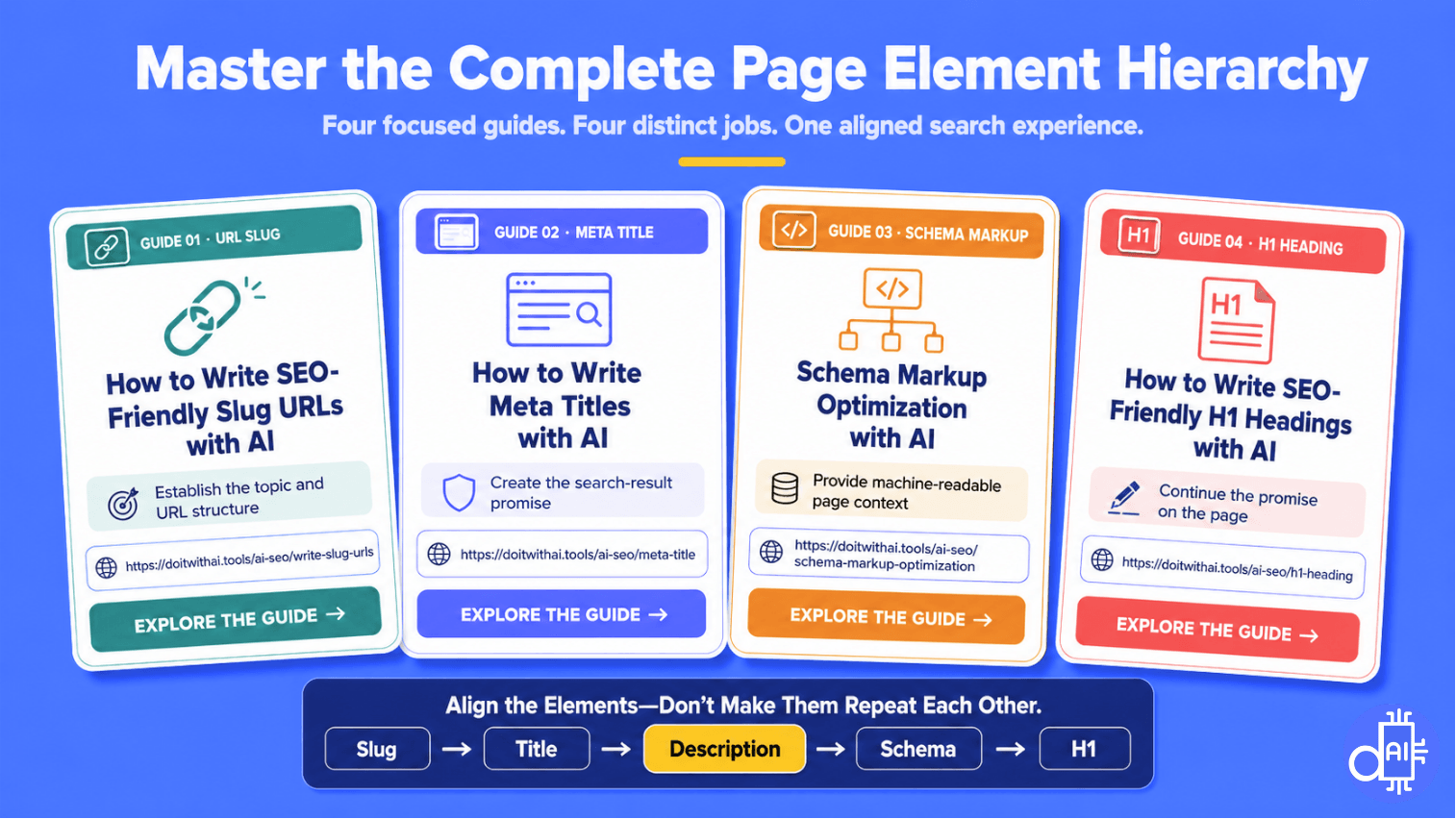
Understanding the page element hierarchy prevents redundancy by giving your meta description a unique job that expands on the meta title's promise.
4. Create Unique Variations: Don’t Copy-Paste Your Meta Title
One rule instantly improves weak meta descriptions:
Never use your meta title as the opening sentence of your meta description.
The searcher has already read the title. Repeating it wastes some of the most valuable space in your snippet.
Weak Approach
Meta Title
How to Write Engaging Meta Descriptions That Rank
Meta Description
Learn how to write engaging meta descriptions that rank. Discover best practices, common mistakes, examples, and AI tools...
The description simply repeats information the user already has.
Better Approach
Same title, stronger description:
Discover proven strategies to write meta descriptions that boost CTR by 32%. Get AI prompts, real examples, and practical frameworks for blogs, products, and services.
Now the two elements work together.
| Meta Title | Meta Description |
|---|---|
| Establishes what the page is about | Adds benefit, proof, scope, or outcome |
| Captures initial attention | Strengthens the reason to click |
| Sets the promise | Expands the promise |
A useful writing principle is:
If your meta title answers “what,” let your meta description answer “why,” “how,” “for whom,” or “what result.”
5. Occupy 80–90% of Your Space: Don’t Waste the SERP Canvas
A meta description gives you a small, finite piece of search-result real estate.
If your snippet is only 70–80 characters long when useful space remains, you may be giving up room that could communicate another persuasive reason to click.
That extra space could add:
- A benefit: “Boost CTR by 32%”
- An audience: “for agencies and freelancers”
- A proof point: “trusted by 10,000+ sites”
- A CTA: “Start free today”
- A differentiator: “with real examples and AI prompts”
The goal is not to make the description longer for SEO.
The goal is to make every visible part of the snippet useful.
Practical target: Use roughly 80–90% of the available display space while keeping the sentence natural and readable.
More words are not automatically better. More useful information is.
6. Readability: Write in a Smooth, Scannable Flow
Remember the searcher’s attention span: you may have only a second or two.
Your description therefore needs to feel effortless to read.
Avoid:
- Choppy fragments
- Repetitive phrasing
- Unnecessary jargon
- Complicated punctuation
- Too many disconnected ideas
Weak: Choppy and Mechanical
“Meta descriptions are important. They affect CTR. Use AI to write them. Check character length.”
Better: One Connected Thought
“Master meta descriptions with AI to boost CTR by 32%, using practical frameworks, prompts, and tools built for modern SEO.”
The second version connects the topic, benefit, and method without forcing the reader to reconstruct the meaning.
A Simple Readability Test
Read your description aloud.
If you stumble, lose the meaning halfway through, or need to reread it, simplify the sentence.
Good meta copy should feel fast even when it contains valuable information.
7. Know Your Audience: Write for Them, Not for Google
Before writing the description, identify who is actually behind the search query.
Are they:
- Beginners learning the topic?
- SEO professionals looking for advanced tactics?
- Business owners focused on ROI?
- Agencies trying to scale repetitive work?
Understanding your target audience, pain points, and search mindset changes the language you should use.
Consider these two searches:
“How to write meta descriptions”“Meta description generator”
They look related, but the intent is different.
Searcher 1: The Learner
They want education and confidence.
Useful language:
- “Learn step by step...”
- “Master the framework...”
- “Discover how...”
Searcher 2: The Tool-Seeker
They want speed and execution.
Useful language:
- “Generate in seconds...”
- “Automate meta descriptions...”
- “Create optimized snippets instantly...”
The goal is not manipulation.
It is relevance.
Your meta description should sound like it was written for the exact person who typed the query.
8. Place Your Primary Keyword Strategically: Front-Load Relevance
Your primary keyword should normally appear in the meta description—but placement matters.
A practical rule is to include it within the first 60% of the description, and ideally much earlier when it reads naturally.
There are three reasons.
1. Search-Query Matching Becomes Easier to Notice
When words in your snippet match a searcher’s query, Google may visually emphasize matching terms.
That immediate visual confirmation can help users recognize relevance faster.
2. The Opening Carries the Most Context
The beginning of the description establishes what the page is about before any supporting detail arrives.
Putting the primary concept early gives search engines, AI systems, and humans a clearer semantic starting point.
3. Mobile Truncation Protects Early Information
If your keyword sits near the end of a long desktop description, a mobile user may never see it.
Front-loading protects the most important context.
Example
❌ Weak
“Learn best practices for writing content that ranks, including tools, examples, common mistakes, and how AI can help with meta descriptions.”
✅ Stronger
“Master meta descriptions with AI to boost CTR using practical prompts, tools, examples, and step-by-step frameworks.”
The second version establishes the topic immediately.
Once you have identified your target terms, use AI keyword research to map your primary, secondary, and related keywords.
9. Use Secondary and Related Keywords: Build the Semantic Layer
Your primary keyword establishes the topic.
Related terminology gives that topic context.
For a page about meta descriptions, that semantic vocabulary might naturally include:
| Primary Topic | Related Terms |
|---|---|
| Meta description | CTR |
| Meta description | Click-through rate |
| Meta description | Google SERP |
| Meta description | AI search |
| Meta description | Character limit |
| Meta description | Search snippet |
Now compare that with a naturally written description:
“Master meta descriptions with AI to boost CTR, using practical prompts, tools, examples, and frameworks for blog posts and product pages.”
The sentence does not repeat the same keyword over and over.
Instead, it communicates the broader topical ecosystem.
Primary keyword + related concepts + natural language
↓Stronger context
That is the core idea behind semantic optimization.
You can use our free AI keyword research tools to identify useful primary and secondary terms—but only include them when they fit naturally.
If a keyword makes the sentence sound forced, the keyword loses. Readability wins.
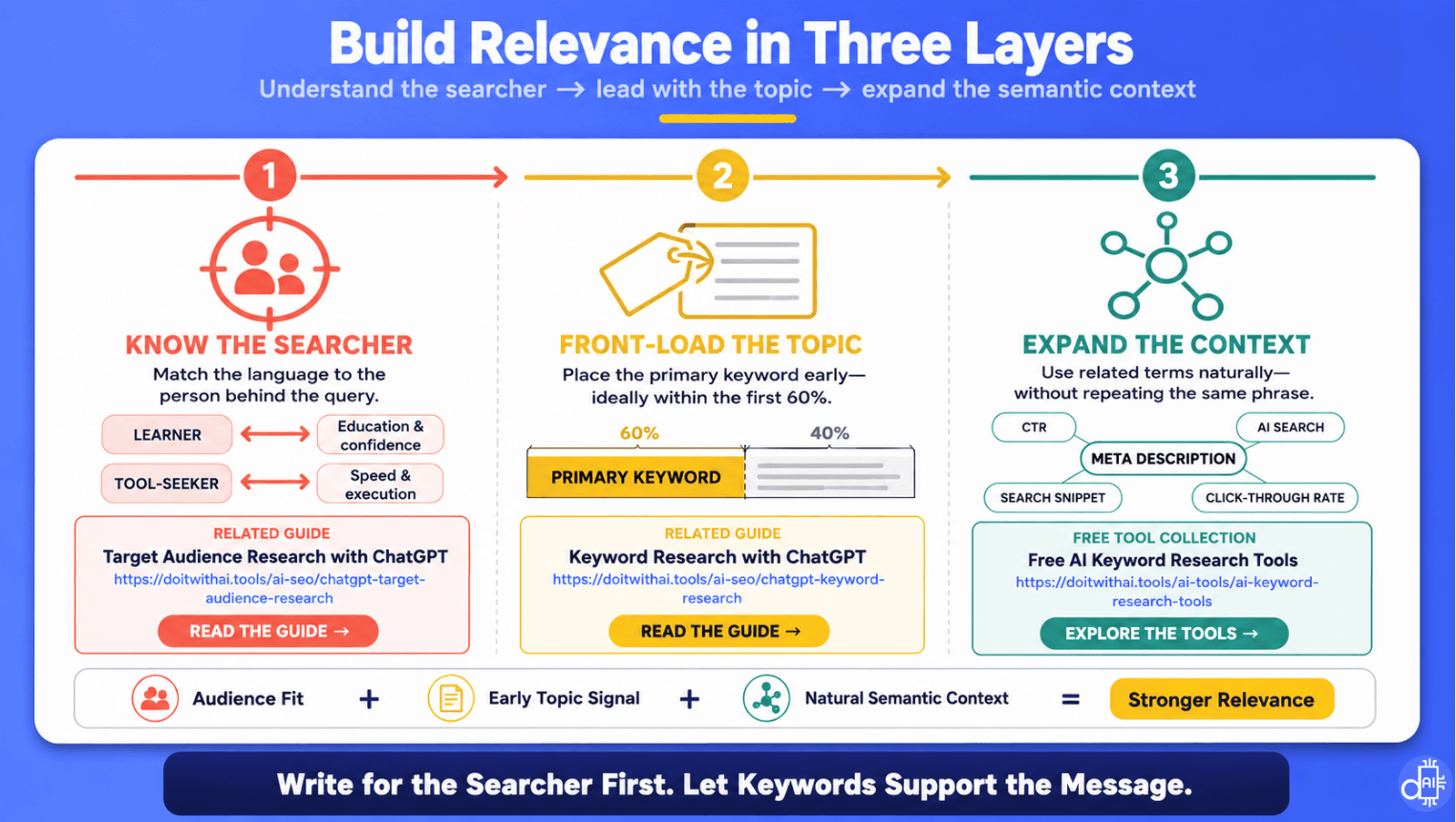
Building relevance in three layers requires matching search intent, placing your primary keyword within the first 60%, and expanding context with secondary terms.
10. Write for Humans First: The Engagement Equation
This principle overrides nearly everything else:
Write for humans first. Optimize for search systems second.
A description can contain the perfect keyword and still fail if nobody wants to click it.
The goal is therefore not:
Keywords OR engagement
It is:
Keyword relevance + Human appeal = Strong meta copy
Here are five ways to create that balance.
Use Strong Verbs
Instead of relying on passive openings like “Learn about,” consider verbs that communicate an action or outcome:
- Master
- Discover
- Unlock
- Get
- Build
- Improve
Use them only when they fit the promise naturally.
Add Specificity
Generic: “Improve your results.”
Specific: “Boost CTR by 32%.”
Specificity makes a promise easier to understand and evaluate.
Address the Pain Point
Generic: “This article explains meta descriptions.”
Pain-focused: “Stop wasting time rewriting weak meta descriptions.”
Create Urgency Only When It Is Real
Timeliness can make a description more compelling, but artificial urgency quickly feels manipulative.
Use phrases such as “for 2026 search” when freshness genuinely matters.
Show the Outcome
Instead of describing only what the article contains, explain what the reader will be able to do.
“Write stronger meta descriptions in minutes using practical AI prompts and CTR-focused frameworks.”
That moves the copy from topic summary to reader benefit.

11. Provide Direct Answers When Appropriate: The Search-Intent Strategy
Here is a useful counterintuitive principle:
Giving the quick answer does not always eliminate the click—it can prove that your page understands the question.
For factual and how-to searches, a direct-answer opening can establish authority immediately.
Example Query
How many characters should a meta description be?
Direct-Answer Style
“A meta description is commonly kept around 155–160 characters on desktop, while mobile may show less. Learn why pixel width and message placement matter too.”
Notice the structure:
Notice the structure:
Immediate Answer
↓Proof of Relevance
↓Additional Depth
↓Reason to Click
The searcher gets the basic answer, but the description also signals that the page explains the nuance behind it.
Google’s documentation on featured snippets is useful for understanding how concise answers can be surfaced directly in search.
The writing principle is simple:
Answer quickly when the intent calls for it, then show why the full page is still worth reading.
12. Use Powerful, Benefit-Driven Language: The CTR Booster
A high-performing meta description should not read like a dry encyclopedia summary.
It should communicate value.
HubSpot has highlighted the importance of specificity and compelling snippet copy, and the underlying principle is straightforward: vague language gives searchers very little reason to choose one result over another.
Make each element pull its weight.
| Weak | Stronger |
|---|---|
| “Improve results” | “Boost CTR by 32%” |
| “Quickly” | “In 10 minutes” |
| “Save time” | “Skip wasted hours” |
| “Popular” | “Trusted by 50,000+ sites” |
| “Learn the basics” | “Master the framework” |
Example Transformation
❌ Generic
“This article discusses meta description best practices and how to write them.”
✅ Benefit-Driven
“Stop settling for weak meta descriptions. Master practical frameworks, AI prompts, and CTR-focused techniques designed to earn more clicks.”
The first version tells the reader what the page contains.
The second tells them why they should care.
And that is the shift that turns a meta description from metadata into persuasive search copy.
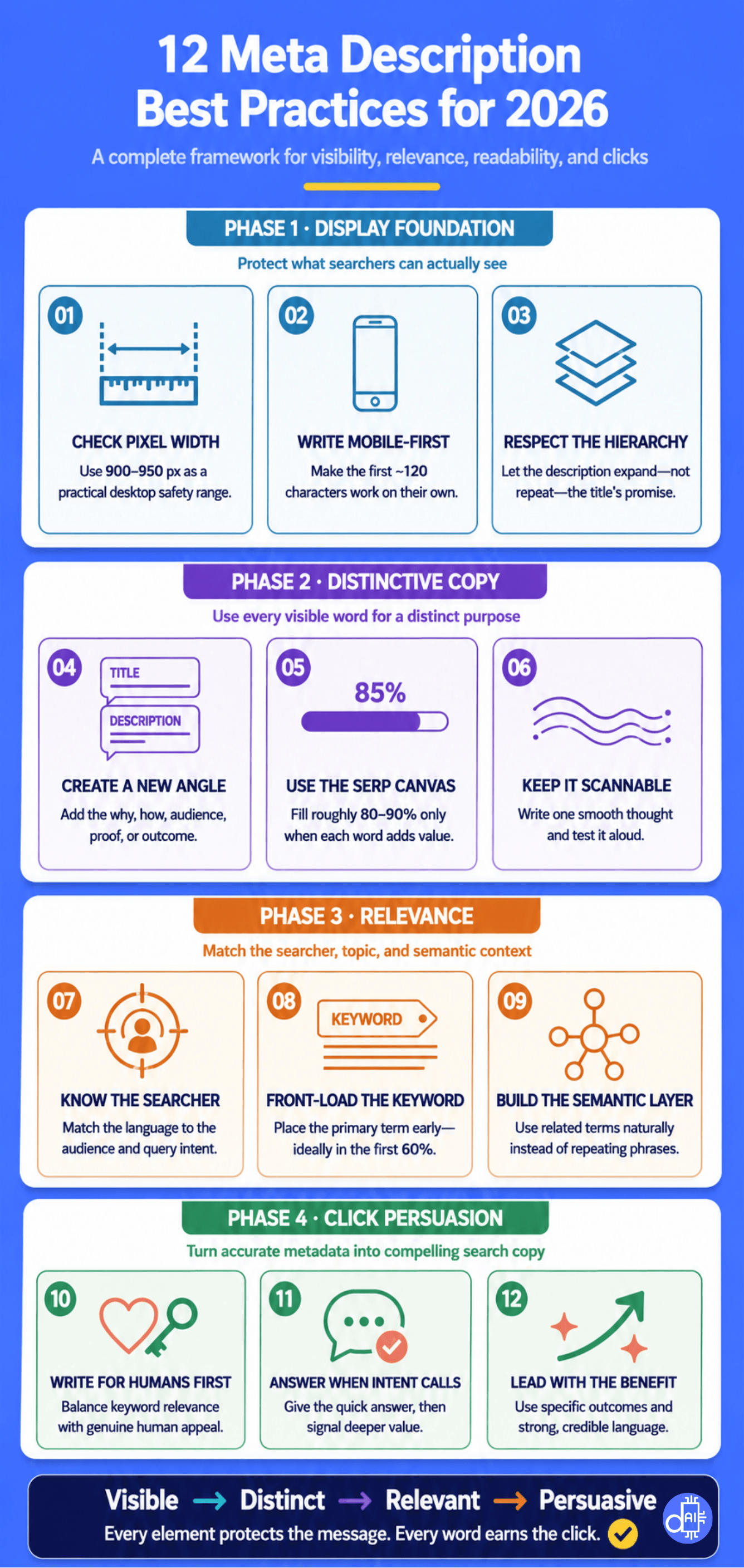
This complete 12-step framework organizes meta description optimization into four sequential phases: display foundation, distinctive copy, relevance, and click persuasion.
Common Meta Description Mistakes That Kill CTR
Even when you understand the best practices, a few common mistakes can still undo the quality of your meta description.
The good news is that most of them are easy to recognize—and even easier to fix once you know what to look for.
1. The Keyword-Stuffing Hangover: Why Old SEO Tactics Backfire
Keyword stuffing may feel outdated, yet descriptions like this still appear:
“Meta descriptions, meta description writing, how to write meta descriptions, meta description optimization, best meta descriptions, meta description tools, meta description tips...”
To both humans and AI systems, this reads like spam rather than useful copy.
The Risk
Search engines can detect unnatural repetition, and a weak or manipulative snippet is more likely to be ignored or rewritten.
Modern Natural Language Processing (NLP) systems also understand semantic relationships, which means repetition is no longer necessary to establish context.
The Fix
Use your primary keyword once, naturally, then build context with related terms and semantic language.
Instead of repeating “meta description” several times, use related concepts such as:
- SERP snippet
- Search result summary
- CTR
- Search visibility
- Google description
- AI search context
Primary keyword + related concepts + natural language
↓Stronger semantic context
The goal is not to force more keywords into the description.
The goal is to make the topic unmistakably clear without making the copy feel engineered.
2. Duplicate Meta Descriptions: The Quiet Relevance Problem
If dozens of pages use almost the same meta description, each page loses the opportunity to communicate its own value.
A homepage, service page, blog post, and FAQ may belong to the same website—but they do not serve the same search intent.
The Risk
Duplicate descriptions make it harder to differentiate pages in search results.
You lose:
- Specificity
- Search-intent alignment
- Unique value propositions
- Opportunities to target related topics differently
- Control over how each page is presented
The Fix: Give Every Page Its Own Elevator Pitch
Even pages covering related subjects should communicate their unique angle.
Page 1
“Master meta descriptions with step-by-step AI prompts and real examples.”
Page 2
“Compare ChatGPT vs Claude for writing meta descriptions and see which AI model works best.”
Page 3
“Boost your CTR by 32% and learn the pixel-width trick most SEO guides overlook.”
Each description stands on its own.
If you manage hundreds of pages, AI can help automate bulk generation while still using each page’s title, headings, audience, and intent to create unique copy.
3. Neglecting the Zero-Click Reality: Why Vagueness Loses
Some descriptions intentionally stay vague in the hope that curiosity alone will force a click:
“Click to discover the top five secrets...”
“You won’t believe what happened next...”
That strategy is risky in modern search.
Over 60% of searches are zero-click searches, which means users increasingly evaluate results directly on the SERP before deciding whether a page deserves their attention.
The Risk
A vague description gives both humans and AI systems less context.
Meanwhile, a competing result that provides a clear answer may immediately look more useful and trustworthy.
The Fix: Give Away the Mini-Answer
Provide enough information to prove that you understand the query.
Specificity builds trust. Trust earns the click.
The description should answer enough to establish credibility, while leaving the full explanation, evidence, examples, or framework on the page itself.
4. Using Raw AI Output Without Refinement
AI can produce a usable first draft in seconds.
The problem begins when that first draft is published without review.
Generic AI descriptions often sound:
- Corporate
- Predictable
- Overly polished
- Vague
- Similar to thousands of other AI-generated snippets
The Risk
You may end up with technically acceptable copy that fails to stand out.
The Fix: Use AI as the Draft, Not the Final Decision
Let AI handle speed and variation, then refine the strongest option yourself.
Add:
- Personality
- Specificity
- Stronger verbs
- Real proof points
- Brand voice
- A clearer benefit
AI draft → Human refinement → Stronger final snippet
We will build this exact workflow in the AI framework later in this guide.
5. Exceeding the Pixel Limit: The Truncation Trap
Even strong descriptions can lose their impact when the ending gets cut off.
The Risk
Truncation can remove:
- Your CTA
- Your key benefit
- A proof point
- The final part of a sentence
The result may look incomplete or awkward.
The Fix
Use the Mangools SERP Simulator to check both character count and pixel width.
A practical workflow is simple:
- Paste the description into the simulator.
- Check desktop width.
- Aim for roughly 900–950px.
- Switch to mobile view.
- Confirm that the first 120 characters still communicate a complete idea.
6. Leaving Too Much Space Unused
A meta description is limited search-result real estate.
If you use only half of the available space, you may be giving up room that could strengthen the click decision.
The Risk
A short description may miss the chance to add:
- A benefit
- A proof point
- A CTA
- A target audience
- A differentiator
The Fix
Aim to use roughly 80% or more of the useful space when the extra wording genuinely adds value.
Do not add fluff just to make the description longer.
Instead, ask:
“What useful reason to click have I not communicated yet?”
That is the space worth filling.
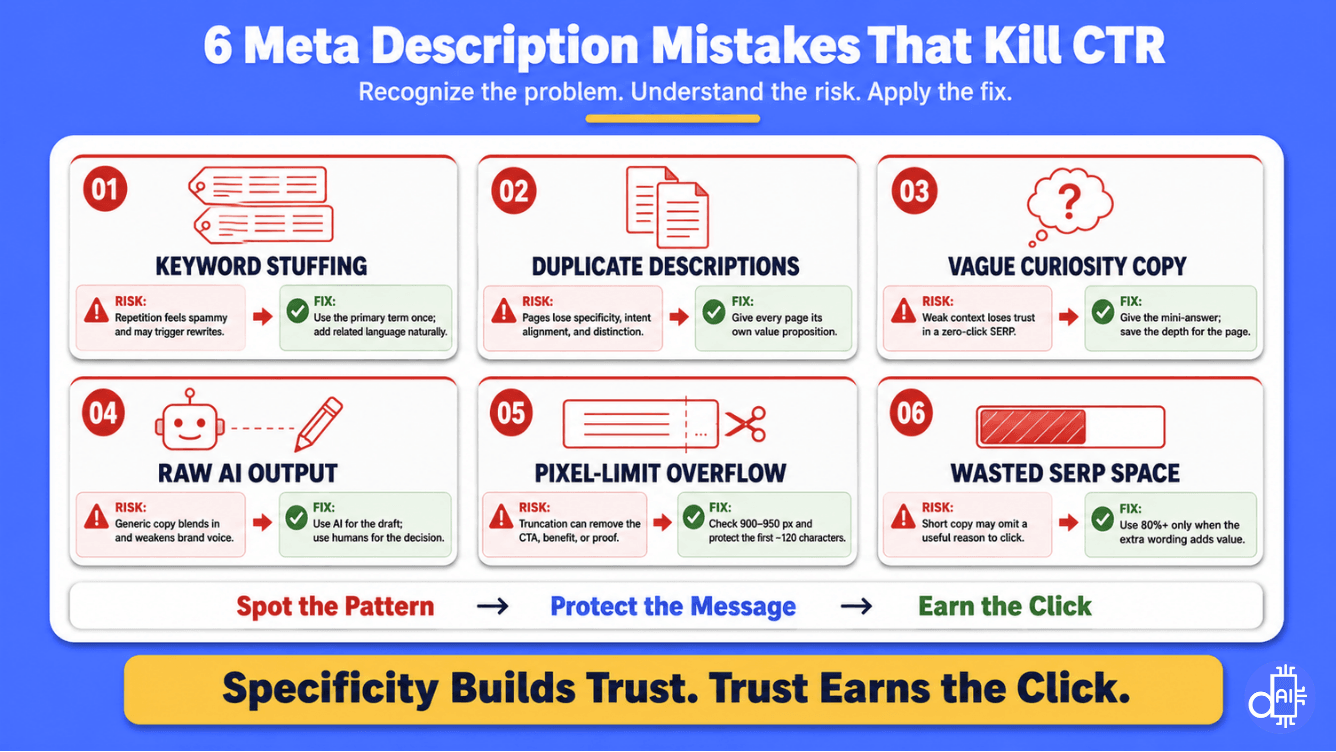
Avoiding these six critical meta description mistakes—including keyword stuffing and pixel overflow—protects your search snippet context and maintains click-through rates.
Meta Description Types: Which Strategy Should You Use?
There is no single “best” meta description formula.
The right approach depends on:
- Search intent
- Page type
- User awareness
- The action you want the visitor to take
Three strategic formats cover most situations.
Type 1: The Direct-Answer Snippet — The Knowledge Booster
This format gives the answer immediately.
No mystery. No artificial curiosity gap.
Best For
- How-to queries
- Informational searches
- Factual questions
- Educational content
- FAQ-style pages
Example
Search Query: “How many characters should a meta description be?”
Meta Description:
“Meta descriptions should be 155–160 characters on desktop and around 120 characters on mobile. Learn why pixel width matters and how to optimize for both.”
Why It Works
- Answers the question immediately
- Builds confidence before the click
- Proves topical relevance
- Leaves room for deeper explanation on the page
For educational content, users often prefer a clear answer over a vague teaser.
Give the quick answer, then make the deeper explanation worth clicking for.
Type 2: The Curiosity-Gap Overview — The Click Magnet
This format reveals enough to create interest without giving away the entire result.
Best For
- Listicles
- Comparison posts
- Case studies
- Trend reports
- “Best of” articles
- Testing or review content
Example
Search Query: “Best meta description tools 2026”
Meta Description:
“We tested 12 meta description generators and found 3 that actually work. See which tools save the most time, produce the best output, and cost the least.”
Why It Works
- Gives proof that real evaluation happened
- Uses specific numbers
- Creates a natural information gap
- Makes the user want to see the complete comparison
Curiosity works best when it is supported by specificity, not vagueness.
Type 3: The Action-Oriented Snippet — The CTA-Driven Format
This format is designed to encourage immediate action.
Best For
- Product pages
- Tool pages
- Service pages
- Landing pages
- Download pages
- Signup pages
Example
Search Query: “Free meta description generator”
Meta Description:
“Generate high-converting meta descriptions in seconds with our free AI tool. No credit card required. Create stronger SEO snippets today.”
Why It Works
- Leads with the action
- Removes friction
- Communicates the main benefit
- Makes the next step obvious
For transactional searches, the user is already closer to action.
Your job is to reduce hesitation.
Choosing the Right Meta Description Type
| Page Type | Primary Goal | Best Description Type | Why |
|---|---|---|---|
| How-to article | Education | Direct Answer | Users want a clear response |
| List article | Curiosity + engagement | Curiosity Gap | Users want to see what made the list |
| Comparison article | Decision-making | Direct Answer + Proof | Users want evidence and conclusions |
| Product/tool page | Conversion | Action-Oriented | Users want to act quickly |
| Service page | Lead generation | Action-Oriented | Benefits and friction reduction matter |
| Narrative blog post | Engagement | Hybrid | Answer the core question, then hint at depth |
| FAQ page | Quick answers | Direct Answer | Users arrive with specific questions |
| Homepage | Brand authority | Brand-focused action | Communicate the overall value proposition |
The principle is simple:
Match the description format to the searcher’s intent—not to a fixed SEO template.
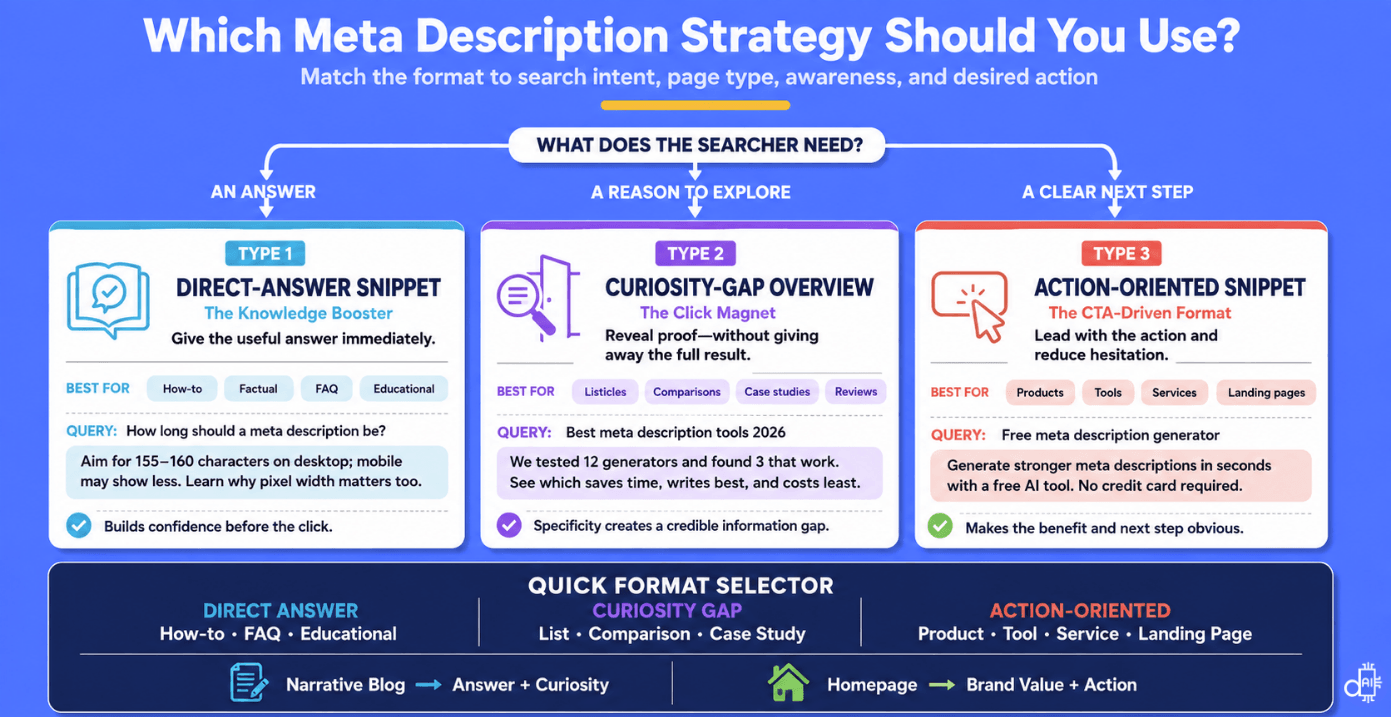
Matching your meta description strategy to search intent—whether providing a direct answer, a curiosity gap, or an action-oriented call to action—drives higher search engagement.
Meta Description Examples by Page Type
The strategy becomes much easier to understand when you see how it changes across real page types.
Blog Posts: How-To Format
Example Page Title:
How to Write Meta Descriptions with AI: Master Every Element in 2026
Best Practices
- Lead with the learning outcome
- Use strong verbs such as Master, Learn, Discover, or Unlock
- Promise a specific benefit or framework
- Include the primary keyword naturally
- Keep the focus on the topic rather than forcing the brand name
Example 1: Strong
“Master meta descriptions with AI-powered prompts and step-by-step frameworks. Learn pixel-width optimization, mobile strategy, and CTR-focused best practices for 2026.”
Why it works:
- Opens with an action verb
- Communicates specific tactics
- Uses the keyword early
- Signals that the guide is current and comprehensive
Example 2: More Benefit-Driven
“Stop wasting hours writing meta descriptions manually. Learn the AI-powered framework used to create stronger CTR-focused snippets in minutes, with real prompts and examples.”
Why it is stronger:
- Opens with a pain point
- Immediately offers the solution
- Communicates speed
- Promises real examples and prompts
Blog Posts: Listicle Format
Example Page Title:
9 Best Free AI-Powered Keyword Research Tools
Best Practices
- Mention the number in the list
- Create curiosity without hiding the topic
- Add a useful differentiator
- Show that comparison or testing took place
Example 1: Strong
“Discover the 9 best free AI keyword research tools for 2026. Compare features, pricing, limitations, and find the right fit for your SEO workflow.”
Why it works:
- Uses the number immediately
- Promises comparison
- Adds freshness with the year
- Communicates a clear outcome
Example 2: More Intriguing
“We tested 20+ AI keyword tools. Only 9 made the cut. See which free options saved the most time, found useful keywords, and required no credit card.”
Why it is stronger:
- Shows real filtering
- Creates scarcity
- Reveals evaluation criteria
- Reduces friction
Product and Tool Pages
Example Page Title:
Free AI Meta Description Generator | ChatGPT Prompt Library
Best Practices
- Lead with the core value proposition
- Mention free when it is genuinely free
- Remove objections
- Include a clear action
- Use the brand name when it adds trust
Example 1: Strong
“Generate high-converting meta descriptions in seconds with a free AI tool, ChatGPT prompts, examples, and templates. No credit card required.”
Why it works:
- Leads with the outcome
- Removes friction
- Communicates multiple resources
- Makes the offer easy to understand
Example 2: More Conversion-Focused
“Write dozens of meta descriptions faster with a free AI workflow. No signup required—generate, refine, and publish stronger snippets without starting from scratch.”
Why it is stronger:
- Leads with speed
- Removes friction
- Focuses on workflow efficiency
- Sounds more conversational
Service Pages
Example Page Title:
SEO Services for Agencies | Rank Page One
Best Practices
- Lead with the transformation
- Show credibility
- Remove friction
- Include a relevant CTA
- Use specificity where possible
Example 1: Strong
“Increase organic traffic for your clients with proven SEO services. Get strategy, execution, and reporting with a free initial audit and no obligation.”
Why it works:
- Leads with the benefit
- Explains what is included
- Removes friction
- Makes the next step clear
Example 2: More Specific
“Scale your agency without building an in-house SEO team. Get strategy, execution, and reporting in one service, with a free audit to identify your biggest growth opportunities.”
Why it is stronger:
- Opens with a real business pain point
- Offers a complete solution
- Shows what the service actually covers
- Adds a useful CTA
Homepage Meta Descriptions
Example Page Title:
DoItWithAI | Master AI Tools for SEO & Content Creation
Best Practices
- Include the brand name
- Communicate the broad value proposition
- Mention the unique angle
- Speak to multiple relevant audience segments
Example
“Learn to use AI tools for SEO, content creation, and business growth with DoItWithAI. Access free resources, practical strategies, and step-by-step guides for 2026.”
Why it works:
- Communicates the brand
- Covers the platform’s main value areas
- Includes the word free
- Signals freshness and breadth
FAQ and Contact Pages
Example Page Title:
FAQ | DoItWithAI
Best Practices
- Tell users what they will find
- Keep the wording direct
- Avoid unnecessary curiosity
- Include the brand where relevant
Example
“Find answers to common questions about AI tools, SEO strategies, content creation, and DoItWithAI resources—all in one place.”
Why it works:
- Explains the purpose immediately
- Names the relevant topics
- Keeps the copy straightforward
- Reassures the user that answers are available
Should You Use AI to Write Meta Descriptions?
Yes—but AI should accelerate the process, not replace judgment.
The strongest workflow is not AI instead of humans.
It is:
AI speed + Human refinement = Better scalable output
The Main Benefits of AI for Meta Descriptions
1. Speed
Writing descriptions manually requires research, drafting, and editing.
AI can generate multiple starting points within seconds, which becomes especially useful when optimizing dozens or hundreds of pages.
2. Consistency
Once you define your framework, AI can apply similar:
- Tone
- Structure
- Keyword rules
- Formatting
- Brand principles
across an entire site.
That helps create a more coherent search presence.
3. Variations for Testing
Instead of relying on one draft, AI can quickly create:
- Direct-answer versions
- Benefit-led versions
- Curiosity-driven versions
- CTA-focused versions
You can then compare performance and refine what works.
4. Scalability
For agencies and large websites, manual creation becomes a bottleneck.
AI makes batch workflows possible without forcing every description to start from a blank page.
5. More Time for Human Refinement
When AI handles the first draft, your time shifts from creating to editing.
That gives you more room to improve:
- Brand voice
- Specificity
- Proof
- Relevance
- Emotional appeal
AI and SEO: Useful Industry Signals
Several industry reports point toward the growing role of AI in content and SEO workflows:
- Companies using AI for content generation report significant time savings
- HubSpot reports performance gains when AI-assisted content receives human refinement
- Semrush has documented increasing adoption of AI across SEO workflows
- Search Engine Journal has reported widespread AI usage among SEO professionals
The takeaway is not that AI should write everything for you.
It is that AI has become a practical productivity layer—and the quality still depends on how well you direct and refine it.
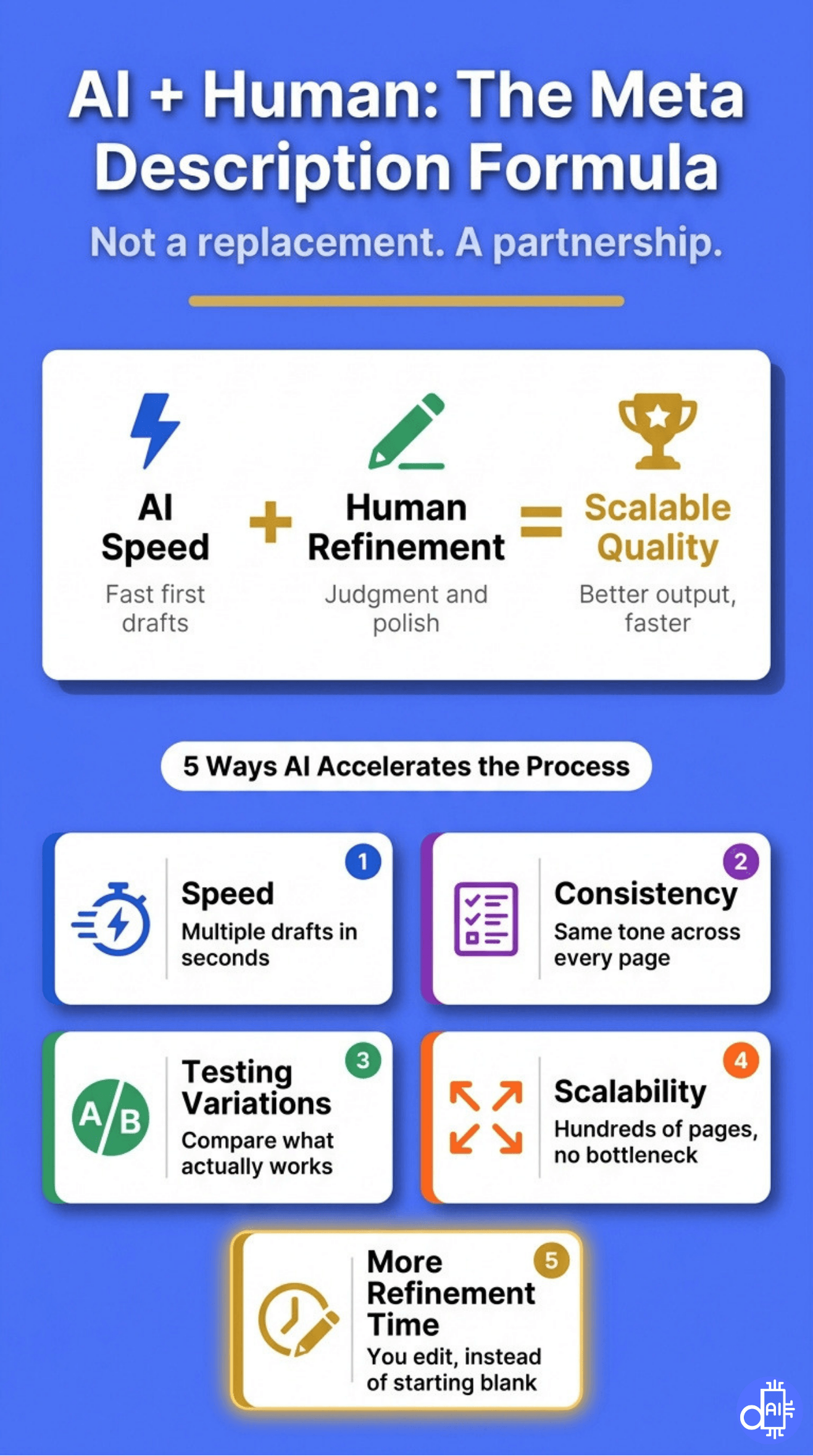
Combining AI speed with human refinement creates a scalable meta description workflow that produces high-quality snippet drafts without sacrificing brand voice.
How to Use AI to Write Meta Descriptions: A Complete Framework
AI becomes far more useful when you give it enough context.
A one-line request such as “write a meta description” usually produces generic output.
A structured prompt produces something much closer to publishable copy.
Step 1: Prepare the Context
Before opening ChatGPT, Claude, Gemini, or another AI assistant, gather:
- Page title — What is the headline?
- Page summary — What does the page actually cover?
- Target audience — Who is it for?
- Primary keyword — What is the main search term?
- Secondary keywords — Which related terms matter?
- Page type — Blog, service page, tool page, FAQ, etc.
- Desired outcome — Read, buy, sign up, download, contact, or learn?
- Tone — Professional, conversational, authoritative, casual, etc.
The more relevant context you provide, the less generic the output becomes.
Step 2: Use a Comprehensive Meta Description Prompt
Copy the prompt below into ChatGPT, Claude, Gemini, or your preferred AI tool and replace the bracketed fields.
1
2
3
4
5
6
7
8
9
10
11
12
13
14
15
16
17
18
19
20
21
22
23
24
25
26
27
28
29
30
31
32
33
34
35
36
37
38
39
40
41
42
43
44
45
46
47
48
49
50
51
52
53
54
55
56
You are an expert SEO copywriter specializing in high-converting meta descriptions that balance search optimization with genuine human engagement.

CONTEXT ABOUT THIS PAGE

Page Title: [YOUR PAGE TITLE]
Page Content Summary: [2–3 sentence summary]
Target Audience: [WHO THIS PAGE IS FOR]
Page Type: [BLOG / PRODUCT / SERVICE / FAQ / ETC.]
Primary Keyword: [PRIMARY KEYWORD]
Secondary Keywords: [RELATED KEYWORDS]
Current Goal: [CLICK / SIGN UP / BUY / LEARN / ETC.]
Desired Tone: [PROFESSIONAL / CONVERSATIONAL / AUTHORITATIVE / ETC.]

META DESCRIPTION REQUIREMENTS

Create multiple meta description options that:

1. Target approximately 155–160 characters.
2. Include the primary keyword naturally within the first 60% of the text.
3. Include at least one relevant secondary keyword when it fits naturally.
4. Lead with a clear benefit, answer, or value proposition.
5. Use strong action-oriented language where appropriate.
6. Read as one smooth, natural sentence.
7. Sound human first and SEO-optimized second.
8. For educational content, establish value while hinting at deeper information.
9. For product/tool pages, emphasize benefits and remove friction.
10. For service pages, lead with transformation, differentiation, or credibility.

STRATEGIC APPROACH

Do not repeat the page title.

Instead:

- Add a different angle or benefit.
- Use different wording.
- Add specificity, proof, or new context.
- Build confidence or curiosity depending on the search intent.

OUTPUT FORMAT

Provide five options:

1. DIRECT ANSWER
2. BENEFIT-FOCUSED
3. CURIOSITY-DRIVEN
4. SEMANTIC / KEYWORD-RICH
5. ACTION-ORIENTED

After each option:
- Provide the character count.
- Briefly explain why it works.
- Ensure the first 120 characters still make sense if shown on mobile.

Avoid generic phrases such as:
“Learn about,” “This article,” “Explore,” or “Check out.”
This prompt does not remove the need for editing.
It simply gives the AI enough information to create stronger starting points.
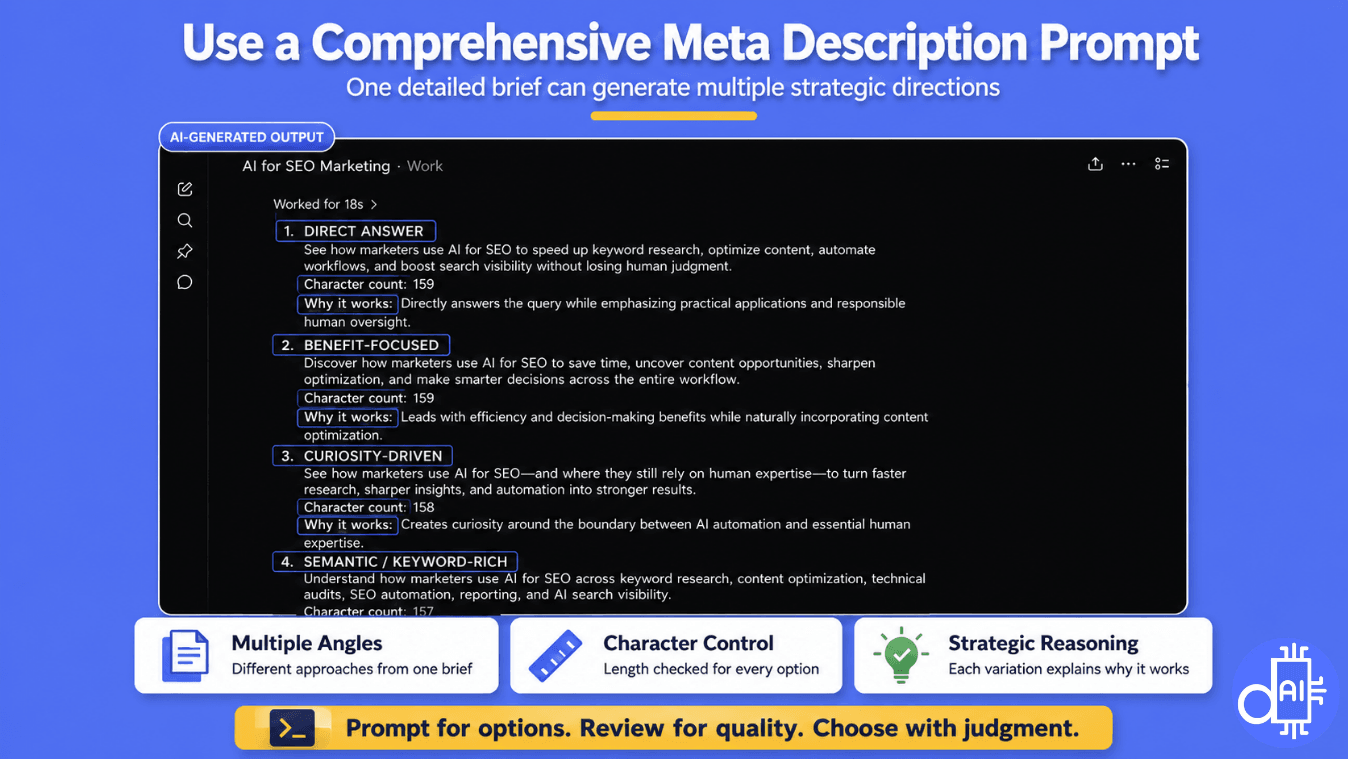
Using a comprehensive AI prompt allows you to generate multiple meta description angles—such as direct answer and benefit-focused—while automatically checking character counts.
Step 3: Evaluate the Options
Do not choose the first result automatically.
Keep an Option If:
- It sounds natural
- The keyword appears early without feeling forced
- The benefit is specific
- The sentence makes you want to click
- The mobile opening still works
Reject an Option If:
- It sounds robotic
- The wording feels corporate or generic
- The keyword placement feels unnatural
- The description is vague
- The length or pixel width is unsuitable
Step 4: Refine and Humanize
AI gives you the foundation.
Now make the description sound like your brand.
Ask:
- Can the opening be stronger?
- Can I replace a generic benefit with a specific one?
- Is there a real number or proof point I can add?
- Does this sound like something I would actually publish?
- Can I make the wording more confident or concise?
Example
AI Draft
“Master meta descriptions with our complete guide covering best practices, examples, and AI strategies for improving CTR.”
Human-Refined Version
“Stop writing forgettable meta descriptions. Master pixel-width optimization, AI prompts, and CTR-focused techniques designed to earn more clicks.”
Same topic.
Much stronger presentation.
Two Important Reminders About AI
1. AI Can Still Make Mistakes
AI does not always calculate character count or display width correctly.
Before publishing:
- Paste the final version into the Mangools SERP Simulator.
- Check desktop and mobile.
- Review the pixel width.
- Confirm that the opening still works if the mobile version truncates.
2. Your Creativity Still Matters
If the output does not match your vision, refine the instruction.
Try prompts such as:
- “Make this more urgent without sounding pushy.”
- “Make this more conversational.”
- “Replace the generic benefit with a specific outcome.”
- “Rewrite this for a beginner rather than an SEO expert.”
- “Make the first 100 characters stronger.”
Great AI output usually comes from iteration, not from one prompt.
Get More AI SEO Prompts
The prompt above is one framework.
You can also visit the Free AI Resources page for:
- Additional meta description prompts
- SEO prompts for titles, H1s, schema, and other page elements
- Real AI conversation examples
- Copy-and-paste frameworks and templates
These resources are designed to help you move from theory into repeatable AI-assisted SEO workflows.
Free AI Meta Description Generators and Tools
You do not have to rely on one workflow.
Some tools are better for writing, others for previewing, and others for auditing existing pages.
Here are the most useful options covered in this guide.
AI Chatbots: Best for Flexibility and Control
ChatGPT, Google Gemini, Claude, and Grok are strong choices because they let you control:
- Tone
- Audience
- Search intent
- Keyword usage
- Description type
- Number of variations
- Refinement process
Unlike fixed generators, you can continue the conversation until the output fits your needs.
Best For
Custom workflows, iterative refinement, and pages that need more than a generic template.
Pro Tip: If you prefer accessing multiple models from one place, Merlin AI can streamline the workflow by reducing tab switching.
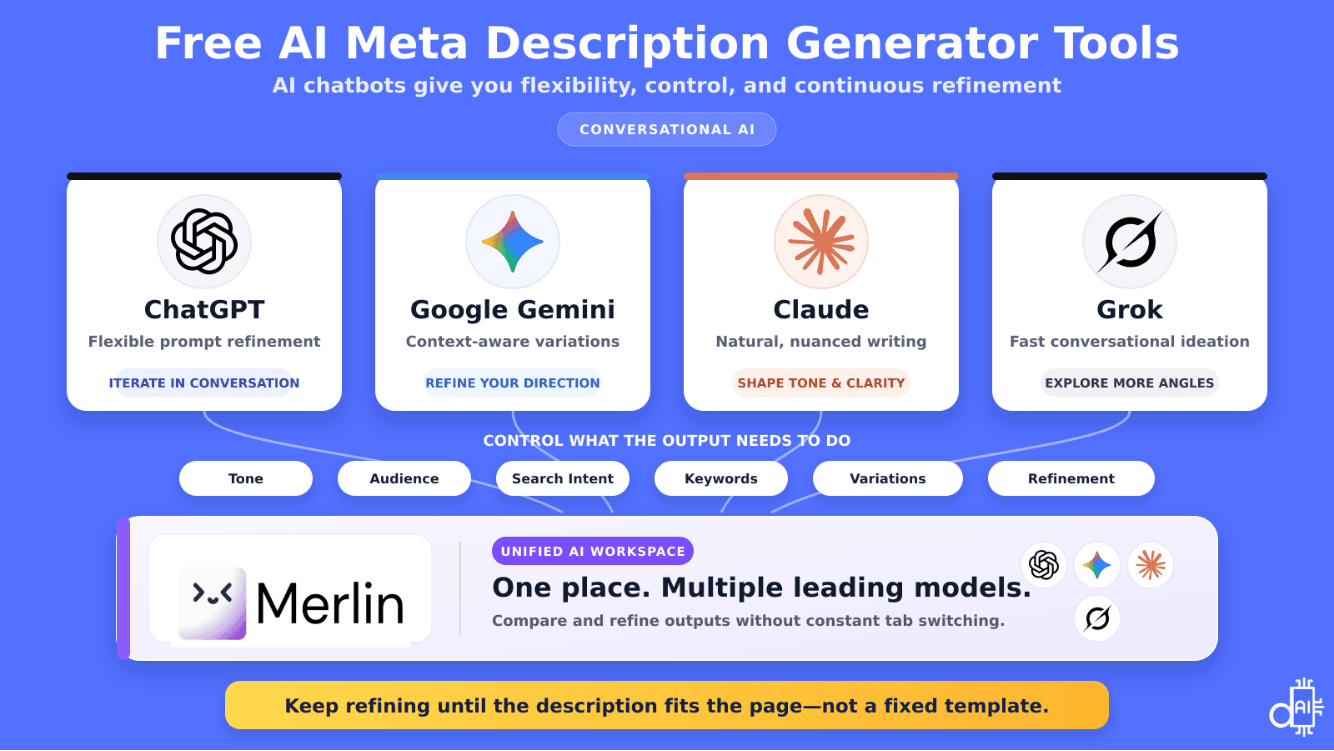
Conversational AI tools like ChatGPT, Gemini, Claude, and Grok give you the control needed to continuously refine meta descriptions until they perfectly match page intent.
Mangools SERP Simulator: Best for Length Checking and Preview
Mangools is useful because it goes beyond basic character counting.
It helps you:
- Check character count and pixel width
- Preview desktop and mobile search appearance
- Test how a live URL currently appears
- Identify whether the snippet may be truncated
Recommended Workflow
- Paste in the final description
- Aim for roughly 900–950px
- Switch to mobile view
- Make sure the first 120 characters still communicate the core message
Cost: Free.
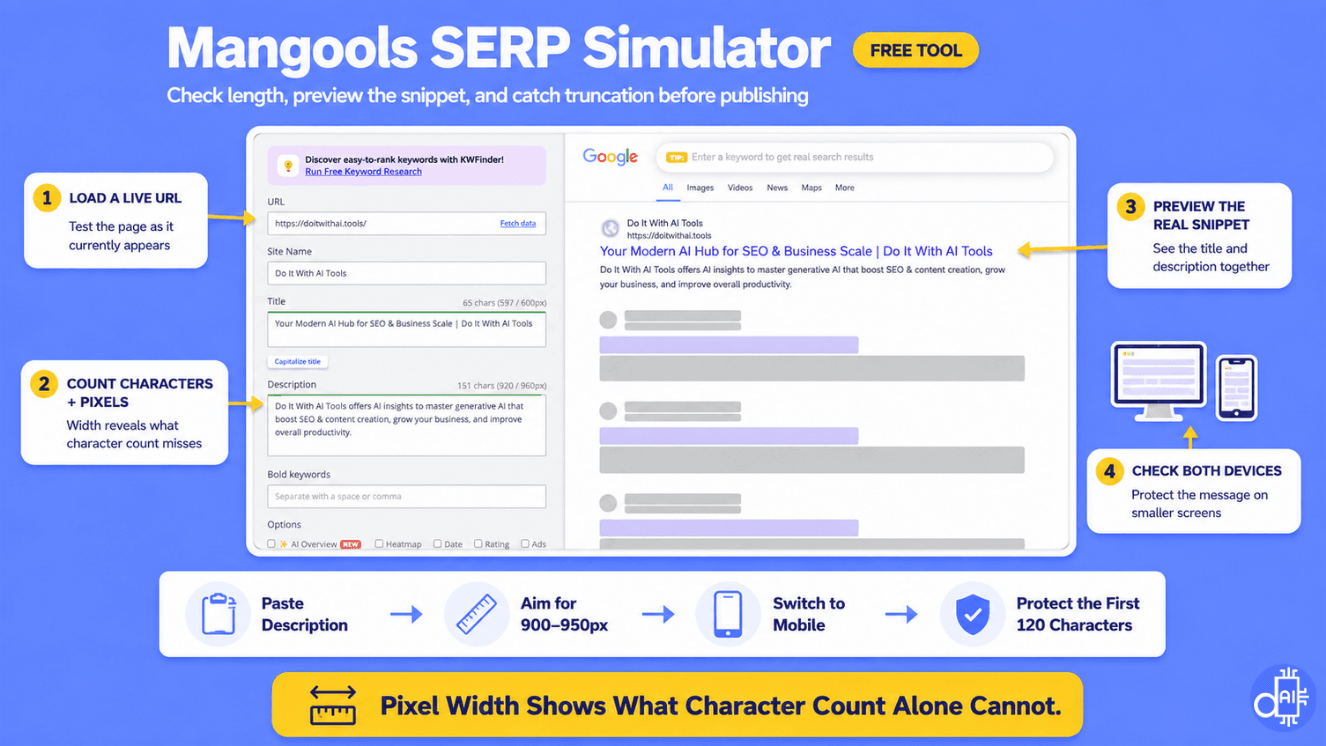
Using the free Mangools SERP Simulator allows you to test live URLs, verify pixel width alongside character counts, and prevent snippet truncation before publishing.
Ahrefs Free AI Meta Description Generator: Best for Fast Options
Ahrefs’ Free Meta Description Generator is a straightforward option when you need several drafts quickly.
How It Works
- Enter your page content or summary.
- Choose a tone.
- Generate multiple options.
- Refine the strongest result.
Best For
Quick ideation when you want alternatives without writing a detailed prompt.
Cost: Free generator available.
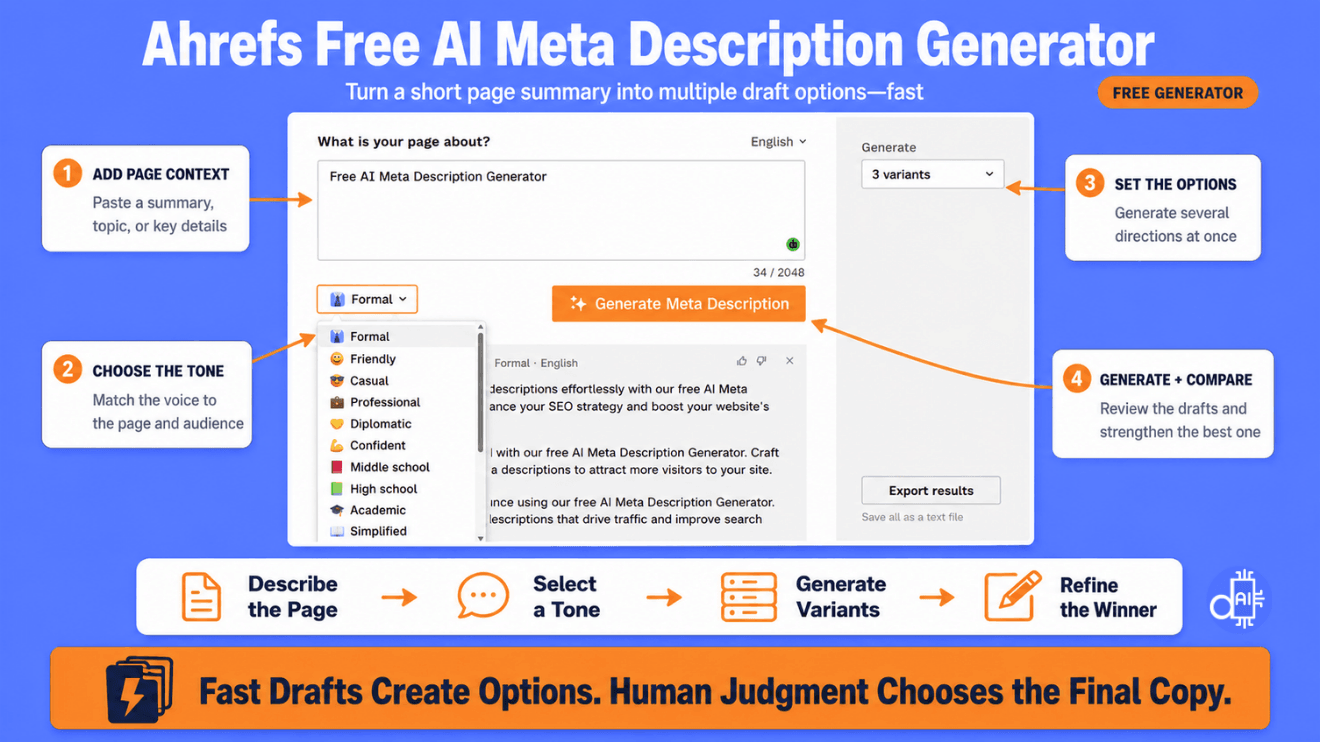
Ahrefs' Free AI Meta Description Generator helps you rapidly produce multiple snippet variations from a single page summary or keyword topic.
Semrush Google SERP Simulator: Best for Visual SERP Testing
Semrush’s SERP Simulator provides another way to preview how your result may appear in Google.
Useful Features
- Preview title, description, and URL
- Check desktop and mobile appearance
- See how the snippet looks in a search-result layout
- Evaluate visual competitiveness
Best For
Writers and SEOs who want a visual second check before publishing.
Cost: Free.
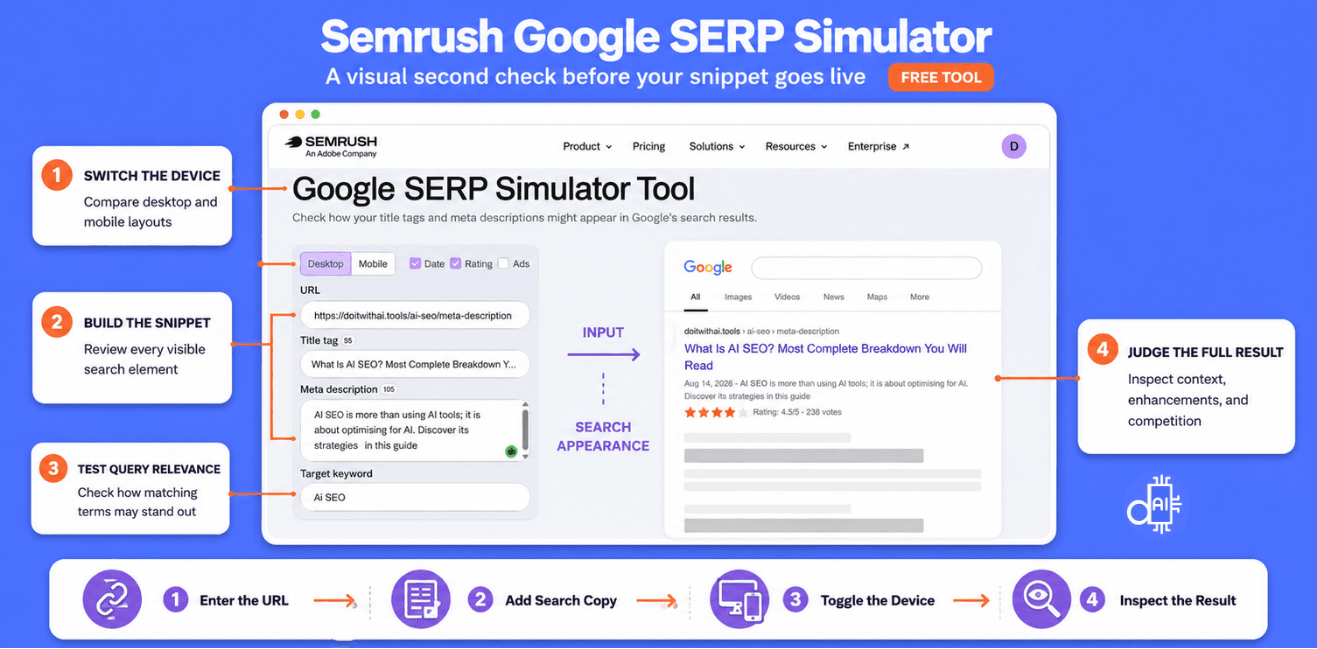
Using Semrush's free Google SERP Simulator provides a visual final check to evaluate title tags, meta descriptions, and keyword relevance before publishing.
Originality.ai Meta Description Generator: Best for Guided SEO Output
Originality.ai provides a more structured generation workflow.
You can supply:
- Page context
- Target keywords
- Audience information
- SEO intent
and generate description options from that input.
Best For
Users who want a dedicated meta description generator instead of a general-purpose chatbot.
Cost: Free usage may be available depending on the current tool offering.
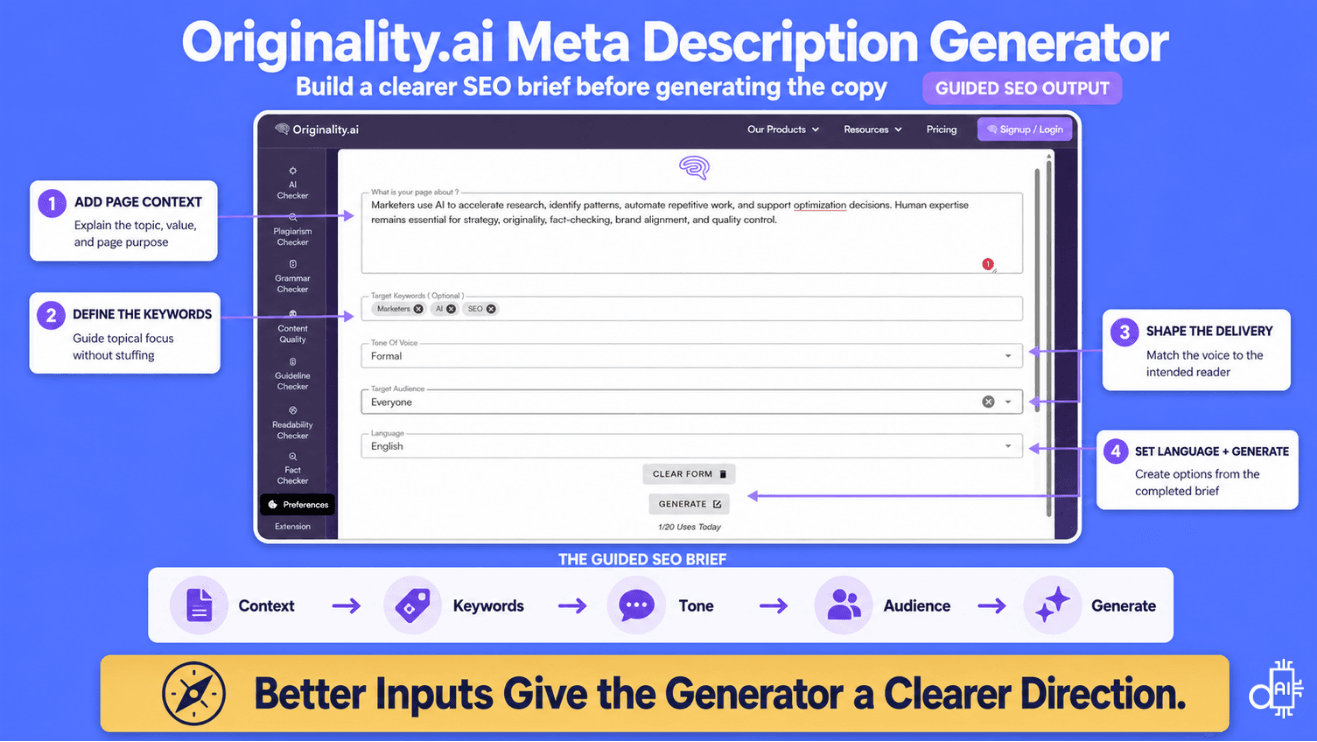
Originality.ai offers a structured meta description generator that transforms detailed page context, target keywords, tone, and target audience data into guided SEO copy.
Complete SEO Editor Tools: Best for Full-Page Context
Some full-page SEO editors—including tools offered by Originality.ai—evaluate metadata in the context of the full article.
Why This Matters
A description should not only sound good in isolation.
It should accurately reflect:
- The page topic
- The main keyword
- Supporting terms
- Headings
- Overall search intent
Best For
Writers who want title, description, headings, and keywords evaluated together rather than as separate elements.
SE Ranking Meta Description Generator: Best for Existing Pages
SE Ranking can be useful when you are auditing live pages that already exist.
Typical Workflow
- Enter the existing URL.
- Let the tool analyze the page.
- Generate new description options.
- Select and refine the strongest version.
- Replace the weak or missing description.
Best For
Auditing and improving existing pages at scale.
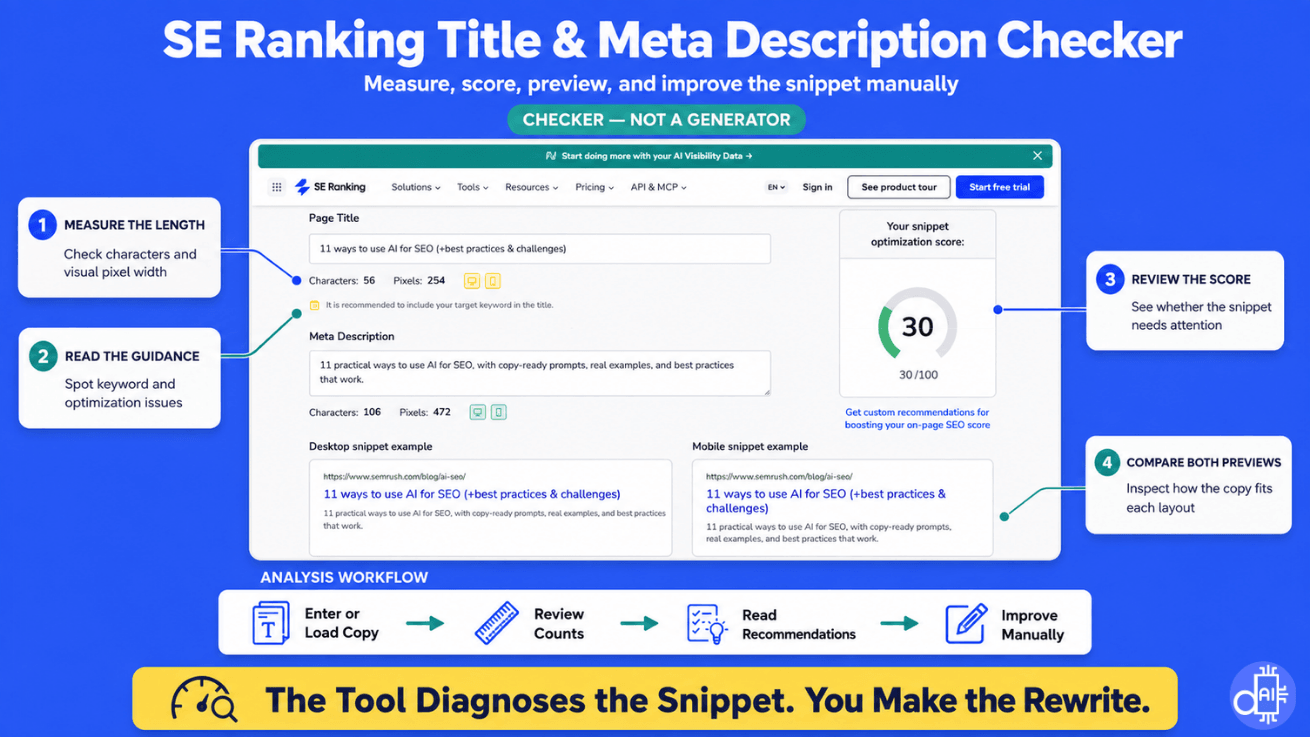
SE Ranking’s Title and Meta Description Checker analyzes existing search snippets by measuring pixel width, evaluating keyword placement, and providing an optimization score.
A Simple Meta Description Action Plan
You do not need a three-month roadmap to put this guide into practice.
Start with one high-impression page that has a weak CTR in Google Search Console.
Then:
- Review the page’s current title, intent, audience, and keyword.
- Generate several description variations using the comprehensive prompt above.
- Refine the strongest option manually.
- Check the final version in the Mangools SERP Simulator.
- Publish it and monitor CTR changes in Google Search Console over time.
Once the workflow works for one page, repeat it across the pages with the highest impressions and weakest CTRs.
That is enough to turn this guide from information into a repeatable optimization process.
Conclusion: Master the Small Element That Influences the Click
Meta descriptions are not direct ranking factors.
But that does not make them unimportant.
In modern search, a strong description has to do several jobs at once:
- Convince humans that your result is worth clicking
- Communicate context clearly to search systems
- Support AI interpretation with concise, relevant metadata
- Differentiate your page from competing results
And it has to do all of that within a very small amount of search-result space.
That is what makes meta descriptions a leverage point.
The goal is not to memorize every rule.
The goal is to understand the system well enough that every meta description you write has a clear purpose.
Here’s Our Promise at Do It With AI Tools
At Do It With AI Tools, the goal is not to help you improve one isolated SEO element.
The goal is to help you understand the full system behind AI-powered SEO and content optimization—from basic concepts to practical strategies, workflows, prompts, and tools.
That is why we continue publishing in-depth guides covering AI-powered SEO, AI keyword research, readability optimization with AI, and AI-assisted target audience research.
The idea is simple:
Give you enough depth to understand the strategy—and enough practical guidance to actually use it.
Your Next Move
Open Google Search Console and find a page with high impressions but weak CTR.
That page is your starting point.
Use the framework from this guide, create a stronger description, validate it in a SERP simulator, publish the update, and track what changes.
The tools are available.
The process is clear.
Now the value comes from applying it.