
AI Tools Expert & Founder
Table of Contents
Search engines judge your content in milliseconds, and the first thing they read isn't your meta title, it's your URL slug.
A slug URL — the last part of a web address, like /how-to-write-slug-url/ — looks small, but it carries meaning for both users and search systems.
Over time, the search itself has changed. What once started as simple keyword matching has now evolved into AI-driven, context-aware answers. And after this shift, the value of a slug URL rose even higher.
Instead of being just a cosmetic piece of the web address, the slug now works as a compact, machine-readable label. In other words, it acts like a quick summary that helps search engines, generative AI systems, and people instantly understand what a page is about.
Think of it this way: a poorly written slug is like placing your masterpiece inside an unmarked box—search engines and AI systems struggle to figure out what’s inside.
On the other hand, a well-optimized slug acts like a clear, bold label. It signals to Google, ChatGPT, Perplexity, and other discovery platforms exactly what your content offers, making it easier to be found, trusted, and clicked.
By the end of this article, you’ll have complete knowledge and practical tools to write slug URLs that maximize both SEO rankings and AI citations.
Understanding Slug URLs in the Age of AI Search
So let’s first talk about what exactly a slug URL is, because understanding this tiny part of your link will make everything else in this article much easier to follow.
A slug URL—also known as an SEO slug URL—is the simple, readable part of a web address that appears in the top URL bar and points to a specific page on your website. It's the part that comes after your domain name and helps both humans and machines understand what the page is about.
For example, in https://doitwithai.tools/ai-seo/write-slug-url, the slug is write-slug-url.
In the modern AI-driven search era, slugs also play another important role: when AI models cite your content in summaries, answer cards, or conversational responses, the slug is often included in the source URL.
A good slug is short, descriptive, and user-friendly; a bad slug is long, auto-generated, or meaningless like /post-1289/.
Because slugs appear in search results, shared links, and AI citations, a clear, descriptive slug boosts click-through rates and builds user trust.
It also helps search engines and AI models understand, classify, and confidently reference your content.
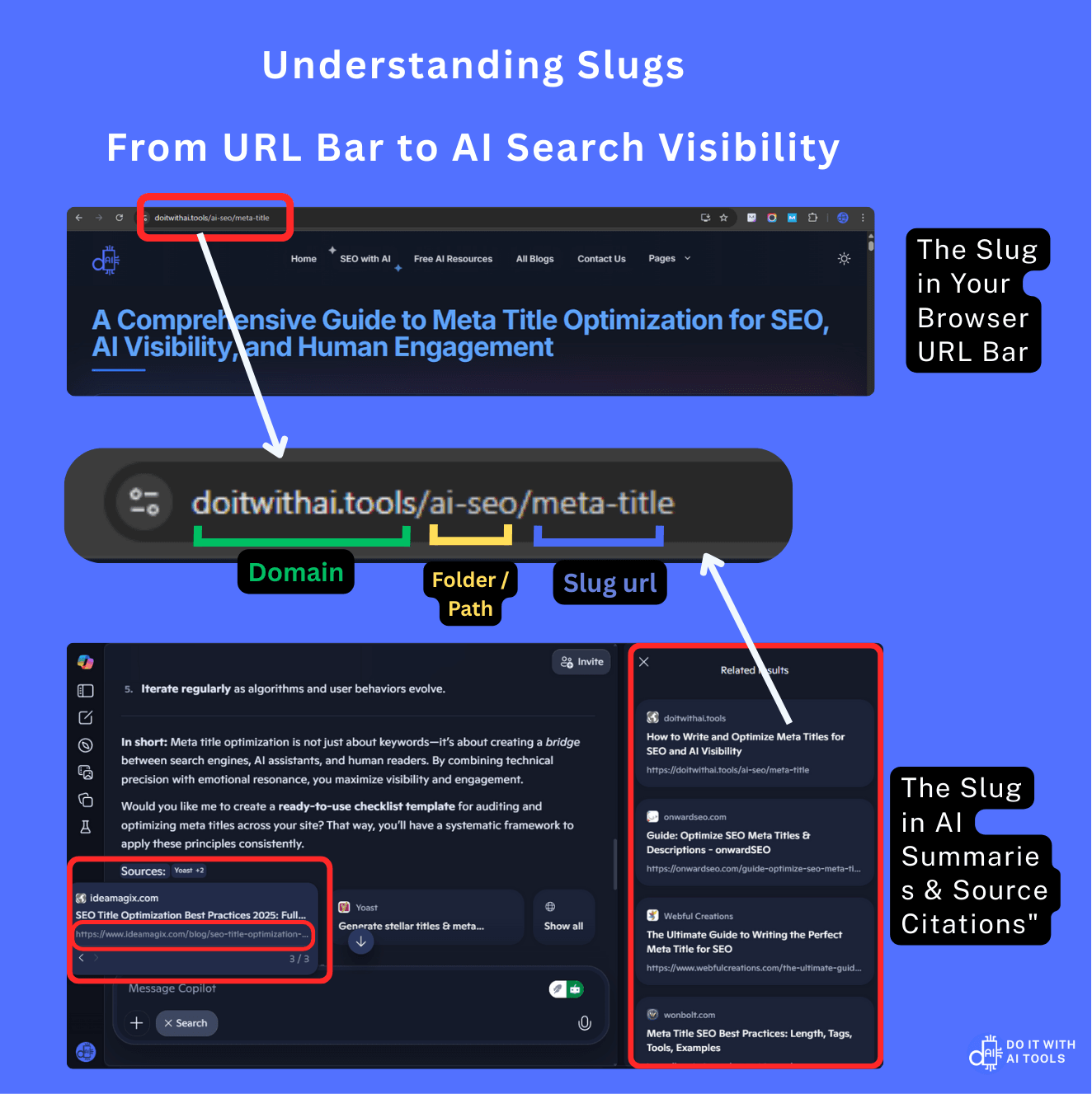
From your browser's address bar to an AI's source citation, the humble slug URL is your content's most powerful, unambiguous identifier.
Why Slug URLs Still Matter in Classic SEO
Now that you understand the basics, it’s important to look at why slugs have always played a steady role in traditional SEO.
Even before AI search systems evolved, slugs helped search engines make fast decisions about what a page is about.
- Search engine interpretation: Google and other search engines parse your slug to quickly understand page content before fully crawling and indexing it. A focused slug that contains your main keyword—selected using AI-powered keyword research tools—gives search bots immediate context about your topic, helping them categorize and rank your content appropriately.
- Faster understanding and better crawlability
Short slugs help search engines process your page faster. When the URL is simple and direct, crawlers immediately understand the topic, which can improve crawl efficiency and reduce the chance of your page being miscategorised. - Impact on rankings and CTR: Studies consistently show that URLs with relevant keywords perform better in search results. When users see a clear, descriptive URL that matches their search query, they're more likely to click. This increased click-through rate sends positive engagement signals to search engines, potentially boosting rankings further.
- User trust and credibility: A professional, readable URL builds instant credibility. Compare these two URLs in a search result:
- doitwithai.tools/ai-content-strategy
- doitwithai.tools/post.php?id=8374&cat=12
- The first URL looks trustworthy and transparent. The second raises suspicion and looks outdated. Users are significantly more likely to click the descriptive option.
- Link-building advantages: When someone copies your URL to share it—in forums, social media, or as plain text—a descriptive slug acts as natural anchor text. Rather than a meaningless number, a keyword-rich slug reinforces your content’s topic and passes more relevant SEO value.
- Mobile search considerations: On mobile devices, URLs are often truncated in search results. A concise, front-loaded slug ensures your most important keywords appear even in limited space, maintaining visibility and relevance in mobile SERPs.
In short, slugs are one of the easiest SEO wins available. Unlike technical optimizations that require developer resources, you control your slugs completely—and you can optimize them instantly.
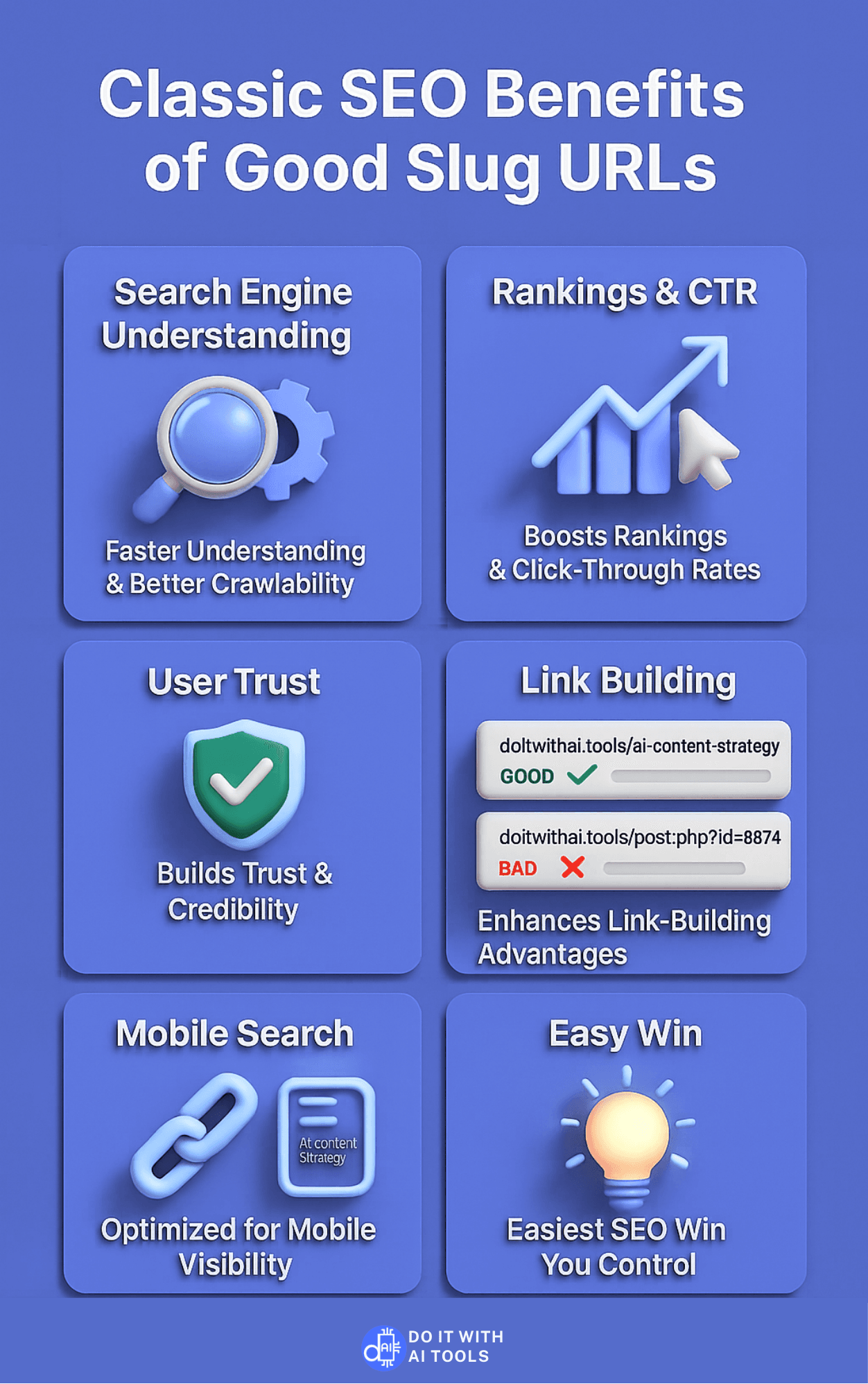
Even in the age of generative AI, the classic SEO slug rules still apply: clarity and a strong semantic signal are mandatory for better rankings and building user confidence.
Why Slugs Matter Even More in GEO/AEO
Now let’s shift our focus to something many creators overlook: how a simple slug URL influences visibility inside GEO and AEO systems. This is where clean, semantic URLs start doing real work behind the scenes.
To understand the slug’s role in this new landscape, we must first recognize the subtle difference between the two dominant AI search modalities:
- Generative Engine Optimization (GEO): This refers to optimizing for AI models that create conversational, comprehensive summaries, and multi-sourced responses (like Google’s AI Overviews or Perplexity). GEO prioritizes semantic relationships and topic coverage.
- Answer Engine Optimization (AEO): This refers to optimizing for AI models that extract a single, precise fact, definition, step, or instruction to provide a direct answer (like a Featured Snippet or a definitive answer card). AEO prioritizes directness and fact extraction.
Since the slug is the very first piece of content both systems read, it carries a distinct signaling function for each.
How Slug URLs Influence GEO (Generative Engine Optimization)
GEO begins reading your page from the very top—starting with your slug URL. This makes the slug a powerful semantic signal that helps generative engines understand the topic, the intent, and the entity relationships behind your content.
When these generative systems pull sources, they rely on clarity, consistency, and semantic precision—all of which begin with the slug URL. A clean, well-structured slug establishes trust before the model even processes your content.
What GEO looks for in a slug URL
A GEO-friendly slug gives the AI model a clean, structured snapshot of what the page is about. This happens because the slug helps GEO interpret:
- URL Semantic Meaning: The slug’s words instantly hint at the page’s core topic, guiding the model toward the right knowledge cluster.
- Topic Clarity: Short slugs make the subject instantly recognizable, avoiding ambiguity.
- Keyword + Entity Relevance: GEO uses the slug to quickly match your page with the correct entities, themes, and query variations, confirming topical authority.
- Content Alignment: GEO reads the page in order: URL → H1 → Content. The slug becomes the foundational entity signal the rest of your content builds upon.
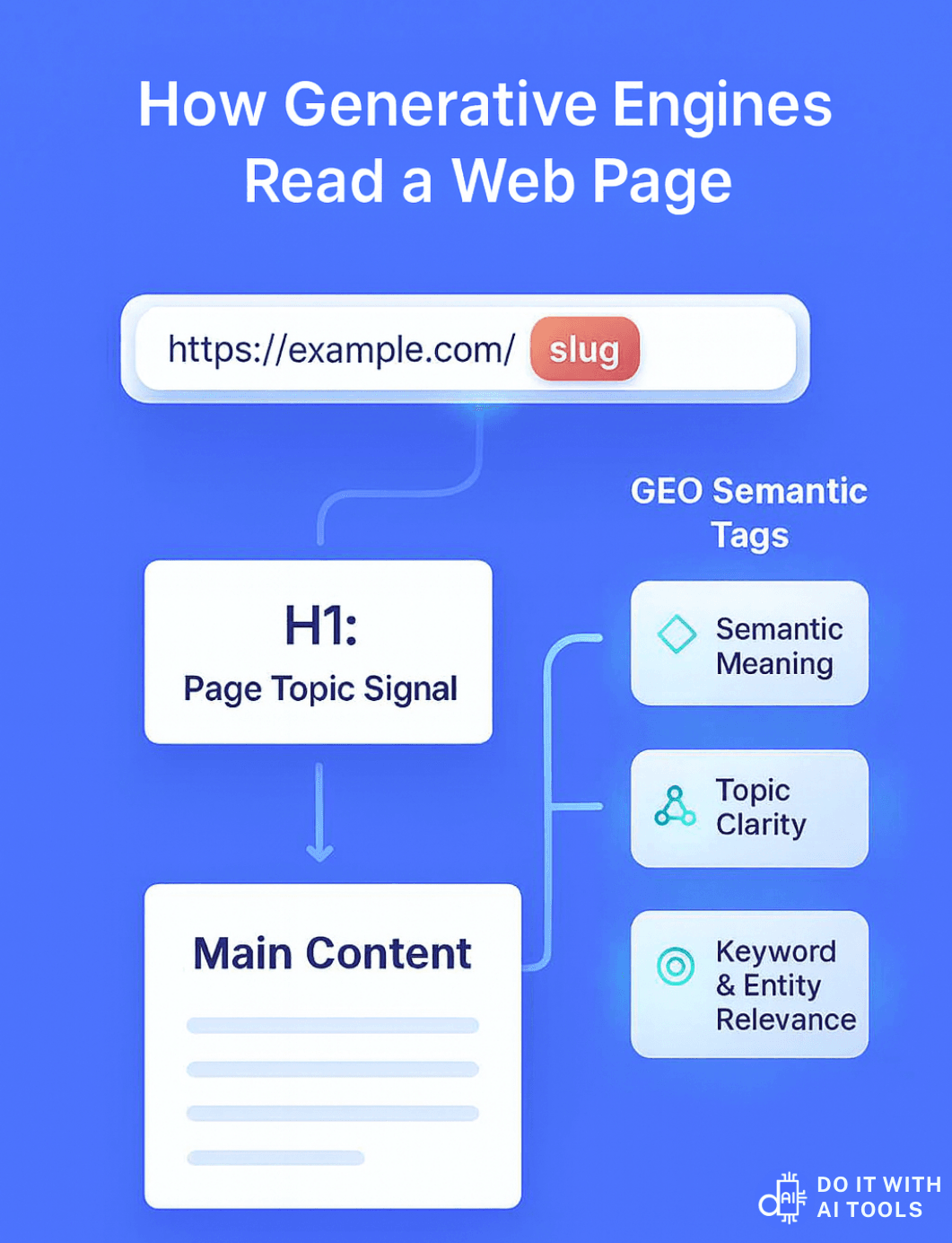
Before AI even touches your H1 or content, it reads your URL slug first, confirming the semantic meaning, topic clarity, and entity relevance of your page.
How Slug URLs Influence AEO (Answer Engine Optimization)
AEO is slightly different because answer engines need to extract a precise, confidence-driven answer. They prioritize clarity and directness, and your slug plays a surprisingly important role in helping the model decide whether your page can deliver a clean, answer-ready response.
The primary role of the slug here is to signal Confidence in the Answer. If the slug is messy, overly long, or unclear, the AEO model will hesitate, believing the URL doesn’t match the direct answer it wants to extract.
What AEO looks for in a slug URL
AEO evaluates whether your slug:
- Clearly Represents the Main Topic: It must be an unmistakable match for the core question or search intent.
- Aligns with the Query Intent: It should match the action or definition the user is seeking (e.g., how-to or what-is).
- Signals a Focused Subject: It assures the model that the page is dedicated to a specific, extractable subject.
- Helps the Engine Locate Answer Context: It acts as a clear signpost, making it easier for the engine to locate structured, answer-worthy content within the page.
- Matches the Structured Answer Inside the Content: A direct slug reinforces the structured answer found in your headings or lists.
AEO cares less about length and more about direct clarity.
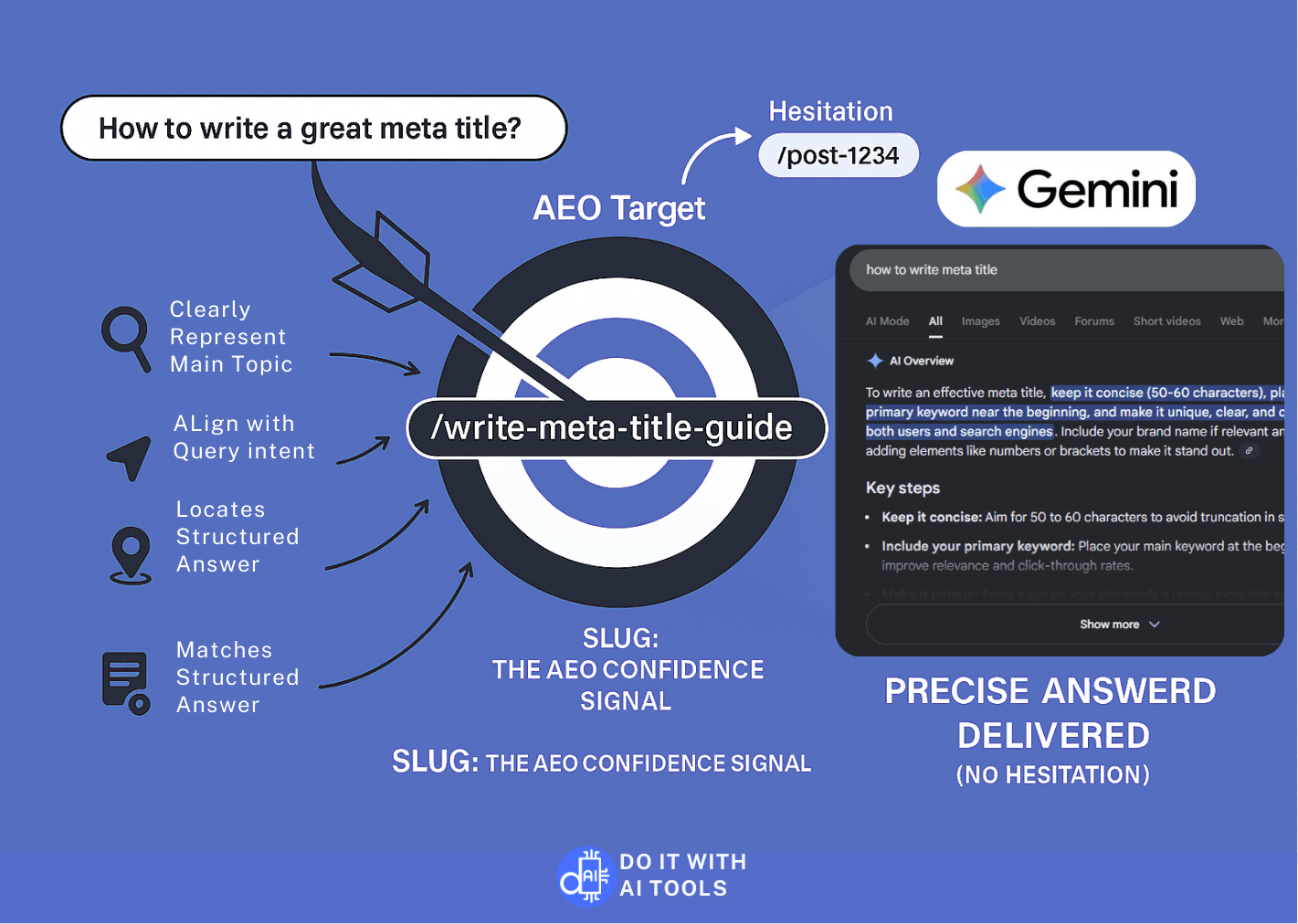
In the world of Answer Engine Optimization, your slug isn't just a label—it's the confidence signal that assures the AI your page contains the precise answer it needs to extract.
Why short, descriptive slugs Work Better for both AEO and GEO
At the end of the day, short, descriptive slugs provide clarity, reduce semantic noise, and strengthen signals that both GEO and AEO rely on.
They make the topic and entities easier to detect, support intent identification, and improve AI’s ability to extract and classify content accurately. This simple practice gives your page a universal advantage across generative and answer-focused search engines.
Examples of Strong vs Weak Slugs for GEO and AEO
Strong slug:/ai-seo-strategy
Short, single-topic, semantically clear, and easily interpreted by both GEO and AEO systems.
Weak slug:/the-complete-guide-to-using-artificial-intelligence-for-modern-seo-strategies-in-2025
Long, overly descriptive, and creates vector noise that reduces clarity and confidence in AI extraction.
Another weak slug example (auto-generated):/pUS5Fr6yVtB64J67NpjCR/
Completely unreadable, providing no semantic value for either GEO or AEO.
What This Means for Your Content Strategy
AI-driven results now appear in a meaningful share of user queries — from Google’s AI Overviews to Perplexity’s multi-source answers to Bing/Copilot’s conversational responses.
Because of this shift:
- A clear slug improves your visibility in generative engines.
- A descriptive slug helps answer engines to trust your page.
- And a focused slug increases your chances of being cited inside AI summaries, cards, and snapshots.
Even a small upgrade in your slug structure can multiply your reach across AI search systems.
What used to be a small SEO detail has now become a practical, high-leverage optimization for both GEO and AEO.

AI isn't impressed by long, messy URLs—it prefers a quick, professional introduction via a short, descriptive slug that signals immediate topical clarity.
How to Write a Strong Slug URL (Step-by-Step Framework)
A good slug is not a last-minute detail. It’s a structural decision that affects your page for years.
That’s why each step below builds on the previous one and should be treated as intentional, not optional.
1. Start With Intent (This Is the Most Sensitive Step)
Before writing a single word, identify the primary search intent behind the page intent (informational, transactional, or navigational) based on your target audience’s search behavior, and shape the slug around that
Your slug should lock into that intent clearly and permanently.
Think of your slug as a long-term identifier, not a flexible headline. Unlike titles or content sections, slugs are expensive to change later and often shouldn’t be touched once published.
Key mindset:
Research first. Decide once. Write the slug as if it will never change.
Once intent is clear, choose wording that mirrors how your audience actually searches—not how you’d phrase it casually.
2. Keep the Slug Short and Precise
Aim for 3–5 words that describe the topic clearly without dilution.
This isn’t about adding detail—it’s about removing friction.
Short slugs act like clean labels. They give just enough context to anchor the page without excess wording that weakens clarity.
This principle stays constant regardless of trends, algorithms, or content format.
3. Use One Primary Keyword—Naturally
A slug does not need to be keyword-rich.
It needs:
- One main keyword
- Placed naturally
- Chosen through proper research
That single keyword provides topic clarity without adding noise. Anything more usually reduces precision rather than improving relevance.
4. Trim Only What Doesn’t Add Meaning
Remove filler words like “the,” “a,” or “and” only if the meaning stays intact.
Sometimes keeping a preposition improves intent matching.
The goal isn’t minimalism—it’s clarity per character.
5. Use Hyphens for Separation
Hyphens are the standard way to separate words in slugs.
They improve readability and help systems parse each term correctly.
Avoid spaces, underscores, or mixed formatting.
6. Align the Slug With the Page Topic
Your slug, page title, and H1 should agree at a topic level.
They don’t need to be identical—but they must point to the same idea. This consistency reduces ambiguity for both users and systems reading the page.
7. Make It Stable and Future-Proof
Write slugs for topics, not moments.
Avoid locking slugs to trends, dates, or temporary angles unless the content itself is time-bound. A well-chosen slug should still make sense months or years later.
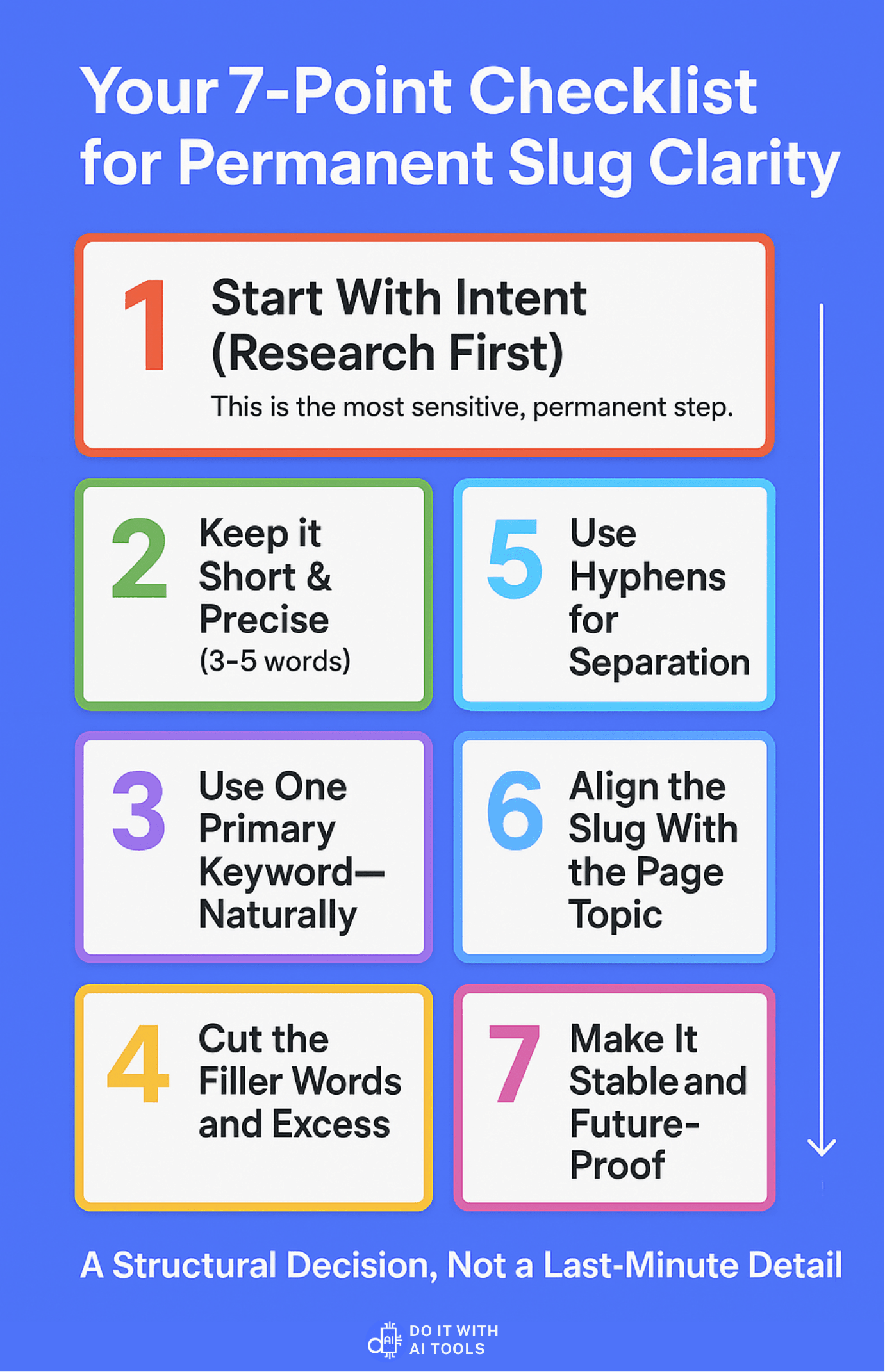
Stop treating the slug as a last-minute detail—use this 7-point checklist to ensure every URL you publish is a permanent, future-proof asset that drives clarity for SEO and AI.
Benefits of a Well-Written Slug URL (By Audience)
Instead of looking at slugs generically, it’s more useful to see who they serve—and how.
Benefits for Human Readers
- Easier to recognize what a page is about before clicking
- Simpler to remember or manually type when revisiting
- Cleaner and more trustworthy when shared as a link
A good slug lowers cognitive effort. Readers don’t need to “interpret” the link—they instantly get it.
Benefits for SEO Systems
- Clear topical signal at the earliest crawl stage
- Strong alignment with page intent and structure
- More consistent interpretation across indexing and ranking stages
Slugs help search systems place your page in the right topical bucket early.
Benefits for AI & Generative Engines
- Clean semantic label before content is processed
- Easier entity and topic matching across queries
- Stronger confidence when evaluating page relevance
AI systems read slugs as structured hints. A clear slug reduces uncertainty before deeper analysis begins.
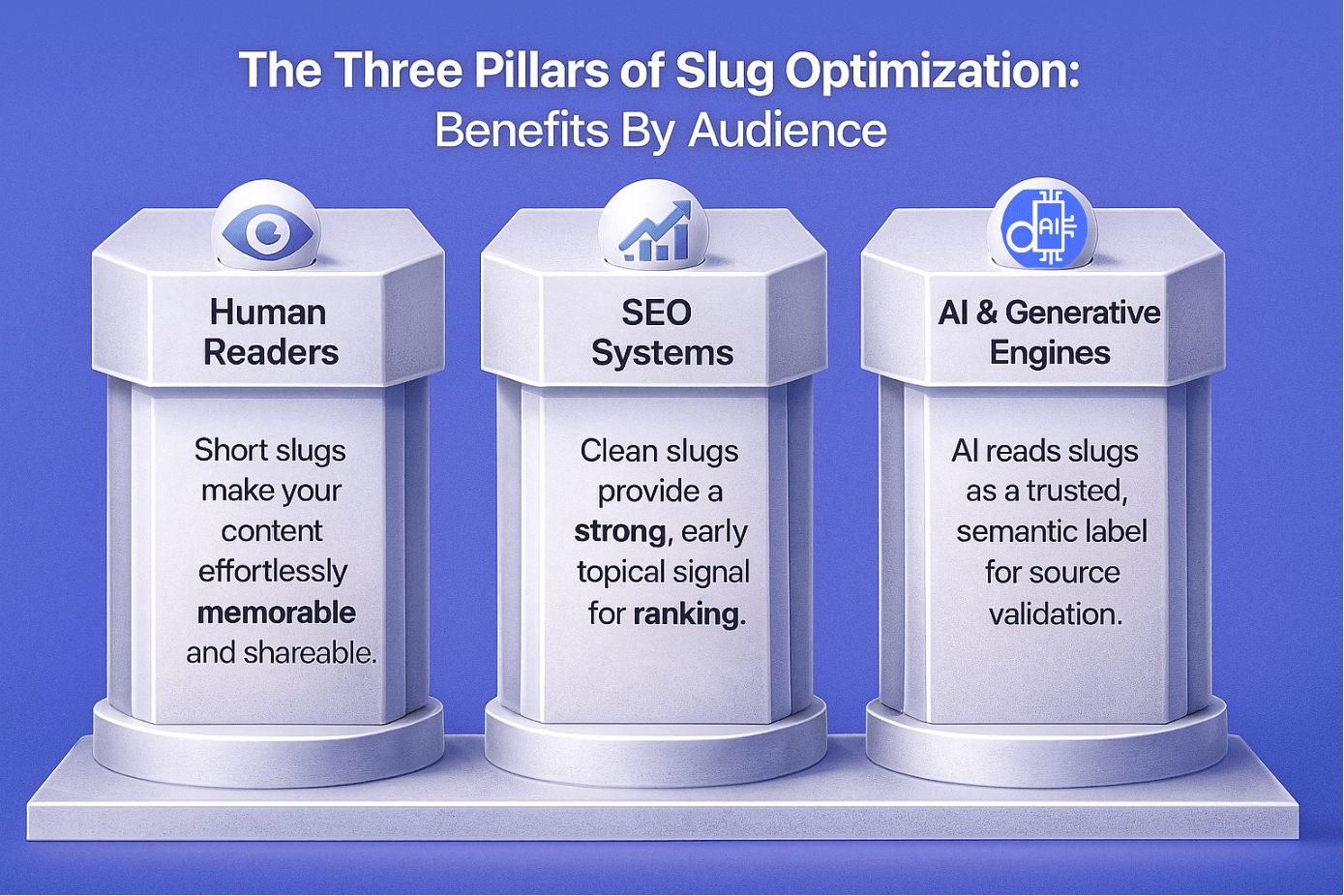
The best slug is the one that serves all three masters equally: giving clean signals to AI, a strong topic signal to SEO systems, and effortless shareability to your readers.
Common Slug URL Mistakes to Avoid
These are the typical missteps we see even seasoned marketers make. Treating the slug casually is the single biggest mistake you can make in the age of AI.
- Keyword Stuffing: The classic mistake of cramming multiple keywords or writing unnecessarily long slugs that end up diluting your topic clarity.
- Ignoring It or Taking It Lightly: The fundamental error of assuming the CMS default is "good enough" or treating the slug as a minor detail after the content is written.
- Frequent Editing and Changing: Changing a slug after publishing forces you to deal with permanent 301 redirects, creating redirect chains that hurt your page’s authority and confuse the AI model's source verification.
- Using Underscores or Spaces: Avoid using spaces (which become messy
%20codes) or underscores (_). These cause parsing and readability problems for search engines. - Adding Dates Unless Necessary: Date-heavy slugs quickly make evergreen content look outdated, severely reducing long-term click-through rates.
- Not Using AI to Check: Failing to use prompt engineering or AI tools to check your slug options for clarity, conciseness, and semantic consistency before publishing.
- Wrongly Trusting the First AI Input: Relying solely on a generative tool’s first suggestion without editing it down to the essential 3 to 5 words, which often results in slugs that are too descriptive and too long.
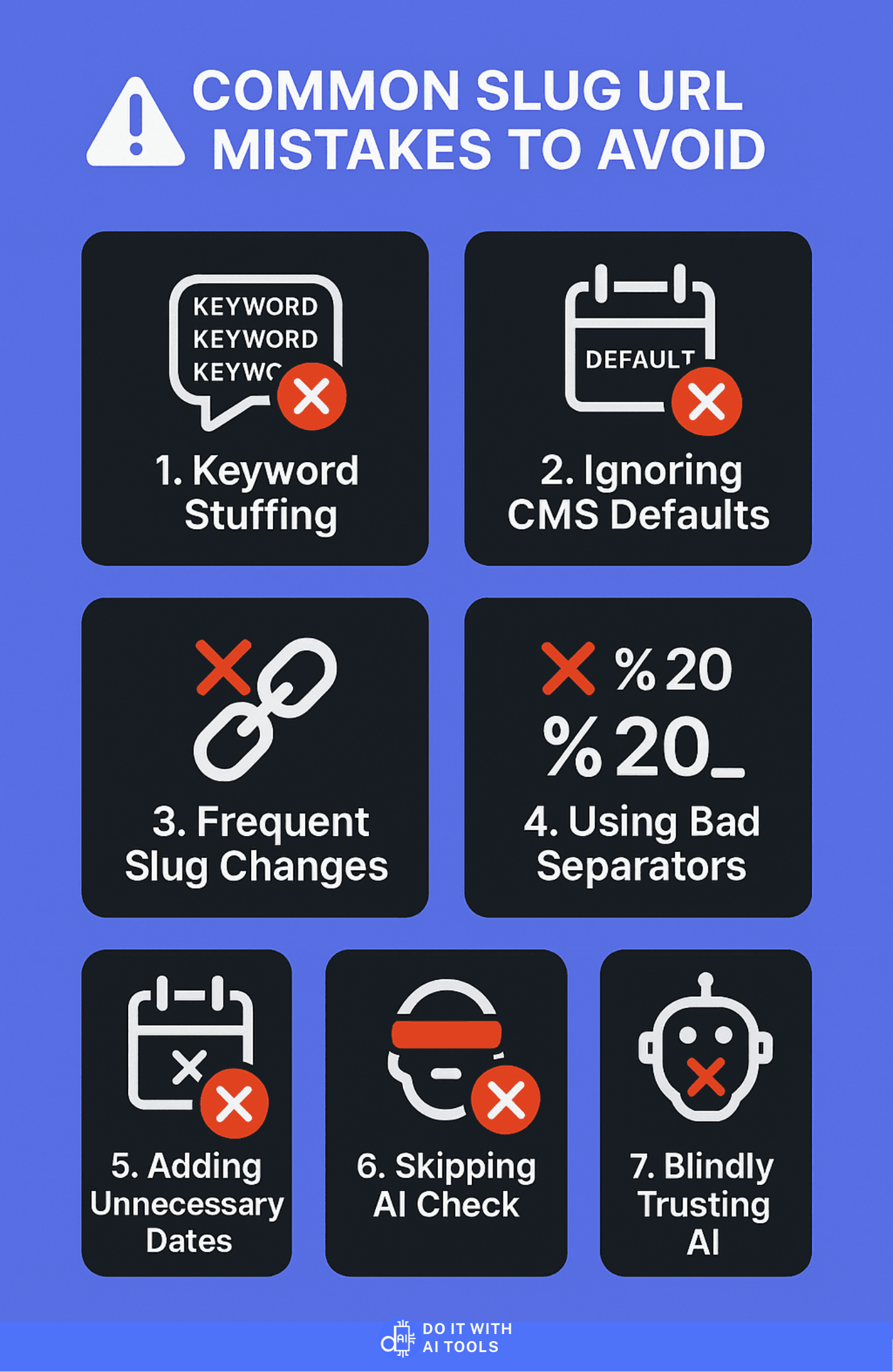
Before you hit publish, confirm you've avoided these seven common slug mistakes—especially ignoring CMS defaults and making frequent, unnecessary changes.
How a Bad Slug URL Creates Problems Across the Web
A bad slug URL is usually long, auto-generated, unclear in structure, or disconnected from real search intent. While this may seem like a small issue, it affects every system that interacts with your page in different ways.
- Impact on human readers
When someone sees a messy or meaningless slug, it instantly creates friction. The URL does not clearly explain what the page contains, which makes users hesitate before clicking or sharing it. Over time, this reduces trust and weakens first impressions, especially when your link appears in search results or social feeds. - Impact on SEO and search engines
Search engines use the slug as an early signal to understand page context. A poorly written slug slows that understanding and adds uncertainty during crawling and indexing. Instead of reinforcing your topic, it forces search systems to rely more heavily on other signals, which can weaken consistency and long-term visibility. - Impact on AI and generative search engines
AI systems look for clear, structured clues to match pages with user questions. A vague or auto-generated slug provides little semantic value, making it harder for the model to confidently classify and reference your content. When AI has multiple sources to choose from, unclear slugs are often filtered out in favor of pages that communicate their topic instantly.
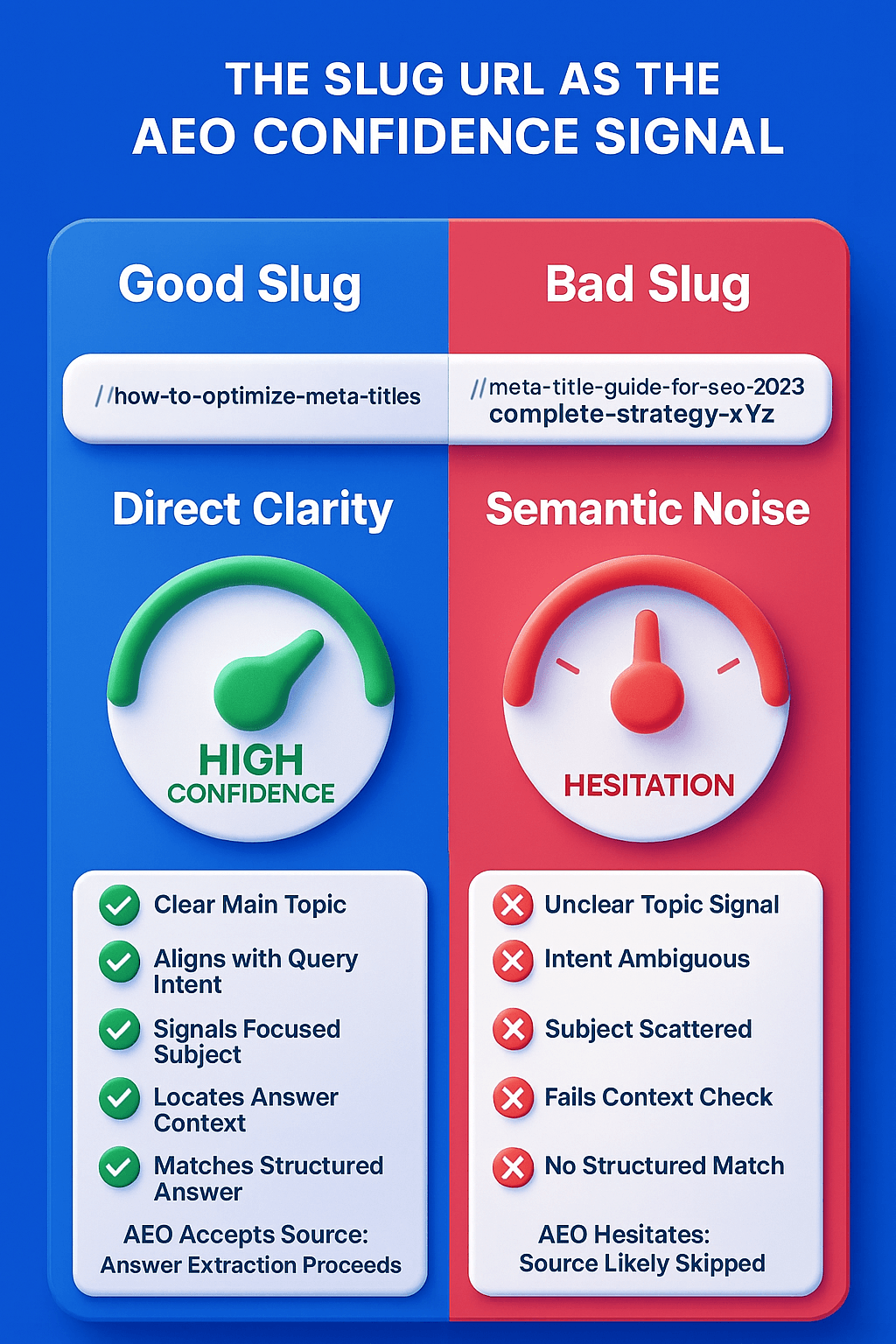
The difference between being cited by an Answer Engine and being skipped is right here: a clear slug ensures Direct Clarity, and a messy slug is pure Semantic Noise.
How to optimize slugs specifically for AI visibility (AEO/GEO tips)
- Make the slug reflect the question people ask: AI engines often match to question-style intent, so slugs like /write-seo-friendly-slug/ map well to “how do I write an SEO-friendly slug?” queries.
- Use entity-friendly wording: include the main entity or topic (e.g., ai-seo) in parent folders to provide topical context.
- Keep cluster consistency: use a stable folder structure for related pages so the model sees consistent entity-topic grouping (e.g., /ai-seo/slug-guide/, /ai-seo/keyword-research/).
- Reinforce E-E-A-T signals elsewhere: slugs help, but combine them with author info, schema, citations, and authoritative links so AI has a broader trust signal set.
- Avoid over-optimizing for exact-match phrases: generative models prioritize intent; natural phrasing wins over awkward exact-match stuffing.
- Since a slug is meant to be easily understood by both users and search systems, focusing on readability helps keep URLs short, clear, and scannable.
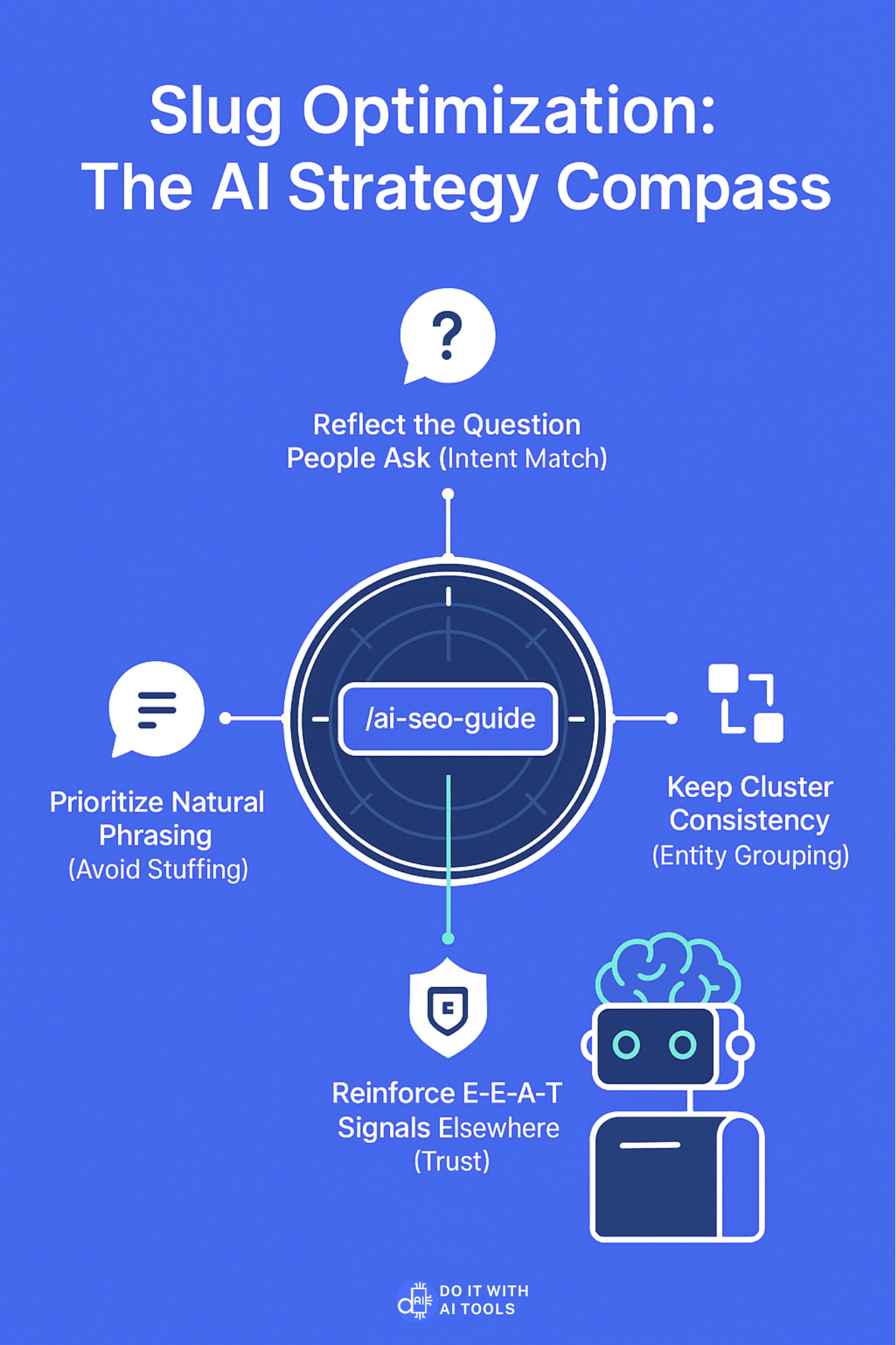
If you want the AI to trust your answer, your slug must point to the right destination; use this four-part strategy to prevent hesitation and boost confidence signals.
Handling slug changes — the 301 redirect rule and when to change a published slug
Warning: Never change a published slug without a strategic reason.
If you must change it, follow the 301 redirect rule: a permanent 301 redirect from the old URL to the new URL preserves the majority of link equity and signals to search engines that the page moved permanently.
Google’s guidance and industry best practices recommend 301s to consolidate signals and prevent 404s.
That said, migrations carry risk: poorly planned or delayed redirects can cause traffic loss, broken links, and ranking drops. (Google for Developers)
When to change a slug (only with a plan):
- The slug is wrong for a long-term topic strategy (e.g., the content pivoted to a different intent).
- The slug is harming CTR or causing confusion.
- You’re consolidating multiple outdated pages into a single authoritative page.
How to change safely:
- Map old URLs to new URLs in a spreadsheet.
- Implement 301 redirects server-side (not client-side).
- Update internal links across the site to point to new URLs.
- Update sitemaps and submit them to Search Console.
- Monitor traffic and indexation closely for at least 4–8 weeks.
- Avoid redirect chains — direct old → new only.
What the evidence says: when done correctly, 301 redirects transfer the majority of link equity and preserve rankings; but frequent URL churn and poor redirect management can still hurt performance if links break or the content relevance changes. Plan migrations carefully and test redirects before making them live. (Alli AI)

The 301 Redirect is non-negotiable: changing a permanent slug without it means dropping your link equity into the 404 abyss, immediately harming your SEO authority.
How to Write Slugs Using AI (Workflows & ChatGPT Prompts)
This is where everything you’ve learned so far becomes practical.
AI tools like ChatGPT can dramatically speed up your entire slug optimization process while ensuring you effortlessly follow all the necessary best practices.
You can also try Merlin AI, which combines several AI capabilities into one interface that makes it even more convenient to execute complex workflows from a single location.
Now, let’s start exploring how to leverage these AI capabilities for writing, fixing, and improving your slug URLs, complete with proven prompts and workflows you can implement today.
Method 1: Creating New Slug URLs With ChatGPT Prompt
When creating content, use AI to generate multiple optimized slug options before publishing.
What You Need:
- Your article's H1 heading/title
- A brief content overview (2-3 sentences)
- Your primary target keyword.
Once you’ve gathered your content information, provide it to AI and use the prompt below to generate slug suggestions.
Prompt Start:
I need help creating an SEO and AI-optimized slug URL for my new article.

**Article H1/Title:** [Your article title]
**Content Overview:** [2-3 sentence summary of what the article covers]
**Primary Keyword:** [Your target keyword]
**Target Audience:** [Who this content is for]

---

**STEP 1: Content Analysis**
Before generating slugs, analyze:
1. **Content Type:** Is this a how-to guide, comparison article, tool review, listicle, tutorial, or informational piece?
2. **Search Intent:** Informational, transactional, or navigational?
3. **Audience Sophistication:** Beginner-friendly, intermediate, or expert-level content?
4. **Topic Sensitivity:** Will this content stay evergreen or is it time-sensitive?

Provide a brief analysis (2-3 sentences) explaining your understanding.

---

**STEP 2: Generate 30 Slug Variations in 3 Categories**

Generate 10 variations for each approach below. All slugs must:
- Use hyphens between words
- Be all lowercase
- Avoid special characters
- Be optimized for both traditional SEO and AI search engines (AEO/GEO)

**SET 1: Keyword-Optimized Slugs (10 variations)**
Priority: Maximum keyword presence and SEO power
- Focus on including primary keyword + related terms
- Example style: `ai-seo-strategy-guide`, `slug-url-seo-optimization`
- Length: 2-4 words preferred

**SET 2: Brief & Concise Slugs (10 variations)**
Priority: Shortest possible while maintaining meaning
- Ultra-compact, essential words only
- Example style: `write-slug-url`, `ai-seo-tips`
- Length: 2-3 words maximum

**SET 3: Clear & Descriptive Slugs (10 variations)**
Priority: Maximum user understanding and intent clarity
- Natural language, mirror how users actually search
- Example style: `how-to-write-slug-url`, `what-is-ai-seo`
- Length: 3-5 words, readability over brevity

---

**STEP 3: Select Top 3 from Each Set**

From each of the 3 sets above, choose the 3 strongest options and explain why they work best within their category approach.

**From SET 1 (Keyword-Optimized) - Top 3:**
1. [slug] - [brief reasoning]
2. [slug] - [brief reasoning]
3. [slug] - [brief reasoning]

**From SET 2 (Brief & Concise) - Top 3:**
1. [slug] - [brief reasoning]
2. [slug] - [brief reasoning]
3. [slug] - [brief reasoning]

**From SET 3 (Clear & Descriptive) - Top 3:**
1. [slug] - [brief reasoning]
2. [slug] - [brief reasoning]
3. [slug] - [brief reasoning]

---

**STEP 4: Final Recommendation Grid**

Present all 9 finalists in a comparison table showing:
- Slug option
- Category (Keyword/Brief/Clear)
- Pros
- Cons
- Best for (which user type/use case)
Prompt End.
This advanced slug generation prompt is designed to give you 30 diverse slug variations organized into three strategic categories.
This process ensures you find the perfect URL slug that matches your specific content goals and audience preferences.
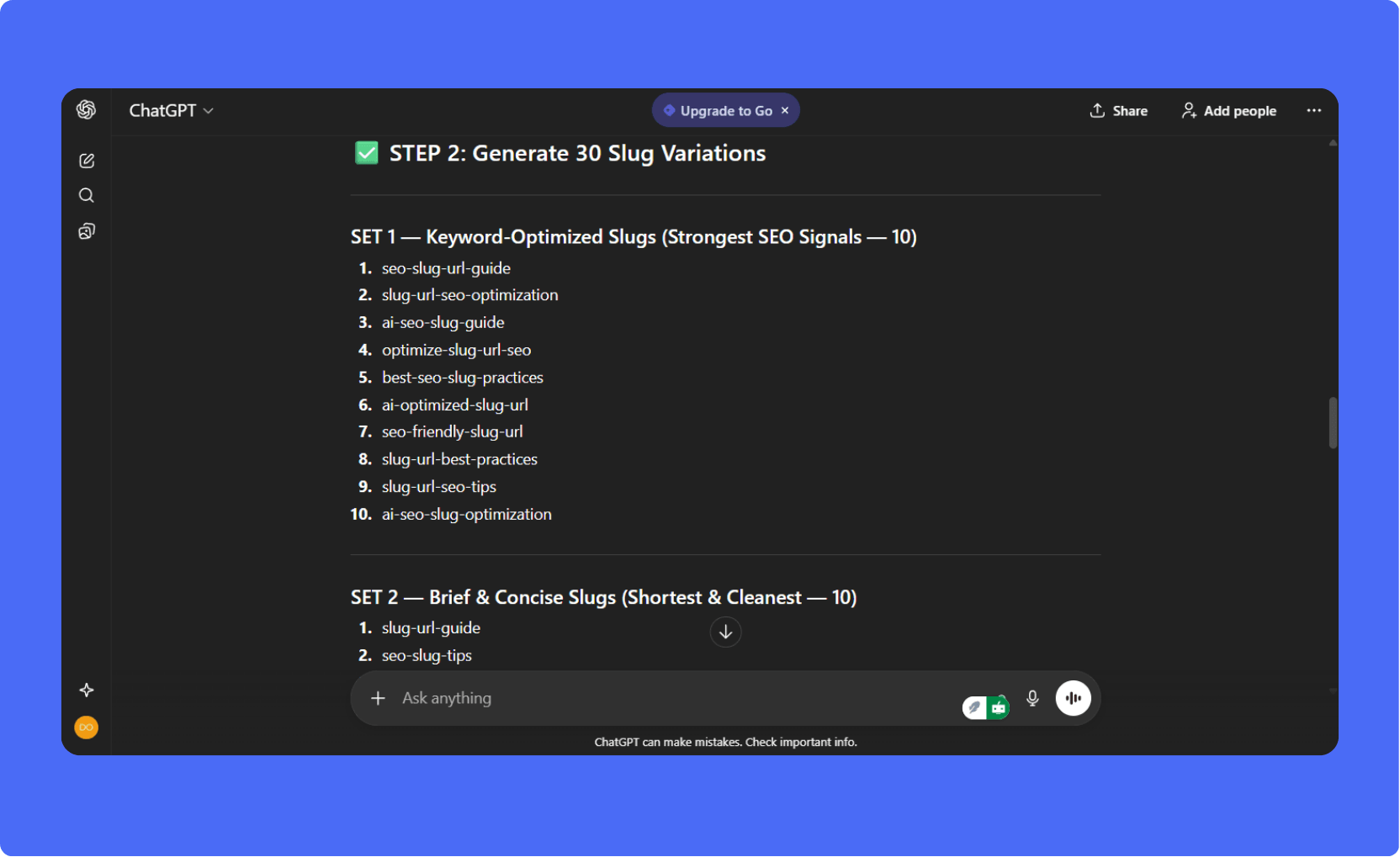
The fastest way to eliminate slug guesswork is to use a prompt like this, ensuring you have the strongest possible options for both traditional SEO signals and modern brevity.
Method 2: Improving Existing Slug URLs with ChatGPT
This powerful method helps you audit and fix problematic slugs across your entire website.
What You'll Need:
Your website's XML sitemap URL (usually yoursite.com/sitemap.xml)
Or a list of URLs you want to audit (exported from Google Analytics, Screaming Frog, or manually compiled)
The Complete Audit & Improvement Prompt:
Prompt Start:
I need you to audit my website's slug URLs and identify any that need optimization for SEO and AI visibility (AEO/GEO).

**My sitemap URL:** [paste your sitemap.xml URL]
OR
**List of URLs to audit:**
[paste list of URLs]

Please analyze each slug URL and:

1. **Identify problematic slugs** that have these issues:
- Too long (6+ words)
- Missing target keywords
- Using special characters, underscores, or uppercase letters
- Contains stop words unnecessarily
- Uses dates or post IDs instead of descriptive text
- Doesn't match search intent
- Poor structure for AI engine interpretation

2. **For each problematic slug, provide:**
- Current slug URL
- Specific issues found
- Improved slug recommendation
- Brief explanation of improvements

3. **Optimization criteria for improvements:**
- 3-5 words maximum
- Include relevant keywords naturally
- Use hyphens as separators
- All lowercase letters
- Remove unnecessary stop words
- Match content intent (informational/transactional/navigational)
- Optimize for both Google SEO and AI search engines (ChatGPT, Perplexity, Google SGE)
- Improve semantic clarity for AI content understanding
- Enhance citation likelihood in AI-generated answers

4. **Prioritize fixes** by severity:
- Critical: Slugs that significantly hurt SEO/AI visibility
- High: Slugs with multiple optimization issues
- Medium: Slugs that could be improved but aren't broken
- Low: Minor improvements for consistency

Please provide results in a table format for easy implementation.
Prompt End.
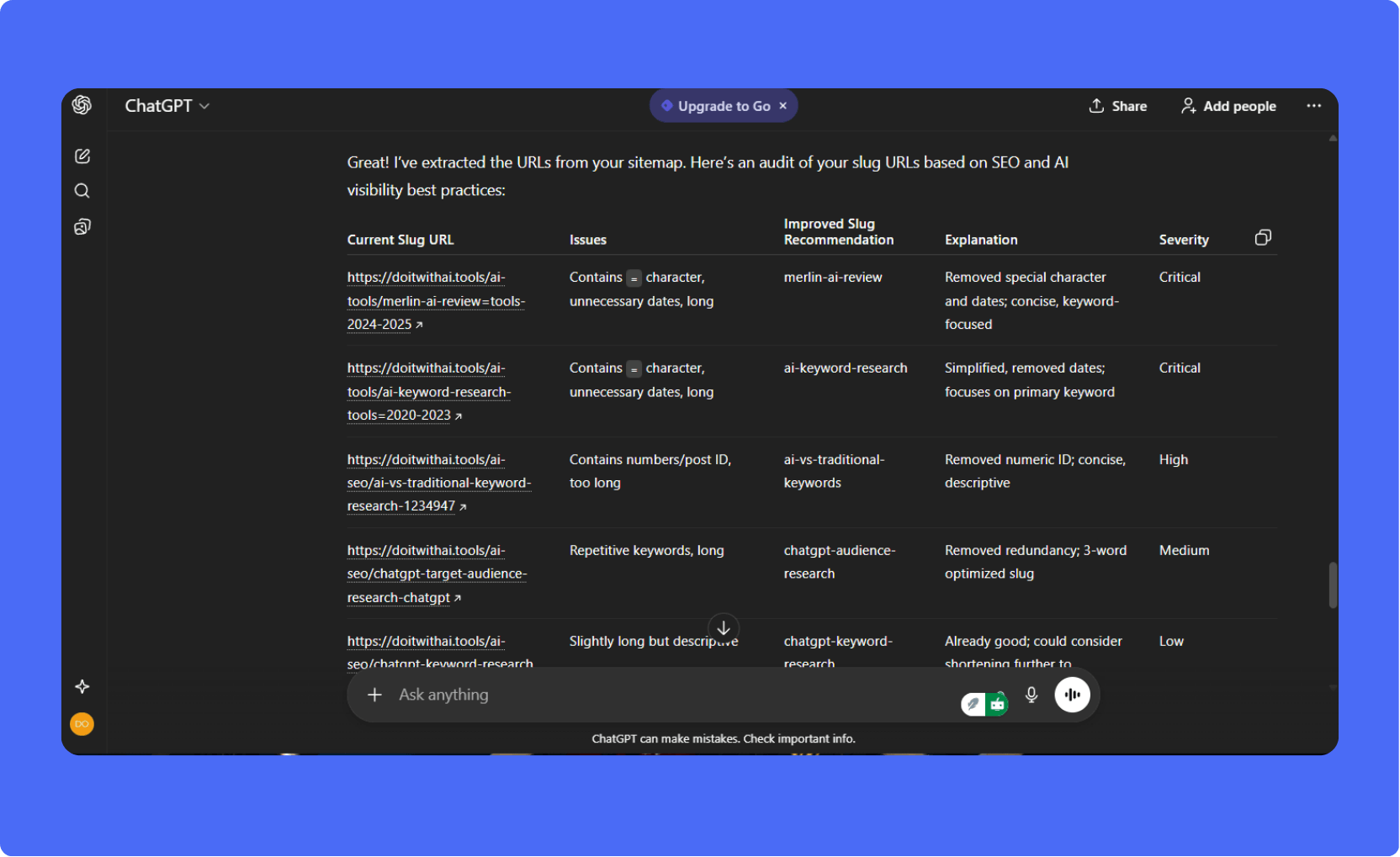
Stop manual audits! This is how you leverage AI precision to instantly check your entire sitemap, identifying critical slug errors like unnecessary dates and redundant keywords.
Why You Should Use AI for Slugs and Content Optimization
There’s an irony in modern search that many creators still overlook: the most reliable way to get cited by AI systems is to use AI during your content creation process.
Generative engines like ChatGPT, Perplexity, and Claude don’t just reward “good writing.” They reward content that is structured, consistent, and easy for machines to parse. And that’s exactly where AI tools excel.
When you use AI to generate clean slug URLs, organize content with clear headings, add FAQ sections, and incorporate semantic keywords naturally, you’re not trying to game the system.
You’re simply aligning your content with the quality standards AI search engines already apply.
In other words, you’re speaking the language these systems understand.
This approach creates a strategic loop. You use AI to structure and optimize your content.
AI-driven search engines then find your pages easier to interpret, classify, and cite. As a result, you gain visibility not only in traditional search results but also in AI summaries, answer cards, and conversational responses.
What makes this even more practical is that AI isn’t just about speed — it’s about consistency and precision.
Marketers even use AI to create supporting visuals and short video content, making the entire content workflow more coherent and machine-friendly.
Research from HubSpot shows that a large majority of marketers using AI report major gains in output, often producing several times more content in the same timeframe. But the real advantage isn’t volume.
It’s the ability to optimize every detail, including slugs, headings, and image alt text, based on patterns rather than guesswork.
For something as small but critical as a URL slug, AI is especially effective. It can scan top-performing competitors, identify keyword patterns that actually drive traffic, remove human bias and overthinking, and generate multiple high-quality options in seconds.
What might take minutes — or lead to hesitation — becomes fast and repeatable.
The creators and marketers winning today aren’t doing more manual work. They’re using AI strategically to get the fundamentals right at scale.
By offloading repetitive, pattern-based tasks like slug optimization to AI, you free your focus for planning, creativity, and decision-making — the work only humans do best.
The takeaway is simple: use AI to optimize for AI. It’s not cheating. It’s how modern content stays visible, trusted, and competitive in an AI-driven search world.
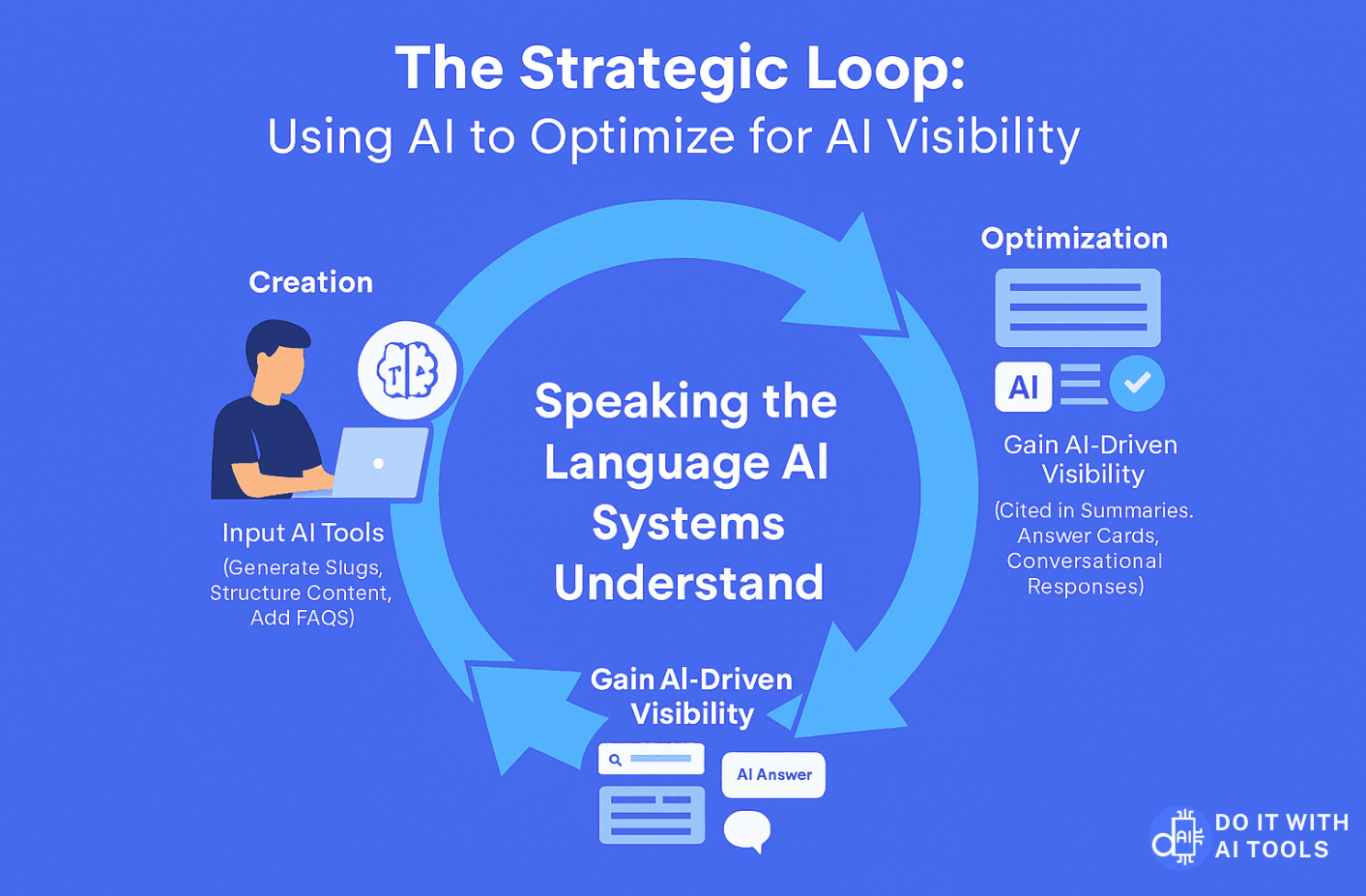
You aren't cheating; you're just being strategic! Use AI to handle the pattern-based work (like slug creation) and get back the time you need for human creativity.
Best Free AI Slug Generator Tools
While ChatGPT is more than capable and often the best choice for generating optimized slug URLs, some creators prefer dedicated tools for a quicker, automated approach. I’ve found two useful options:
Slugify.online
Slugify.online is a simple, no-fuss slug generator that converts your title into a clean URL with dashes. It also removes stop words and numbers in a single click, making it easy to produce short, readable slugs instantly.
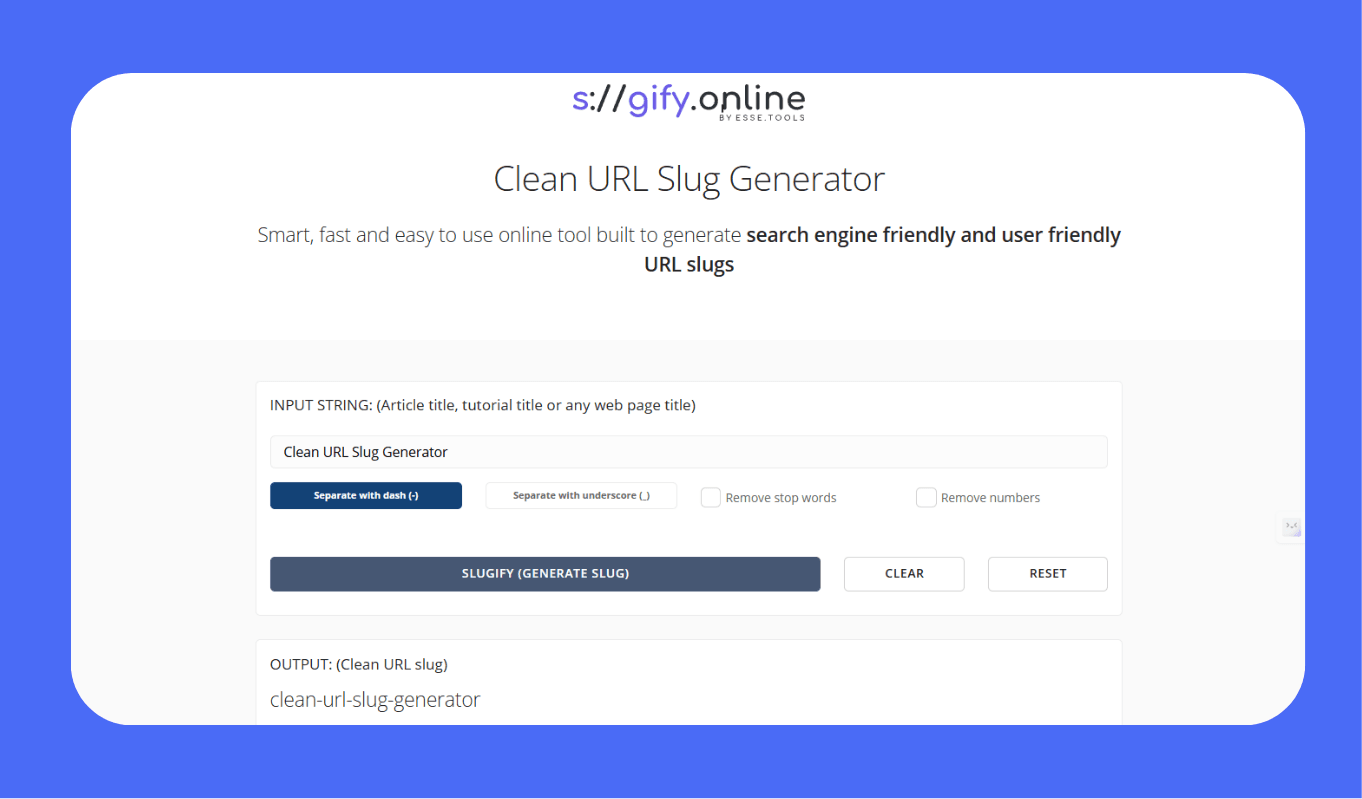
This tool demonstrates the true advantage of automation: the ability to generate multiple high-quality, technically flawless slugs in seconds, freeing you for high-value strategic work.
Junia AI Slug Generator
Junia AI Slug Generator takes things a step further. It works similarly to Slugify.online, but if a slug feels too long, Junia will suggest improvements to shorten it while keeping meaning intact. This little “tweak” feature helps ensure your slug stays clear, concise, and SEO-friendly.
Both tools are fast, beginner-friendly, and useful for generating optimized slugs when you don’t want to manually tweak them yourself.
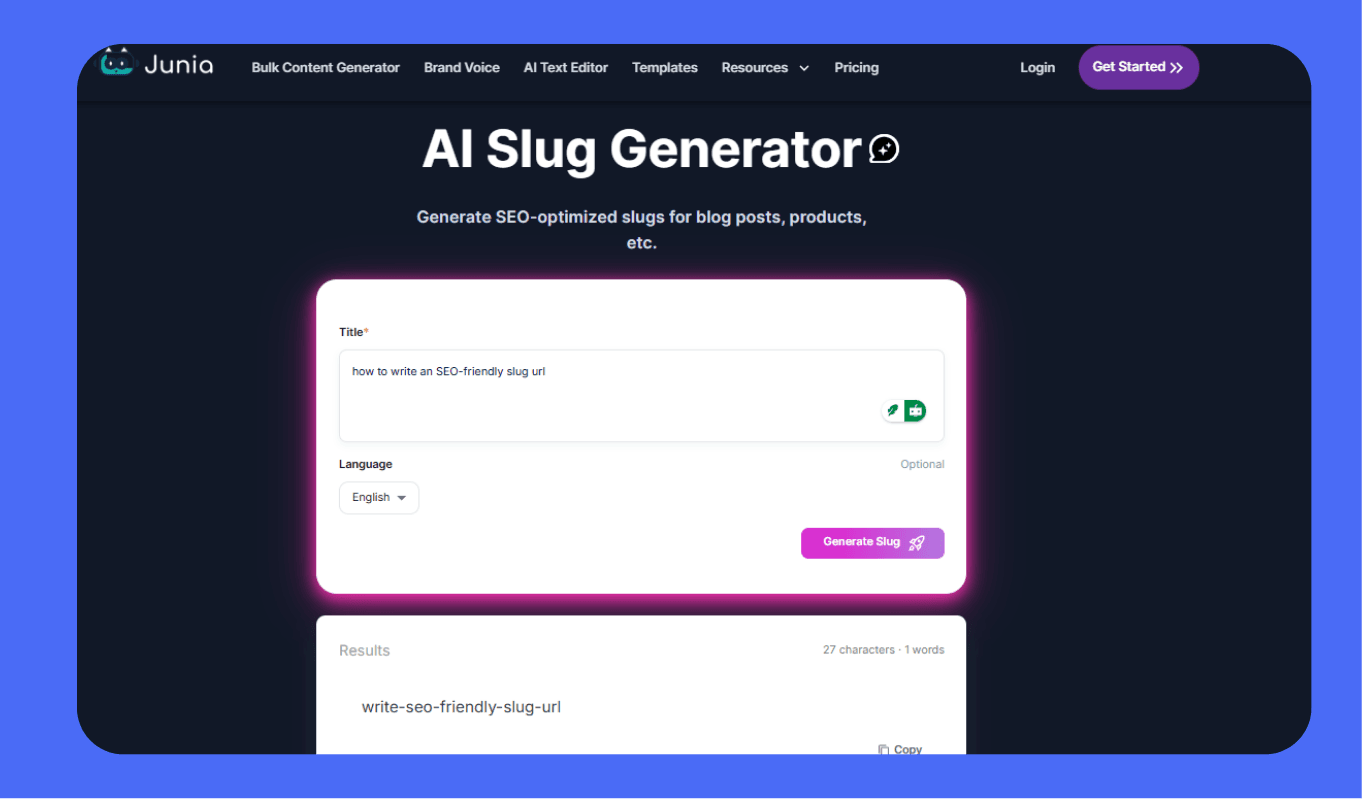
Stop manually typing and editing slugs—this is how modern creators use AI to instantly translate a long title into a short, perfect, SEO-friendly slug in seconds.
Conclusion — Short, Practical Takeaway
In the age of AI-powered search, every element of your page matters — and the slug URL is the very first piece of content both humans and AI encounter, making it one of the most powerful signals you can control.
A clear, concise, and descriptive slug not only helps humans understand your content at a glance but also guides AI engines in accurately classifying, ranking, and citing your page.
By using prompts to craft slugs, testing options with ChatGPT, and exploring dedicated AI slug generator tools, you can create URLs that are readable, meaningful, and optimised for both GEO and AEO.
Take control of your URLs today and start turning every slug into a powerful tool for AI visibility and user engagement.