
94 PROMPTS · NINE TOPIC CLUSTERING & TOPICAL AUTHORITY WORKFLOWS
94 ChatGPT Prompts for Topic Clustering, Pillar Pages & Topical Authority
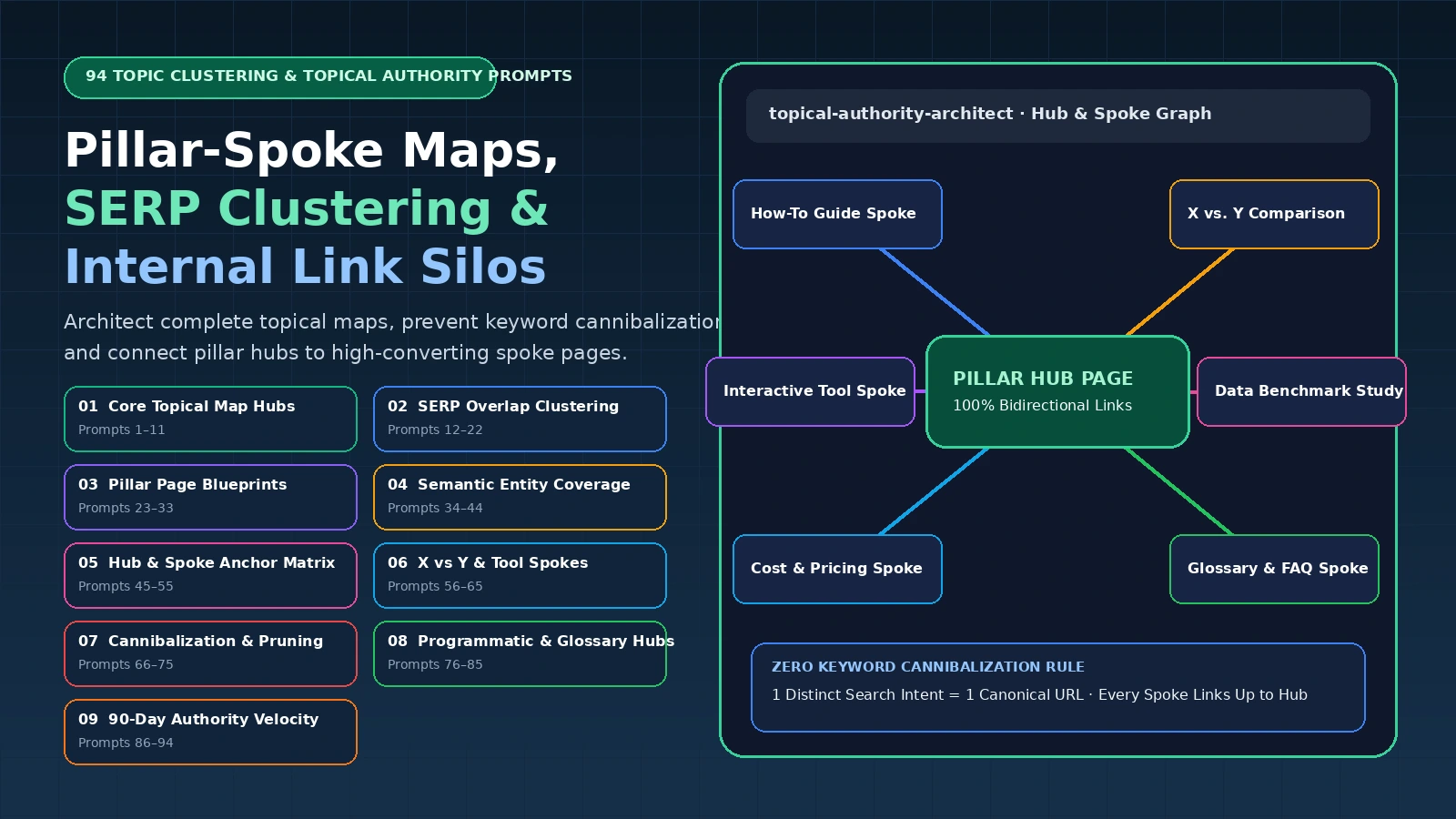
Architect 3-tier Pillar-and-Spoke topical maps, cluster keywords by SERP overlap, define anti-cannibalization scope boundaries, build bidirectional internal link matrices, and connect informational hubs to high-converting tools and comparison pages.
 Sufian MustafaFounder and author · Do It With AI ToolsPublished November 1, 2026
Build connected topical silos instead of isolated blog posts
Publishing random, disconnected articles one keyword at a time leads to orphaned pages and accidental keyword cannibalization. Search engines and AI answer engines reward domains that cover a subject systematically—with a central Pillar Hub, clearly scoped child Spokes, semantic entity depth, and interactive tools.
These 94 prompts guide you from initial domain mapping and SERP overlap clustering to Pillar Page outlines, internal link matrices, and 90-day publishing roadmaps.
Fast Topical Authority Path: Start by mapping your domain with Prompt 1 (3-Tier Topical Map), group your keyword list with Prompt 12 (Single-URL Keyword Clustering), design your hub with Prompt 23 (Pillar Page Blueprint), wire your internal links with Prompt 45 (Hub & Spoke Link Matrix), and resolve overlapping URLs with Prompt 66 (GSC Cannibalization Audit).
Three rules of cannibalization-free topical clusters
- Rule 1
One search intent = one canonical URL
Combine close wording variations onto a single strong page rather than spinning up thin duplicate articles.
- Rule 2
Set strict Include / Exclude boundaries
Tell each spoke writer what to cover in depth and what to summarize in two sentences with a link to the sibling spoke.
- Rule 3
Anchor every cluster in a free tool or study
Place an interactive calculator, studio tool, or benchmark study inside your cluster to earn links and conversions.
94 Topic Clustering, Pillar Page & Topical Authority prompts by workflow
Select the topical architecture workflow you need—from 3-tier topical maps and SERP overlap clustering to Pillar Page blueprints, semantic entity coverage, Hub-and-Spoke internal linking matrices, `X vs. Y` commercial spokes, and keyword cannibalization cleanup.
Customize your shared topical cluster brief (Updates all 94 prompts)
Enter your core pillar domain, target searcher persona, and existing URL/tool inventory once below to pre-fill all 94 prompts. Paste specific keyword lists, GSC exports, or competitor sitemaps inside any individual prompt card.
94 of 94 prompts shown. Click any prompt card to customize, copy, or open it in ChatGPT.
Core topical map architecture: Hubs, sub-pillars & supporting spokes
Map an entire domain into logical Pillar Hubs, Sub-Pillars, and atomic Spoke articles so search engines recognize your depth across every subtopic.
Open companion studio: AI Topical Map & Silo Generator ↗1Architect a 3-Tier Topical Map (1 Pillar Hub + 4 Sub-Pillars + 20 Supporting Spokes)
Break down your core domain into a complete 3-tier topical hierarchy where every URL has a distinct search intent, target reader task, and parent-child relationship.
Prepare: Core topic domain, product/service offer, and target audience.
Act as a Principal Topical Authority Architect and SEO Content Strategist. Work on this specific task using only the supplied material.

Core pillar domain & offer: {{Pillar}}
Target searcher & skill level: {{Persona}}
Existing URLs, tools & proof inventory: {{Inventory}}
Specific inputs: [Core topic domain, product/service offer, and target audience: paste here]

Task
Break down your core domain into a complete 3-tier topical hierarchy where every URL has a distinct search intent, target reader task, and parent-child relationship.

Output
Return 3-tier topical map table (Tier, Page Title, Suggested URL Slug, Search Intent, Primary Reader Task).

Topical architecture & anti-cannibalization boundaries
- Follow the '1 Distinct Search Intent = 1 Canonical URL' rule: never create multiple thin pages for close wording variations.
- Define clear Include/Exclude scope boundaries between parent Pillars and child Spokes so pages complement rather than compete.
- Never invent search volume or live SERP rankings; base clustering decisions on reader tasks and supplied search evidence.Expected output: 3-tier topical map table (Tier, Page Title, Suggested URL Slug, Search Intent, Primary Reader Task).
2Separate 'Core Monetizable Nodes' from 'Outer Educational Nodes' in a Topical Map
Divide your topical map into Core Nodes (directly tied to your product, tool, or service) and Outer Context Nodes (educational concepts that build authority and link into the Core).
Prepare: Product/tool capabilities and broad industry topic.
Act as a Principal Topical Authority Architect and SEO Content Strategist. Work on this specific task using only the supplied material.

Core pillar domain & offer: {{Pillar}}
Target searcher & skill level: {{Persona}}
Existing URLs, tools & proof inventory: {{Inventory}}
Specific inputs: [Product/tool capabilities and broad industry topic: paste here]

Task
Divide your topical map into Core Nodes (directly tied to your product, tool, or service) and Outer Context Nodes (educational concepts that build authority and link into the Core).

Output
Return Core vs. Outer topical map table with internal link bridge paths.

Topical architecture & anti-cannibalization boundaries
- Follow the '1 Distinct Search Intent = 1 Canonical URL' rule: never create multiple thin pages for close wording variations.
- Define clear Include/Exclude scope boundaries between parent Pillars and child Spokes so pages complement rather than compete.
- Never invent search volume or live SERP rankings; base clustering decisions on reader tasks and supplied search evidence.Expected output: Core vs. Outer topical map table with internal link bridge paths.
3Audit an existing blog archive to map live URLs onto a clean Topical Silo
Classify your supplied list of existing blog URLs into topic clusters—identifying which clusters already have a strong Pillar Hub, which are missing a Hub, and which URLs are isolated orphans.
Prepare: List of existing URLs and titles.
Act as a Principal Topical Authority Architect and SEO Content Strategist. Work on this specific task using only the supplied material.

Core pillar domain & offer: {{Pillar}}
Target searcher & skill level: {{Persona}}
Existing URLs, tools & proof inventory: {{Inventory}}
Specific inputs: [List of existing URLs and titles: paste here]

Task
Classify your supplied list of existing blog URLs into topic clusters—identifying which clusters already have a strong Pillar Hub, which are missing a Hub, and which URLs are isolated orphans.

Output
Return Existing inventory cluster map + missing hub & spoke gap report.

Topical architecture & anti-cannibalization boundaries
- Follow the '1 Distinct Search Intent = 1 Canonical URL' rule: never create multiple thin pages for close wording variations.
- Define clear Include/Exclude scope boundaries between parent Pillars and child Spokes so pages complement rather than compete.
- Never invent search volume or live SERP rankings; base clustering decisions on reader tasks and supplied search evidence.Expected output: Existing inventory cluster map + missing hub & spoke gap report.
4Generate 15 'Zero-Volume / High-Intent Practitioner' spoke topics competitors miss
Identify specific operational edge cases, implementation errors, and workflow combinations that real practitioners search for even when keyword tools report '0–10' monthly volume.
Prepare: Core topic and common practitioner frustrations.
Act as a Principal Topical Authority Architect and SEO Content Strategist. Work on this specific task using only the supplied material.

Core pillar domain & offer: {{Pillar}}
Target searcher & skill level: {{Persona}}
Existing URLs, tools & proof inventory: {{Inventory}}
Specific inputs: [Core topic and common practitioner frustrations: paste here]

Task
Identify specific operational edge cases, implementation errors, and workflow combinations that real practitioners search for even when keyword tools report '0–10' monthly volume.

Output
Return 15 high-intent practitioner spoke topics with target queries.

Topical architecture & anti-cannibalization boundaries
- Follow the '1 Distinct Search Intent = 1 Canonical URL' rule: never create multiple thin pages for close wording variations.
- Define clear Include/Exclude scope boundaries between parent Pillars and child Spokes so pages complement rather than compete.
- Never invent search volume or live SERP rankings; base clustering decisions on reader tasks and supplied search evidence.Expected output: 15 high-intent practitioner spoke topics with target queries.
5Design a Topical Map around an Interactive Free Tool (`Tool-Led Content Silo`)
Place your free interactive calculator or studio tool at the center of a cluster and map 8 supporting articles (How-To, Examples, Templates, Troubleshooting, Comparisons) that funnel users into the tool.
Prepare: Interactive tool name, URL, and core user job.
Act as a Principal Topical Authority Architect and SEO Content Strategist. Work on this specific task using only the supplied material.

Core pillar domain & offer: {{Pillar}}
Target searcher & skill level: {{Persona}}
Existing URLs, tools & proof inventory: {{Inventory}}
Specific inputs: [Interactive tool name, URL, and core user job: paste here]

Task
Place your free interactive calculator or studio tool at the center of a cluster and map 8 supporting articles (How-To, Examples, Templates, Troubleshooting, Comparisons) that funnel users into the tool.

Output
Return Tool-led hub-and-spoke blueprint (1 Tool Hub + 8 Supporting Articles).

Topical architecture & anti-cannibalization boundaries
- Follow the '1 Distinct Search Intent = 1 Canonical URL' rule: never create multiple thin pages for close wording variations.
- Define clear Include/Exclude scope boundaries between parent Pillars and child Spokes so pages complement rather than compete.
- Never invent search volume or live SERP rankings; base clustering decisions on reader tasks and supplied search evidence.Expected output: Tool-led hub-and-spoke blueprint (1 Tool Hub + 8 Supporting Articles).
6Map a 'Beginner -> Intermediate -> Advanced' learning progression inside a cluster
Organize your cluster spokes by skill level so a reader landing on a beginner definition is guided naturally toward intermediate workflows and advanced edge cases.
Prepare: List of cluster topics.
Act as a Principal Topical Authority Architect and SEO Content Strategist. Work on this specific task using only the supplied material.

Core pillar domain & offer: {{Pillar}}
Target searcher & skill level: {{Persona}}
Existing URLs, tools & proof inventory: {{Inventory}}
Specific inputs: [List of cluster topics: paste here]

Task
Organize your cluster spokes by skill level so a reader landing on a beginner definition is guided naturally toward intermediate workflows and advanced edge cases.

Output
Return 3-level learning path sequence + 'Next Step' callout rules.

Topical architecture & anti-cannibalization boundaries
- Follow the '1 Distinct Search Intent = 1 Canonical URL' rule: never create multiple thin pages for close wording variations.
- Define clear Include/Exclude scope boundaries between parent Pillars and child Spokes so pages complement rather than compete.
- Never invent search volume or live SERP rankings; base clustering decisions on reader tasks and supplied search evidence.Expected output: 3-level learning path sequence + 'Next Step' callout rules.
7Define clear 'Scope Boundaries' between sibling spoke pages (`Include` vs. `Exclude`)
For each spoke in a cluster, list the exact subtopics it MUST cover and the subtopics it MUST NOT cover in depth (linking out to the sibling spoke instead) so writers never create overlapping pages.
Prepare: List of 5–8 sibling spoke titles in the same cluster.
Act as a Principal Topical Authority Architect and SEO Content Strategist. Work on this specific task using only the supplied material.

Core pillar domain & offer: {{Pillar}}
Target searcher & skill level: {{Persona}}
Existing URLs, tools & proof inventory: {{Inventory}}
Specific inputs: [List of 5–8 sibling spoke titles in the same cluster: paste here]

Task
For each spoke in a cluster, list the exact subtopics it MUST cover and the subtopics it MUST NOT cover in depth (linking out to the sibling spoke instead) so writers never create overlapping pages.

Output
Return Scope boundary table (Spoke Title, Must Cover, Must Defer to Sibling URL).

Topical architecture & anti-cannibalization boundaries
- Follow the '1 Distinct Search Intent = 1 Canonical URL' rule: never create multiple thin pages for close wording variations.
- Define clear Include/Exclude scope boundaries between parent Pillars and child Spokes so pages complement rather than compete.
- Never invent search volume or live SERP rankings; base clustering decisions on reader tasks and supplied search evidence.Expected output: Scope boundary table (Spoke Title, Must Cover, Must Defer to Sibling URL).
8Expand one broad keyword into 6 distinct Search Intent Spokes
Take a broad head term and split it into 6 distinct intent spokes: (1) Definitive Guide, (2) Copy-Paste Examples/Templates, (3) Step-by-Step Audit Checklist, (4) Common Mistakes/Fixes, (5) X vs. Y Comparison, and (6) Interactive Generator.
Prepare: Broad seed topic.
Act as a Principal Topical Authority Architect and SEO Content Strategist. Work on this specific task using only the supplied material.

Core pillar domain & offer: {{Pillar}}
Target searcher & skill level: {{Persona}}
Existing URLs, tools & proof inventory: {{Inventory}}
Specific inputs: [Broad seed topic: paste here]

Task
Take a broad head term and split it into 6 distinct intent spokes: (1) Definitive Guide, (2) Copy-Paste Examples/Templates, (3) Step-by-Step Audit Checklist, (4) Common Mistakes/Fixes, (5) X vs. Y Comparison, and (6) Interactive Generator.

Output
Return 6 intent-differentiated spoke briefs.

Topical architecture & anti-cannibalization boundaries
- Follow the '1 Distinct Search Intent = 1 Canonical URL' rule: never create multiple thin pages for close wording variations.
- Define clear Include/Exclude scope boundaries between parent Pillars and child Spokes so pages complement rather than compete.
- Never invent search volume or live SERP rankings; base clustering decisions on reader tasks and supplied search evidence.Expected output: 6 intent-differentiated spoke briefs.
9Design URL Slug conventions that stay evergreen when you expand or update clusters
Create short, evergreen URL slugs (`/prompts/keyword-research-prompts` instead of `/2024/11/75-keyword-prompts-part-1`) that won't require 301 redirects when you update counts or years.
Prepare: Planned cluster page titles.
Act as a Principal Topical Authority Architect and SEO Content Strategist. Work on this specific task using only the supplied material.

Core pillar domain & offer: {{Pillar}}
Target searcher & skill level: {{Persona}}
Existing URLs, tools & proof inventory: {{Inventory}}
Specific inputs: [Planned cluster page titles: paste here]

Task
Create short, evergreen URL slugs (`/prompts/keyword-research-prompts` instead of `/2024/11/75-keyword-prompts-part-1`) that won't require 301 redirects when you update counts or years.

Output
Return Evergreen URL slug table + naming rules.

Topical architecture & anti-cannibalization boundaries
- Follow the '1 Distinct Search Intent = 1 Canonical URL' rule: never create multiple thin pages for close wording variations.
- Define clear Include/Exclude scope boundaries between parent Pillars and child Spokes so pages complement rather than compete.
- Never invent search volume or live SERP rankings; base clustering decisions on reader tasks and supplied search evidence.Expected output: Evergreen URL slug table + naming rules.
10Compare your Topical Map coverage against a top-ranking domain
Compare your planned or live cluster URLs against a competitor's sitemap/category list to spot entire sub-silos they cover that you haven't built yet.
Prepare: Your cluster URLs vs. competitor's URLs/titles.
Act as a Principal Topical Authority Architect and SEO Content Strategist. Work on this specific task using only the supplied material.

Core pillar domain & offer: {{Pillar}}
Target searcher & skill level: {{Persona}}
Existing URLs, tools & proof inventory: {{Inventory}}
Specific inputs: [Your cluster URLs vs. competitor's URLs/titles: paste here]

Task
Compare your planned or live cluster URLs against a competitor's sitemap/category list to spot entire sub-silos they cover that you haven't built yet.

Output
Return Sub-silo coverage gap matrix + top 5 priority spokes to build first.

Topical architecture & anti-cannibalization boundaries
- Follow the '1 Distinct Search Intent = 1 Canonical URL' rule: never create multiple thin pages for close wording variations.
- Define clear Include/Exclude scope boundaries between parent Pillars and child Spokes so pages complement rather than compete.
- Never invent search volume or live SERP rankings; base clustering decisions on reader tasks and supplied search evidence.Expected output: Sub-silo coverage gap matrix + top 5 priority spokes to build first.
11Build an Executive Visual Diagram of your Topical Cluster (`Hub & Spoke Map`)
Format your pillar and spoke titles into a clean Hub-and-Spoke diagram specification to align writers, editors, and stakeholders.
Prepare: Pillar title and 6–8 primary spokes.
Act as a Principal Topical Authority Architect and SEO Content Strategist. Work on this specific task using only the supplied material.

Core pillar domain & offer: {{Pillar}}
Target searcher & skill level: {{Persona}}
Existing URLs, tools & proof inventory: {{Inventory}}
Specific inputs: [Pillar title and 6–8 primary spokes: paste here]

Task
Format your pillar and spoke titles into a clean Hub-and-Spoke diagram specification to align writers, editors, and stakeholders.

Output
Return Hub-and-Spoke visual diagram specification.

Topical architecture & anti-cannibalization boundaries
- Follow the '1 Distinct Search Intent = 1 Canonical URL' rule: never create multiple thin pages for close wording variations.
- Define clear Include/Exclude scope boundaries between parent Pillars and child Spokes so pages complement rather than compete.
- Never invent search volume or live SERP rankings; base clustering decisions on reader tasks and supplied search evidence.Expected output: Hub-and-Spoke visual diagram specification.
SERP overlap clustering: Single-page vs. separate-URL decisions
Decide whether two close keyword variations belong as H2 sections on the same URL or require two separate canonical pages based on reader task and SERP overlap.
Open companion studio: Keyword Clustering & Intent Grouping Studio ↗12Group a raw list of 30–100 keywords into Single-URL Page Clusters
Cluster the supplied keyword list so all synonyms and close phrasing variations that share the same reader task map to a single canonical URL (1 Primary Keyword + 4–8 Secondary Keywords).
Prepare: Raw keyword list.
Act as a Principal Topical Authority Architect and SEO Content Strategist. Work on this specific task using only the supplied material.

Core pillar domain & offer: {{Pillar}}
Target searcher & skill level: {{Persona}}
Existing URLs, tools & proof inventory: {{Inventory}}
Specific inputs: [Raw keyword list: paste here]

Task
Cluster the supplied keyword list so all synonyms and close phrasing variations that share the same reader task map to a single canonical URL (1 Primary Keyword + 4–8 Secondary Keywords).

Output
Return Clustered page table (Canonical Page Topic, Primary Keyword, Secondary Variations, Page Format).

Topical architecture & anti-cannibalization boundaries
- Follow the '1 Distinct Search Intent = 1 Canonical URL' rule: never create multiple thin pages for close wording variations.
- Define clear Include/Exclude scope boundaries between parent Pillars and child Spokes so pages complement rather than compete.
- Never invent search volume or live SERP rankings; base clustering decisions on reader tasks and supplied search evidence.Expected output: Clustered page table (Canonical Page Topic, Primary Keyword, Secondary Variations, Page Format).
13Evaluate SERP Overlap ('4+ Shared Ranking URLs Rule') between two queries
Compare the top 10 search results you observed for Query A vs. Query B to decide whether Google treats them as the same topic (combine on 1 URL) or distinct intents (build 2 URLs).
Prepare: Query A top results vs. Query B top results.
Act as a Principal Topical Authority Architect and SEO Content Strategist. Work on this specific task using only the supplied material.

Core pillar domain & offer: {{Pillar}}
Target searcher & skill level: {{Persona}}
Existing URLs, tools & proof inventory: {{Inventory}}
Specific inputs: [Query A top results vs. Query B top results: paste here]

Task
Compare the top 10 search results you observed for Query A vs. Query B to decide whether Google treats them as the same topic (combine on 1 URL) or distinct intents (build 2 URLs).

Output
Return SERP overlap analysis + Combine vs. Separate verdict.

Topical architecture & anti-cannibalization boundaries
- Follow the '1 Distinct Search Intent = 1 Canonical URL' rule: never create multiple thin pages for close wording variations.
- Define clear Include/Exclude scope boundaries between parent Pillars and child Spokes so pages complement rather than compete.
- Never invent search volume or live SERP rankings; base clustering decisions on reader tasks and supplied search evidence.Expected output: SERP overlap analysis + Combine vs. Separate verdict.
14Decide whether a sub-question deserves an H2 Section or a Standalone Spoke URL
Apply a 4-factor test (1. Required depth > 500 words, 2. Distinct SERP results, 3. Unique search modifier, 4. Standalone utility) to decide between an H2 section on the pillar or a dedicated spoke.
Prepare: Parent pillar topic and candidate sub-question.
Act as a Principal Topical Authority Architect and SEO Content Strategist. Work on this specific task using only the supplied material.

Core pillar domain & offer: {{Pillar}}
Target searcher & skill level: {{Persona}}
Existing URLs, tools & proof inventory: {{Inventory}}
Specific inputs: [Parent pillar topic and candidate sub-question: paste here]

Task
Apply a 4-factor test (1. Required depth > 500 words, 2. Distinct SERP results, 3. Unique search modifier, 4. Standalone utility) to decide between an H2 section on the pillar or a dedicated spoke.

Output
Return 4-factor scorecard + H2 vs. Standalone URL decision.

Topical architecture & anti-cannibalization boundaries
- Follow the '1 Distinct Search Intent = 1 Canonical URL' rule: never create multiple thin pages for close wording variations.
- Define clear Include/Exclude scope boundaries between parent Pillars and child Spokes so pages complement rather than compete.
- Never invent search volume or live SERP rankings; base clustering decisions on reader tasks and supplied search evidence.Expected output: 4-factor scorecard + H2 vs. Standalone URL decision.
15Resolve 'Fractured / Mixed Search Intent' queries inside a cluster
When a query's top 10 results are split between interactive tools, how-to guides, and template lists, design a hybrid page layout that satisfies both tasks cleanly.
Prepare: Query and observed mix of ranking page types.
Act as a Principal Topical Authority Architect and SEO Content Strategist. Work on this specific task using only the supplied material.

Core pillar domain & offer: {{Pillar}}
Target searcher & skill level: {{Persona}}
Existing URLs, tools & proof inventory: {{Inventory}}
Specific inputs: [Query and observed mix of ranking page types: paste here]

Task
When a query's top 10 results are split between interactive tools, how-to guides, and template lists, design a hybrid page layout that satisfies both tasks cleanly.

Output
Return Hybrid page architecture combining tool/template access with concise guide sections.

Topical architecture & anti-cannibalization boundaries
- Follow the '1 Distinct Search Intent = 1 Canonical URL' rule: never create multiple thin pages for close wording variations.
- Define clear Include/Exclude scope boundaries between parent Pillars and child Spokes so pages complement rather than compete.
- Never invent search volume or live SERP rankings; base clustering decisions on reader tasks and supplied search evidence.Expected output: Hybrid page architecture combining tool/template access with concise guide sections.
16Cluster 'People Also Ask (PAA)' & community questions into logical H2/FAQ groups
Take 25–40 raw questions from PAA, Reddit, or customer support and group them into (a) core H2 sections on your pillar, (b) dedicated spoke articles, and (c) 50-word FAQ schema blocks.
Prepare: List of 25–40 raw audience questions.
Act as a Principal Topical Authority Architect and SEO Content Strategist. Work on this specific task using only the supplied material.

Core pillar domain & offer: {{Pillar}}
Target searcher & skill level: {{Persona}}
Existing URLs, tools & proof inventory: {{Inventory}}
Specific inputs: [List of 25–40 raw audience questions: paste here]

Task
Take 25–40 raw questions from PAA, Reddit, or customer support and group them into (a) core H2 sections on your pillar, (b) dedicated spoke articles, and (c) 50-word FAQ schema blocks.

Output
Return Classified question routing table (Pillar H2 vs. New Spoke vs. FAQ Block).

Topical architecture & anti-cannibalization boundaries
- Follow the '1 Distinct Search Intent = 1 Canonical URL' rule: never create multiple thin pages for close wording variations.
- Define clear Include/Exclude scope boundaries between parent Pillars and child Spokes so pages complement rather than compete.
- Never invent search volume or live SERP rankings; base clustering decisions on reader tasks and supplied search evidence.Expected output: Classified question routing table (Pillar H2 vs. New Spoke vs. FAQ Block).
17Separate 'Informational Guide' vs. 'Template / Example Pack' vs. 'Tool' keywords
Sort modifier keywords (`how to...`, `...examples`, `...template`, `...Prompts`, `...generator`, `...checker`) into their exact matching page templates.
Prepare: List of modifier keywords in your niche.
Act as a Principal Topical Authority Architect and SEO Content Strategist. Work on this specific task using only the supplied material.

Core pillar domain & offer: {{Pillar}}
Target searcher & skill level: {{Persona}}
Existing URLs, tools & proof inventory: {{Inventory}}
Specific inputs: [List of modifier keywords in your niche: paste here]

Task
Sort modifier keywords (`how to...`, `...examples`, `...template`, `...Prompts`, `...generator`, `...checker`) into their exact matching page templates.

Output
Return Modifier-to-Template mapping table.

Topical architecture & anti-cannibalization boundaries
- Follow the '1 Distinct Search Intent = 1 Canonical URL' rule: never create multiple thin pages for close wording variations.
- Define clear Include/Exclude scope boundaries between parent Pillars and child Spokes so pages complement rather than compete.
- Never invent search volume or live SERP rankings; base clustering decisions on reader tasks and supplied search evidence.Expected output: Modifier-to-Template mapping table.
18Cluster regional, industry, or role-specific keyword modifiers without doorway bloat
Decide which role or industry modifiers (`for SaaS`, `for e-commerce`, `for local business`) have genuinely different workflows worthy of a dedicated spoke vs. an H2 section.
Prepare: List of industry/role keyword modifiers.
Act as a Principal Topical Authority Architect and SEO Content Strategist. Work on this specific task using only the supplied material.

Core pillar domain & offer: {{Pillar}}
Target searcher & skill level: {{Persona}}
Existing URLs, tools & proof inventory: {{Inventory}}
Specific inputs: [List of industry/role keyword modifiers: paste here]

Task
Decide which role or industry modifiers (`for SaaS`, `for e-commerce`, `for local business`) have genuinely different workflows worthy of a dedicated spoke vs. an H2 section.

Output
Return Substantive workflow difference test + page consolidation plan.

Topical architecture & anti-cannibalization boundaries
- Follow the '1 Distinct Search Intent = 1 Canonical URL' rule: never create multiple thin pages for close wording variations.
- Define clear Include/Exclude scope boundaries between parent Pillars and child Spokes so pages complement rather than compete.
- Never invent search volume or live SERP rankings; base clustering decisions on reader tasks and supplied search evidence.Expected output: Substantive workflow difference test + page consolidation plan.
19Map Secondary Keywords in a cluster to specific H2 and H3 subheadings
Once 8 secondary keywords are assigned to a single page, map each secondary query to the exact H2/H3 section where that nuance should be answered.
Prepare: Primary keyword and 6–10 secondary keywords for one page.
Act as a Principal Topical Authority Architect and SEO Content Strategist. Work on this specific task using only the supplied material.

Core pillar domain & offer: {{Pillar}}
Target searcher & skill level: {{Persona}}
Existing URLs, tools & proof inventory: {{Inventory}}
Specific inputs: [Primary keyword and 6–10 secondary keywords for one page: paste here]

Task
Once 8 secondary keywords are assigned to a single page, map each secondary query to the exact H2/H3 section where that nuance should be answered.

Output
Return Keyword-to-Heading assignment table.

Topical architecture & anti-cannibalization boundaries
- Follow the '1 Distinct Search Intent = 1 Canonical URL' rule: never create multiple thin pages for close wording variations.
- Define clear Include/Exclude scope boundaries between parent Pillars and child Spokes so pages complement rather than compete.
- Never invent search volume or live SERP rankings; base clustering decisions on reader tasks and supplied search evidence.Expected output: Keyword-to-Heading assignment table.
20Identify 'Bridge Topics' that connect two separate Pillar Silos on your site
Spot crossover topics (e.g., 'Image Alt Text for Infographics' bridging your On-Page SEO silo and your Visual Infographic silo) that naturally link both hubs together.
Prepare: Silo A topic and Silo B topic.
Act as a Principal Topical Authority Architect and SEO Content Strategist. Work on this specific task using only the supplied material.

Core pillar domain & offer: {{Pillar}}
Target searcher & skill level: {{Persona}}
Existing URLs, tools & proof inventory: {{Inventory}}
Specific inputs: [Silo A topic and Silo B topic: paste here]

Task
Spot crossover topics (e.g., 'Image Alt Text for Infographics' bridging your On-Page SEO silo and your Visual Infographic silo) that naturally link both hubs together.

Output
Return 5 crossover bridge article ideas + bidirectional link plan.

Topical architecture & anti-cannibalization boundaries
- Follow the '1 Distinct Search Intent = 1 Canonical URL' rule: never create multiple thin pages for close wording variations.
- Define clear Include/Exclude scope boundaries between parent Pillars and child Spokes so pages complement rather than compete.
- Never invent search volume or live SERP rankings; base clustering decisions on reader tasks and supplied search evidence.Expected output: 5 crossover bridge article ideas + bidirectional link plan.
21Audit a proposed keyword cluster for 'False Positive Synonym Grouping'
Review a clustered keyword sheet to catch cases where two terms look similar on paper (e.g., `google review link generator` vs. `google review response generator`) but require completely different tools/pages.
Prepare: Proposed keyword cluster table.
Act as a Principal Topical Authority Architect and SEO Content Strategist. Work on this specific task using only the supplied material.

Core pillar domain & offer: {{Pillar}}
Target searcher & skill level: {{Persona}}
Existing URLs, tools & proof inventory: {{Inventory}}
Specific inputs: [Proposed keyword cluster table: paste here]

Task
Review a clustered keyword sheet to catch cases where two terms look similar on paper (e.g., `google review link generator` vs. `google review response generator`) but require completely different tools/pages.

Output
Return False-positive split audit + corrected URL assignments.

Topical architecture & anti-cannibalization boundaries
- Follow the '1 Distinct Search Intent = 1 Canonical URL' rule: never create multiple thin pages for close wording variations.
- Define clear Include/Exclude scope boundaries between parent Pillars and child Spokes so pages complement rather than compete.
- Never invent search volume or live SERP rankings; base clustering decisions on reader tasks and supplied search evidence.Expected output: False-positive split audit + corrected URL assignments.
22Prioritize your clustered pages by 'Business Value × Ranking Feasibility'
Score each planned cluster page from 1–5 on Product/Tool Tie-In, First-Hand Proof Available, and SERP Competition so you build the highest-ROI pages first.
Prepare: List of planned cluster pages.
Act as a Principal Topical Authority Architect and SEO Content Strategist. Work on this specific task using only the supplied material.

Core pillar domain & offer: {{Pillar}}
Target searcher & skill level: {{Persona}}
Existing URLs, tools & proof inventory: {{Inventory}}
Specific inputs: [List of planned cluster pages: paste here]

Task
Score each planned cluster page from 1–5 on Product/Tool Tie-In, First-Hand Proof Available, and SERP Competition so you build the highest-ROI pages first.

Output
Return Prioritized cluster build table sorted by composite score.

Topical architecture & anti-cannibalization boundaries
- Follow the '1 Distinct Search Intent = 1 Canonical URL' rule: never create multiple thin pages for close wording variations.
- Define clear Include/Exclude scope boundaries between parent Pillars and child Spokes so pages complement rather than compete.
- Never invent search volume or live SERP rankings; base clustering decisions on reader tasks and supplied search evidence.Expected output: Prioritized cluster build table sorted by composite score.
Pillar page blueprints & comprehensive hub-page design
Structure definitive Pillar Pages that answer the core topic clearly while acting as an organized launchpad linking out to every deep spoke article.
Open companion studio: SEO Content Brief & Pillar Planner ↗23Write a comprehensive Pillar Page Blueprint (Hub Overview + Spoke Launchpad)
Architect a Pillar Hub page that gives a clear executive answer at the top, covers each major sub-theme in 200-word summary sections with a 'Deep Dive ->' link to the spoke, and embeds an interactive tool.
Prepare: Pillar topic, target query, and list of child spoke URLs.
Act as a Principal Topical Authority Architect and SEO Content Strategist. Work on this specific task using only the supplied material.

Core pillar domain & offer: {{Pillar}}
Target searcher & skill level: {{Persona}}
Existing URLs, tools & proof inventory: {{Inventory}}
Specific inputs: [Pillar topic, target query, and list of child spoke URLs: paste here]

Task
Architect a Pillar Hub page that gives a clear executive answer at the top, covers each major sub-theme in 200-word summary sections with a 'Deep Dive ->' link to the spoke, and embeds an interactive tool.

Output
Return Complete Pillar Page H1–H3 blueprint with spoke-link callout slots.

Topical architecture & anti-cannibalization boundaries
- Follow the '1 Distinct Search Intent = 1 Canonical URL' rule: never create multiple thin pages for close wording variations.
- Define clear Include/Exclude scope boundaries between parent Pillars and child Spokes so pages complement rather than compete.
- Never invent search volume or live SERP rankings; base clustering decisions on reader tasks and supplied search evidence.Expected output: Complete Pillar Page H1–H3 blueprint with spoke-link callout slots.
24Prevent your Pillar Page from cannibalizing its own child Spoke articles
Define the exact depth boundary between the Pillar (what the subtopic is + why it matters + summary checklist) and the Child Spoke (20+ examples, edge cases, and step-by-step execution).
Prepare: Pillar topic and a specific child spoke topic.
Act as a Principal Topical Authority Architect and SEO Content Strategist. Work on this specific task using only the supplied material.

Core pillar domain & offer: {{Pillar}}
Target searcher & skill level: {{Persona}}
Existing URLs, tools & proof inventory: {{Inventory}}
Specific inputs: [Pillar topic and a specific child spoke topic: paste here]

Task
Define the exact depth boundary between the Pillar (what the subtopic is + why it matters + summary checklist) and the Child Spoke (20+ examples, edge cases, and step-by-step execution).

Output
Return Pillar vs. Spoke depth boundary guide + 150-word Pillar summary section with spoke link.

Topical architecture & anti-cannibalization boundaries
- Follow the '1 Distinct Search Intent = 1 Canonical URL' rule: never create multiple thin pages for close wording variations.
- Define clear Include/Exclude scope boundaries between parent Pillars and child Spokes so pages complement rather than compete.
- Never invent search volume or live SERP rankings; base clustering decisions on reader tasks and supplied search evidence.Expected output: Pillar vs. Spoke depth boundary guide + 150-word Pillar summary section with spoke link.
25Design an interactive 'Cluster Navigation / Jump-Link Table of Contents' for a Pillar Hub
Create a scannable top navigation grid for a Pillar Page that lets readers jump to any H2 section on the page or click directly into the dedicated tools and prompt libraries in the cluster.
Prepare: Pillar H2 sections and companion tool/prompt URLs.
Act as a Principal Topical Authority Architect and SEO Content Strategist. Work on this specific task using only the supplied material.

Core pillar domain & offer: {{Pillar}}
Target searcher & skill level: {{Persona}}
Existing URLs, tools & proof inventory: {{Inventory}}
Specific inputs: [Pillar H2 sections and companion tool/prompt URLs: paste here]

Task
Create a scannable top navigation grid for a Pillar Page that lets readers jump to any H2 section on the page or click directly into the dedicated tools and prompt libraries in the cluster.

Output
Return Cluster navigation grid specification + short anchor labels.

Topical architecture & anti-cannibalization boundaries
- Follow the '1 Distinct Search Intent = 1 Canonical URL' rule: never create multiple thin pages for close wording variations.
- Define clear Include/Exclude scope boundaries between parent Pillars and child Spokes so pages complement rather than compete.
- Never invent search volume or live SERP rankings; base clustering decisions on reader tasks and supplied search evidence.Expected output: Cluster navigation grid specification + short anchor labels.
26Write a 70-Word 'Pillar Definition & Scope Box' for the top of your hub page
Draft a self-contained opening summary box that defines the core domain, states who the hub is built for, and lists the 4 core workflows covered below.
Prepare: Pillar topic and target audience.
Act as a Principal Topical Authority Architect and SEO Content Strategist. Work on this specific task using only the supplied material.

Core pillar domain & offer: {{Pillar}}
Target searcher & skill level: {{Persona}}
Existing URLs, tools & proof inventory: {{Inventory}}
Specific inputs: [Pillar topic and target audience: paste here]

Task
Draft a self-contained opening summary box that defines the core domain, states who the hub is built for, and lists the 4 core workflows covered below.

Output
Return 70-word Pillar Definition & Scope box.

Topical architecture & anti-cannibalization boundaries
- Follow the '1 Distinct Search Intent = 1 Canonical URL' rule: never create multiple thin pages for close wording variations.
- Define clear Include/Exclude scope boundaries between parent Pillars and child Spokes so pages complement rather than compete.
- Never invent search volume or live SERP rankings; base clustering decisions on reader tasks and supplied search evidence.Expected output: 70-word Pillar Definition & Scope box.
27Design a 'Which Guide / Tool Do You Need?' interactive routing table on your Pillar Page
Build a 6-row routing table (`If your goal is X -> Start with [Spoke/Tool Y] -> Expected time: 10 mins`) to place near the top of your Pillar Page.
Prepare: List of cluster spokes and tools.
Act as a Principal Topical Authority Architect and SEO Content Strategist. Work on this specific task using only the supplied material.

Core pillar domain & offer: {{Pillar}}
Target searcher & skill level: {{Persona}}
Existing URLs, tools & proof inventory: {{Inventory}}
Specific inputs: [List of cluster spokes and tools: paste here]

Task
Build a 6-row routing table (`If your goal is X -> Start with [Spoke/Tool Y] -> Expected time: 10 mins`) to place near the top of your Pillar Page.

Output
Return 6-row 'Start Here' reader routing table.

Topical architecture & anti-cannibalization boundaries
- Follow the '1 Distinct Search Intent = 1 Canonical URL' rule: never create multiple thin pages for close wording variations.
- Define clear Include/Exclude scope boundaries between parent Pillars and child Spokes so pages complement rather than compete.
- Never invent search volume or live SERP rankings; base clustering decisions on reader tasks and supplied search evidence.Expected output: 6-row 'Start Here' reader routing table.
28Integrate a Visual Infographic & 2×2 Matrix into your Pillar Page architecture
Specify where to place a summary 8-node infographic and a 2×2 strategic matrix inside your Pillar Page to maximize reader dwell time and backlink citations.
Prepare: Pillar outline.
Act as a Principal Topical Authority Architect and SEO Content Strategist. Work on this specific task using only the supplied material.

Core pillar domain & offer: {{Pillar}}
Target searcher & skill level: {{Persona}}
Existing URLs, tools & proof inventory: {{Inventory}}
Specific inputs: [Pillar outline: paste here]

Task
Specify where to place a summary 8-node infographic and a 2×2 strategic matrix inside your Pillar Page to maximize reader dwell time and backlink citations.

Output
Return Visual asset placement plan + infographic/matrix specs.

Topical architecture & anti-cannibalization boundaries
- Follow the '1 Distinct Search Intent = 1 Canonical URL' rule: never create multiple thin pages for close wording variations.
- Define clear Include/Exclude scope boundaries between parent Pillars and child Spokes so pages complement rather than compete.
- Never invent search volume or live SERP rankings; base clustering decisions on reader tasks and supplied search evidence.Expected output: Visual asset placement plan + infographic/matrix specs.
29Write 'Spoke Preview Teaser Cards' to embed at the end of each Pillar H2 section
For each H2 section on your Pillar Page, write a compelling 2-line teaser callout (`Read the full guide: [Spoke Title] — Includes [Specific Proof/Templates] ↗`) that drives high click-through to your spokes.
Prepare: Pillar H2 topics and corresponding child spoke URLs.
Act as a Principal Topical Authority Architect and SEO Content Strategist. Work on this specific task using only the supplied material.

Core pillar domain & offer: {{Pillar}}
Target searcher & skill level: {{Persona}}
Existing URLs, tools & proof inventory: {{Inventory}}
Specific inputs: [Pillar H2 topics and corresponding child spoke URLs: paste here]

Task
For each H2 section on your Pillar Page, write a compelling 2-line teaser callout (`Read the full guide: [Spoke Title] — Includes [Specific Proof/Templates] ↗`) that drives high click-through to your spokes.

Output
Return Contextual Spoke Teaser Callouts for every H2.

Topical architecture & anti-cannibalization boundaries
- Follow the '1 Distinct Search Intent = 1 Canonical URL' rule: never create multiple thin pages for close wording variations.
- Define clear Include/Exclude scope boundaries between parent Pillars and child Spokes so pages complement rather than compete.
- Never invent search volume or live SERP rankings; base clustering decisions on reader tasks and supplied search evidence.Expected output: Contextual Spoke Teaser Callouts for every H2.
30Design a 'Resource & Tool Directory Hub' Pillar Page
Structure a directory-style Pillar Page (like a Prompt Library or Tool Suite Hub) combining category filter pills, featured Flagship Guides, and an SEO-rich editorial guide below the grid.
Prepare: Hub category items and primary target keyword.
Act as a Principal Topical Authority Architect and SEO Content Strategist. Work on this specific task using only the supplied material.

Core pillar domain & offer: {{Pillar}}
Target searcher & skill level: {{Persona}}
Existing URLs, tools & proof inventory: {{Inventory}}
Specific inputs: [Hub category items and primary target keyword: paste here]

Task
Structure a directory-style Pillar Page (like a Prompt Library or Tool Suite Hub) combining category filter pills, featured Flagship Guides, and an SEO-rich editorial guide below the grid.

Output
Return Directory Hub wireframe + below-the-grid editorial outline.

Topical architecture & anti-cannibalization boundaries
- Follow the '1 Distinct Search Intent = 1 Canonical URL' rule: never create multiple thin pages for close wording variations.
- Define clear Include/Exclude scope boundaries between parent Pillars and child Spokes so pages complement rather than compete.
- Never invent search volume or live SERP rankings; base clustering decisions on reader tasks and supplied search evidence.Expected output: Directory Hub wireframe + below-the-grid editorial outline.
31Add `CollectionPage` + `ItemList` + `FAQPage` JSON-LD to a Pillar Hub
Generate connected JSON-LD structured data for a Pillar Hub page that declares its child spoke URLs inside an `ItemList` alongside `Article` and `FAQPage` nodes.
Prepare: Pillar URL, title, child spoke URLs, and FAQs.
Act as a Principal Topical Authority Architect and SEO Content Strategist. Work on this specific task using only the supplied material.

Core pillar domain & offer: {{Pillar}}
Target searcher & skill level: {{Persona}}
Existing URLs, tools & proof inventory: {{Inventory}}
Specific inputs: [Pillar URL, title, child spoke URLs, and FAQs: paste here]

Task
Generate connected JSON-LD structured data for a Pillar Hub page that declares its child spoke URLs inside an `ItemList` alongside `Article` and `FAQPage` nodes.

Output
Return Connected `@graph` JSON-LD for a Pillar Hub.

Topical architecture & anti-cannibalization boundaries
- Follow the '1 Distinct Search Intent = 1 Canonical URL' rule: never create multiple thin pages for close wording variations.
- Define clear Include/Exclude scope boundaries between parent Pillars and child Spokes so pages complement rather than compete.
- Never invent search volume or live SERP rankings; base clustering decisions on reader tasks and supplied search evidence.Expected output: Connected `@graph` JSON-LD for a Pillar Hub.
32Audit an existing 4,000-word 'Ultimate Guide' to split it into a Pillar + 4 Spokes
Review an overcrowded 4,000-word article that tries to rank for everything at once, and show how to keep the core hub on the existing URL while spinning off 3–4 focused child spokes.
Prepare: Current long article H2/H3 outline and GSC queries.
Act as a Principal Topical Authority Architect and SEO Content Strategist. Work on this specific task using only the supplied material.

Core pillar domain & offer: {{Pillar}}
Target searcher & skill level: {{Persona}}
Existing URLs, tools & proof inventory: {{Inventory}}
Specific inputs: [Current long article H2/H3 outline and GSC queries: paste here]

Task
Review an overcrowded 4,000-word article that tries to rank for everything at once, and show how to keep the core hub on the existing URL while spinning off 3–4 focused child spokes.

Output
Return Hub retention plan + 4 spin-off spoke briefs.

Topical architecture & anti-cannibalization boundaries
- Follow the '1 Distinct Search Intent = 1 Canonical URL' rule: never create multiple thin pages for close wording variations.
- Define clear Include/Exclude scope boundaries between parent Pillars and child Spokes so pages complement rather than compete.
- Never invent search volume or live SERP rankings; base clustering decisions on reader tasks and supplied search evidence.Expected output: Hub retention plan + 4 spin-off spoke briefs.
33Create a 'Downloadable Cluster Bundle / Cheat Sheet' CTA for your Pillar Page
Design a high-value downloadable bundle (combining all checklists, prompts, or templates across the cluster) to capture bookmarks and shares on the Pillar Hub.
Prepare: Cluster topic and assets included.
Act as a Principal Topical Authority Architect and SEO Content Strategist. Work on this specific task using only the supplied material.

Core pillar domain & offer: {{Pillar}}
Target searcher & skill level: {{Persona}}
Existing URLs, tools & proof inventory: {{Inventory}}
Specific inputs: [Cluster topic and assets included: paste here]

Task
Design a high-value downloadable bundle (combining all checklists, prompts, or templates across the cluster) to capture bookmarks and shares on the Pillar Hub.

Output
Return Cluster bundle CTA copy + HTML cheat sheet outline.

Topical architecture & anti-cannibalization boundaries
- Follow the '1 Distinct Search Intent = 1 Canonical URL' rule: never create multiple thin pages for close wording variations.
- Define clear Include/Exclude scope boundaries between parent Pillars and child Spokes so pages complement rather than compete.
- Never invent search volume or live SERP rankings; base clustering decisions on reader tasks and supplied search evidence.Expected output: Cluster bundle CTA copy + HTML cheat sheet outline.
Semantic entity coverage, Knowledge Graph attributes & gap analysis
Identify the missing entities, technical attributes, standards, and adjacent concepts your cluster needs to match comprehensive domain expertise.
Open companion studio: Semantic Entity & Content Gap Analyzer ↗34Extract the Core Semantic Entities & Attributes required for Topical Completeness
List the essential entities (standards, specifications, metrics, tools, formulas, and failure modes) an authoritative cluster on this topic must address—without using arbitrary repetition counts.
Prepare: Core cluster topic and target technical depth.
Act as a Principal Topical Authority Architect and SEO Content Strategist. Work on this specific task using only the supplied material.

Core pillar domain & offer: {{Pillar}}
Target searcher & skill level: {{Persona}}
Existing URLs, tools & proof inventory: {{Inventory}}
Specific inputs: [Core cluster topic and target technical depth: paste here]

Task
List the essential entities (standards, specifications, metrics, tools, formulas, and failure modes) an authoritative cluster on this topic must address—without using arbitrary repetition counts.

Output
Return Categorized Entity & Attribute Checklist mapped to specific cluster pages.

Topical architecture & anti-cannibalization boundaries
- Follow the '1 Distinct Search Intent = 1 Canonical URL' rule: never create multiple thin pages for close wording variations.
- Define clear Include/Exclude scope boundaries between parent Pillars and child Spokes so pages complement rather than compete.
- Never invent search volume or live SERP rankings; base clustering decisions on reader tasks and supplied search evidence.Expected output: Categorized Entity & Attribute Checklist mapped to specific cluster pages.
35Run a 'Subtopic & Entity Gap Audit' between your cluster and top ranking hubs
Compare your cluster's covered subtopics and entities against the supplied competitor outlines to spot substantive missing concepts.
Prepare: Your cluster outline vs. competitor outlines.
Act as a Principal Topical Authority Architect and SEO Content Strategist. Work on this specific task using only the supplied material.

Core pillar domain & offer: {{Pillar}}
Target searcher & skill level: {{Persona}}
Existing URLs, tools & proof inventory: {{Inventory}}
Specific inputs: [Your cluster outline vs. competitor outlines: paste here]

Task
Compare your cluster's covered subtopics and entities against the supplied competitor outlines to spot substantive missing concepts.

Output
Return Missing entity & subtopic gap report.

Topical architecture & anti-cannibalization boundaries
- Follow the '1 Distinct Search Intent = 1 Canonical URL' rule: never create multiple thin pages for close wording variations.
- Define clear Include/Exclude scope boundaries between parent Pillars and child Spokes so pages complement rather than compete.
- Never invent search volume or live SERP rankings; base clustering decisions on reader tasks and supplied search evidence.Expected output: Missing entity & subtopic gap report.
36Map Knowledge Graph `sameAs` and Wikipedia/Wikidata/Standard references for key terms
Identify authoritative primary standards (W3C, RFC, Schema.org, Google Search Central, ISO) to reference and link when defining technical entities in your cluster.
Prepare: Key technical concepts in your cluster.
Act as a Principal Topical Authority Architect and SEO Content Strategist. Work on this specific task using only the supplied material.

Core pillar domain & offer: {{Pillar}}
Target searcher & skill level: {{Persona}}
Existing URLs, tools & proof inventory: {{Inventory}}
Specific inputs: [Key technical concepts in your cluster: paste here]

Task
Identify authoritative primary standards (W3C, RFC, Schema.org, Google Search Central, ISO) to reference and link when defining technical entities in your cluster.

Output
Return Primary authority citation & `sameAs` mapping table.

Topical architecture & anti-cannibalization boundaries
- Follow the '1 Distinct Search Intent = 1 Canonical URL' rule: never create multiple thin pages for close wording variations.
- Define clear Include/Exclude scope boundaries between parent Pillars and child Spokes so pages complement rather than compete.
- Never invent search volume or live SERP rankings; base clustering decisions on reader tasks and supplied search evidence.Expected output: Primary authority citation & `sameAs` mapping table.
37Build a consistent 'Entity Naming & Terminology Style Guide' across all cluster writers
Standardize how your team names core concepts, metrics, and tools across all 20 articles in a cluster so your pages reinforce the exact same subject-predicate-object relationships.
Prepare: Core concepts and common naming inconsistencies.
Act as a Principal Topical Authority Architect and SEO Content Strategist. Work on this specific task using only the supplied material.

Core pillar domain & offer: {{Pillar}}
Target searcher & skill level: {{Persona}}
Existing URLs, tools & proof inventory: {{Inventory}}
Specific inputs: [Core concepts and common naming inconsistencies: paste here]

Task
Standardize how your team names core concepts, metrics, and tools across all 20 articles in a cluster so your pages reinforce the exact same subject-predicate-object relationships.

Output
Return Cluster Terminology & Entity Style Guide.

Topical architecture & anti-cannibalization boundaries
- Follow the '1 Distinct Search Intent = 1 Canonical URL' rule: never create multiple thin pages for close wording variations.
- Define clear Include/Exclude scope boundaries between parent Pillars and child Spokes so pages complement rather than compete.
- Never invent search volume or live SERP rankings; base clustering decisions on reader tasks and supplied search evidence.Expected output: Cluster Terminology & Entity Style Guide.
38Add 'Quantitative Boundaries & Thresholds' to vague cluster explanations
Replace vague adjectives ('keep titles short', 'make pages fast', 'use a good sample size') across your cluster with concrete industry thresholds (`50–60 chars / ~580px`, `LCP < 2.5s`, `45–55 words`).
Prepare: Draft explanations or rules in your cluster.
Act as a Principal Topical Authority Architect and SEO Content Strategist. Work on this specific task using only the supplied material.

Core pillar domain & offer: {{Pillar}}
Target searcher & skill level: {{Persona}}
Existing URLs, tools & proof inventory: {{Inventory}}
Specific inputs: [Draft explanations or rules in your cluster: paste here]

Task
Replace vague adjectives ('keep titles short', 'make pages fast', 'use a good sample size') across your cluster with concrete industry thresholds (`50–60 chars / ~580px`, `LCP < 2.5s`, `45–55 words`).

Output
Return Quantified rule table with exact thresholds and caveats.

Topical architecture & anti-cannibalization boundaries
- Follow the '1 Distinct Search Intent = 1 Canonical URL' rule: never create multiple thin pages for close wording variations.
- Define clear Include/Exclude scope boundaries between parent Pillars and child Spokes so pages complement rather than compete.
- Never invent search volume or live SERP rankings; base clustering decisions on reader tasks and supplied search evidence.Expected output: Quantified rule table with exact thresholds and caveats.
39Inject Unique 'Information Gain' across every spoke in your topical cluster
Ensure no spoke in your cluster is a generic rewrite of existing results by assigning each spoke a specific original element (worked example, teardown table, calculator, or counter-intuitive caveat).
Prepare: List of planned spoke articles.
Act as a Principal Topical Authority Architect and SEO Content Strategist. Work on this specific task using only the supplied material.

Core pillar domain & offer: {{Pillar}}
Target searcher & skill level: {{Persona}}
Existing URLs, tools & proof inventory: {{Inventory}}
Specific inputs: [List of planned spoke articles: paste here]

Task
Ensure no spoke in your cluster is a generic rewrite of existing results by assigning each spoke a specific original element (worked example, teardown table, calculator, or counter-intuitive caveat).

Output
Return Spoke-by-spoke Information Gain assignment matrix.

Topical architecture & anti-cannibalization boundaries
- Follow the '1 Distinct Search Intent = 1 Canonical URL' rule: never create multiple thin pages for close wording variations.
- Define clear Include/Exclude scope boundaries between parent Pillars and child Spokes so pages complement rather than compete.
- Never invent search volume or live SERP rankings; base clustering decisions on reader tasks and supplied search evidence.Expected output: Spoke-by-spoke Information Gain assignment matrix.
40Map 'Adjacent & Prerequisite Concepts' that establish deep domain context
Identify the upstream causes and downstream impacts of your core topic so your articles explain how the topic connects to the broader system.
Prepare: Core topic.
Act as a Principal Topical Authority Architect and SEO Content Strategist. Work on this specific task using only the supplied material.

Core pillar domain & offer: {{Pillar}}
Target searcher & skill level: {{Persona}}
Existing URLs, tools & proof inventory: {{Inventory}}
Specific inputs: [Core topic: paste here]

Task
Identify the upstream causes and downstream impacts of your core topic so your articles explain how the topic connects to the broader system.

Output
Return Upstream -> Core -> Downstream entity relationship map.

Topical architecture & anti-cannibalization boundaries
- Follow the '1 Distinct Search Intent = 1 Canonical URL' rule: never create multiple thin pages for close wording variations.
- Define clear Include/Exclude scope boundaries between parent Pillars and child Spokes so pages complement rather than compete.
- Never invent search volume or live SERP rankings; base clustering decisions on reader tasks and supplied search evidence.Expected output: Upstream -> Core -> Downstream entity relationship map.
41Audit Author & Reviewer E-E-A-T signals across a topical cluster
Align author bios, `knowsAbout` schema properties, methodology notes, and first-hand testing proof across every article in your cluster.
Prepare: Author credentials, testing methodology, and cluster topic.
Act as a Principal Topical Authority Architect and SEO Content Strategist. Work on this specific task using only the supplied material.

Core pillar domain & offer: {{Pillar}}
Target searcher & skill level: {{Persona}}
Existing URLs, tools & proof inventory: {{Inventory}}
Specific inputs: [Author credentials, testing methodology, and cluster topic: paste here]

Task
Align author bios, `knowsAbout` schema properties, methodology notes, and first-hand testing proof across every article in your cluster.

Output
Return Cluster-wide E-E-A-T consistency checklist + `Person` `knowsAbout` array.

Topical architecture & anti-cannibalization boundaries
- Follow the '1 Distinct Search Intent = 1 Canonical URL' rule: never create multiple thin pages for close wording variations.
- Define clear Include/Exclude scope boundaries between parent Pillars and child Spokes so pages complement rather than compete.
- Never invent search volume or live SERP rankings; base clustering decisions on reader tasks and supplied search evidence.Expected output: Cluster-wide E-E-A-T consistency checklist + `Person` `knowsAbout` array.
42Create a 'Cluster-Wide Original Benchmark or Dataset' that every spoke can cite
Design one small, reproducible study or audit in your niche whose data slices can provide original charts and statistics across 8 different spoke articles.
Prepare: Cluster topic and sample you can audit.
Act as a Principal Topical Authority Architect and SEO Content Strategist. Work on this specific task using only the supplied material.

Core pillar domain & offer: {{Pillar}}
Target searcher & skill level: {{Persona}}
Existing URLs, tools & proof inventory: {{Inventory}}
Specific inputs: [Cluster topic and sample you can audit: paste here]

Task
Design one small, reproducible study or audit in your niche whose data slices can provide original charts and statistics across 8 different spoke articles.

Output
Return 1 Dataset -> 8 Spoke Data Slices plan.

Topical architecture & anti-cannibalization boundaries
- Follow the '1 Distinct Search Intent = 1 Canonical URL' rule: never create multiple thin pages for close wording variations.
- Define clear Include/Exclude scope boundaries between parent Pillars and child Spokes so pages complement rather than compete.
- Never invent search volume or live SERP rankings; base clustering decisions on reader tasks and supplied search evidence.Expected output: 1 Dataset -> 8 Spoke Data Slices plan.
43Map 'Failure Modes, Edge Cases & Troubleshooting' entities into your cluster
List the specific error messages, edge cases, and failure scenarios users encounter in this domain and assign them to troubleshooting sections or spokes.
Prepare: Domain and common user failures.
Act as a Principal Topical Authority Architect and SEO Content Strategist. Work on this specific task using only the supplied material.

Core pillar domain & offer: {{Pillar}}
Target searcher & skill level: {{Persona}}
Existing URLs, tools & proof inventory: {{Inventory}}
Specific inputs: [Domain and common user failures: paste here]

Task
List the specific error messages, edge cases, and failure scenarios users encounter in this domain and assign them to troubleshooting sections or spokes.

Output
Return Troubleshooting entity matrix.

Topical architecture & anti-cannibalization boundaries
- Follow the '1 Distinct Search Intent = 1 Canonical URL' rule: never create multiple thin pages for close wording variations.
- Define clear Include/Exclude scope boundaries between parent Pillars and child Spokes so pages complement rather than compete.
- Never invent search volume or live SERP rankings; base clustering decisions on reader tasks and supplied search evidence.Expected output: Troubleshooting entity matrix.
44Audit external outbound citations across your cluster for authority & freshness
Review outbound links across your cluster drafts to ensure they cite primary documentation and dated studies rather than secondary reblogs or competitor money pages.
Prepare: List of outbound links in your cluster drafts.
Act as a Principal Topical Authority Architect and SEO Content Strategist. Work on this specific task using only the supplied material.

Core pillar domain & offer: {{Pillar}}
Target searcher & skill level: {{Persona}}
Existing URLs, tools & proof inventory: {{Inventory}}
Specific inputs: [List of outbound links in your cluster drafts: paste here]

Task
Review outbound links across your cluster drafts to ensure they cite primary documentation and dated studies rather than secondary reblogs or competitor money pages.

Output
Return Outbound link authority audit + primary source replacements.

Topical architecture & anti-cannibalization boundaries
- Follow the '1 Distinct Search Intent = 1 Canonical URL' rule: never create multiple thin pages for close wording variations.
- Define clear Include/Exclude scope boundaries between parent Pillars and child Spokes so pages complement rather than compete.
- Never invent search volume or live SERP rankings; base clustering decisions on reader tasks and supplied search evidence.Expected output: Outbound link authority audit + primary source replacements.
Hub-and-spoke internal linking matrices & contextual anchor rules
Build bidirectional internal linking rules (Hub -> All Spokes, Every Spoke -> Hub, and Spoke A <-> Spoke B) with natural, non-cannibalized anchor text.
Open companion studio: Internal Link Opportunity Finder ↗45Generate a complete Hub-and-Spoke Internal Linking Matrix (`Hub <-> Spokes <-> Siblings`)
Build a deterministic linking matrix for a 10-page cluster showing: (1) Pillar -> Every Spoke, (2) Every Spoke -> Pillar (in the first 300 words), and (3) Every Spoke -> 2 Sibling Spokes.
Prepare: Pillar URL/title and 8–10 child spoke URLs/titles.
Act as a Principal Topical Authority Architect and SEO Content Strategist. Work on this specific task using only the supplied material.

Core pillar domain & offer: {{Pillar}}
Target searcher & skill level: {{Persona}}
Existing URLs, tools & proof inventory: {{Inventory}}
Specific inputs: [Pillar URL/title and 8–10 child spoke URLs/titles: paste here]

Task
Build a deterministic linking matrix for a 10-page cluster showing: (1) Pillar -> Every Spoke, (2) Every Spoke -> Pillar (in the first 300 words), and (3) Every Spoke -> 2 Sibling Spokes.

Output
Return Complete Source-to-Target internal linking matrix with suggested anchor phrases.

Topical architecture & anti-cannibalization boundaries
- Follow the '1 Distinct Search Intent = 1 Canonical URL' rule: never create multiple thin pages for close wording variations.
- Define clear Include/Exclude scope boundaries between parent Pillars and child Spokes so pages complement rather than compete.
- Never invent search volume or live SERP rankings; base clustering decisions on reader tasks and supplied search evidence.Expected output: Complete Source-to-Target internal linking matrix with suggested anchor phrases.
46Write 5 varied, natural Internal Anchor Text options for each page in a cluster
Generate 5 distinct descriptive anchor phrases (exact topic, partial-match task, and natural noun phrase) for each URL so you never repeat the exact same robotic anchor 20 times.
Prepare: List of cluster URLs and their primary topics.
Act as a Principal Topical Authority Architect and SEO Content Strategist. Work on this specific task using only the supplied material.

Core pillar domain & offer: {{Pillar}}
Target searcher & skill level: {{Persona}}
Existing URLs, tools & proof inventory: {{Inventory}}
Specific inputs: [List of cluster URLs and their primary topics: paste here]

Task
Generate 5 distinct descriptive anchor phrases (exact topic, partial-match task, and natural noun phrase) for each URL so you never repeat the exact same robotic anchor 20 times.

Output
Return URL-by-URL anchor text variation bank (5 anchors per URL).

Topical architecture & anti-cannibalization boundaries
- Follow the '1 Distinct Search Intent = 1 Canonical URL' rule: never create multiple thin pages for close wording variations.
- Define clear Include/Exclude scope boundaries between parent Pillars and child Spokes so pages complement rather than compete.
- Never invent search volume or live SERP rankings; base clustering decisions on reader tasks and supplied search evidence.Expected output: URL-by-URL anchor text variation bank (5 anchors per URL).
47Write 'Contextual 2-Sentence Bridge Paragraphs' to insert internal links naturally
Instead of pasting bare links at the bottom of a post, write natural 2-sentence in-body transitions that connect the current paragraph's point to the linked spoke.
Prepare: Source article topic, Target spoke URL/title, and target anchor phrase.
Act as a Principal Topical Authority Architect and SEO Content Strategist. Work on this specific task using only the supplied material.

Core pillar domain & offer: {{Pillar}}
Target searcher & skill level: {{Persona}}
Existing URLs, tools & proof inventory: {{Inventory}}
Specific inputs: [Source article topic, Target spoke URL/title, and target anchor phrase: paste here]

Task
Instead of pasting bare links at the bottom of a post, write natural 2-sentence in-body transitions that connect the current paragraph's point to the linked spoke.

Output
Return 3 natural 2-sentence internal link bridge paragraphs.

Topical architecture & anti-cannibalization boundaries
- Follow the '1 Distinct Search Intent = 1 Canonical URL' rule: never create multiple thin pages for close wording variations.
- Define clear Include/Exclude scope boundaries between parent Pillars and child Spokes so pages complement rather than compete.
- Never invent search volume or live SERP rankings; base clustering decisions on reader tasks and supplied search evidence.Expected output: 3 natural 2-sentence internal link bridge paragraphs.
48Audit a cluster's internal links for 'Cross-Silo Bleed' or Anchor Cannibalization
Check an internal link export to ensure two different pages are never linked with the exact same commercial anchor text and that spokes always link back to their parent Pillar.
Prepare: Internal link export (Source URL, Target URL, Anchor Text).
Act as a Principal Topical Authority Architect and SEO Content Strategist. Work on this specific task using only the supplied material.

Core pillar domain & offer: {{Pillar}}
Target searcher & skill level: {{Persona}}
Existing URLs, tools & proof inventory: {{Inventory}}
Specific inputs: [Internal link export (Source URL, Target URL, Anchor Text): paste here]

Task
Check an internal link export to ensure two different pages are never linked with the exact same commercial anchor text and that spokes always link back to their parent Pillar.

Output
Return Internal link conflict report + exact anchor fixes.

Topical architecture & anti-cannibalization boundaries
- Follow the '1 Distinct Search Intent = 1 Canonical URL' rule: never create multiple thin pages for close wording variations.
- Define clear Include/Exclude scope boundaries between parent Pillars and child Spokes so pages complement rather than compete.
- Never invent search volume or live SERP rankings; base clustering decisions on reader tasks and supplied search evidence.Expected output: Internal link conflict report + exact anchor fixes.
49Design an 'In-Article Interactive Tool / Prompt Guide Callout Card' placement strategy
Map which interactive studio tool and dedicated prompt guide should be embedded as a visual callout card inside each informational blog spoke.
Prepare: List of informational spokes and available tools/prompt pages.
Act as a Principal Topical Authority Architect and SEO Content Strategist. Work on this specific task using only the supplied material.

Core pillar domain & offer: {{Pillar}}
Target searcher & skill level: {{Persona}}
Existing URLs, tools & proof inventory: {{Inventory}}
Specific inputs: [List of informational spokes and available tools/prompt pages: paste here]

Task
Map which interactive studio tool and dedicated prompt guide should be embedded as a visual callout card inside each informational blog spoke.

Output
Return Spoke-to-Tool/Prompt visual card pairing table.

Topical architecture & anti-cannibalization boundaries
- Follow the '1 Distinct Search Intent = 1 Canonical URL' rule: never create multiple thin pages for close wording variations.
- Define clear Include/Exclude scope boundaries between parent Pillars and child Spokes so pages complement rather than compete.
- Never invent search volume or live SERP rankings; base clustering decisions on reader tasks and supplied search evidence.Expected output: Spoke-to-Tool/Prompt visual card pairing table.
50Rescue newly published Spoke articles by adding 5 Retroactive Internal Links from older posts
Whenever a new spoke goes live, identify the 5 best existing indexed pages on your site to edit and write the exact insertion sentences.
Prepare: New spoke URL/title and list of existing indexed pages on your site.
Act as a Principal Topical Authority Architect and SEO Content Strategist. Work on this specific task using only the supplied material.

Core pillar domain & offer: {{Pillar}}
Target searcher & skill level: {{Persona}}
Existing URLs, tools & proof inventory: {{Inventory}}
Specific inputs: [New spoke URL/title and list of existing indexed pages on your site: paste here]

Task
Whenever a new spoke goes live, identify the 5 best existing indexed pages on your site to edit and write the exact insertion sentences.

Output
Return 5 retroactive internal link insertion snippets.

Topical architecture & anti-cannibalization boundaries
- Follow the '1 Distinct Search Intent = 1 Canonical URL' rule: never create multiple thin pages for close wording variations.
- Define clear Include/Exclude scope boundaries between parent Pillars and child Spokes so pages complement rather than compete.
- Never invent search volume or live SERP rankings; base clustering decisions on reader tasks and supplied search evidence.Expected output: 5 retroactive internal link insertion snippets.
51Design a 'Cluster Sidebar / Sticky Series Progress Nav' for multi-part guides
Structure a compact 'Part of the [Topic] Series (Part 3 of 7)' navigation box that shows readers where the current article sits inside the broader cluster.
Prepare: Cluster title and ordered list of 6–8 series articles.
Act as a Principal Topical Authority Architect and SEO Content Strategist. Work on this specific task using only the supplied material.

Core pillar domain & offer: {{Pillar}}
Target searcher & skill level: {{Persona}}
Existing URLs, tools & proof inventory: {{Inventory}}
Specific inputs: [Cluster title and ordered list of 6–8 series articles: paste here]

Task
Structure a compact 'Part of the [Topic] Series (Part 3 of 7)' navigation box that shows readers where the current article sits inside the broader cluster.

Output
Return Series navigation box copy + HTML structure.

Topical architecture & anti-cannibalization boundaries
- Follow the '1 Distinct Search Intent = 1 Canonical URL' rule: never create multiple thin pages for close wording variations.
- Define clear Include/Exclude scope boundaries between parent Pillars and child Spokes so pages complement rather than compete.
- Never invent search volume or live SERP rankings; base clustering decisions on reader tasks and supplied search evidence.Expected output: Series navigation box copy + HTML structure.
52Pass external backlink authority from Digital PR studies into your Topical Cluster
Map internal link paths from your highest-referring-domain pages (free tools, data studies, homepage) directly into your target Pillar Hub and commercial spokes.
Prepare: Top pages by external backlinks and target cluster URLs.
Act as a Principal Topical Authority Architect and SEO Content Strategist. Work on this specific task using only the supplied material.

Core pillar domain & offer: {{Pillar}}
Target searcher & skill level: {{Persona}}
Existing URLs, tools & proof inventory: {{Inventory}}
Specific inputs: [Top pages by external backlinks and target cluster URLs: paste here]

Task
Map internal link paths from your highest-referring-domain pages (free tools, data studies, homepage) directly into your target Pillar Hub and commercial spokes.

Output
Return Authority flow internal link bridge plan.

Topical architecture & anti-cannibalization boundaries
- Follow the '1 Distinct Search Intent = 1 Canonical URL' rule: never create multiple thin pages for close wording variations.
- Define clear Include/Exclude scope boundaries between parent Pillars and child Spokes so pages complement rather than compete.
- Never invent search volume or live SERP rankings; base clustering decisions on reader tasks and supplied search evidence.Expected output: Authority flow internal link bridge plan.
53Audit 'First Link Priority' & duplicate links to the same URL on a single page
Review a page template where the same target URL is linked in the nav, in the body, and in the footer—ensuring the contextual in-body anchor carries clear semantic context.
Prepare: Page link list pointing to the same destination URL.
Act as a Principal Topical Authority Architect and SEO Content Strategist. Work on this specific task using only the supplied material.

Core pillar domain & offer: {{Pillar}}
Target searcher & skill level: {{Persona}}
Existing URLs, tools & proof inventory: {{Inventory}}
Specific inputs: [Page link list pointing to the same destination URL: paste here]

Task
Review a page template where the same target URL is linked in the nav, in the body, and in the footer—ensuring the contextual in-body anchor carries clear semantic context.

Output
Return Link placement & anchor optimization recommendations.

Topical architecture & anti-cannibalization boundaries
- Follow the '1 Distinct Search Intent = 1 Canonical URL' rule: never create multiple thin pages for close wording variations.
- Define clear Include/Exclude scope boundaries between parent Pillars and child Spokes so pages complement rather than compete.
- Never invent search volume or live SERP rankings; base clustering decisions on reader tasks and supplied search evidence.Expected output: Link placement & anchor optimization recommendations.
54Create a Breadcrumb hierarchy that reinforces your Pillar-to-Spoke taxonomy
Align visible HTML breadcrumbs (`Home / Category Hub / Pillar / Spoke`) and `BreadcrumbList` JSON-LD so every spoke passes structural context up to its parent hub.
Prepare: Site hierarchy and URL structure.
Act as a Principal Topical Authority Architect and SEO Content Strategist. Work on this specific task using only the supplied material.

Core pillar domain & offer: {{Pillar}}
Target searcher & skill level: {{Persona}}
Existing URLs, tools & proof inventory: {{Inventory}}
Specific inputs: [Site hierarchy and URL structure: paste here]

Task
Align visible HTML breadcrumbs (`Home / Category Hub / Pillar / Spoke`) and `BreadcrumbList` JSON-LD so every spoke passes structural context up to its parent hub.

Output
Return Breadcrumb trail rules + `BreadcrumbList` JSON-LD.

Topical architecture & anti-cannibalization boundaries
- Follow the '1 Distinct Search Intent = 1 Canonical URL' rule: never create multiple thin pages for close wording variations.
- Define clear Include/Exclude scope boundaries between parent Pillars and child Spokes so pages complement rather than compete.
- Never invent search volume or live SERP rankings; base clustering decisions on reader tasks and supplied search evidence.Expected output: Breadcrumb trail rules + `BreadcrumbList` JSON-LD.
55Build a Pre-Publish 'Zero Orphan' Internal Link Checklist for writers
Create a mandatory 5-point internal link check (1 Upward link to Pillar, 2 Sibling Spoke links, 1 Interactive Tool link, and 3 Retroactive incoming links) before any post is marked complete.
Prepare: Editorial workflow.
Act as a Principal Topical Authority Architect and SEO Content Strategist. Work on this specific task using only the supplied material.

Core pillar domain & offer: {{Pillar}}
Target searcher & skill level: {{Persona}}
Existing URLs, tools & proof inventory: {{Inventory}}
Specific inputs: [Editorial workflow: paste here]

Task
Create a mandatory 5-point internal link check (1 Upward link to Pillar, 2 Sibling Spoke links, 1 Interactive Tool link, and 3 Retroactive incoming links) before any post is marked complete.

Output
Return 5-point Zero-Orphan publishing checklist.

Topical architecture & anti-cannibalization boundaries
- Follow the '1 Distinct Search Intent = 1 Canonical URL' rule: never create multiple thin pages for close wording variations.
- Define clear Include/Exclude scope boundaries between parent Pillars and child Spokes so pages complement rather than compete.
- Never invent search volume or live SERP rankings; base clustering decisions on reader tasks and supplied search evidence.Expected output: 5-point Zero-Orphan publishing checklist.
Buyer-journey spokes: 'X vs. Y' comparisons, alternatives & free tools
Connect your informational guides to high-intent commercial spokes—including 'X vs. Y' matrices, pricing breakdowns, and interactive browser tools.
Open companion studio: X vs. Y Comparison Page & Matrix Builder ↗56Plan high-intent 'Option A vs. Option B' Comparison Spokes inside your cluster
Identify the top 5 comparison queries (`[Tool/Method A] vs [Tool/Method B]`) buyers search when evaluating solutions in your topic cluster.
Prepare: Your solution/method and 4–5 alternative solutions.
Act as a Principal Topical Authority Architect and SEO Content Strategist. Work on this specific task using only the supplied material.

Core pillar domain & offer: {{Pillar}}
Target searcher & skill level: {{Persona}}
Existing URLs, tools & proof inventory: {{Inventory}}
Specific inputs: [Your solution/method and 4–5 alternative solutions: paste here]

Task
Identify the top 5 comparison queries (`[Tool/Method A] vs [Tool/Method B]`) buyers search when evaluating solutions in your topic cluster.

Output
Return 5 'X vs. Y' comparison spoke briefs with neutral evaluation criteria.

Topical architecture & anti-cannibalization boundaries
- Follow the '1 Distinct Search Intent = 1 Canonical URL' rule: never create multiple thin pages for close wording variations.
- Define clear Include/Exclude scope boundaries between parent Pillars and child Spokes so pages complement rather than compete.
- Never invent search volume or live SERP rankings; base clustering decisions on reader tasks and supplied search evidence.Expected output: 5 'X vs. Y' comparison spoke briefs with neutral evaluation criteria.
57Structure an honest, high-converting 'X vs. Y' Comparison Article & Matrix
Design a comparison spoke with a 50-word verdict summary at the top, a 'Choose X if / Choose Y if' decision box, a 7-attribute comparison table, and real workflow tests.
Prepare: Option A vs. Option B details and test observations.
Act as a Principal Topical Authority Architect and SEO Content Strategist. Work on this specific task using only the supplied material.

Core pillar domain & offer: {{Pillar}}
Target searcher & skill level: {{Persona}}
Existing URLs, tools & proof inventory: {{Inventory}}
Specific inputs: [Option A vs. Option B details and test observations: paste here]

Task
Design a comparison spoke with a 50-word verdict summary at the top, a 'Choose X if / Choose Y if' decision box, a 7-attribute comparison table, and real workflow tests.

Output
Return Complete X vs. Y article outline + comparison matrix.

Topical architecture & anti-cannibalization boundaries
- Follow the '1 Distinct Search Intent = 1 Canonical URL' rule: never create multiple thin pages for close wording variations.
- Define clear Include/Exclude scope boundaries between parent Pillars and child Spokes so pages complement rather than compete.
- Never invent search volume or live SERP rankings; base clustering decisions on reader tasks and supplied search evidence.Expected output: Complete X vs. Y article outline + comparison matrix.
58Write a transparent 'Best [Category] Alternatives & Competitors' Spoke
Draft a genuinely helpful alternatives guide that categorizes each option by specific buyer constraint (Best for Solo Creators, Best for Technical Teams, Best Free Browser Studio).
Prepare: Category and 6–8 candidate tools/solutions.
Act as a Principal Topical Authority Architect and SEO Content Strategist. Work on this specific task using only the supplied material.

Core pillar domain & offer: {{Pillar}}
Target searcher & skill level: {{Persona}}
Existing URLs, tools & proof inventory: {{Inventory}}
Specific inputs: [Category and 6–8 candidate tools/solutions: paste here]

Task
Draft a genuinely helpful alternatives guide that categorizes each option by specific buyer constraint (Best for Solo Creators, Best for Technical Teams, Best Free Browser Studio).

Output
Return Categorized alternatives matrix + fair pros/cons for each.

Topical architecture & anti-cannibalization boundaries
- Follow the '1 Distinct Search Intent = 1 Canonical URL' rule: never create multiple thin pages for close wording variations.
- Define clear Include/Exclude scope boundaries between parent Pillars and child Spokes so pages complement rather than compete.
- Never invent search volume or live SERP rankings; base clustering decisions on reader tasks and supplied search evidence.Expected output: Categorized alternatives matrix + fair pros/cons for each.
59Design a 'Use-Case / Job-to-be-Done' Commercial Landing Spoke
Structure a commercial spoke around a concrete user job (`How to Convert a Blog Post into an Infographic in 60 Seconds`) that teaches the manual principle and lets the user run it live in your tool.
Prepare: User job-to-be-done and your interactive tool.
Act as a Principal Topical Authority Architect and SEO Content Strategist. Work on this specific task using only the supplied material.

Core pillar domain & offer: {{Pillar}}
Target searcher & skill level: {{Persona}}
Existing URLs, tools & proof inventory: {{Inventory}}
Specific inputs: [User job-to-be-done and your interactive tool: paste here]

Task
Structure a commercial spoke around a concrete user job (`How to Convert a Blog Post into an Infographic in 60 Seconds`) that teaches the manual principle and lets the user run it live in your tool.

Output
Return Job-to-be-Done spoke outline bridging education to tool action.

Topical architecture & anti-cannibalization boundaries
- Follow the '1 Distinct Search Intent = 1 Canonical URL' rule: never create multiple thin pages for close wording variations.
- Define clear Include/Exclude scope boundaries between parent Pillars and child Spokes so pages complement rather than compete.
- Never invent search volume or live SERP rankings; base clustering decisions on reader tasks and supplied search evidence.Expected output: Job-to-be-Done spoke outline bridging education to tool action.
60Write 'Cost, Pricing & ROI Breakdown' Spokes that capture bottom-of-funnel searchers
Outline a transparent pricing and ROI guide answering 'How much does X cost?', what drives price differences, and how to calculate time/cost savings.
Prepare: Category pricing ranges and ROI variables.
Act as a Principal Topical Authority Architect and SEO Content Strategist. Work on this specific task using only the supplied material.

Core pillar domain & offer: {{Pillar}}
Target searcher & skill level: {{Persona}}
Existing URLs, tools & proof inventory: {{Inventory}}
Specific inputs: [Category pricing ranges and ROI variables: paste here]

Task
Outline a transparent pricing and ROI guide answering 'How much does X cost?', what drives price differences, and how to calculate time/cost savings.

Output
Return Pricing & ROI spoke outline + cost breakdown table.

Topical architecture & anti-cannibalization boundaries
- Follow the '1 Distinct Search Intent = 1 Canonical URL' rule: never create multiple thin pages for close wording variations.
- Define clear Include/Exclude scope boundaries between parent Pillars and child Spokes so pages complement rather than compete.
- Never invent search volume or live SERP rankings; base clustering decisions on reader tasks and supplied search evidence.Expected output: Pricing & ROI spoke outline + cost breakdown table.
61Create 'Template / Prompt Pack' Spokes that naturally introduce your interactive studio
Pair a high-demand template or prompt collection page with 1-click 'Run in Studio Tool ↗' buttons on every template card.
Prepare: Template/prompt topic and companion interactive tool.
Act as a Principal Topical Authority Architect and SEO Content Strategist. Work on this specific task using only the supplied material.

Core pillar domain & offer: {{Pillar}}
Target searcher & skill level: {{Persona}}
Existing URLs, tools & proof inventory: {{Inventory}}
Specific inputs: [Template/prompt topic and companion interactive tool: paste here]

Task
Pair a high-demand template or prompt collection page with 1-click 'Run in Studio Tool ↗' buttons on every template card.

Output
Return Template spoke structure + tool integration pattern.

Topical architecture & anti-cannibalization boundaries
- Follow the '1 Distinct Search Intent = 1 Canonical URL' rule: never create multiple thin pages for close wording variations.
- Define clear Include/Exclude scope boundaries between parent Pillars and child Spokes so pages complement rather than compete.
- Never invent search volume or live SERP rankings; base clustering decisions on reader tasks and supplied search evidence.Expected output: Template spoke structure + tool integration pattern.
62Write 'Migration / Switching from X to Y' Spokes for advanced buyers
Outline a practical migration guide showing step-by-step how a team transitions from a legacy workflow or tool to a modern workflow without losing data or rankings.
Prepare: Legacy workflow/tool and modern replacement.
Act as a Principal Topical Authority Architect and SEO Content Strategist. Work on this specific task using only the supplied material.

Core pillar domain & offer: {{Pillar}}
Target searcher & skill level: {{Persona}}
Existing URLs, tools & proof inventory: {{Inventory}}
Specific inputs: [Legacy workflow/tool and modern replacement: paste here]

Task
Outline a practical migration guide showing step-by-step how a team transitions from a legacy workflow or tool to a modern workflow without losing data or rankings.

Output
Return Step-by-step switching guide outline.

Topical architecture & anti-cannibalization boundaries
- Follow the '1 Distinct Search Intent = 1 Canonical URL' rule: never create multiple thin pages for close wording variations.
- Define clear Include/Exclude scope boundaries between parent Pillars and child Spokes so pages complement rather than compete.
- Never invent search volume or live SERP rankings; base clustering decisions on reader tasks and supplied search evidence.Expected output: Step-by-step switching guide outline.
63Design 'Role-Specific Solution Spokes' (`[Workflow] for Agencies / Founders / Editors`)
Tailor a core workflow spoke to a specific role—replacing generic examples with the exact deliverables, client reporting, or time constraints that role faces.
Prepare: Core workflow and target role.
Act as a Principal Topical Authority Architect and SEO Content Strategist. Work on this specific task using only the supplied material.

Core pillar domain & offer: {{Pillar}}
Target searcher & skill level: {{Persona}}
Existing URLs, tools & proof inventory: {{Inventory}}
Specific inputs: [Core workflow and target role: paste here]

Task
Tailor a core workflow spoke to a specific role—replacing generic examples with the exact deliverables, client reporting, or time constraints that role faces.

Output
Return Role-specific spoke brief with tailored examples.

Topical architecture & anti-cannibalization boundaries
- Follow the '1 Distinct Search Intent = 1 Canonical URL' rule: never create multiple thin pages for close wording variations.
- Define clear Include/Exclude scope boundaries between parent Pillars and child Spokes so pages complement rather than compete.
- Never invent search volume or live SERP rankings; base clustering decisions on reader tasks and supplied search evidence.Expected output: Role-specific spoke brief with tailored examples.
64Add non-intrusive 'Try It Live in Our Studio' CTAs inside informational spokes
Write 3 contextual, helpful in-article callout boxes that invite readers of a how-to article to test their own draft or URL immediately in your free tool.
Prepare: Article section topic and matching free tool URL.
Act as a Principal Topical Authority Architect and SEO Content Strategist. Work on this specific task using only the supplied material.

Core pillar domain & offer: {{Pillar}}
Target searcher & skill level: {{Persona}}
Existing URLs, tools & proof inventory: {{Inventory}}
Specific inputs: [Article section topic and matching free tool URL: paste here]

Task
Write 3 contextual, helpful in-article callout boxes that invite readers of a how-to article to test their own draft or URL immediately in your free tool.

Output
Return 3 contextual tool callout boxes.

Topical architecture & anti-cannibalization boundaries
- Follow the '1 Distinct Search Intent = 1 Canonical URL' rule: never create multiple thin pages for close wording variations.
- Define clear Include/Exclude scope boundaries between parent Pillars and child Spokes so pages complement rather than compete.
- Never invent search volume or live SERP rankings; base clustering decisions on reader tasks and supplied search evidence.Expected output: 3 contextual tool callout boxes.
65Audit your Topical Cluster's TOFU : MOFU : BOFU ratio
Review all URLs in your cluster to ensure you haven't built 30 top-of-funnel definitions with zero middle-of-funnel templates or bottom-of-funnel tool/comparison pages.
Prepare: List of cluster URLs.
Act as a Principal Topical Authority Architect and SEO Content Strategist. Work on this specific task using only the supplied material.

Core pillar domain & offer: {{Pillar}}
Target searcher & skill level: {{Persona}}
Existing URLs, tools & proof inventory: {{Inventory}}
Specific inputs: [List of cluster URLs: paste here]

Task
Review all URLs in your cluster to ensure you haven't built 30 top-of-funnel definitions with zero middle-of-funnel templates or bottom-of-funnel tool/comparison pages.

Output
Return Funnel-stage balance audit + 4 missing MOFU/BOFU spoke briefs.

Topical architecture & anti-cannibalization boundaries
- Follow the '1 Distinct Search Intent = 1 Canonical URL' rule: never create multiple thin pages for close wording variations.
- Define clear Include/Exclude scope boundaries between parent Pillars and child Spokes so pages complement rather than compete.
- Never invent search volume or live SERP rankings; base clustering decisions on reader tasks and supplied search evidence.Expected output: Funnel-stage balance audit + 4 missing MOFU/BOFU spoke briefs.
Keyword cannibalization audits, URL consolidation & cluster pruning
Spot overlapping articles competing for the same query in Google Search Console and decide whether to merge + 301 redirect or differentiate their scope.
Open companion studio: Keyword Cannibalization Finder ↗66Diagnose Keyword Cannibalization from Google Search Console query-to-URL data
Analyze GSC rows where 2 or 3 URLs on your site split impressions and swap positions for the same query, and determine whether the conflict is true cannibalization or benign co-ranking.
Prepare: GSC query, competing URLs, clicks, impressions, and average positions.
Act as a Principal Topical Authority Architect and SEO Content Strategist. Work on this specific task using only the supplied material.

Core pillar domain & offer: {{Pillar}}
Target searcher & skill level: {{Persona}}
Existing URLs, tools & proof inventory: {{Inventory}}
Specific inputs: [GSC query, competing URLs, clicks, impressions, and average positions: paste here]

Task
Analyze GSC rows where 2 or 3 URLs on your site split impressions and swap positions for the same query, and determine whether the conflict is true cannibalization or benign co-ranking.

Output
Return Cannibalization diagnosis + action decision (Merge & 301 vs. Re-Anchor & Differentiate).

Topical architecture & anti-cannibalization boundaries
- Follow the '1 Distinct Search Intent = 1 Canonical URL' rule: never create multiple thin pages for close wording variations.
- Define clear Include/Exclude scope boundaries between parent Pillars and child Spokes so pages complement rather than compete.
- Never invent search volume or live SERP rankings; base clustering decisions on reader tasks and supplied search evidence.Expected output: Cannibalization diagnosis + action decision (Merge & 301 vs. Re-Anchor & Differentiate).
67Merge two overlapping Spoke articles into one authoritative Canonical URL
Combine the unique sections, examples, and FAQs of URL A and URL B into a single stronger article on the surviving canonical URL, and specify the 301 redirect + internal link updates.
Prepare: Outline/content of URL A and URL B + performance stats.
Act as a Principal Topical Authority Architect and SEO Content Strategist. Work on this specific task using only the supplied material.

Core pillar domain & offer: {{Pillar}}
Target searcher & skill level: {{Persona}}
Existing URLs, tools & proof inventory: {{Inventory}}
Specific inputs: [Outline/content of URL A and URL B + performance stats: paste here]

Task
Combine the unique sections, examples, and FAQs of URL A and URL B into a single stronger article on the surviving canonical URL, and specify the 301 redirect + internal link updates.

Output
Return Merged master outline + 301 redirect and internal link update checklist.

Topical architecture & anti-cannibalization boundaries
- Follow the '1 Distinct Search Intent = 1 Canonical URL' rule: never create multiple thin pages for close wording variations.
- Define clear Include/Exclude scope boundaries between parent Pillars and child Spokes so pages complement rather than compete.
- Never invent search volume or live SERP rankings; base clustering decisions on reader tasks and supplied search evidence.Expected output: Merged master outline + 301 redirect and internal link update checklist.
68Re-differentiate two similar URLs when both need to exist (`Intent Split`)
When a Tool Page and a Guide Page (or a Pillar and a Spoke) compete for the same query, rewrite their `<title>`, H1, opening paragraph, and internal link anchors so each targets its distinct intent.
Prepare: URL 1 (e.g. Tool) and URL 2 (e.g. Guide) and the shared query.
Act as a Principal Topical Authority Architect and SEO Content Strategist. Work on this specific task using only the supplied material.

Core pillar domain & offer: {{Pillar}}
Target searcher & skill level: {{Persona}}
Existing URLs, tools & proof inventory: {{Inventory}}
Specific inputs: [URL 1 (e.g. Tool) and URL 2 (e.g. Guide) and the shared query: paste here]

Task
When a Tool Page and a Guide Page (or a Pillar and a Spoke) compete for the same query, rewrite their `<title>`, H1, opening paragraph, and internal link anchors so each targets its distinct intent.

Output
Return Side-by-side title, H1, intro, and internal anchor differentiation plan.

Topical architecture & anti-cannibalization boundaries
- Follow the '1 Distinct Search Intent = 1 Canonical URL' rule: never create multiple thin pages for close wording variations.
- Define clear Include/Exclude scope boundaries between parent Pillars and child Spokes so pages complement rather than compete.
- Never invent search volume or live SERP rankings; base clustering decisions on reader tasks and supplied search evidence.Expected output: Side-by-side title, H1, intro, and internal anchor differentiation plan.
69Run a 'Keep, Refresh, Merge, or Prune (410)' audit on an aging content cluster
Evaluate a list of 20+ older cluster URLs using 12-month clicks, impressions, backlinks, and topical relevance to assign each URL a clear lifecycle action.
Prepare: List of cluster URLs with 12m clicks, impressions, and backlinks.
Act as a Principal Topical Authority Architect and SEO Content Strategist. Work on this specific task using only the supplied material.

Core pillar domain & offer: {{Pillar}}
Target searcher & skill level: {{Persona}}
Existing URLs, tools & proof inventory: {{Inventory}}
Specific inputs: [List of cluster URLs with 12m clicks, impressions, and backlinks: paste here]

Task
Evaluate a list of 20+ older cluster URLs using 12-month clicks, impressions, backlinks, and topical relevance to assign each URL a clear lifecycle action.

Output
Return URL-by-URL Keep / Refresh / Merge (301) / Prune (410) decision table.

Topical architecture & anti-cannibalization boundaries
- Follow the '1 Distinct Search Intent = 1 Canonical URL' rule: never create multiple thin pages for close wording variations.
- Define clear Include/Exclude scope boundaries between parent Pillars and child Spokes so pages complement rather than compete.
- Never invent search volume or live SERP rankings; base clustering decisions on reader tasks and supplied search evidence.Expected output: URL-by-URL Keep / Refresh / Merge (301) / Prune (410) decision table.
70Refresh a decaying Pillar or Spoke page that lost 30%+ clicks over 6 months
Compare GSC queries from the last 3 months vs. the prior period to identify which sub-queries dropped and what updated 2026 sections, tables, or examples are needed.
Prepare: Decaying URL, lost queries, and current outline.
Act as a Principal Topical Authority Architect and SEO Content Strategist. Work on this specific task using only the supplied material.

Core pillar domain & offer: {{Pillar}}
Target searcher & skill level: {{Persona}}
Existing URLs, tools & proof inventory: {{Inventory}}
Specific inputs: [Decaying URL, lost queries, and current outline: paste here]

Task
Compare GSC queries from the last 3 months vs. the prior period to identify which sub-queries dropped and what updated 2026 sections, tables, or examples are needed.

Output
Return Targeted content refresh brief preserving existing URL equity.

Topical architecture & anti-cannibalization boundaries
- Follow the '1 Distinct Search Intent = 1 Canonical URL' rule: never create multiple thin pages for close wording variations.
- Define clear Include/Exclude scope boundaries between parent Pillars and child Spokes so pages complement rather than compete.
- Never invent search volume or live SERP rankings; base clustering decisions on reader tasks and supplied search evidence.Expected output: Targeted content refresh brief preserving existing URL equity.
71Clean up thin Tag, Author, or Date Archive pages that cannibalize core Pillars
Audit WordPress or CMS `/tag/` and `/category/` archives that compete with your dedicated Pillar Hubs, and plan a clean `noindex` or `301` consolidation.
Prepare: List of archive URLs and competing Pillar Hub URLs.
Act as a Principal Topical Authority Architect and SEO Content Strategist. Work on this specific task using only the supplied material.

Core pillar domain & offer: {{Pillar}}
Target searcher & skill level: {{Persona}}
Existing URLs, tools & proof inventory: {{Inventory}}
Specific inputs: [List of archive URLs and competing Pillar Hub URLs: paste here]

Task
Audit WordPress or CMS `/tag/` and `/category/` archives that compete with your dedicated Pillar Hubs, and plan a clean `noindex` or `301` consolidation.

Output
Return Archive consolidation & canonical cleanup plan.

Topical architecture & anti-cannibalization boundaries
- Follow the '1 Distinct Search Intent = 1 Canonical URL' rule: never create multiple thin pages for close wording variations.
- Define clear Include/Exclude scope boundaries between parent Pillars and child Spokes so pages complement rather than compete.
- Never invent search volume or live SERP rankings; base clustering decisions on reader tasks and supplied search evidence.Expected output: Archive consolidation & canonical cleanup plan.
72Audit internal anchor text pointing to cannibalized URLs
Find internal links that accidentally use Spoke B's primary keyword to link to Pillar A (or vice versa) and provide the exact replacement anchors.
Prepare: Internal links pointing to the competing URLs.
Act as a Principal Topical Authority Architect and SEO Content Strategist. Work on this specific task using only the supplied material.

Core pillar domain & offer: {{Pillar}}
Target searcher & skill level: {{Persona}}
Existing URLs, tools & proof inventory: {{Inventory}}
Specific inputs: [Internal links pointing to the competing URLs: paste here]

Task
Find internal links that accidentally use Spoke B's primary keyword to link to Pillar A (or vice versa) and provide the exact replacement anchors.

Output
Return Internal anchor text realignment table.

Topical architecture & anti-cannibalization boundaries
- Follow the '1 Distinct Search Intent = 1 Canonical URL' rule: never create multiple thin pages for close wording variations.
- Define clear Include/Exclude scope boundaries between parent Pillars and child Spokes so pages complement rather than compete.
- Never invent search volume or live SERP rankings; base clustering decisions on reader tasks and supplied search evidence.Expected output: Internal anchor text realignment table.
73Consolidate multiple yearly posts (`/2024-trends`, `/2025-trends`) into one Evergreen Hub
Stop creating a new URL every January. Plan how to redirect old year-stamped URLs into a single evergreen slug (`/prompts/keyword-research-prompts`) updated annually.
Prepare: List of year-stamped URLs and target evergreen slug.
Act as a Principal Topical Authority Architect and SEO Content Strategist. Work on this specific task using only the supplied material.

Core pillar domain & offer: {{Pillar}}
Target searcher & skill level: {{Persona}}
Existing URLs, tools & proof inventory: {{Inventory}}
Specific inputs: [List of year-stamped URLs and target evergreen slug: paste here]

Task
Stop creating a new URL every January. Plan how to redirect old year-stamped URLs into a single evergreen slug (`/prompts/keyword-research-prompts`) updated annually.

Output
Return Evergreen URL consolidation + 301 redirect map.

Topical architecture & anti-cannibalization boundaries
- Follow the '1 Distinct Search Intent = 1 Canonical URL' rule: never create multiple thin pages for close wording variations.
- Define clear Include/Exclude scope boundaries between parent Pillars and child Spokes so pages complement rather than compete.
- Never invent search volume or live SERP rankings; base clustering decisions on reader tasks and supplied search evidence.Expected output: Evergreen URL consolidation + 301 redirect map.
74Diagnose why a newly published Spoke is stuck on Page 2 (`Positions 11–20`)
Review a spoke sitting in positions 11–20 in Google Search Console and check its internal incoming links from the Pillar, title CTR, 45-word snippet alignment, and missing entities.
Prepare: URL, GSC striking-distance queries (pos 8–20), and current H1–H3 outline.
Act as a Principal Topical Authority Architect and SEO Content Strategist. Work on this specific task using only the supplied material.

Core pillar domain & offer: {{Pillar}}
Target searcher & skill level: {{Persona}}
Existing URLs, tools & proof inventory: {{Inventory}}
Specific inputs: [URL, GSC striking-distance queries (pos 8–20), and current H1–H3 outline: paste here]

Task
Review a spoke sitting in positions 11–20 in Google Search Console and check its internal incoming links from the Pillar, title CTR, 45-word snippet alignment, and missing entities.

Output
Return Page-2 to Page-1 promotion checklist.

Topical architecture & anti-cannibalization boundaries
- Follow the '1 Distinct Search Intent = 1 Canonical URL' rule: never create multiple thin pages for close wording variations.
- Define clear Include/Exclude scope boundaries between parent Pillars and child Spokes so pages complement rather than compete.
- Never invent search volume or live SERP rankings; base clustering decisions on reader tasks and supplied search evidence.Expected output: Page-2 to Page-1 promotion checklist.
75Audit a site's Category & Topic Taxonomy for '1 Item = 1 Primary Category' hygiene
Review how tools, guides, or prompts are categorized across your site so each item belongs to strictly one primary category and one primary topic—preventing duplicate taxonomy dilution.
Prepare: Current category/topic assignments.
Act as a Principal Topical Authority Architect and SEO Content Strategist. Work on this specific task using only the supplied material.

Core pillar domain & offer: {{Pillar}}
Target searcher & skill level: {{Persona}}
Existing URLs, tools & proof inventory: {{Inventory}}
Specific inputs: [Current category/topic assignments: paste here]

Task
Review how tools, guides, or prompts are categorized across your site so each item belongs to strictly one primary category and one primary topic—preventing duplicate taxonomy dilution.

Output
Return Clean 1-to-1 taxonomy normalization plan.

Topical architecture & anti-cannibalization boundaries
- Follow the '1 Distinct Search Intent = 1 Canonical URL' rule: never create multiple thin pages for close wording variations.
- Define clear Include/Exclude scope boundaries between parent Pillars and child Spokes so pages complement rather than compete.
- Never invent search volume or live SERP rankings; base clustering decisions on reader tasks and supplied search evidence.Expected output: Clean 1-to-1 taxonomy normalization plan.
Programmatic SEO, template hubs & glossary silos without thin bloat
Design scalable template libraries, prompt hubs, and technical glossaries where every generated page provides unique data, examples, and utility.
Open companion studio: Information Gain & Originality Scorer ↗76Design a High-Utility Programmatic / Template Hub without thin doorway pages
Plan a scalable template, prompt, or converter collection where every page has unique task logic, custom worked examples, and genuine standalone value.
Prepare: Template/tool pattern and variable dimensions.
Act as a Principal Topical Authority Architect and SEO Content Strategist. Work on this specific task using only the supplied material.

Core pillar domain & offer: {{Pillar}}
Target searcher & skill level: {{Persona}}
Existing URLs, tools & proof inventory: {{Inventory}}
Specific inputs: [Template/tool pattern and variable dimensions: paste here]

Task
Plan a scalable template, prompt, or converter collection where every page has unique task logic, custom worked examples, and genuine standalone value.

Output
Return Anti-thin programmatic page specification + quality floor rules.

Topical architecture & anti-cannibalization boundaries
- Follow the '1 Distinct Search Intent = 1 Canonical URL' rule: never create multiple thin pages for close wording variations.
- Define clear Include/Exclude scope boundaries between parent Pillars and child Spokes so pages complement rather than compete.
- Never invent search volume or live SERP rankings; base clustering decisions on reader tasks and supplied search evidence.Expected output: Anti-thin programmatic page specification + quality floor rules.
77Set a 'Minimum Unique Value Floor' before creating a new programmatic or glossary URL
Define 4 strict criteria (unique worked example, distinct search intent, interactive or downloadable component, and 3+ specific FAQs) that a candidate page must pass before being indexed.
Prepare: Candidate programmatic or glossary page list.
Act as a Principal Topical Authority Architect and SEO Content Strategist. Work on this specific task using only the supplied material.

Core pillar domain & offer: {{Pillar}}
Target searcher & skill level: {{Persona}}
Existing URLs, tools & proof inventory: {{Inventory}}
Specific inputs: [Candidate programmatic or glossary page list: paste here]

Task
Define 4 strict criteria (unique worked example, distinct search intent, interactive or downloadable component, and 3+ specific FAQs) that a candidate page must pass before being indexed.

Output
Return Indexation eligibility scorecard (Publish & Index vs. Combine into Parent Hub).

Topical architecture & anti-cannibalization boundaries
- Follow the '1 Distinct Search Intent = 1 Canonical URL' rule: never create multiple thin pages for close wording variations.
- Define clear Include/Exclude scope boundaries between parent Pillars and child Spokes so pages complement rather than compete.
- Never invent search volume or live SERP rankings; base clustering decisions on reader tasks and supplied search evidence.Expected output: Indexation eligibility scorecard (Publish & Index vs. Combine into Parent Hub).
78Structure an authoritative Technical Glossary Spoke that earns Featured Snippets
Design a glossary page layout with a 50-word entity-explicit definition at the top, a real code/workflow example, 'How It Connects to [Parent Pillar]', and common mistakes.
Prepare: Glossary term and parent pillar topic.
Act as a Principal Topical Authority Architect and SEO Content Strategist. Work on this specific task using only the supplied material.

Core pillar domain & offer: {{Pillar}}
Target searcher & skill level: {{Persona}}
Existing URLs, tools & proof inventory: {{Inventory}}
Specific inputs: [Glossary term and parent pillar topic: paste here]

Task
Design a glossary page layout with a 50-word entity-explicit definition at the top, a real code/workflow example, 'How It Connects to [Parent Pillar]', and common mistakes.

Output
Return High-utility Glossary Spoke template.

Topical architecture & anti-cannibalization boundaries
- Follow the '1 Distinct Search Intent = 1 Canonical URL' rule: never create multiple thin pages for close wording variations.
- Define clear Include/Exclude scope boundaries between parent Pillars and child Spokes so pages complement rather than compete.
- Never invent search volume or live SERP rankings; base clustering decisions on reader tasks and supplied search evidence.Expected output: High-utility Glossary Spoke template.
79Link Glossary Definitions to your Commercial Tools & Pillar Guides
Turn high-traffic top-of-funnel glossary definitions into conversion bridges by adding a contextual 'Test this live in our [Studio Tool]' box right below the definition.
Prepare: Glossary terms and matching interactive tools.
Act as a Principal Topical Authority Architect and SEO Content Strategist. Work on this specific task using only the supplied material.

Core pillar domain & offer: {{Pillar}}
Target searcher & skill level: {{Persona}}
Existing URLs, tools & proof inventory: {{Inventory}}
Specific inputs: [Glossary terms and matching interactive tools: paste here]

Task
Turn high-traffic top-of-funnel glossary definitions into conversion bridges by adding a contextual 'Test this live in our [Studio Tool]' box right below the definition.

Output
Return Glossary-to-Tool conversion bridge map.

Topical architecture & anti-cannibalization boundaries
- Follow the '1 Distinct Search Intent = 1 Canonical URL' rule: never create multiple thin pages for close wording variations.
- Define clear Include/Exclude scope boundaries between parent Pillars and child Spokes so pages complement rather than compete.
- Never invent search volume or live SERP rankings; base clustering decisions on reader tasks and supplied search evidence.Expected output: Glossary-to-Tool conversion bridge map.
80Design a 'Prompt Library / Swipe File Silo' with distinct, non-generic counts
Plan a multi-page prompt hub where each dedicated guide targets a specific workflow and a distinct, memorable count (`87`, `93`, `84`, `79`, `91`, `76`, `88`, `83`, `77`, `94`) backed by an interactive customizer.
Prepare: Target workflows and companion tools.
Act as a Principal Topical Authority Architect and SEO Content Strategist. Work on this specific task using only the supplied material.

Core pillar domain & offer: {{Pillar}}
Target searcher & skill level: {{Persona}}
Existing URLs, tools & proof inventory: {{Inventory}}
Specific inputs: [Target workflows and companion tools: paste here]

Task
Plan a multi-page prompt hub where each dedicated guide targets a specific workflow and a distinct, memorable count (`87`, `93`, `84`, `79`, `91`, `76`, `88`, `83`, `77`, `94`) backed by an interactive customizer.

Output
Return Prompt Hub silo architecture + interactive workbench requirements.

Topical architecture & anti-cannibalization boundaries
- Follow the '1 Distinct Search Intent = 1 Canonical URL' rule: never create multiple thin pages for close wording variations.
- Define clear Include/Exclude scope boundaries between parent Pillars and child Spokes so pages complement rather than compete.
- Never invent search volume or live SERP rankings; base clustering decisions on reader tasks and supplied search evidence.Expected output: Prompt Hub silo architecture + interactive workbench requirements.
81Build a 'Use-Case × Format Converter' Matrix (`Blog to X`, `Article to Y`)
Map source formats (`Blog`, `Article`, `Video Transcript`, `Data CSV`) against output formats (`Infographic`, `MP3`, `PDF`, `Carousel`, `Pinterest Pin`, `Chart Card`) to uncover high-intent utility pages.
Prepare: Existing converter/studio tools.
Act as a Principal Topical Authority Architect and SEO Content Strategist. Work on this specific task using only the supplied material.

Core pillar domain & offer: {{Pillar}}
Target searcher & skill level: {{Persona}}
Existing URLs, tools & proof inventory: {{Inventory}}
Specific inputs: [Existing converter/studio tools: paste here]

Task
Map source formats (`Blog`, `Article`, `Video Transcript`, `Data CSV`) against output formats (`Infographic`, `MP3`, `PDF`, `Carousel`, `Pinterest Pin`, `Chart Card`) to uncover high-intent utility pages.

Output
Return Source × Output converter matrix + internal cross-linking plan.

Topical architecture & anti-cannibalization boundaries
- Follow the '1 Distinct Search Intent = 1 Canonical URL' rule: never create multiple thin pages for close wording variations.
- Define clear Include/Exclude scope boundaries between parent Pillars and child Spokes so pages complement rather than compete.
- Never invent search volume or live SERP rankings; base clustering decisions on reader tasks and supplied search evidence.Expected output: Source × Output converter matrix + internal cross-linking plan.
82Write unique, non-templated Meta Titles & Descriptions across a 50-page hub
Create varied title and meta description patterns that highlight each page's specific count, workflow, or output format instead of repeating the same boilerplate suffix.
Prepare: Sample hub pages and their unique attributes.
Act as a Principal Topical Authority Architect and SEO Content Strategist. Work on this specific task using only the supplied material.

Core pillar domain & offer: {{Pillar}}
Target searcher & skill level: {{Persona}}
Existing URLs, tools & proof inventory: {{Inventory}}
Specific inputs: [Sample hub pages and their unique attributes: paste here]

Task
Create varied title and meta description patterns that highlight each page's specific count, workflow, or output format instead of repeating the same boilerplate suffix.

Output
Return Varied metadata formula + 10 sample title/description pairs.

Topical architecture & anti-cannibalization boundaries
- Follow the '1 Distinct Search Intent = 1 Canonical URL' rule: never create multiple thin pages for close wording variations.
- Define clear Include/Exclude scope boundaries between parent Pillars and child Spokes so pages complement rather than compete.
- Never invent search volume or live SERP rankings; base clustering decisions on reader tasks and supplied search evidence.Expected output: Varied metadata formula + 10 sample title/description pairs.
83Audit a large directory or hub for 'Crawl Budget vs. Index Value' balance
Review a directory or glossary hub to ensure faceted filters, search sorts, and empty tag combinations do not generate thousands of low-value URLs.
Prepare: Directory URL structure and filter parameters.
Act as a Principal Topical Authority Architect and SEO Content Strategist. Work on this specific task using only the supplied material.

Core pillar domain & offer: {{Pillar}}
Target searcher & skill level: {{Persona}}
Existing URLs, tools & proof inventory: {{Inventory}}
Specific inputs: [Directory URL structure and filter parameters: paste here]

Task
Review a directory or glossary hub to ensure faceted filters, search sorts, and empty tag combinations do not generate thousands of low-value URLs.

Output
Return Crawl efficiency rules for large content hubs.

Topical architecture & anti-cannibalization boundaries
- Follow the '1 Distinct Search Intent = 1 Canonical URL' rule: never create multiple thin pages for close wording variations.
- Define clear Include/Exclude scope boundaries between parent Pillars and child Spokes so pages complement rather than compete.
- Never invent search volume or live SERP rankings; base clustering decisions on reader tasks and supplied search evidence.Expected output: Crawl efficiency rules for large content hubs.
84Add dynamic, page-specific Worked Examples to template or tool landing pages
Generate realistic, domain-accurate sample inputs and sample outputs for each tool or template page so first-time visitors immediately see what the page produces.
Prepare: Tool/template name and target user.
Act as a Principal Topical Authority Architect and SEO Content Strategist. Work on this specific task using only the supplied material.

Core pillar domain & offer: {{Pillar}}
Target searcher & skill level: {{Persona}}
Existing URLs, tools & proof inventory: {{Inventory}}
Specific inputs: [Tool/template name and target user: paste here]

Task
Generate realistic, domain-accurate sample inputs and sample outputs for each tool or template page so first-time visitors immediately see what the page produces.

Output
Return Worked Input -> Output example block.

Topical architecture & anti-cannibalization boundaries
- Follow the '1 Distinct Search Intent = 1 Canonical URL' rule: never create multiple thin pages for close wording variations.
- Define clear Include/Exclude scope boundaries between parent Pillars and child Spokes so pages complement rather than compete.
- Never invent search volume or live SERP rankings; base clustering decisions on reader tasks and supplied search evidence.Expected output: Worked Input -> Output example block.
85Connect related tools and guides via a deterministic 'Next Step in Your Workflow' bar
Map each tool or guide to the logical previous step and next step in the user's workflow (e.g., `Keyword Research -> Content Brief -> On-Page Analyzer -> Blog to Infographic`).
Prepare: List of tools/guides in your catalog.
Act as a Principal Topical Authority Architect and SEO Content Strategist. Work on this specific task using only the supplied material.

Core pillar domain & offer: {{Pillar}}
Target searcher & skill level: {{Persona}}
Existing URLs, tools & proof inventory: {{Inventory}}
Specific inputs: [List of tools/guides in your catalog: paste here]

Task
Map each tool or guide to the logical previous step and next step in the user's workflow (e.g., `Keyword Research -> Content Brief -> On-Page Analyzer -> Blog to Infographic`).

Output
Return Sequential workflow chain map.

Topical architecture & anti-cannibalization boundaries
- Follow the '1 Distinct Search Intent = 1 Canonical URL' rule: never create multiple thin pages for close wording variations.
- Define clear Include/Exclude scope boundaries between parent Pillars and child Spokes so pages complement rather than compete.
- Never invent search volume or live SERP rankings; base clustering decisions on reader tasks and supplied search evidence.Expected output: Sequential workflow chain map.
90-day topical authority publishing sequence & GSC cluster tracking
Sequence your cluster rollout (Bottom-Up Spoke-First vs. Hub-First) and track cluster-wide impressions and striking-distance keywords in GSC.
Open companion studio: GSC Striking Distance Keyword Finder ↗86Sequence a 90-Day Topical Cluster Rollout (`Foundation Spokes -> Pillar Hub -> Commercial Spokes`)
Order your 15–25 planned cluster pages into a 12-week publishing calendar so when your Pillar Hub and commercial pages launch, they immediately have 6–8 live supporting spokes to link to.
Prepare: List of 15–25 planned cluster pages and weekly publishing capacity.
Act as a Principal Topical Authority Architect and SEO Content Strategist. Work on this specific task using only the supplied material.

Core pillar domain & offer: {{Pillar}}
Target searcher & skill level: {{Persona}}
Existing URLs, tools & proof inventory: {{Inventory}}
Specific inputs: [List of 15–25 planned cluster pages and weekly publishing capacity: paste here]

Task
Order your 15–25 planned cluster pages into a 12-week publishing calendar so when your Pillar Hub and commercial pages launch, they immediately have 6–8 live supporting spokes to link to.

Output
Return Week-by-week 90-day cluster launch schedule.

Topical architecture & anti-cannibalization boundaries
- Follow the '1 Distinct Search Intent = 1 Canonical URL' rule: never create multiple thin pages for close wording variations.
- Define clear Include/Exclude scope boundaries between parent Pillars and child Spokes so pages complement rather than compete.
- Never invent search volume or live SERP rankings; base clustering decisions on reader tasks and supplied search evidence.Expected output: Week-by-week 90-day cluster launch schedule.
87Write a 'Cluster Launch Batch' checklist (Publishing 1 Pillar + 4 Spokes together)
Coordinate the simultaneous launch of a Pillar Hub and its first 4 child spokes—verifying bidirectional links, XML sitemap inclusion, IndexNow pings, and visual infographics.
Prepare: Pillar and 4 initial spokes.
Act as a Principal Topical Authority Architect and SEO Content Strategist. Work on this specific task using only the supplied material.

Core pillar domain & offer: {{Pillar}}
Target searcher & skill level: {{Persona}}
Existing URLs, tools & proof inventory: {{Inventory}}
Specific inputs: [Pillar and 4 initial spokes: paste here]

Task
Coordinate the simultaneous launch of a Pillar Hub and its first 4 child spokes—verifying bidirectional links, XML sitemap inclusion, IndexNow pings, and visual infographics.

Output
Return Batch-launch verification checklist.

Topical architecture & anti-cannibalization boundaries
- Follow the '1 Distinct Search Intent = 1 Canonical URL' rule: never create multiple thin pages for close wording variations.
- Define clear Include/Exclude scope boundaries between parent Pillars and child Spokes so pages complement rather than compete.
- Never invent search volume or live SERP rankings; base clustering decisions on reader tasks and supplied search evidence.Expected output: Batch-launch verification checklist.
88Track 'Cluster-Wide Impressions & Query Breadth' in Google Search Console
Design a monthly GSC reporting view filtered by URL folder or cluster regex that tracks total cluster impressions, number of ranking queries, and average position across all spokes.
Prepare: Cluster URLs or shared slug pattern.
Act as a Principal Topical Authority Architect and SEO Content Strategist. Work on this specific task using only the supplied material.

Core pillar domain & offer: {{Pillar}}
Target searcher & skill level: {{Persona}}
Existing URLs, tools & proof inventory: {{Inventory}}
Specific inputs: [Cluster URLs or shared slug pattern: paste here]

Task
Design a monthly GSC reporting view filtered by URL folder or cluster regex that tracks total cluster impressions, number of ranking queries, and average position across all spokes.

Output
Return GSC regex filter + monthly cluster health scorecard.

Topical architecture & anti-cannibalization boundaries
- Follow the '1 Distinct Search Intent = 1 Canonical URL' rule: never create multiple thin pages for close wording variations.
- Define clear Include/Exclude scope boundaries between parent Pillars and child Spokes so pages complement rather than compete.
- Never invent search volume or live SERP rankings; base clustering decisions on reader tasks and supplied search evidence.Expected output: GSC regex filter + monthly cluster health scorecard.
89Find 'Striking Distance' queries (`Positions 5–15`) inside an active cluster
Analyze GSC queries where a cluster page ranks in positions 5–15 with high impressions, and decide whether to expand the existing H2 section or spin out a dedicated child spoke.
Prepare: GSC striking-distance query export for your cluster.
Act as a Principal Topical Authority Architect and SEO Content Strategist. Work on this specific task using only the supplied material.

Core pillar domain & offer: {{Pillar}}
Target searcher & skill level: {{Persona}}
Existing URLs, tools & proof inventory: {{Inventory}}
Specific inputs: [GSC striking-distance query export for your cluster: paste here]

Task
Analyze GSC queries where a cluster page ranks in positions 5–15 with high impressions, and decide whether to expand the existing H2 section or spin out a dedicated child spoke.

Output
Return Striking-distance action table (Expand H2 + Snippet vs. New Child Spoke).

Topical architecture & anti-cannibalization boundaries
- Follow the '1 Distinct Search Intent = 1 Canonical URL' rule: never create multiple thin pages for close wording variations.
- Define clear Include/Exclude scope boundaries between parent Pillars and child Spokes so pages complement rather than compete.
- Never invent search volume or live SERP rankings; base clustering decisions on reader tasks and supplied search evidence.Expected output: Striking-distance action table (Expand H2 + Snippet vs. New Child Spoke).
90Optimize low-CTR cluster pages ranking in the Top 5 (`GSC CTR Click-Loss Audit`)
Inspect cluster pages that rank in positions 1–5 but earn below-benchmark click-through rates, and rewrite their meta titles and descriptions to match exact reader intent.
Prepare: Cluster URLs, primary queries, average position, and current CTR.
Act as a Principal Topical Authority Architect and SEO Content Strategist. Work on this specific task using only the supplied material.

Core pillar domain & offer: {{Pillar}}
Target searcher & skill level: {{Persona}}
Existing URLs, tools & proof inventory: {{Inventory}}
Specific inputs: [Cluster URLs, primary queries, average position, and current CTR: paste here]

Task
Inspect cluster pages that rank in positions 1–5 but earn below-benchmark click-through rates, and rewrite their meta titles and descriptions to match exact reader intent.

Output
Return CTR recovery plan + 3 tested title/description rewrites per URL.

Topical architecture & anti-cannibalization boundaries
- Follow the '1 Distinct Search Intent = 1 Canonical URL' rule: never create multiple thin pages for close wording variations.
- Define clear Include/Exclude scope boundaries between parent Pillars and child Spokes so pages complement rather than compete.
- Never invent search volume or live SERP rankings; base clustering decisions on reader tasks and supplied search evidence.Expected output: CTR recovery plan + 3 tested title/description rewrites per URL.
91Expand a winning Topical Cluster into its next adjacent Sub-Silo
Once Cluster #1 reaches top-3 positions, identify the closest adjacent sub-silo where your existing topical authority and audience overlap will accelerate rankings.
Prepare: Completed Cluster #1 topic and candidate adjacent topics.
Act as a Principal Topical Authority Architect and SEO Content Strategist. Work on this specific task using only the supplied material.

Core pillar domain & offer: {{Pillar}}
Target searcher & skill level: {{Persona}}
Existing URLs, tools & proof inventory: {{Inventory}}
Specific inputs: [Completed Cluster #1 topic and candidate adjacent topics: paste here]

Task
Once Cluster #1 reaches top-3 positions, identify the closest adjacent sub-silo where your existing topical authority and audience overlap will accelerate rankings.

Output
Return Adjacent sub-silo selection matrix + bridge link plan.

Topical architecture & anti-cannibalization boundaries
- Follow the '1 Distinct Search Intent = 1 Canonical URL' rule: never create multiple thin pages for close wording variations.
- Define clear Include/Exclude scope boundaries between parent Pillars and child Spokes so pages complement rather than compete.
- Never invent search volume or live SERP rankings; base clustering decisions on reader tasks and supplied search evidence.Expected output: Adjacent sub-silo selection matrix + bridge link plan.
92Repurpose a completed Topical Cluster into a Flagship E-Book, Course, or Email Series
Package your Pillar Hub and 8 supporting spokes into a cohesive 5-day email mini-course or downloadable PDF handbook.
Prepare: Pillar and spoke titles in your completed cluster.
Act as a Principal Topical Authority Architect and SEO Content Strategist. Work on this specific task using only the supplied material.

Core pillar domain & offer: {{Pillar}}
Target searcher & skill level: {{Persona}}
Existing URLs, tools & proof inventory: {{Inventory}}
Specific inputs: [Pillar and spoke titles in your completed cluster: paste here]

Task
Package your Pillar Hub and 8 supporting spokes into a cohesive 5-day email mini-course or downloadable PDF handbook.

Output
Return 5-day email course outline + PDF handbook chapter map.

Topical architecture & anti-cannibalization boundaries
- Follow the '1 Distinct Search Intent = 1 Canonical URL' rule: never create multiple thin pages for close wording variations.
- Define clear Include/Exclude scope boundaries between parent Pillars and child Spokes so pages complement rather than compete.
- Never invent search volume or live SERP rankings; base clustering decisions on reader tasks and supplied search evidence.Expected output: 5-day email course outline + PDF handbook chapter map.
93Assign clear Editorial Briefs to multiple writers without losing cluster voice
Create a standardized 1-page Spoke Brief template that gives every writer the exact parent Pillar URL, sibling URLs to link to, `[MY INPUT]` evidence slots, and forbidden overlap topics.
Prepare: Cluster topic and editorial standards.
Act as a Principal Topical Authority Architect and SEO Content Strategist. Work on this specific task using only the supplied material.

Core pillar domain & offer: {{Pillar}}
Target searcher & skill level: {{Persona}}
Existing URLs, tools & proof inventory: {{Inventory}}
Specific inputs: [Cluster topic and editorial standards: paste here]

Task
Create a standardized 1-page Spoke Brief template that gives every writer the exact parent Pillar URL, sibling URLs to link to, `[MY INPUT]` evidence slots, and forbidden overlap topics.

Output
Return Standardized Cluster Writer Brief template.

Topical architecture & anti-cannibalization boundaries
- Follow the '1 Distinct Search Intent = 1 Canonical URL' rule: never create multiple thin pages for close wording variations.
- Define clear Include/Exclude scope boundaries between parent Pillars and child Spokes so pages complement rather than compete.
- Never invent search volume or live SERP rankings; base clustering decisions on reader tasks and supplied search evidence.Expected output: Standardized Cluster Writer Brief template.
94Run a 6-Month Topical Authority Health Audit across all published silos
Review all live topical silos on your site to score each silo on: (1) Hub-to-Spoke coverage %, (2) Internal link completeness, (3) Visual/Tool integration, and (4) GSC impression trend.
Prepare: List of live silos and current URL counts.
Act as a Principal Topical Authority Architect and SEO Content Strategist. Work on this specific task using only the supplied material.

Core pillar domain & offer: {{Pillar}}
Target searcher & skill level: {{Persona}}
Existing URLs, tools & proof inventory: {{Inventory}}
Specific inputs: [List of live silos and current URL counts: paste here]

Task
Review all live topical silos on your site to score each silo on: (1) Hub-to-Spoke coverage %, (2) Internal link completeness, (3) Visual/Tool integration, and (4) GSC impression trend.

Output
Return 6-month Topical Authority Audit scorecard + next quarter roadmap.

Topical architecture & anti-cannibalization boundaries
- Follow the '1 Distinct Search Intent = 1 Canonical URL' rule: never create multiple thin pages for close wording variations.
- Define clear Include/Exclude scope boundaries between parent Pillars and child Spokes so pages complement rather than compete.
- Never invent search volume or live SERP rankings; base clustering decisions on reader tasks and supplied search evidence.Expected output: 6-month Topical Authority Audit scorecard + next quarter roadmap.
 Do It With AI Tools · Topical Authority & Clustering Studios
ARCHITECT, CLUSTER & AUDIT YOUR SILOS
Generate topical maps, cluster keywords & audit cannibalization
Pair these 94 prompts with our interactive Topical Map, Keyword Clustering, and Internal Link studios to build durable organic authority.
Topic clustering, pillar pages & topical authority FAQs
How do I know if two keywords belong on the same page or need two separate URLs?
Compare the reader's task and the current top 10 search results for both queries. If 4 or more of the same URLs rank in the top 10 for both queries—or if answering one query naturally answers the other—group them onto a single canonical URL with an H2 subheading. Only create a second URL when the search intent or required page format differs (Prompts 12–22).
How do I stop my Pillar Page from cannibalizing its own child Spoke articles?
Give the Pillar Page the 'Executive Overview & Routing' job: define each subtopic in 150 to 200 words, give a summary checklist, and link out with a clear descriptive anchor to the child Spoke for the 20+ examples, edge cases, and step-by-step walk-through (Prompts 23–33 and 66–75).
What is the ideal internal linking structure inside a Topic Cluster?
Every child Spoke should link upward to its parent Pillar Hub within the first 300 words, the Pillar Hub should link downward to every child Spoke, and each Spoke should link horizontally to 2 to 3 adjacent sibling Spokes—plus at least one commercial tool or comparison page (Prompts 45–55).
Should I publish the Pillar Hub first or the supporting Spoke articles first?
Publishing 5 to 6 foundational Spokes first (or launching the Pillar + 4 Spokes together as a batch) ensures your Pillar Hub immediately has real, indexed deep-dive pages to link out to rather than dead placeholder sections (Prompts 86–94).
Why do purely informational topic clusters sometimes fail to drive revenue?
Clusters made of 100% top-of-funnel definitions attract readers who leave immediately after getting a quick definition. Always include middle- and bottom-of-funnel spokes in your topical map—such as 'X vs. Y' comparison matrices, template/prompt packs, and interactive free tools (Prompts 56–65).
Related prompt guides to continue your workflow
100 Keyword Research Prompts for SEO & YouTube
Discover seed queries, long-tail modifiers, and competitor keyword gaps to feed your topical map.
84 On-Page SEO, Headings, E-E-A-T & Readability Prompts
Execute each spoke brief with question-led H1–H3 headings and 45-word snippet definitions.
91 AI Search, AEO, GEO & Citation Prompts
Connect your cluster entities in a unified JSON-LD @graph and optimize for Query Fan-Out.
76 Technical SEO Audit, Schema & CWV Prompts
Audit canonical signals, internal link depth, and XML sitemaps across your entire topical silo.