
84 PROMPTS · EIGHT ON-PAGE SEO, HEADING & EDITORIAL WORKFLOWS
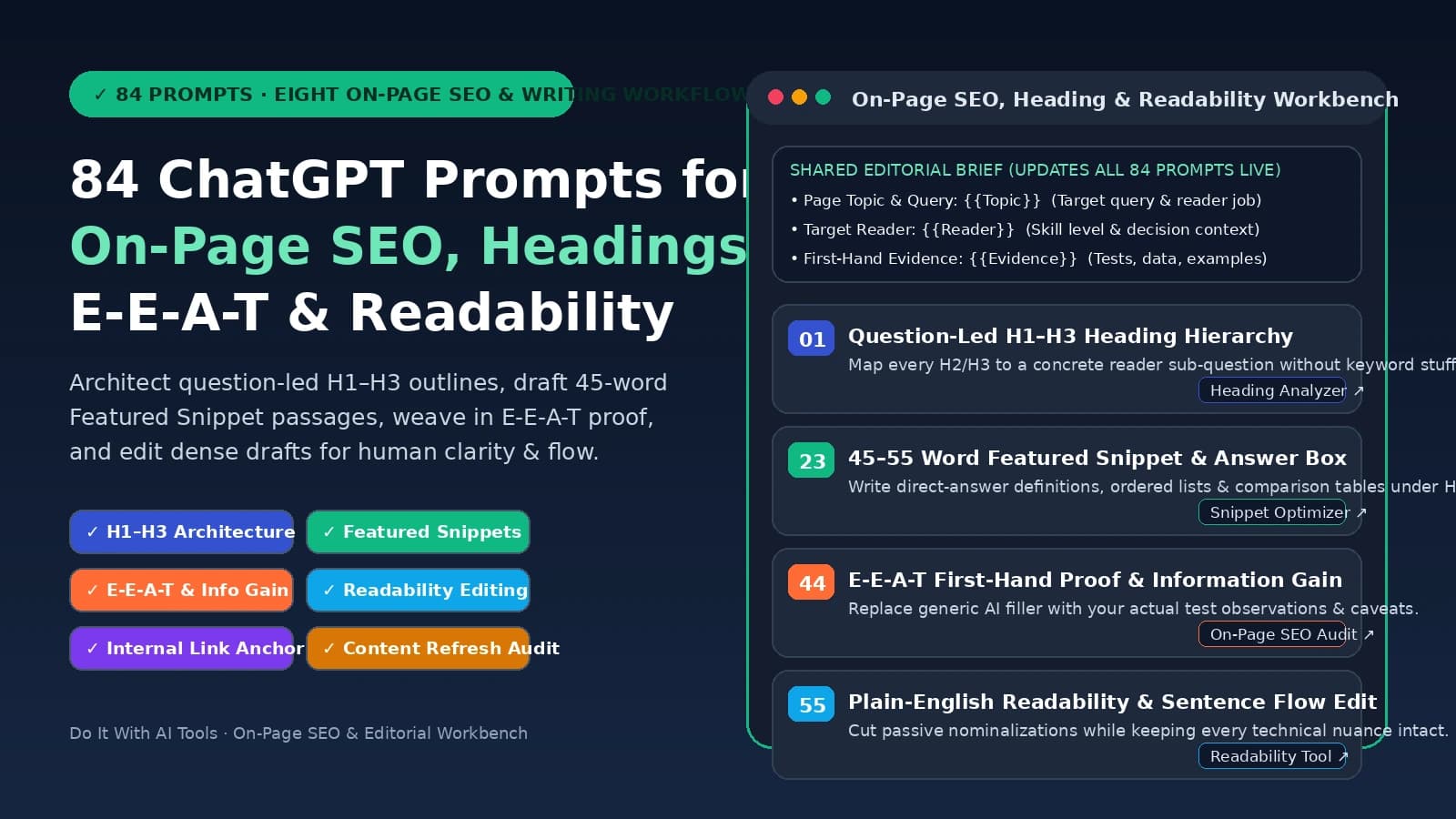
84 ChatGPT prompts for on-page SEO, headings, E-E-A-T & readability
Plan question-led H1–H3 outlines, draft 45-word Featured Snippet answers, inject first-hand E-E-A-T proof, and edit dense passages into clear, human-sounding prose.
 Sufian MustafaFounder and author · Do It With AI ToolsPublished November 1, 2026
Write pages that earn both human trust and search citations
Asking an assistant to “write an SEO blog post for [keyword]” in a single shot produces repetitive headings, vague filler intros, and zero original Information Gain. Strong on-page SEO happens in deliberate editorial stages: structure first, evidence second, and readability refinement third.
These 84 prompts keep you in the editor's seat—marking exact [MY INPUT] slots for your own screenshots and numbers, structuring 45-word answer blocks and comparison tables, and stripping robotic AI phrasing without losing technical caveats.
Fast Editorial Path: Start with Prompt 1 (Question-Led H1–H3 Outline), write your opening with Prompt 12 (65-Word Answer-First Intro), format key sections with Prompt 22 (45-Word Featured Snippet) and Prompt 33 (Information Gain Audit), and polish your prose with Prompt 44 (Grade 8 Readability Edit).
Three principles of high-ranking, reader-first content
- Principle 1
Give every heading a single job
Each H2 should answer one concrete reader question, followed immediately by a 45-word direct answer before diving into nuances.
- Principle 2
Lead with first-hand Information Gain
Show your own tests, screenshots, edge-case warnings, and quantitative comparisons that generic summaries cannot replicate.
- Principle 3
Edit for active verbs & visual rhythm
Break up long walls of text every 200 words with a comparison table, parallel bullet list, or embedded infographic card.
84 on-page SEO, heading & readability prompts by editorial task
Select the editorial workflow you need—from H1–H3 outline architecture and 45-word Featured Snippets to E-E-A-T Information Gain, plain-English readability editing, and content decay refreshes.
Customize the shared editorial brief (Updates all 84 prompts)
Fill in your page topic, target reader, and first-hand evidence once below to pre-fill all 84 prompts. Paste specific paragraphs, heading trees, or competitor outlines inside any individual prompt card.
84 of 84 prompts shown. Click any prompt card to customize, copy, or open it in ChatGPT.
Question-led H1–H3 heading hierarchy & content briefs
Build logical H1, H2, and H3 outlines around real reader sub-questions and competitor gaps without stuffing the primary keyword into every heading.
Open companion studio: Heading Structure & H1–H6 Analyzer ↗1Build a question-led H1–H3 outline with '[MY INPUT]' proof slots
Create a logical H1, H2, and H3 heading hierarchy for the supplied topic where each H2 answers a distinct reader task and marks exact `[MY INPUT]` slots where the author should insert first-hand screenshots, test numbers, or client examples.
Prepare: Page topic, primary keyword, and available first-hand experience.
Act as a senior On-Page SEO Editor and Technical Content Strategist. Work on this specific task using only the supplied material.

Page topic & primary query: {{Topic}}
Target reader & skill level: {{Reader}}
First-hand evidence & constraints: {{Evidence}}
Specific inputs: [Page topic, primary keyword, and available first-hand experience: paste here]

Task
Create a logical H1, H2, and H3 heading hierarchy for the supplied topic where each H2 answers a distinct reader task and marks exact `[MY INPUT]` slots where the author should insert first-hand screenshots, test numbers, or client examples.

Output
Return one descriptive H1, 5–7 H2 sections with H3 sub-points, reader questions answered per section, and `[MY INPUT]` proof placeholders.

Editorial & SEO boundaries
- Write for human readers first: lead with a clear answer, use logical H1–H3 hierarchy, and keep sentences concise and active.
- Never invent statistics, citations, search volume, or first-hand tests; mark any place needing author verification with `[VERIFY]` or `[MY INPUT]`.
- Avoid mechanical keyword stuffing, 'LSI' checklists, or unsupported promises about guaranteed rankings.Expected output: One descriptive H1, 5–7 H2 sections with H3 sub-points, reader questions answered per section, and `[MY INPUT]` proof placeholders.
2Compare top 3 competitor heading trees to find 'Must-Haves vs. Gaps'
Analyze the pasted H2/H3 headings from the top 3 ranking pages and separate: (1) Table-stakes topics all 3 cover, (2) Unique angles only 1 covers, and (3) Reader questions none of them answer.
Prepare: Pasted H1–H3 headings from 3 competing pages.
Act as a senior On-Page SEO Editor and Technical Content Strategist. Work on this specific task using only the supplied material.

Page topic & primary query: {{Topic}}
Target reader & skill level: {{Reader}}
First-hand evidence & constraints: {{Evidence}}
Specific inputs: [Pasted H1–H3 headings from 3 competing pages: paste here]

Task
Analyze the pasted H2/H3 headings from the top 3 ranking pages and separate: (1) Table-stakes topics all 3 cover, (2) Unique angles only 1 covers, and (3) Reader questions none of them answer.

Output
Return a 3-part heading comparison table plus a differentiated H1–H3 outline that covers essentials and wins on the gaps.

Editorial & SEO boundaries
- Write for human readers first: lead with a clear answer, use logical H1–H3 hierarchy, and keep sentences concise and active.
- Never invent statistics, citations, search volume, or first-hand tests; mark any place needing author verification with `[VERIFY]` or `[MY INPUT]`.
- Avoid mechanical keyword stuffing, 'LSI' checklists, or unsupported promises about guaranteed rankings.Expected output: A 3-part heading comparison table plus a differentiated H1–H3 outline that covers essentials and wins on the gaps.
3Audit an existing draft's H1–H4 hierarchy for skipped levels & overlap
Review the supplied heading list to flag skipped heading levels (e.g., H2 jumping to H4), overlapping sections that repeat the same point, and vague headings ('Overview', 'Things to know').
Prepare: Current H1–H6 heading tree from your draft.
Act as a senior On-Page SEO Editor and Technical Content Strategist. Work on this specific task using only the supplied material.

Page topic & primary query: {{Topic}}
Target reader & skill level: {{Reader}}
First-hand evidence & constraints: {{Evidence}}
Specific inputs: [Current H1–H6 heading tree from your draft: paste here]

Task
Review the supplied heading list to flag skipped heading levels (e.g., H2 jumping to H4), overlapping sections that repeat the same point, and vague headings ('Overview', 'Things to know').

Output
Return a heading audit table with structural issue, reader clarity score, and cụ thể rewritten headings.

Editorial & SEO boundaries
- Write for human readers first: lead with a clear answer, use logical H1–H3 hierarchy, and keep sentences concise and active.
- Never invent statistics, citations, search volume, or first-hand tests; mark any place needing author verification with `[VERIFY]` or `[MY INPUT]`.
- Avoid mechanical keyword stuffing, 'LSI' checklists, or unsupported promises about guaranteed rankings.Expected output: A heading audit table with structural issue, reader clarity score, and cụ thể rewritten headings.
4Rewrite generic headings into specific 'Action + Outcome' subheadings
Transform vague, one-word, or repetitive keyword-stuffed H2s into clear, benefit-driven subheadings that tell skimmers what each section helps them accomplish.
Prepare: List of current H2 and H3 headings.
Act as a senior On-Page SEO Editor and Technical Content Strategist. Work on this specific task using only the supplied material.

Page topic & primary query: {{Topic}}
Target reader & skill level: {{Reader}}
First-hand evidence & constraints: {{Evidence}}
Specific inputs: [List of current H2 and H3 headings: paste here]

Task
Transform vague, one-word, or repetitive keyword-stuffed H2s into clear, benefit-driven subheadings that tell skimmers what each section helps them accomplish.

Output
Return side-by-side Before vs. After headings with rationale for skimmers.

Editorial & SEO boundaries
- Write for human readers first: lead with a clear answer, use logical H1–H3 hierarchy, and keep sentences concise and active.
- Never invent statistics, citations, search volume, or first-hand tests; mark any place needing author verification with `[VERIFY]` or `[MY INPUT]`.
- Avoid mechanical keyword stuffing, 'LSI' checklists, or unsupported promises about guaranteed rankings.Expected output: Side-by-side Before vs. After headings with rationale for skimmers.
5Sequence H2 sections by reader task priority ('Inverted Pyramid')
Reorder the proposed sections of your article so the reader's primary question and most actionable workflow appear in the top third of the page rather than buried below 800 words of history.
Prepare: Unordered list of article sections and primary reader task.
Act as a senior On-Page SEO Editor and Technical Content Strategist. Work on this specific task using only the supplied material.

Page topic & primary query: {{Topic}}
Target reader & skill level: {{Reader}}
First-hand evidence & constraints: {{Evidence}}
Specific inputs: [Unordered list of article sections and primary reader task: paste here]

Task
Reorder the proposed sections of your article so the reader's primary question and most actionable workflow appear in the top third of the page rather than buried below 800 words of history.

Output
Return a re-sequenced H2–H3 outline ordered by reader urgency and search intent.

Editorial & SEO boundaries
- Write for human readers first: lead with a clear answer, use logical H1–H3 hierarchy, and keep sentences concise and active.
- Never invent statistics, citations, search volume, or first-hand tests; mark any place needing author verification with `[VERIFY]` or `[MY INPUT]`.
- Avoid mechanical keyword stuffing, 'LSI' checklists, or unsupported promises about guaranteed rankings.Expected output: A re-sequenced H2–H3 outline ordered by reader urgency and search intent.
6Design an H1 tag that complements—rather than duplicates—the <title> tag
Write five H1 options that align closely with your SEO `<title>` tag's promise while using natural on-page phrasing and slightly expanded context for readers who just clicked.
Prepare: Selected SEO <title> tag and page summary.
Act as a senior On-Page SEO Editor and Technical Content Strategist. Work on this specific task using only the supplied material.

Page topic & primary query: {{Topic}}
Target reader & skill level: {{Reader}}
First-hand evidence & constraints: {{Evidence}}
Specific inputs: [Selected SEO <title> tag and page summary: paste here]

Task
Write five H1 options that align closely with your SEO `<title>` tag's promise while using natural on-page phrasing and slightly expanded context for readers who just clicked.

Output
Return five natural H1 headlines with notes on how each pairs with the SERP title.

Editorial & SEO boundaries
- Write for human readers first: lead with a clear answer, use logical H1–H3 hierarchy, and keep sentences concise and active.
- Never invent statistics, citations, search volume, or first-hand tests; mark any place needing author verification with `[VERIFY]` or `[MY INPUT]`.
- Avoid mechanical keyword stuffing, 'LSI' checklists, or unsupported promises about guaranteed rankings.Expected output: Five natural H1 headlines with notes on how each pairs with the SERP title.
7Determine when a sub-topic needs an H3 vs. a bulleted list vs. a new page
Evaluate the proposed sub-points under a long H2 section and decide which belong as H3 subsections, which should be condensed into a scannable list, and which deserve a separate spoke article.
Prepare: Long H2 section draft or outline.
Act as a senior On-Page SEO Editor and Technical Content Strategist. Work on this specific task using only the supplied material.

Page topic & primary query: {{Topic}}
Target reader & skill level: {{Reader}}
First-hand evidence & constraints: {{Evidence}}
Specific inputs: [Long H2 section draft or outline: paste here]

Task
Evaluate the proposed sub-points under a long H2 section and decide which belong as H3 subsections, which should be condensed into a scannable list, and which deserve a separate spoke article.

Output
Return structural recommendation for each sub-point with internal link bridge notes.

Editorial & SEO boundaries
- Write for human readers first: lead with a clear answer, use logical H1–H3 hierarchy, and keep sentences concise and active.
- Never invent statistics, citations, search volume, or first-hand tests; mark any place needing author verification with `[VERIFY]` or `[MY INPUT]`.
- Avoid mechanical keyword stuffing, 'LSI' checklists, or unsupported promises about guaranteed rankings.Expected output: Structural recommendation for each sub-point with internal link bridge notes.
8Structure an objective 'X vs. Y Comparison' page heading tree
Build a fair, buyer-focused H1–H3 outline for a product, tool, or methodology comparison page covering: Quick Verdict Table, Evaluation Criteria, Where X Wins, Where Y Wins, Pricing/Limits, and Decision Matrix.
Prepare: Items being compared and target buyer criteria.
Act as a senior On-Page SEO Editor and Technical Content Strategist. Work on this specific task using only the supplied material.

Page topic & primary query: {{Topic}}
Target reader & skill level: {{Reader}}
First-hand evidence & constraints: {{Evidence}}
Specific inputs: [Items being compared and target buyer criteria: paste here]

Task
Build a fair, buyer-focused H1–H3 outline for a product, tool, or methodology comparison page covering: Quick Verdict Table, Evaluation Criteria, Where X Wins, Where Y Wins, Pricing/Limits, and Decision Matrix.

Output
Return complete comparison page H1–H3 outline with table and scorecard placements.

Editorial & SEO boundaries
- Write for human readers first: lead with a clear answer, use logical H1–H3 hierarchy, and keep sentences concise and active.
- Never invent statistics, citations, search volume, or first-hand tests; mark any place needing author verification with `[VERIFY]` or `[MY INPUT]`.
- Avoid mechanical keyword stuffing, 'LSI' checklists, or unsupported promises about guaranteed rankings.Expected output: Complete comparison page H1–H3 outline with table and scorecard placements.
9Structure a 'How-To / Step-by-Step SOP' tutorial heading tree
Organize a procedural tutorial so every H2 represents a sequential phase (`Step 1: [Action]`) and includes prerequisites, time required, verification check, and common troubleshooting.
Prepare: Process steps and required tools/inputs.
Act as a senior On-Page SEO Editor and Technical Content Strategist. Work on this specific task using only the supplied material.

Page topic & primary query: {{Topic}}
Target reader & skill level: {{Reader}}
First-hand evidence & constraints: {{Evidence}}
Specific inputs: [Process steps and required tools/inputs: paste here]

Task
Organize a procedural tutorial so every H2 represents a sequential phase (`Step 1: [Action]`) and includes prerequisites, time required, verification check, and common troubleshooting.

Output
Return a step-by-step H1–H3 tutorial outline ready for HowTo/Article structure.

Editorial & SEO boundaries
- Write for human readers first: lead with a clear answer, use logical H1–H3 hierarchy, and keep sentences concise and active.
- Never invent statistics, citations, search volume, or first-hand tests; mark any place needing author verification with `[VERIFY]` or `[MY INPUT]`.
- Avoid mechanical keyword stuffing, 'LSI' checklists, or unsupported promises about guaranteed rankings.Expected output: A step-by-step H1–H3 tutorial outline ready for HowTo/Article structure.
10De-stuff over-optimized headings that repeat the exact keyword
Edit a heading outline where the exact primary keyword was forced into 70%+ of H2s, replacing repetitive phrasing with natural pronouns, sub-tasks, and related concepts.
Prepare: Keyword-stuffed heading list.
Act as a senior On-Page SEO Editor and Technical Content Strategist. Work on this specific task using only the supplied material.

Page topic & primary query: {{Topic}}
Target reader & skill level: {{Reader}}
First-hand evidence & constraints: {{Evidence}}
Specific inputs: [Keyword-stuffed heading list: paste here]

Task
Edit a heading outline where the exact primary keyword was forced into 70%+ of H2s, replacing repetitive phrasing with natural pronouns, sub-tasks, and related concepts.

Output
Return cleaned, natural heading hierarchy that preserves topical focus without spam signals.

Editorial & SEO boundaries
- Write for human readers first: lead with a clear answer, use logical H1–H3 hierarchy, and keep sentences concise and active.
- Never invent statistics, citations, search volume, or first-hand tests; mark any place needing author verification with `[VERIFY]` or `[MY INPUT]`.
- Avoid mechanical keyword stuffing, 'LSI' checklists, or unsupported promises about guaranteed rankings.Expected output: Cleaned, natural heading hierarchy that preserves topical focus without spam signals.
11Create a writer-ready SEO Content Brief from an approved H1–H3 outline
Expand your finalized H1–H3 outline into a complete editorial brief specifying section word-count targets, required proof points, internal links to include, and claims to avoid.
Prepare: Approved H1–H3 outline and source notes.
Act as a senior On-Page SEO Editor and Technical Content Strategist. Work on this specific task using only the supplied material.

Page topic & primary query: {{Topic}}
Target reader & skill level: {{Reader}}
First-hand evidence & constraints: {{Evidence}}
Specific inputs: [Approved H1–H3 outline and source notes: paste here]

Task
Expand your finalized H1–H3 outline into a complete editorial brief specifying section word-count targets, required proof points, internal links to include, and claims to avoid.

Output
Return a comprehensive writer brief with section-by-section guardrails.

Editorial & SEO boundaries
- Write for human readers first: lead with a clear answer, use logical H1–H3 hierarchy, and keep sentences concise and active.
- Never invent statistics, citations, search volume, or first-hand tests; mark any place needing author verification with `[VERIFY]` or `[MY INPUT]`.
- Avoid mechanical keyword stuffing, 'LSI' checklists, or unsupported promises about guaranteed rankings.Expected output: A comprehensive writer brief with section-by-section guardrails.
Answer-first introductions, TL;DR boxes & jump-link TOCs
Eliminate fluffy 200-word throat-clearing intros. Answer the core query in paragraph one, frame who the page is for, and build crawl-safe jump-link Table of Contents.
Open companion studio: SEO Content Brief & Outline Generator ↗12Write an 'Answer-First' opening paragraph (Direct Answer + Context)
Draft an opening 65-word paragraph that directly answers the reader's primary query in sentences 1–2, establishes who the guide is written for in sentence 3, and previews the methodology in sentence 4.
Prepare: Primary reader question and core answer.
Act as a senior On-Page SEO Editor and Technical Content Strategist. Work on this specific task using only the supplied material.

Page topic & primary query: {{Topic}}
Target reader & skill level: {{Reader}}
First-hand evidence & constraints: {{Evidence}}
Specific inputs: [Primary reader question and core answer: paste here]

Task
Draft an opening 65-word paragraph that directly answers the reader's primary query in sentences 1–2, establishes who the guide is written for in sentence 3, and previews the methodology in sentence 4.

Output
Return three answer-first opening paragraphs (55–75 words) free of throat-clearing filler.

Editorial & SEO boundaries
- Write for human readers first: lead with a clear answer, use logical H1–H3 hierarchy, and keep sentences concise and active.
- Never invent statistics, citations, search volume, or first-hand tests; mark any place needing author verification with `[VERIFY]` or `[MY INPUT]`.
- Avoid mechanical keyword stuffing, 'LSI' checklists, or unsupported promises about guaranteed rankings.Expected output: Three answer-first opening paragraphs (55–75 words) free of throat-clearing filler.
13Delete 'AI Throat-Clearing' from an existing article introduction
Strip clichés ('In today's digital landscape', 'Have you ever wondered', 'It is no secret that') from the supplied introduction and start immediately with the core problem and solution.
Prepare: Drafted article introduction.
Act as a senior On-Page SEO Editor and Technical Content Strategist. Work on this specific task using only the supplied material.

Page topic & primary query: {{Topic}}
Target reader & skill level: {{Reader}}
First-hand evidence & constraints: {{Evidence}}
Specific inputs: [Drafted article introduction: paste here]

Task
Strip clichés ('In today's digital landscape', 'Have you ever wondered', 'It is no secret that') from the supplied introduction and start immediately with the core problem and solution.

Output
Return cleaned, high-velocity introduction + list of deleted filler phrases.

Editorial & SEO boundaries
- Write for human readers first: lead with a clear answer, use logical H1–H3 hierarchy, and keep sentences concise and active.
- Never invent statistics, citations, search volume, or first-hand tests; mark any place needing author verification with `[VERIFY]` or `[MY INPUT]`.
- Avoid mechanical keyword stuffing, 'LSI' checklists, or unsupported promises about guaranteed rankings.Expected output: Cleaned, high-velocity introduction + list of deleted filler phrases.
14Design a 4-Bullet 'TL;DR / Key Takeaways' executive summary box
Distill the entire article into four parallel, single-sentence takeaways (12–18 words each) to display in a callout box right below the introduction.
Prepare: Full article draft or outline.
Act as a senior On-Page SEO Editor and Technical Content Strategist. Work on this specific task using only the supplied material.

Page topic & primary query: {{Topic}}
Target reader & skill level: {{Reader}}
First-hand evidence & constraints: {{Evidence}}
Specific inputs: [Full article draft or outline: paste here]

Task
Distill the entire article into four parallel, single-sentence takeaways (12–18 words each) to display in a callout box right below the introduction.

Output
Return a 4-bullet TL;DR summary box written with parallel active verbs.

Editorial & SEO boundaries
- Write for human readers first: lead with a clear answer, use logical H1–H3 hierarchy, and keep sentences concise and active.
- Never invent statistics, citations, search volume, or first-hand tests; mark any place needing author verification with `[VERIFY]` or `[MY INPUT]`.
- Avoid mechanical keyword stuffing, 'LSI' checklists, or unsupported promises about guaranteed rankings.Expected output: A 4-bullet TL;DR summary box written with parallel active verbs.
15Generate a crawl-safe HTML `<nav>` Jump-Link Table of Contents
Convert your H2 heading list into short, 3-to-5 word jump-link labels with clean kebab-case `#anchor-id` slugs so mobile readers can jump straight to their section.
Prepare: List of H2 headings.
Act as a senior On-Page SEO Editor and Technical Content Strategist. Work on this specific task using only the supplied material.

Page topic & primary query: {{Topic}}
Target reader & skill level: {{Reader}}
First-hand evidence & constraints: {{Evidence}}
Specific inputs: [List of H2 headings: paste here]

Task
Convert your H2 heading list into short, 3-to-5 word jump-link labels with clean kebab-case `#anchor-id` slugs so mobile readers can jump straight to their section.

Output
Return short TOC labels, `#anchor-id` slugs, and accessible `<nav aria-label='Table of Contents'>` HTML.

Editorial & SEO boundaries
- Write for human readers first: lead with a clear answer, use logical H1–H3 hierarchy, and keep sentences concise and active.
- Never invent statistics, citations, search volume, or first-hand tests; mark any place needing author verification with `[VERIFY]` or `[MY INPUT]`.
- Avoid mechanical keyword stuffing, 'LSI' checklists, or unsupported promises about guaranteed rankings.Expected output: Short TOC labels, `#anchor-id` slugs, and accessible `<nav aria-label='Table of Contents'>` HTML.
16Write a 'Proof-Led / Benchmark' introduction for a case study or guide
Open the article with the verified test sample size, timeframe, or benchmark finding from your supplied evidence to establish immediate E-E-A-T authority.
Prepare: Supplied test methodology or dataset notes.
Act as a senior On-Page SEO Editor and Technical Content Strategist. Work on this specific task using only the supplied material.

Page topic & primary query: {{Topic}}
Target reader & skill level: {{Reader}}
First-hand evidence & constraints: {{Evidence}}
Specific inputs: [Supplied test methodology or dataset notes: paste here]

Task
Open the article with the verified test sample size, timeframe, or benchmark finding from your supplied evidence to establish immediate E-E-A-T authority.

Output
Return two proof-led introductions that cite your exact scope and limitations.

Editorial & SEO boundaries
- Write for human readers first: lead with a clear answer, use logical H1–H3 hierarchy, and keep sentences concise and active.
- Never invent statistics, citations, search volume, or first-hand tests; mark any place needing author verification with `[VERIFY]` or `[MY INPUT]`.
- Avoid mechanical keyword stuffing, 'LSI' checklists, or unsupported promises about guaranteed rankings.Expected output: Two proof-led introductions that cite your exact scope and limitations.
17Write an 'Audience Qualification' callout ('Who this guide is & isn't for')
Add a brief 3-line box near the top of the article that tells readers whether this guide matches their setup, skill level, and goal—reducing pogo-sticking.
Prepare: Target reader profile and prerequisites.
Act as a senior On-Page SEO Editor and Technical Content Strategist. Work on this specific task using only the supplied material.

Page topic & primary query: {{Topic}}
Target reader & skill level: {{Reader}}
First-hand evidence & constraints: {{Evidence}}
Specific inputs: [Target reader profile and prerequisites: paste here]

Task
Add a brief 3-line box near the top of the article that tells readers whether this guide matches their setup, skill level, and goal—reducing pogo-sticking.

Output
Return a 3-line 'Who this is for / What you'll need' callout box.

Editorial & SEO boundaries
- Write for human readers first: lead with a clear answer, use logical H1–H3 hierarchy, and keep sentences concise and active.
- Never invent statistics, citations, search volume, or first-hand tests; mark any place needing author verification with `[VERIFY]` or `[MY INPUT]`.
- Avoid mechanical keyword stuffing, 'LSI' checklists, or unsupported promises about guaranteed rankings.Expected output: A 3-line 'Who this is for / What you'll need' callout box.
18Craft smooth transition bridges between major H2 sections
Write 1-sentence closing/opening bridges between your H2 sections so the article reads like a cohesive narrative rather than 6 disconnected AI responses.
Prepare: List of H2 headings and section summaries.
Act as a senior On-Page SEO Editor and Technical Content Strategist. Work on this specific task using only the supplied material.

Page topic & primary query: {{Topic}}
Target reader & skill level: {{Reader}}
First-hand evidence & constraints: {{Evidence}}
Specific inputs: [List of H2 headings and section summaries: paste here]

Task
Write 1-sentence closing/opening bridges between your H2 sections so the article reads like a cohesive narrative rather than 6 disconnected AI responses.

Output
Return section-to-section transition sentences that maintain reading momentum.

Editorial & SEO boundaries
- Write for human readers first: lead with a clear answer, use logical H1–H3 hierarchy, and keep sentences concise and active.
- Never invent statistics, citations, search volume, or first-hand tests; mark any place needing author verification with `[VERIFY]` or `[MY INPUT]`.
- Avoid mechanical keyword stuffing, 'LSI' checklists, or unsupported promises about guaranteed rankings.Expected output: Section-to-section transition sentences that maintain reading momentum.
19Write a 'Decision-First' introduction for commercial comparison pages
For 'Best X' or 'X vs Y' pages, give the reader the top recommendation by use case in the first 80 words before diving into detailed reviews.
Prepare: Evaluated products/options and winner by use case.
Act as a senior On-Page SEO Editor and Technical Content Strategist. Work on this specific task using only the supplied material.

Page topic & primary query: {{Topic}}
Target reader & skill level: {{Reader}}
First-hand evidence & constraints: {{Evidence}}
Specific inputs: [Evaluated products/options and winner by use case: paste here]

Task
For 'Best X' or 'X vs Y' pages, give the reader the top recommendation by use case in the first 80 words before diving into detailed reviews.

Output
Return an 80-word decision-first intro + quick-pick summary bullets.

Editorial & SEO boundaries
- Write for human readers first: lead with a clear answer, use logical H1–H3 hierarchy, and keep sentences concise and active.
- Never invent statistics, citations, search volume, or first-hand tests; mark any place needing author verification with `[VERIFY]` or `[MY INPUT]`.
- Avoid mechanical keyword stuffing, 'LSI' checklists, or unsupported promises about guaranteed rankings.Expected output: An 80-word decision-first intro + quick-pick summary bullets.
20Replace a weak 'In Conclusion' section with a 'Next-Step Action Plan'
Rewrite a repetitive conclusion that merely restates the intro into a concrete 3-step 'What to do in the next 15 minutes' action checklist.
Prepare: Drafted conclusion and core article steps.
Act as a senior On-Page SEO Editor and Technical Content Strategist. Work on this specific task using only the supplied material.

Page topic & primary query: {{Topic}}
Target reader & skill level: {{Reader}}
First-hand evidence & constraints: {{Evidence}}
Specific inputs: [Drafted conclusion and core article steps: paste here]

Task
Rewrite a repetitive conclusion that merely restates the intro into a concrete 3-step 'What to do in the next 15 minutes' action checklist.

Output
Return an action-oriented closing section with a 3-step implementation checklist.

Editorial & SEO boundaries
- Write for human readers first: lead with a clear answer, use logical H1–H3 hierarchy, and keep sentences concise and active.
- Never invent statistics, citations, search volume, or first-hand tests; mark any place needing author verification with `[VERIFY]` or `[MY INPUT]`.
- Avoid mechanical keyword stuffing, 'LSI' checklists, or unsupported promises about guaranteed rankings.Expected output: An action-oriented closing section with a 3-step implementation checklist.
21Audit the first 200 words of a page for 'Time-to-Value'
Count how many words a reader must scroll past before encountering the first concrete fact, step, or answer, and compress the opening to deliver value within 50 words.
Prepare: First 250 words of your draft.
Act as a senior On-Page SEO Editor and Technical Content Strategist. Work on this specific task using only the supplied material.

Page topic & primary query: {{Topic}}
Target reader & skill level: {{Reader}}
First-hand evidence & constraints: {{Evidence}}
Specific inputs: [First 250 words of your draft: paste here]

Task
Count how many words a reader must scroll past before encountering the first concrete fact, step, or answer, and compress the opening to deliver value within 50 words.

Output
Return time-to-Value word count audit and a compressed 100-word opening.

Editorial & SEO boundaries
- Write for human readers first: lead with a clear answer, use logical H1–H3 hierarchy, and keep sentences concise and active.
- Never invent statistics, citations, search volume, or first-hand tests; mark any place needing author verification with `[VERIFY]` or `[MY INPUT]`.
- Avoid mechanical keyword stuffing, 'LSI' checklists, or unsupported promises about guaranteed rankings.Expected output: Time-to-Value word count audit and a compressed 100-word opening.
45-word Featured Snippets, People Also Ask & comparison tables
Write self-contained 40-to-55 word definition passages, ordered process lists, and HTML/Markdown comparison tables immediately underneath question-based H2 headings.
Open companion studio: AI Citation & Featured Snippet Optimizer ↗22Write a 45–55 word 'Paragraph Featured Snippet' definition block
Immediately beneath a 'What is [X]?' or 'Why does [X] happen?' H2 heading, write a self-contained 45-to-55 word answer that begins with '[Topic] is...' and can be quoted standalone.
Prepare: Question H2 heading and factual definition.
Act as a senior On-Page SEO Editor and Technical Content Strategist. Work on this specific task using only the supplied material.

Page topic & primary query: {{Topic}}
Target reader & skill level: {{Reader}}
First-hand evidence & constraints: {{Evidence}}
Specific inputs: [Question H2 heading and factual definition: paste here]

Task
Immediately beneath a 'What is [X]?' or 'Why does [X] happen?' H2 heading, write a self-contained 45-to-55 word answer that begins with '[Topic] is...' and can be quoted standalone.

Output
Return three 45–55 word snippet-ready paragraphs with exact word counts.

Editorial & SEO boundaries
- Write for human readers first: lead with a clear answer, use logical H1–H3 hierarchy, and keep sentences concise and active.
- Never invent statistics, citations, search volume, or first-hand tests; mark any place needing author verification with `[VERIFY]` or `[MY INPUT]`.
- Avoid mechanical keyword stuffing, 'LSI' checklists, or unsupported promises about guaranteed rankings.Expected output: Three 45–55 word snippet-ready paragraphs with exact word counts.
23Format a 'Numbered Process Snippet' (`<ol>`) with bold lead-in stems
Structure a 5-to-7 step process under a 'How to [X]' H2 so each `<li>` begins with a bold 3-to-5 word action stem (`<strong>1. Audit canonical tags:</strong>`) that Google can pull into list snippets.
Prepare: Process steps from your article.
Act as a senior On-Page SEO Editor and Technical Content Strategist. Work on this specific task using only the supplied material.

Page topic & primary query: {{Topic}}
Target reader & skill level: {{Reader}}
First-hand evidence & constraints: {{Evidence}}
Specific inputs: [Process steps from your article: paste here]

Task
Structure a 5-to-7 step process under a 'How to [X]' H2 so each `<li>` begins with a bold 3-to-5 word action stem (`<strong>1. Audit canonical tags:</strong>`) that Google can pull into list snippets.

Output
Return formatted `<ol>` list with bold action stems and 18-word explanations.

Editorial & SEO boundaries
- Write for human readers first: lead with a clear answer, use logical H1–H3 hierarchy, and keep sentences concise and active.
- Never invent statistics, citations, search volume, or first-hand tests; mark any place needing author verification with `[VERIFY]` or `[MY INPUT]`.
- Avoid mechanical keyword stuffing, 'LSI' checklists, or unsupported promises about guaranteed rankings.Expected output: Formatted `<ol>` list with bold action stems and 18-word explanations.
24Convert a dense comparison paragraph into a scannable Markdown/HTML Table
Transform a multi-sentence comparison of features, prices, specifications, or pros/cons into a clean 4-column table with concise cell values.
Prepare: Dense paragraph comparing multiple options or attributes.
Act as a senior On-Page SEO Editor and Technical Content Strategist. Work on this specific task using only the supplied material.

Page topic & primary query: {{Topic}}
Target reader & skill level: {{Reader}}
First-hand evidence & constraints: {{Evidence}}
Specific inputs: [Dense paragraph comparing multiple options or attributes: paste here]

Task
Transform a multi-sentence comparison of features, prices, specifications, or pros/cons into a clean 4-column table with concise cell values.

Output
Return a structured Markdown and HTML `<table>` with clear column headers and concise cells.

Editorial & SEO boundaries
- Write for human readers first: lead with a clear answer, use logical H1–H3 hierarchy, and keep sentences concise and active.
- Never invent statistics, citations, search volume, or first-hand tests; mark any place needing author verification with `[VERIFY]` or `[MY INPUT]`.
- Avoid mechanical keyword stuffing, 'LSI' checklists, or unsupported promises about guaranteed rankings.Expected output: A structured Markdown and HTML `<table>` with clear column headers and concise cells.
25Answer 6 'People Also Ask' (PAA) questions in 45 words each
Write direct, zero-fluff 40-to-55 word answers to the supplied People Also Ask questions, flagging any answer that depends on jurisdiction, pricing, or version changes.
Prepare: List of 4–8 observed People Also Ask questions.
Act as a senior On-Page SEO Editor and Technical Content Strategist. Work on this specific task using only the supplied material.

Page topic & primary query: {{Topic}}
Target reader & skill level: {{Reader}}
First-hand evidence & constraints: {{Evidence}}
Specific inputs: [List of 4–8 observed People Also Ask questions: paste here]

Task
Write direct, zero-fluff 40-to-55 word answers to the supplied People Also Ask questions, flagging any answer that depends on jurisdiction, pricing, or version changes.

Output
Return concise 45-word answers with source-verification flags.

Editorial & SEO boundaries
- Write for human readers first: lead with a clear answer, use logical H1–H3 hierarchy, and keep sentences concise and active.
- Never invent statistics, citations, search volume, or first-hand tests; mark any place needing author verification with `[VERIFY]` or `[MY INPUT]`.
- Avoid mechanical keyword stuffing, 'LSI' checklists, or unsupported promises about guaranteed rankings.Expected output: Concise 45-word answers with source-verification flags.
26Build a 'Quick-Reference Specification / Threshold Table'
Extract numerical thresholds, character limits, dimensions, or status codes from your article into a 2-or-3 column reference table readers will bookmark.
Prepare: Technical limits, dimensions, or rules in your article.
Act as a senior On-Page SEO Editor and Technical Content Strategist. Work on this specific task using only the supplied material.

Page topic & primary query: {{Topic}}
Target reader & skill level: {{Reader}}
First-hand evidence & constraints: {{Evidence}}
Specific inputs: [Technical limits, dimensions, or rules in your article: paste here]

Task
Extract numerical thresholds, character limits, dimensions, or status codes from your article into a 2-or-3 column reference table readers will bookmark.

Output
Return a compact reference table + 1-sentence caption.

Editorial & SEO boundaries
- Write for human readers first: lead with a clear answer, use logical H1–H3 hierarchy, and keep sentences concise and active.
- Never invent statistics, citations, search volume, or first-hand tests; mark any place needing author verification with `[VERIFY]` or `[MY INPUT]`.
- Avoid mechanical keyword stuffing, 'LSI' checklists, or unsupported promises about guaranteed rankings.Expected output: A compact reference table + 1-sentence caption.
27Rewrite a vague FAQ section so every answer stands alone without context
Edit your FAQ answers so each answer repeats the core subject noun in sentence 1 (instead of 'Yes, it does...')—making every Q&A pair clear when extracted in search or AI snippets.
Prepare: Drafted FAQ questions and answers.
Act as a senior On-Page SEO Editor and Technical Content Strategist. Work on this specific task using only the supplied material.

Page topic & primary query: {{Topic}}
Target reader & skill level: {{Reader}}
First-hand evidence & constraints: {{Evidence}}
Specific inputs: [Drafted FAQ questions and answers: paste here]

Task
Edit your FAQ answers so each answer repeats the core subject noun in sentence 1 (instead of 'Yes, it does...')—making every Q&A pair clear when extracted in search or AI snippets.

Output
Return self-contained, entity-explicit FAQ pairs ready for FAQPage schema.

Editorial & SEO boundaries
- Write for human readers first: lead with a clear answer, use logical H1–H3 hierarchy, and keep sentences concise and active.
- Never invent statistics, citations, search volume, or first-hand tests; mark any place needing author verification with `[VERIFY]` or `[MY INPUT]`.
- Avoid mechanical keyword stuffing, 'LSI' checklists, or unsupported promises about guaranteed rankings.Expected output: Self-contained, entity-explicit FAQ pairs ready for FAQPage schema.
28Create a 'Pros, Cons & Best For' summary box for product/method reviews
Summarize each reviewed item in a consistent 3-part card: 3 Concrete Strengths, 2 Real Limitations/Trade-offs, and 1 Ideal User Profile.
Prepare: Notes on reviewed tool, service, or method.
Act as a senior On-Page SEO Editor and Technical Content Strategist. Work on this specific task using only the supplied material.

Page topic & primary query: {{Topic}}
Target reader & skill level: {{Reader}}
First-hand evidence & constraints: {{Evidence}}
Specific inputs: [Notes on reviewed tool, service, or method: paste here]

Task
Summarize each reviewed item in a consistent 3-part card: 3 Concrete Strengths, 2 Real Limitations/Trade-offs, and 1 Ideal User Profile.

Output
Return balanced Pros / Cons / Best-For summary block.

Editorial & SEO boundaries
- Write for human readers first: lead with a clear answer, use logical H1–H3 hierarchy, and keep sentences concise and active.
- Never invent statistics, citations, search volume, or first-hand tests; mark any place needing author verification with `[VERIFY]` or `[MY INPUT]`.
- Avoid mechanical keyword stuffing, 'LSI' checklists, or unsupported promises about guaranteed rankings.Expected output: Balanced Pros / Cons / Best-For summary block.
29Format a 'Formula / Calculation' callout box with a worked example
Present a metric or calculation clearly in three parts: (1) The plain-text formula, (2) What each variable means, and (3) A realistic worked number example.
Prepare: Metric name, formula, and sample numbers.
Act as a senior On-Page SEO Editor and Technical Content Strategist. Work on this specific task using only the supplied material.

Page topic & primary query: {{Topic}}
Target reader & skill level: {{Reader}}
First-hand evidence & constraints: {{Evidence}}
Specific inputs: [Metric name, formula, and sample numbers: paste here]

Task
Present a metric or calculation clearly in three parts: (1) The plain-text formula, (2) What each variable means, and (3) A realistic worked number example.

Output
Return clean formula box + step-by-step worked calculation.

Editorial & SEO boundaries
- Write for human readers first: lead with a clear answer, use logical H1–H3 hierarchy, and keep sentences concise and active.
- Never invent statistics, citations, search volume, or first-hand tests; mark any place needing author verification with `[VERIFY]` or `[MY INPUT]`.
- Avoid mechanical keyword stuffing, 'LSI' checklists, or unsupported promises about guaranteed rankings.Expected output: Clean formula box + step-by-step worked calculation.
30Design a 'Decision Tree / If-Then' table for troubleshooting guides
Map reader scenarios into an 'If you see [Symptom] → Likely Cause → Exact Action to Take' table.
Prepare: Troubleshooting scenarios from your guide.
Act as a senior On-Page SEO Editor and Technical Content Strategist. Work on this specific task using only the supplied material.

Page topic & primary query: {{Topic}}
Target reader & skill level: {{Reader}}
First-hand evidence & constraints: {{Evidence}}
Specific inputs: [Troubleshooting scenarios from your guide: paste here]

Task
Map reader scenarios into an 'If you see [Symptom] → Likely Cause → Exact Action to Take' table.

Output
Return a 3-column Symptom → Cause → Fix decision table.

Editorial & SEO boundaries
- Write for human readers first: lead with a clear answer, use logical H1–H3 hierarchy, and keep sentences concise and active.
- Never invent statistics, citations, search volume, or first-hand tests; mark any place needing author verification with `[VERIFY]` or `[MY INPUT]`.
- Avoid mechanical keyword stuffing, 'LSI' checklists, or unsupported promises about guaranteed rankings.Expected output: A 3-column Symptom → Cause → Fix decision table.
31Optimize table headers (`<th>`) and captions (`<caption>`) for search clarity
Rewrite ambiguous table column headers ('Type', 'Value', 'Info') into specific, self-explanatory headers ('Redirect Status Code', 'Cache Behavior', 'SEO Impact').
Prepare: Existing table markup or draft.
Act as a senior On-Page SEO Editor and Technical Content Strategist. Work on this specific task using only the supplied material.

Page topic & primary query: {{Topic}}
Target reader & skill level: {{Reader}}
First-hand evidence & constraints: {{Evidence}}
Specific inputs: [Existing table markup or draft: paste here]

Task
Rewrite ambiguous table column headers ('Type', 'Value', 'Info') into specific, self-explanatory headers ('Redirect Status Code', 'Cache Behavior', 'SEO Impact').

Output
Return upgraded semantic `<table>` with descriptive `<caption>` and `<th>` labels.

Editorial & SEO boundaries
- Write for human readers first: lead with a clear answer, use logical H1–H3 hierarchy, and keep sentences concise and active.
- Never invent statistics, citations, search volume, or first-hand tests; mark any place needing author verification with `[VERIFY]` or `[MY INPUT]`.
- Avoid mechanical keyword stuffing, 'LSI' checklists, or unsupported promises about guaranteed rankings.Expected output: Upgraded semantic `<table>` with descriptive `<caption>` and `<th>` labels.
32Audit a long article for 'Wall-of-Text' zones needing a table or callout
Scan the supplied article and identify any stretch of 350+ words of unbroken paragraphs that would be clearer as a table, checklist, or visual card.
Prepare: Full article draft.
Act as a senior On-Page SEO Editor and Technical Content Strategist. Work on this specific task using only the supplied material.

Page topic & primary query: {{Topic}}
Target reader & skill level: {{Reader}}
First-hand evidence & constraints: {{Evidence}}
Specific inputs: [Full article draft: paste here]

Task
Scan the supplied article and identify any stretch of 350+ words of unbroken paragraphs that would be clearer as a table, checklist, or visual card.

Output
Return location audit with converted table/checklist replacements for dense passages.

Editorial & SEO boundaries
- Write for human readers first: lead with a clear answer, use logical H1–H3 hierarchy, and keep sentences concise and active.
- Never invent statistics, citations, search volume, or first-hand tests; mark any place needing author verification with `[VERIFY]` or `[MY INPUT]`.
- Avoid mechanical keyword stuffing, 'LSI' checklists, or unsupported promises about guaranteed rankings.Expected output: Location audit with converted table/checklist replacements for dense passages.
E-E-A-T first-hand proof, Information Gain & citation weaving
Differentiate your article from consensus AI summaries by weaving in first-hand test notes, quantitative benchmarks, edge-case caveats, and primary source citations.
Open companion studio: On-Page AI SEO & E-E-A-T Analyzer ↗33Audit a draft for 'Information Gain' vs. generic consensus repetition
Evaluate the supplied draft to identify which paragraphs merely repeat standard common knowledge vs. which sections contribute new examples, data, counter-arguments, or operational nuance.
Prepare: Article draft and topic summary.
Act as a senior On-Page SEO Editor and Technical Content Strategist. Work on this specific task using only the supplied material.

Page topic & primary query: {{Topic}}
Target reader & skill level: {{Reader}}
First-hand evidence & constraints: {{Evidence}}
Specific inputs: [Article draft and topic summary: paste here]

Task
Evaluate the supplied draft to identify which paragraphs merely repeat standard common knowledge vs. which sections contribute new examples, data, counter-arguments, or operational nuance.

Output
Return an Information Gain scorecard flagging generic sections and suggesting 5 specific ways to add original value.

Editorial & SEO boundaries
- Write for human readers first: lead with a clear answer, use logical H1–H3 hierarchy, and keep sentences concise and active.
- Never invent statistics, citations, search volume, or first-hand tests; mark any place needing author verification with `[VERIFY]` or `[MY INPUT]`.
- Avoid mechanical keyword stuffing, 'LSI' checklists, or unsupported promises about guaranteed rankings.Expected output: An Information Gain scorecard flagging generic sections and suggesting 5 specific ways to add original value.
34Weave raw practitioner notes or voice-memo transcripts into a section
Integrate the author's messy first-hand notes, test observations, or lessons learned naturally into the drafted section without losing their authentic operator voice.
Prepare: Drafted section + author's raw first-hand notes.
Act as a senior On-Page SEO Editor and Technical Content Strategist. Work on this specific task using only the supplied material.

Page topic & primary query: {{Topic}}
Target reader & skill level: {{Reader}}
First-hand evidence & constraints: {{Evidence}}
Specific inputs: [Drafted section + author's raw first-hand notes: paste here]

Task
Integrate the author's messy first-hand notes, test observations, or lessons learned naturally into the drafted section without losing their authentic operator voice.

Output
Return revised section that foregrounds real practitioner experience.

Editorial & SEO boundaries
- Write for human readers first: lead with a clear answer, use logical H1–H3 hierarchy, and keep sentences concise and active.
- Never invent statistics, citations, search volume, or first-hand tests; mark any place needing author verification with `[VERIFY]` or `[MY INPUT]`.
- Avoid mechanical keyword stuffing, 'LSI' checklists, or unsupported promises about guaranteed rankings.Expected output: Revised section that foregrounds real practitioner experience.
35Add 'Edge Cases, Caveats & When This Does NOT Work' for E-E-A-T trust
Identify where the advice in your article has real-world exceptions (budget size, platform limits, edge cases) and write a transparent caveat paragraph that builds reader trust.
Prepare: Article advice and known operational limitations.
Act as a senior On-Page SEO Editor and Technical Content Strategist. Work on this specific task using only the supplied material.

Page topic & primary query: {{Topic}}
Target reader & skill level: {{Reader}}
First-hand evidence & constraints: {{Evidence}}
Specific inputs: [Article advice and known operational limitations: paste here]

Task
Identify where the advice in your article has real-world exceptions (budget size, platform limits, edge cases) and write a transparent caveat paragraph that builds reader trust.

Output
Return a candid 'When to skip this / Edge cases' subsection.

Editorial & SEO boundaries
- Write for human readers first: lead with a clear answer, use logical H1–H3 hierarchy, and keep sentences concise and active.
- Never invent statistics, citations, search volume, or first-hand tests; mark any place needing author verification with `[VERIFY]` or `[MY INPUT]`.
- Avoid mechanical keyword stuffing, 'LSI' checklists, or unsupported promises about guaranteed rankings.Expected output: A candid 'When to skip this / Edge cases' subsection.
36Replace hypothetical 'Imagine a company...' examples with concrete scenarios
Swap out cartoonish filler examples ('Imagine Bob owns a widget shop') for realistic, domain-accurate scenarios using the supplied industry details.
Prepare: Vague example passage + real industry context.
Act as a senior On-Page SEO Editor and Technical Content Strategist. Work on this specific task using only the supplied material.

Page topic & primary query: {{Topic}}
Target reader & skill level: {{Reader}}
First-hand evidence & constraints: {{Evidence}}
Specific inputs: [Vague example passage + real industry context: paste here]

Task
Swap out cartoonish filler examples ('Imagine Bob owns a widget shop') for realistic, domain-accurate scenarios using the supplied industry details.

Output
Return concrete, practitioner-grade worked example.

Editorial & SEO boundaries
- Write for human readers first: lead with a clear answer, use logical H1–H3 hierarchy, and keep sentences concise and active.
- Never invent statistics, citations, search volume, or first-hand tests; mark any place needing author verification with `[VERIFY]` or `[MY INPUT]`.
- Avoid mechanical keyword stuffing, 'LSI' checklists, or unsupported promises about guaranteed rankings.Expected output: Concrete, practitioner-grade worked example.
37Format primary source citations and methodology disclosures
Ensure every statistic, law, clinical claim, or documentation rule in your draft carries a clear inline attribution to its primary source and states the date/scope of the data.
Prepare: Draft passages containing statistics or rules + source list.
Act as a senior On-Page SEO Editor and Technical Content Strategist. Work on this specific task using only the supplied material.

Page topic & primary query: {{Topic}}
Target reader & skill level: {{Reader}}
First-hand evidence & constraints: {{Evidence}}
Specific inputs: [Draft passages containing statistics or rules + source list: paste here]

Task
Ensure every statistic, law, clinical claim, or documentation rule in your draft carries a clear inline attribution to its primary source and states the date/scope of the data.

Output
Return properly attributed passages with source-fidelity checks.

Editorial & SEO boundaries
- Write for human readers first: lead with a clear answer, use logical H1–H3 hierarchy, and keep sentences concise and active.
- Never invent statistics, citations, search volume, or first-hand tests; mark any place needing author verification with `[VERIFY]` or `[MY INPUT]`.
- Avoid mechanical keyword stuffing, 'LSI' checklists, or unsupported promises about guaranteed rankings.Expected output: Properly attributed passages with source-fidelity checks.
38Write an 'How We Tested / Methodology' disclosure box
Draft a transparent 75-word methodology box explaining how the tools, workflows, or strategies on the page were evaluated, what criteria were used, and what was excluded.
Prepare: Testing notes, evaluation criteria, and dates.
Act as a senior On-Page SEO Editor and Technical Content Strategist. Work on this specific task using only the supplied material.

Page topic & primary query: {{Topic}}
Target reader & skill level: {{Reader}}
First-hand evidence & constraints: {{Evidence}}
Specific inputs: [Testing notes, evaluation criteria, and dates: paste here]

Task
Draft a transparent 75-word methodology box explaining how the tools, workflows, or strategies on the page were evaluated, what criteria were used, and what was excluded.

Output
Return a clear 'How We Evaluated This' E-E-A-T disclosure block.

Editorial & SEO boundaries
- Write for human readers first: lead with a clear answer, use logical H1–H3 hierarchy, and keep sentences concise and active.
- Never invent statistics, citations, search volume, or first-hand tests; mark any place needing author verification with `[VERIFY]` or `[MY INPUT]`.
- Avoid mechanical keyword stuffing, 'LSI' checklists, or unsupported promises about guaranteed rankings.Expected output: A clear 'How We Evaluated This' E-E-A-T disclosure block.
39Turn a generic tip into a 'Before vs. After' real-world example
Demonstrate a writing, coding, or marketing rule by showing the exact flawed 'Before' version alongside the improved 'After' version and explaining why it works.
Prepare: Rule or tip being taught.
Act as a senior On-Page SEO Editor and Technical Content Strategist. Work on this specific task using only the supplied material.

Page topic & primary query: {{Topic}}
Target reader & skill level: {{Reader}}
First-hand evidence & constraints: {{Evidence}}
Specific inputs: [Rule or tip being taught: paste here]

Task
Demonstrate a writing, coding, or marketing rule by showing the exact flawed 'Before' version alongside the improved 'After' version and explaining why it works.

Output
Return a side-by-side Before / After demonstration block with 3 annotation bullets.

Editorial & SEO boundaries
- Write for human readers first: lead with a clear answer, use logical H1–H3 hierarchy, and keep sentences concise and active.
- Never invent statistics, citations, search volume, or first-hand tests; mark any place needing author verification with `[VERIFY]` or `[MY INPUT]`.
- Avoid mechanical keyword stuffing, 'LSI' checklists, or unsupported promises about guaranteed rankings.Expected output: A side-by-side Before / After demonstration block with 3 annotation bullets.
40Write an Author Bio & Reviewer Byline that demonstrates topic-specific E-E-A-T
Craft a concise 45-word author byline tailored to this specific article category—highlighting relevant hands-on experience, credentials, and published work.
Prepare: Author background and article topic.
Act as a senior On-Page SEO Editor and Technical Content Strategist. Work on this specific task using only the supplied material.

Page topic & primary query: {{Topic}}
Target reader & skill level: {{Reader}}
First-hand evidence & constraints: {{Evidence}}
Specific inputs: [Author background and article topic: paste here]

Task
Craft a concise 45-word author byline tailored to this specific article category—highlighting relevant hands-on experience, credentials, and published work.

Output
Return a topic-aligned 45-word author bio + Person schema properties.

Editorial & SEO boundaries
- Write for human readers first: lead with a clear answer, use logical H1–H3 hierarchy, and keep sentences concise and active.
- Never invent statistics, citations, search volume, or first-hand tests; mark any place needing author verification with `[VERIFY]` or `[MY INPUT]`.
- Avoid mechanical keyword stuffing, 'LSI' checklists, or unsupported promises about guaranteed rankings.Expected output: A topic-aligned 45-word author bio + Person schema properties.
41Spot and remove unsupported superlatives & ranking guarantees
Scan the draft for exaggerated marketing claims ('100% guaranteed', 'instant #1 rankings', 'undisputed best') and replace them with measured, evidence-backed statements.
Prepare: Article draft.
Act as a senior On-Page SEO Editor and Technical Content Strategist. Work on this specific task using only the supplied material.

Page topic & primary query: {{Topic}}
Target reader & skill level: {{Reader}}
First-hand evidence & constraints: {{Evidence}}
Specific inputs: [Article draft: paste here]

Task
Scan the draft for exaggerated marketing claims ('100% guaranteed', 'instant #1 rankings', 'undisputed best') and replace them with measured, evidence-backed statements.

Output
Return list of flagged overclaims with accurate, trustworthy replacements.

Editorial & SEO boundaries
- Write for human readers first: lead with a clear answer, use logical H1–H3 hierarchy, and keep sentences concise and active.
- Never invent statistics, citations, search volume, or first-hand tests; mark any place needing author verification with `[VERIFY]` or `[MY INPUT]`.
- Avoid mechanical keyword stuffing, 'LSI' checklists, or unsupported promises about guaranteed rankings.Expected output: List of flagged overclaims with accurate, trustworthy replacements.
42Create an 'Original Mini-Dataset / Benchmark Summary' from internal logs
Help structure a small internal dataset (e.g., 25 audited sites, 50 tested prompts, 30 support tickets) into a citable original finding table and chart brief.
Prepare: Raw observations or tally from your own work.
Act as a senior On-Page SEO Editor and Technical Content Strategist. Work on this specific task using only the supplied material.

Page topic & primary query: {{Topic}}
Target reader & skill level: {{Reader}}
First-hand evidence & constraints: {{Evidence}}
Specific inputs: [Raw observations or tally from your own work: paste here]

Task
Help structure a small internal dataset (e.g., 25 audited sites, 50 tested prompts, 30 support tickets) into a citable original finding table and chart brief.

Output
Return a citable summary finding, methodology caveat, and Data Chart Card brief.

Editorial & SEO boundaries
- Write for human readers first: lead with a clear answer, use logical H1–H3 hierarchy, and keep sentences concise and active.
- Never invent statistics, citations, search volume, or first-hand tests; mark any place needing author verification with `[VERIFY]` or `[MY INPUT]`.
- Avoid mechanical keyword stuffing, 'LSI' checklists, or unsupported promises about guaranteed rankings.Expected output: A citable summary finding, methodology caveat, and Data Chart Card brief.
43Verify YMYL (Finance, Health, Legal, Safety) disclaimers and precision
Review sensitive or high-stakes content to ensure qualifications are preserved, professional review requirements are noted, and no speculative advice is stated as fact.
Prepare: Draft passage on a high-stakes topic.
Act as a senior On-Page SEO Editor and Technical Content Strategist. Work on this specific task using only the supplied material.

Page topic & primary query: {{Topic}}
Target reader & skill level: {{Reader}}
First-hand evidence & constraints: {{Evidence}}
Specific inputs: [Draft passage on a high-stakes topic: paste here]

Task
Review sensitive or high-stakes content to ensure qualifications are preserved, professional review requirements are noted, and no speculative advice is stated as fact.

Output
Return risk & precision review with required disclaimer language.

Editorial & SEO boundaries
- Write for human readers first: lead with a clear answer, use logical H1–H3 hierarchy, and keep sentences concise and active.
- Never invent statistics, citations, search volume, or first-hand tests; mark any place needing author verification with `[VERIFY]` or `[MY INPUT]`.
- Avoid mechanical keyword stuffing, 'LSI' checklists, or unsupported promises about guaranteed rankings.Expected output: Risk & precision review with required disclaimer language.
Plain-English readability editing, sentence cadence & de-fluffing
Revise dense, academic, or robotic paragraphs for Grade 7–9 clarity while strictly preserving technical accuracy, legal/clinical caveats, and author voice.
Open companion studio: Readability & Sentence Flow Checker ↗44Edit a dense paragraph for Grade 8 readability without losing meaning
Rewrite the supplied passage using familiar words, active verbs, and varied sentence lengths while keeping every technical term, caveat, link, and fact intact.
Prepare: Dense or convoluted paragraph.
Act as a senior On-Page SEO Editor and Technical Content Strategist. Work on this specific task using only the supplied material.

Page topic & primary query: {{Topic}}
Target reader & skill level: {{Reader}}
First-hand evidence & constraints: {{Evidence}}
Specific inputs: [Dense or convoluted paragraph: paste here]

Task
Rewrite the supplied passage using familiar words, active verbs, and varied sentence lengths while keeping every technical term, caveat, link, and fact intact.

Output
Return revised passage + explanation of the 3 most helpful clarity edits.

Editorial & SEO boundaries
- Write for human readers first: lead with a clear answer, use logical H1–H3 hierarchy, and keep sentences concise and active.
- Never invent statistics, citations, search volume, or first-hand tests; mark any place needing author verification with `[VERIFY]` or `[MY INPUT]`.
- Avoid mechanical keyword stuffing, 'LSI' checklists, or unsupported promises about guaranteed rankings.Expected output: Revised passage + explanation of the 3 most helpful clarity edits.
45Eliminate passive voice and 'Zombie Nouns' (Nominalizations)
Convert passive constructions and heavy noun phrases ('implementation of the optimization was performed') into direct active verbs ('we optimized').
Prepare: Passive or bureaucratic draft text.
Act as a senior On-Page SEO Editor and Technical Content Strategist. Work on this specific task using only the supplied material.

Page topic & primary query: {{Topic}}
Target reader & skill level: {{Reader}}
First-hand evidence & constraints: {{Evidence}}
Specific inputs: [Passive or bureaucratic draft text: paste here]

Task
Convert passive constructions and heavy noun phrases ('implementation of the optimization was performed') into direct active verbs ('we optimized').

Output
Return active-voice revision with highlighted verb replacements.

Editorial & SEO boundaries
- Write for human readers first: lead with a clear answer, use logical H1–H3 hierarchy, and keep sentences concise and active.
- Never invent statistics, citations, search volume, or first-hand tests; mark any place needing author verification with `[VERIFY]` or `[MY INPUT]`.
- Avoid mechanical keyword stuffing, 'LSI' checklists, or unsupported promises about guaranteed rankings.Expected output: Active-voice revision with highlighted verb replacements.
46Break 40-word run-on sentences into crisp, breathable prose
Identify any sentence over 28 words that packs multiple clauses together and split it into clear, well-paced sentences.
Prepare: Long-form draft section.
Act as a senior On-Page SEO Editor and Technical Content Strategist. Work on this specific task using only the supplied material.

Page topic & primary query: {{Topic}}
Target reader & skill level: {{Reader}}
First-hand evidence & constraints: {{Evidence}}
Specific inputs: [Long-form draft section: paste here]

Task
Identify any sentence over 28 words that packs multiple clauses together and split it into clear, well-paced sentences.

Output
Return sentence-length audit and split rewrites that improve reading cadence.

Editorial & SEO boundaries
- Write for human readers first: lead with a clear answer, use logical H1–H3 hierarchy, and keep sentences concise and active.
- Never invent statistics, citations, search volume, or first-hand tests; mark any place needing author verification with `[VERIFY]` or `[MY INPUT]`.
- Avoid mechanical keyword stuffing, 'LSI' checklists, or unsupported promises about guaranteed rankings.Expected output: Sentence-length audit and split rewrites that improve reading cadence.
47Fix 'Monotonous AI Sentence Rhythm' (Varying sentence length)
Edit a passage where every sentence is the exact same 14-word length and structure, introducing a natural mix of short punchy lines and medium explanatory sentences.
Prepare: Robotic-sounding AI draft.
Act as a senior On-Page SEO Editor and Technical Content Strategist. Work on this specific task using only the supplied material.

Page topic & primary query: {{Topic}}
Target reader & skill level: {{Reader}}
First-hand evidence & constraints: {{Evidence}}
Specific inputs: [Robotic-sounding AI draft: paste here]

Task
Edit a passage where every sentence is the exact same 14-word length and structure, introducing a natural mix of short punchy lines and medium explanatory sentences.

Output
Return rhythm-varied revision that reads like a skilled human editor.

Editorial & SEO boundaries
- Write for human readers first: lead with a clear answer, use logical H1–H3 hierarchy, and keep sentences concise and active.
- Never invent statistics, citations, search volume, or first-hand tests; mark any place needing author verification with `[VERIFY]` or `[MY INPUT]`.
- Avoid mechanical keyword stuffing, 'LSI' checklists, or unsupported promises about guaranteed rankings.Expected output: Rhythm-varied revision that reads like a skilled human editor.
48Enforce strictly parallel grammatical structure in bulleted lists
Rewrite the supplied bullet list so every bullet starts with the exact same grammatical form (all imperative action verbs or all bold noun phrases).
Prepare: Unbalanced bulleted list.
Act as a senior On-Page SEO Editor and Technical Content Strategist. Work on this specific task using only the supplied material.

Page topic & primary query: {{Topic}}
Target reader & skill level: {{Reader}}
First-hand evidence & constraints: {{Evidence}}
Specific inputs: [Unbalanced bulleted list: paste here]

Task
Rewrite the supplied bullet list so every bullet starts with the exact same grammatical form (all imperative action verbs or all bold noun phrases).

Output
Return parallel-structured bullet list with bold 3-word lead-ins.

Editorial & SEO boundaries
- Write for human readers first: lead with a clear answer, use logical H1–H3 hierarchy, and keep sentences concise and active.
- Never invent statistics, citations, search volume, or first-hand tests; mark any place needing author verification with `[VERIFY]` or `[MY INPUT]`.
- Avoid mechanical keyword stuffing, 'LSI' checklists, or unsupported promises about guaranteed rankings.Expected output: Parallel-structured bullet list with bold 3-word lead-ins.
49Strip banned AI buzzwords ('Delve', 'Tapestry', 'Testament', 'Unlock')
Purge overused LLM clichés, empty adverbs ('seamlessly', 'effortlessly', 'meticulously'), and repetitive 'Not only X, but also Y' patterns from the draft.
Prepare: Draft text.
Act as a senior On-Page SEO Editor and Technical Content Strategist. Work on this specific task using only the supplied material.

Page topic & primary query: {{Topic}}
Target reader & skill level: {{Reader}}
First-hand evidence & constraints: {{Evidence}}
Specific inputs: [Draft text: paste here]

Task
Purge overused LLM clichés, empty adverbs ('seamlessly', 'effortlessly', 'meticulously'), and repetitive 'Not only X, but also Y' patterns from the draft.

Output
Return cleaned prose + list of removed AI clichés.

Editorial & SEO boundaries
- Write for human readers first: lead with a clear answer, use logical H1–H3 hierarchy, and keep sentences concise and active.
- Never invent statistics, citations, search volume, or first-hand tests; mark any place needing author verification with `[VERIFY]` or `[MY INPUT]`.
- Avoid mechanical keyword stuffing, 'LSI' checklists, or unsupported promises about guaranteed rankings.Expected output: Cleaned prose + list of removed AI clichés.
50Adapt a specialist technical explanation for a non-technical decision-maker
Keep the technical accuracy of the passage while adding a 1-sentence plain-English translation of *why* the setting or metric matters to the business.
Prepare: Technical passage and executive reader profile.
Act as a senior On-Page SEO Editor and Technical Content Strategist. Work on this specific task using only the supplied material.

Page topic & primary query: {{Topic}}
Target reader & skill level: {{Reader}}
First-hand evidence & constraints: {{Evidence}}
Specific inputs: [Technical passage and executive reader profile: paste here]

Task
Keep the technical accuracy of the passage while adding a 1-sentence plain-English translation of *why* the setting or metric matters to the business.

Output
Return dual-layer explanation (Plain-English impact + Technical detail).

Editorial & SEO boundaries
- Write for human readers first: lead with a clear answer, use logical H1–H3 hierarchy, and keep sentences concise and active.
- Never invent statistics, citations, search volume, or first-hand tests; mark any place needing author verification with `[VERIFY]` or `[MY INPUT]`.
- Avoid mechanical keyword stuffing, 'LSI' checklists, or unsupported promises about guaranteed rankings.Expected output: Dual-layer explanation (Plain-English impact + Technical detail).
51Trim 25% word-count bloat without cutting a single fact or step
Tighten a wordy draft by removing redundant adjectives, throat-clearing preambles, and repeated points while preserving 100% of the factual substance.
Prepare: Wordy article section.
Act as a senior On-Page SEO Editor and Technical Content Strategist. Work on this specific task using only the supplied material.

Page topic & primary query: {{Topic}}
Target reader & skill level: {{Reader}}
First-hand evidence & constraints: {{Evidence}}
Specific inputs: [Wordy article section: paste here]

Task
Tighten a wordy draft by removing redundant adjectives, throat-clearing preambles, and repeated points while preserving 100% of the factual substance.

Output
Return tightened text (showing old vs. new word count) and list of preserved facts.

Editorial & SEO boundaries
- Write for human readers first: lead with a clear answer, use logical H1–H3 hierarchy, and keep sentences concise and active.
- Never invent statistics, citations, search volume, or first-hand tests; mark any place needing author verification with `[VERIFY]` or `[MY INPUT]`.
- Avoid mechanical keyword stuffing, 'LSI' checklists, or unsupported promises about guaranteed rankings.Expected output: Tightened text (showing old vs. new word count) and list of preserved facts.
52Improve mobile paragraph spacing (2-to-3 sentence paragraph rule)
Re-paragraph a dense desktop-style essay into 2-to-3 sentence blocks with subheadings or bullets every 150–200 words for effortless mobile scrolling.
Prepare: Long unbroken article section.
Act as a senior On-Page SEO Editor and Technical Content Strategist. Work on this specific task using only the supplied material.

Page topic & primary query: {{Topic}}
Target reader & skill level: {{Reader}}
First-hand evidence & constraints: {{Evidence}}
Specific inputs: [Long unbroken article section: paste here]

Task
Re-paragraph a dense desktop-style essay into 2-to-3 sentence blocks with subheadings or bullets every 150–200 words for effortless mobile scrolling.

Output
Return mobile-formatted text with visual breathing room.

Editorial & SEO boundaries
- Write for human readers first: lead with a clear answer, use logical H1–H3 hierarchy, and keep sentences concise and active.
- Never invent statistics, citations, search volume, or first-hand tests; mark any place needing author verification with `[VERIFY]` or `[MY INPUT]`.
- Avoid mechanical keyword stuffing, 'LSI' checklists, or unsupported promises about guaranteed rankings.Expected output: Mobile-formatted text with visual breathing room.
53Align tone of voice across a multi-author or AI-assisted draft
Harmonize inconsistent sections so the entire article speaks in a unified, warm, direct peer-to-peer practitioner voice.
Prepare: Draft sections + target brand voice rules.
Act as a senior On-Page SEO Editor and Technical Content Strategist. Work on this specific task using only the supplied material.

Page topic & primary query: {{Topic}}
Target reader & skill level: {{Reader}}
First-hand evidence & constraints: {{Evidence}}
Specific inputs: [Draft sections + target brand voice rules: paste here]

Task
Harmonize inconsistent sections so the entire article speaks in a unified, warm, direct peer-to-peer practitioner voice.

Output
Return tone-harmonized revision.

Editorial & SEO boundaries
- Write for human readers first: lead with a clear answer, use logical H1–H3 hierarchy, and keep sentences concise and active.
- Never invent statistics, citations, search volume, or first-hand tests; mark any place needing author verification with `[VERIFY]` or `[MY INPUT]`.
- Avoid mechanical keyword stuffing, 'LSI' checklists, or unsupported promises about guaranteed rankings.Expected output: Tone-harmonized revision.
54Run a 'Read-Aloud Tongue-Twister & Clarity Check'
Flag awkward consonant clusters, ambiguous pronouns ('it', 'this', 'they' with unclear antecedents), and double negatives that trip readers up.
Prepare: Draft passage.
Act as a senior On-Page SEO Editor and Technical Content Strategist. Work on this specific task using only the supplied material.

Page topic & primary query: {{Topic}}
Target reader & skill level: {{Reader}}
First-hand evidence & constraints: {{Evidence}}
Specific inputs: [Draft passage: paste here]

Task
Flag awkward consonant clusters, ambiguous pronouns ('it', 'this', 'they' with unclear antecedents), and double negatives that trip readers up.

Output
Return pronoun and read-aloud clarity fixes.

Editorial & SEO boundaries
- Write for human readers first: lead with a clear answer, use logical H1–H3 hierarchy, and keep sentences concise and active.
- Never invent statistics, citations, search volume, or first-hand tests; mark any place needing author verification with `[VERIFY]` or `[MY INPUT]`.
- Avoid mechanical keyword stuffing, 'LSI' checklists, or unsupported promises about guaranteed rankings.Expected output: Pronoun and read-aloud clarity fixes.
Semantic coverage, competitor sub-topic gaps & entity depth
Compare your draft against top-ranking outlines to spot missing sub-topics, unanswered reader edge cases, and natural domain terminology without 'LSI' keyword stuffing.
Open companion studio: Competitor Content Gap Analyzer ↗55Perform a Sub-Topic & Entity Completeness Audit against reader tasks
Check whether your draft covers the essential concepts, tools, standards, and follow-up questions a reader needs to complete the task—without treating 'LSI keywords' as a mechanical checklist.
Prepare: Article draft and primary reader task.
Act as a senior On-Page SEO Editor and Technical Content Strategist. Work on this specific task using only the supplied material.

Page topic & primary query: {{Topic}}
Target reader & skill level: {{Reader}}
First-hand evidence & constraints: {{Evidence}}
Specific inputs: [Article draft and primary reader task: paste here]

Task
Check whether your draft covers the essential concepts, tools, standards, and follow-up questions a reader needs to complete the task—without treating 'LSI keywords' as a mechanical checklist.

Output
Return list of missing helpful concepts/sub-topics and where to integrate them naturally.

Editorial & SEO boundaries
- Write for human readers first: lead with a clear answer, use logical H1–H3 hierarchy, and keep sentences concise and active.
- Never invent statistics, citations, search volume, or first-hand tests; mark any place needing author verification with `[VERIFY]` or `[MY INPUT]`.
- Avoid mechanical keyword stuffing, 'LSI' checklists, or unsupported promises about guaranteed rankings.Expected output: List of missing helpful concepts/sub-topics and where to integrate them naturally.
56Integrate secondary & long-tail keyword variations naturally
Weave the supplied secondary queries into relevant H2/H3 subheadings, FAQ questions, or example sentences only where they genuinely fit the meaning.
Prepare: Article draft + list of 5–10 secondary queries.
Act as a senior On-Page SEO Editor and Technical Content Strategist. Work on this specific task using only the supplied material.

Page topic & primary query: {{Topic}}
Target reader & skill level: {{Reader}}
First-hand evidence & constraints: {{Evidence}}
Specific inputs: [Article draft + list of 5–10 secondary queries: paste here]

Task
Weave the supplied secondary queries into relevant H2/H3 subheadings, FAQ questions, or example sentences only where they genuinely fit the meaning.

Output
Return natural integration placements (and rejection of any phrase that doesn't fit).

Editorial & SEO boundaries
- Write for human readers first: lead with a clear answer, use logical H1–H3 hierarchy, and keep sentences concise and active.
- Never invent statistics, citations, search volume, or first-hand tests; mark any place needing author verification with `[VERIFY]` or `[MY INPUT]`.
- Avoid mechanical keyword stuffing, 'LSI' checklists, or unsupported promises about guaranteed rankings.Expected output: Natural integration placements (and rejection of any phrase that doesn't fit).
57Resolve 'Mixed Search Intent' on a single page (Beginner vs. Advanced)
Structure a page whose query attracts both beginners wanting a definition and practitioners wanting a template/tool—serving both cleanly via a fast jump-bar.
Prepare: Mixed-intent keyword and page outline.
Act as a senior On-Page SEO Editor and Technical Content Strategist. Work on this specific task using only the supplied material.

Page topic & primary query: {{Topic}}
Target reader & skill level: {{Reader}}
First-hand evidence & constraints: {{Evidence}}
Specific inputs: [Mixed-intent keyword and page outline: paste here]

Task
Structure a page whose query attracts both beginners wanting a definition and practitioners wanting a template/tool—serving both cleanly via a fast jump-bar.

Output
Return a layered page layout that satisfies quick-action users at the top and deep-learners below.

Editorial & SEO boundaries
- Write for human readers first: lead with a clear answer, use logical H1–H3 hierarchy, and keep sentences concise and active.
- Never invent statistics, citations, search volume, or first-hand tests; mark any place needing author verification with `[VERIFY]` or `[MY INPUT]`.
- Avoid mechanical keyword stuffing, 'LSI' checklists, or unsupported promises about guaranteed rankings.Expected output: A layered page layout that satisfies quick-action users at the top and deep-learners below.
58Add concrete 'Named Entities, Standards & Tool Names' where vague nouns exist
Replace vague references ('use a spreadsheet tool', 'check search guidelines', 'test page speed') with specific, verifiable named entities where appropriate.
Prepare: Vague draft passage.
Act as a senior On-Page SEO Editor and Technical Content Strategist. Work on this specific task using only the supplied material.

Page topic & primary query: {{Topic}}
Target reader & skill level: {{Reader}}
First-hand evidence & constraints: {{Evidence}}
Specific inputs: [Vague draft passage: paste here]

Task
Replace vague references ('use a spreadsheet tool', 'check search guidelines', 'test page speed') with specific, verifiable named entities where appropriate.

Output
Return entity-enriched passage with accurate terminology.

Editorial & SEO boundaries
- Write for human readers first: lead with a clear answer, use logical H1–H3 hierarchy, and keep sentences concise and active.
- Never invent statistics, citations, search volume, or first-hand tests; mark any place needing author verification with `[VERIFY]` or `[MY INPUT]`.
- Avoid mechanical keyword stuffing, 'LSI' checklists, or unsupported promises about guaranteed rankings.Expected output: Entity-enriched passage with accurate terminology.
59Write a 'Common Misconceptions / What People Get Wrong' subsection
Add a high-value subsection addressing the #1 myth or outdated advice still circulating on other blogs for your topic.
Prepare: Topic and outdated advice still ranking on older blogs.
Act as a senior On-Page SEO Editor and Technical Content Strategist. Work on this specific task using only the supplied material.

Page topic & primary query: {{Topic}}
Target reader & skill level: {{Reader}}
First-hand evidence & constraints: {{Evidence}}
Specific inputs: [Topic and outdated advice still ranking on older blogs: paste here]

Task
Add a high-value subsection addressing the #1 myth or outdated advice still circulating on other blogs for your topic.

Output
Return a 150-word myth-correction subsection.

Editorial & SEO boundaries
- Write for human readers first: lead with a clear answer, use logical H1–H3 hierarchy, and keep sentences concise and active.
- Never invent statistics, citations, search volume, or first-hand tests; mark any place needing author verification with `[VERIFY]` or `[MY INPUT]`.
- Avoid mechanical keyword stuffing, 'LSI' checklists, or unsupported promises about guaranteed rankings.Expected output: A 150-word myth-correction subsection.
60Build a 'Glossary of Key Terms' sidebar or bottom reference block
Define 5 to 7 core domain terms used in your article in 25 words each for readers who are new to the vocabulary.
Prepare: List of domain terms in your article.
Act as a senior On-Page SEO Editor and Technical Content Strategist. Work on this specific task using only the supplied material.

Page topic & primary query: {{Topic}}
Target reader & skill level: {{Reader}}
First-hand evidence & constraints: {{Evidence}}
Specific inputs: [List of domain terms in your article: paste here]

Task
Define 5 to 7 core domain terms used in your article in 25 words each for readers who are new to the vocabulary.

Output
Return five to seven crisp 25-word glossary definitions.

Editorial & SEO boundaries
- Write for human readers first: lead with a clear answer, use logical H1–H3 hierarchy, and keep sentences concise and active.
- Never invent statistics, citations, search volume, or first-hand tests; mark any place needing author verification with `[VERIFY]` or `[MY INPUT]`.
- Avoid mechanical keyword stuffing, 'LSI' checklists, or unsupported promises about guaranteed rankings.Expected output: Five to seven crisp 25-word glossary definitions.
61Expand a thin 400-word section with a concrete 3-step 'How to Execute' block
Replace high-level 'You should optimize X' advice with the exact 3 clicks, commands, or checks required to actually do it.
Prepare: Thin 'what to do' paragraph.
Act as a senior On-Page SEO Editor and Technical Content Strategist. Work on this specific task using only the supplied material.

Page topic & primary query: {{Topic}}
Target reader & skill level: {{Reader}}
First-hand evidence & constraints: {{Evidence}}
Specific inputs: [Thin 'what to do' paragraph: paste here]

Task
Replace high-level 'You should optimize X' advice with the exact 3 clicks, commands, or checks required to actually do it.

Output
Return expanded 'how to actually do it' step-by-step block.

Editorial & SEO boundaries
- Write for human readers first: lead with a clear answer, use logical H1–H3 hierarchy, and keep sentences concise and active.
- Never invent statistics, citations, search volume, or first-hand tests; mark any place needing author verification with `[VERIFY]` or `[MY INPUT]`.
- Avoid mechanical keyword stuffing, 'LSI' checklists, or unsupported promises about guaranteed rankings.Expected output: Expanded 'how to actually do it' step-by-step block.
62Check a draft for 'Keyword Cannibalization' overlap with a sister URL
Compare your new draft's scope against an existing URL on your site to ensure each page has a distinct primary job and cross-links cleanly.
Prepare: New draft summary + existing sister page summary.
Act as a senior On-Page SEO Editor and Technical Content Strategist. Work on this specific task using only the supplied material.

Page topic & primary query: {{Topic}}
Target reader & skill level: {{Reader}}
First-hand evidence & constraints: {{Evidence}}
Specific inputs: [New draft summary + existing sister page summary: paste here]

Task
Compare your new draft's scope against an existing URL on your site to ensure each page has a distinct primary job and cross-links cleanly.

Output
Return boundary definition showing what belongs on Page A vs. Page B.

Editorial & SEO boundaries
- Write for human readers first: lead with a clear answer, use logical H1–H3 hierarchy, and keep sentences concise and active.
- Never invent statistics, citations, search volume, or first-hand tests; mark any place needing author verification with `[VERIFY]` or `[MY INPUT]`.
- Avoid mechanical keyword stuffing, 'LSI' checklists, or unsupported promises about guaranteed rankings.Expected output: Boundary definition showing what belongs on Page A vs. Page B.
63Add 'Cost, Timeframe & Difficulty' realistic expectations to a guide
Help readers plan by stating realistic setup time, skill prerequisites, and cost/resource trade-offs for the recommended workflow.
Prepare: Workflow steps.
Act as a senior On-Page SEO Editor and Technical Content Strategist. Work on this specific task using only the supplied material.

Page topic & primary query: {{Topic}}
Target reader & skill level: {{Reader}}
First-hand evidence & constraints: {{Evidence}}
Specific inputs: [Workflow steps: paste here]

Task
Help readers plan by stating realistic setup time, skill prerequisites, and cost/resource trade-offs for the recommended workflow.

Output
Return a 'Time / Difficulty / Prerequisites' expectation box.

Editorial & SEO boundaries
- Write for human readers first: lead with a clear answer, use logical H1–H3 hierarchy, and keep sentences concise and active.
- Never invent statistics, citations, search volume, or first-hand tests; mark any place needing author verification with `[VERIFY]` or `[MY INPUT]`.
- Avoid mechanical keyword stuffing, 'LSI' checklists, or unsupported promises about guaranteed rankings.Expected output: A 'Time / Difficulty / Prerequisites' expectation box.
64Audit whether the page satisfies the query without forcing a 2nd search
Put yourself in the shoes of a reader who just finished your article: what is the very next question or template they need so they don't bounce back to Google?
Prepare: Completed article draft.
Act as a senior On-Page SEO Editor and Technical Content Strategist. Work on this specific task using only the supplied material.

Page topic & primary query: {{Topic}}
Target reader & skill level: {{Reader}}
First-hand evidence & constraints: {{Evidence}}
Specific inputs: [Completed article draft: paste here]

Task
Put yourself in the shoes of a reader who just finished your article: what is the very next question or template they need so they don't bounce back to Google?

Output
Return next-step completeness review + 2 high-utility add-on blocks.

Editorial & SEO boundaries
- Write for human readers first: lead with a clear answer, use logical H1–H3 hierarchy, and keep sentences concise and active.
- Never invent statistics, citations, search volume, or first-hand tests; mark any place needing author verification with `[VERIFY]` or `[MY INPUT]`.
- Avoid mechanical keyword stuffing, 'LSI' checklists, or unsupported promises about guaranteed rankings.Expected output: Next-step completeness review + 2 high-utility add-on blocks.
Internal link anchor bridges, image Alt Text & visual callouts
Write natural contextual bridge sentences for internal links, descriptive screen-reader & SEO image Alt Text, and inline infographic or chart callout boxes.
Open companion studio: AI Image Alt Text & Accessibility Studio ↗65Write natural 'Contextual Internal Link Bridges' (No 'Click Here' anchors)
Given your draft and a list of 5 target internal URLs on your site, write natural 1-to-2 sentence contextual bridges with descriptive 3-to-6 word anchor text.
Prepare: Article draft + 5 internal URLs and their topics.
Act as a senior On-Page SEO Editor and Technical Content Strategist. Work on this specific task using only the supplied material.

Page topic & primary query: {{Topic}}
Target reader & skill level: {{Reader}}
First-hand evidence & constraints: {{Evidence}}
Specific inputs: [Article draft + 5 internal URLs and their topics: paste here]

Task
Given your draft and a list of 5 target internal URLs on your site, write natural 1-to-2 sentence contextual bridges with descriptive 3-to-6 word anchor text.

Output
Return five inline sentences with bolded descriptive `[anchor text](url)` placements.

Editorial & SEO boundaries
- Write for human readers first: lead with a clear answer, use logical H1–H3 hierarchy, and keep sentences concise and active.
- Never invent statistics, citations, search volume, or first-hand tests; mark any place needing author verification with `[VERIFY]` or `[MY INPUT]`.
- Avoid mechanical keyword stuffing, 'LSI' checklists, or unsupported promises about guaranteed rankings.Expected output: Five inline sentences with bolded descriptive `[anchor text](url)` placements.
66Audit existing anchor texts on a page for 'Generic / Over-Exact' issues
Review the internal and external links in your draft to replace generic anchors ('read more', 'this tool', 'here') with descriptive topic anchors.
Prepare: List of current anchor texts and target URLs.
Act as a senior On-Page SEO Editor and Technical Content Strategist. Work on this specific task using only the supplied material.

Page topic & primary query: {{Topic}}
Target reader & skill level: {{Reader}}
First-hand evidence & constraints: {{Evidence}}
Specific inputs: [List of current anchor texts and target URLs: paste here]

Task
Review the internal and external links in your draft to replace generic anchors ('read more', 'this tool', 'here') with descriptive topic anchors.

Output
Return rewritten descriptive anchor texts for every link.

Editorial & SEO boundaries
- Write for human readers first: lead with a clear answer, use logical H1–H3 hierarchy, and keep sentences concise and active.
- Never invent statistics, citations, search volume, or first-hand tests; mark any place needing author verification with `[VERIFY]` or `[MY INPUT]`.
- Avoid mechanical keyword stuffing, 'LSI' checklists, or unsupported promises about guaranteed rankings.Expected output: Rewritten descriptive anchor texts for every link.
67Write screen-reader & SEO Image Alt Text for screenshots, charts & photos
Generate accurate, concise (<125 chars) `alt` attributes for each image in your article—describing the actual information shown on charts/screenshots without starting with 'Image of...'.
Prepare: List of images/screenshots in your article and what each shows.
Act as a senior On-Page SEO Editor and Technical Content Strategist. Work on this specific task using only the supplied material.

Page topic & primary query: {{Topic}}
Target reader & skill level: {{Reader}}
First-hand evidence & constraints: {{Evidence}}
Specific inputs: [List of images/screenshots in your article and what each shows: paste here]

Task
Generate accurate, concise (<125 chars) `alt` attributes for each image in your article—describing the actual information shown on charts/screenshots without starting with 'Image of...'.

Output
Return descriptive `alt` text strings + `<figcaption>` captions for every visual.

Editorial & SEO boundaries
- Write for human readers first: lead with a clear answer, use logical H1–H3 hierarchy, and keep sentences concise and active.
- Never invent statistics, citations, search volume, or first-hand tests; mark any place needing author verification with `[VERIFY]` or `[MY INPUT]`.
- Avoid mechanical keyword stuffing, 'LSI' checklists, or unsupported promises about guaranteed rankings.Expected output: Descriptive `alt` text strings + `<figcaption>` captions for every visual.
68Plan 3 'Visual Break / Infographic Callout' placements inside a long article
Identify the three best places in your 1,500-word article to embed a custom 8-Node Infographic, 2x2 Matrix, or 1080p Data Chart Card so readers never face a wall of text.
Prepare: Article H2 outline and key takeaways.
Act as a senior On-Page SEO Editor and Technical Content Strategist. Work on this specific task using only the supplied material.

Page topic & primary query: {{Topic}}
Target reader & skill level: {{Reader}}
First-hand evidence & constraints: {{Evidence}}
Specific inputs: [Article H2 outline and key takeaways: paste here]

Task
Identify the three best places in your 1,500-word article to embed a custom 8-Node Infographic, 2x2 Matrix, or 1080p Data Chart Card so readers never face a wall of text.

Output
Return three visual asset briefs mapped to specific H2 sections.

Editorial & SEO boundaries
- Write for human readers first: lead with a clear answer, use logical H1–H3 hierarchy, and keep sentences concise and active.
- Never invent statistics, citations, search volume, or first-hand tests; mark any place needing author verification with `[VERIFY]` or `[MY INPUT]`.
- Avoid mechanical keyword stuffing, 'LSI' checklists, or unsupported promises about guaranteed rankings.Expected output: Three visual asset briefs mapped to specific H2 sections.
69Write an inline 'Interactive Tool Handoff Card' CTA inside an article
Draft a helpful, non-interruptive 3-line callout box placed right after an instructional section that invites the reader to run the exact step inside your free interactive tool.
Prepare: Article section topic + matching tool name and URL.
Act as a senior On-Page SEO Editor and Technical Content Strategist. Work on this specific task using only the supplied material.

Page topic & primary query: {{Topic}}
Target reader & skill level: {{Reader}}
First-hand evidence & constraints: {{Evidence}}
Specific inputs: [Article section topic + matching tool name and URL: paste here]

Task
Draft a helpful, non-interruptive 3-line callout box placed right after an instructional section that invites the reader to run the exact step inside your free interactive tool.

Output
Return three inline tool handoff callout variations (Headline, 18-word benefit, Button label).

Editorial & SEO boundaries
- Write for human readers first: lead with a clear answer, use logical H1–H3 hierarchy, and keep sentences concise and active.
- Never invent statistics, citations, search volume, or first-hand tests; mark any place needing author verification with `[VERIFY]` or `[MY INPUT]`.
- Avoid mechanical keyword stuffing, 'LSI' checklists, or unsupported promises about guaranteed rankings.Expected output: Three inline tool handoff callout variations (Headline, 18-word benefit, Button label).
70Create descriptive `<figcaption>` captions that summarize chart takeaways
Write 1-sentence captions for your article's images and charts that state the core takeaway for skimmers who only read headings and image captions.
Prepare: Descriptions of your article's charts or screenshots.
Act as a senior On-Page SEO Editor and Technical Content Strategist. Work on this specific task using only the supplied material.

Page topic & primary query: {{Topic}}
Target reader & skill level: {{Reader}}
First-hand evidence & constraints: {{Evidence}}
Specific inputs: [Descriptions of your article's charts or screenshots: paste here]

Task
Write 1-sentence captions for your article's images and charts that state the core takeaway for skimmers who only read headings and image captions.

Output
Return insight-led `<figcaption>` lines for each visual.

Editorial & SEO boundaries
- Write for human readers first: lead with a clear answer, use logical H1–H3 hierarchy, and keep sentences concise and active.
- Never invent statistics, citations, search volume, or first-hand tests; mark any place needing author verification with `[VERIFY]` or `[MY INPUT]`.
- Avoid mechanical keyword stuffing, 'LSI' checklists, or unsupported promises about guaranteed rankings.Expected output: Insight-led `<figcaption>` lines for each visual.
71Build a 'Related Guides & Tools' cluster footer for topical authority
Select and frame 3 related guides and 2 interactive tools to link at the bottom of your article, explaining in 12 words why each link is the logical next step.
Prepare: Current article topic + candidate internal pages/tools.
Act as a senior On-Page SEO Editor and Technical Content Strategist. Work on this specific task using only the supplied material.

Page topic & primary query: {{Topic}}
Target reader & skill level: {{Reader}}
First-hand evidence & constraints: {{Evidence}}
Specific inputs: [Current article topic + candidate internal pages/tools: paste here]

Task
Select and frame 3 related guides and 2 interactive tools to link at the bottom of your article, explaining in 12 words why each link is the logical next step.

Output
Return a structured 'Where to Go Next' hub-and-spoke link block.

Editorial & SEO boundaries
- Write for human readers first: lead with a clear answer, use logical H1–H3 hierarchy, and keep sentences concise and active.
- Never invent statistics, citations, search volume, or first-hand tests; mark any place needing author verification with `[VERIFY]` or `[MY INPUT]`.
- Avoid mechanical keyword stuffing, 'LSI' checklists, or unsupported promises about guaranteed rankings.Expected output: A structured 'Where to Go Next' hub-and-spoke link block.
72Convert a complex 5-step paragraph into an inline SVG / Diagram prompt
Extract the nodes and directional arrows from a complex process description so you can render it in the 2x2 Matrix & Workflow Diagram Studio.
Prepare: Complex process paragraph.
Act as a senior On-Page SEO Editor and Technical Content Strategist. Work on this specific task using only the supplied material.

Page topic & primary query: {{Topic}}
Target reader & skill level: {{Reader}}
First-hand evidence & constraints: {{Evidence}}
Specific inputs: [Complex process paragraph: paste here]

Task
Extract the nodes and directional arrows from a complex process description so you can render it in the 2x2 Matrix & Workflow Diagram Studio.

Output
Return node-by-node diagram specification (Step Badge, 4-Word Title, 12-Word Detail).

Editorial & SEO boundaries
- Write for human readers first: lead with a clear answer, use logical H1–H3 hierarchy, and keep sentences concise and active.
- Never invent statistics, citations, search volume, or first-hand tests; mark any place needing author verification with `[VERIFY]` or `[MY INPUT]`.
- Avoid mechanical keyword stuffing, 'LSI' checklists, or unsupported promises about guaranteed rankings.Expected output: Node-by-node diagram specification (Step Badge, 4-Word Title, 12-Word Detail).
73Write SEO-safe external citation anchor text to authoritative sources
Format outbound links to official documentation, peer-reviewed studies, or primary datasets so the anchor text names the specific source and finding.
Prepare: Facts being cited and source URLs.
Act as a senior On-Page SEO Editor and Technical Content Strategist. Work on this specific task using only the supplied material.

Page topic & primary query: {{Topic}}
Target reader & skill level: {{Reader}}
First-hand evidence & constraints: {{Evidence}}
Specific inputs: [Facts being cited and source URLs: paste here]

Task
Format outbound links to official documentation, peer-reviewed studies, or primary datasets so the anchor text names the specific source and finding.

Output
Return natural outbound citation sentences with descriptive anchors.

Editorial & SEO boundaries
- Write for human readers first: lead with a clear answer, use logical H1–H3 hierarchy, and keep sentences concise and active.
- Never invent statistics, citations, search volume, or first-hand tests; mark any place needing author verification with `[VERIFY]` or `[MY INPUT]`.
- Avoid mechanical keyword stuffing, 'LSI' checklists, or unsupported promises about guaranteed rankings.Expected output: Natural outbound citation sentences with descriptive anchors.
74Generate clean URL slug candidates (`kebab-case`) for a new page
Create 5 short, evergreen, 3-to-5 word URL slugs that name the core topic without dates, numbers (`10-ways`), or stop words.
Prepare: Page title and primary keyword.
Act as a senior On-Page SEO Editor and Technical Content Strategist. Work on this specific task using only the supplied material.

Page topic & primary query: {{Topic}}
Target reader & skill level: {{Reader}}
First-hand evidence & constraints: {{Evidence}}
Specific inputs: [Page title and primary keyword: paste here]

Task
Create 5 short, evergreen, 3-to-5 word URL slugs that name the core topic without dates, numbers (`10-ways`), or stop words.

Output
Return five evergreen `kebab-case` URL slugs with rationale.

Editorial & SEO boundaries
- Write for human readers first: lead with a clear answer, use logical H1–H3 hierarchy, and keep sentences concise and active.
- Never invent statistics, citations, search volume, or first-hand tests; mark any place needing author verification with `[VERIFY]` or `[MY INPUT]`.
- Avoid mechanical keyword stuffing, 'LSI' checklists, or unsupported promises about guaranteed rankings.Expected output: Five evergreen `kebab-case` URL slugs with rationale.
Content decay refreshes, historical updates & pre-publish QA
Audit decaying articles for outdated claims, merge thin overlapping sections, update year-specific examples responsibly, and run a final pre-publish fact & SEO check.
Open companion studio: Content Decay & Refresh Planner ↗75Run a 'Content Decay & Freshness Triage' on an older ranking article
Inspect an article written 6–24 months ago to flag outdated years, deprecated UI screenshots, superseded statistics, and sections that now lag behind current search intent.
Prepare: Full text of an older article + current date.
Act as a senior On-Page SEO Editor and Technical Content Strategist. Work on this specific task using only the supplied material.

Page topic & primary query: {{Topic}}
Target reader & skill level: {{Reader}}
First-hand evidence & constraints: {{Evidence}}
Specific inputs: [Full text of an older article + current date: paste here]

Task
Inspect an article written 6–24 months ago to flag outdated years, deprecated UI screenshots, superseded statistics, and sections that now lag behind current search intent.

Output
Return a prioritized refresh checklist separating Quick Factual Updates from Deep Section Rewrites.

Editorial & SEO boundaries
- Write for human readers first: lead with a clear answer, use logical H1–H3 hierarchy, and keep sentences concise and active.
- Never invent statistics, citations, search volume, or first-hand tests; mark any place needing author verification with `[VERIFY]` or `[MY INPUT]`.
- Avoid mechanical keyword stuffing, 'LSI' checklists, or unsupported promises about guaranteed rankings.Expected output: A prioritized refresh checklist separating Quick Factual Updates from Deep Section Rewrites.
76Update an older guide for a new year without 'Fake Date Bumping'
Identify what genuinely changed in the industry or workflow this year so your updated guide earns its new `dateModified` timestamp honestly.
Prepare: Older article text + recent industry/product changes.
Act as a senior On-Page SEO Editor and Technical Content Strategist. Work on this specific task using only the supplied material.

Page topic & primary query: {{Topic}}
Target reader & skill level: {{Reader}}
First-hand evidence & constraints: {{Evidence}}
Specific inputs: [Older article text + recent industry/product changes: paste here]

Task
Identify what genuinely changed in the industry or workflow this year so your updated guide earns its new `dateModified` timestamp honestly.

Output
Return substantive 2026 update additions + list of outdated claims to retire.

Editorial & SEO boundaries
- Write for human readers first: lead with a clear answer, use logical H1–H3 hierarchy, and keep sentences concise and active.
- Never invent statistics, citations, search volume, or first-hand tests; mark any place needing author verification with `[VERIFY]` or `[MY INPUT]`.
- Avoid mechanical keyword stuffing, 'LSI' checklists, or unsupported promises about guaranteed rankings.Expected output: Substantive 2026 update additions + list of outdated claims to retire.
77Consolidate two thin, cannibalizing articles into one authoritative guide
Merge the best unique sections, examples, and FAQs from URL A and URL B into a single unified master draft, and specify which URL should 301-redirect.
Prepare: Text of Article A and Article B.
Act as a senior On-Page SEO Editor and Technical Content Strategist. Work on this specific task using only the supplied material.

Page topic & primary query: {{Topic}}
Target reader & skill level: {{Reader}}
First-hand evidence & constraints: {{Evidence}}
Specific inputs: [Text of Article A and Article B: paste here]

Task
Merge the best unique sections, examples, and FAQs from URL A and URL B into a single unified master draft, and specify which URL should 301-redirect.

Output
Return unified master outline/draft + 301 redirect and canonical recommendation.

Editorial & SEO boundaries
- Write for human readers first: lead with a clear answer, use logical H1–H3 hierarchy, and keep sentences concise and active.
- Never invent statistics, citations, search volume, or first-hand tests; mark any place needing author verification with `[VERIFY]` or `[MY INPUT]`.
- Avoid mechanical keyword stuffing, 'LSI' checklists, or unsupported promises about guaranteed rankings.Expected output: Unified master outline/draft + 301 redirect and canonical recommendation.
78Trim 'Scope Creep' from an article that drifted off-topic over time
Identify bloated tangents added during past edits that dilute the page's primary search intent, moving them to a separate post or cutting them cleanly.
Prepare: Bloated article text and primary target query.
Act as a senior On-Page SEO Editor and Technical Content Strategist. Work on this specific task using only the supplied material.

Page topic & primary query: {{Topic}}
Target reader & skill level: {{Reader}}
First-hand evidence & constraints: {{Evidence}}
Specific inputs: [Bloated article text and primary target query: paste here]

Task
Identify bloated tangents added during past edits that dilute the page's primary search intent, moving them to a separate post or cutting them cleanly.

Output
Return pruning plan showing which paragraphs to cut or spin off.

Editorial & SEO boundaries
- Write for human readers first: lead with a clear answer, use logical H1–H3 hierarchy, and keep sentences concise and active.
- Never invent statistics, citations, search volume, or first-hand tests; mark any place needing author verification with `[VERIFY]` or `[MY INPUT]`.
- Avoid mechanical keyword stuffing, 'LSI' checklists, or unsupported promises about guaranteed rankings.Expected output: Pruning plan showing which paragraphs to cut or spin off.
79Upgrade a text-only legacy post with 'Visual + Snippet + Tool' blocks
Retrofit an older text-heavy post with a 45-word answer-first intro, a comparison table, an 8-node infographic brief, and an interactive tool handoff card.
Prepare: Legacy article text.
Act as a senior On-Page SEO Editor and Technical Content Strategist. Work on this specific task using only the supplied material.

Page topic & primary query: {{Topic}}
Target reader & skill level: {{Reader}}
First-hand evidence & constraints: {{Evidence}}
Specific inputs: [Legacy article text: paste here]

Task
Retrofit an older text-heavy post with a 45-word answer-first intro, a comparison table, an 8-node infographic brief, and an interactive tool handoff card.

Output
Return complete retrofit pack (New Intro, Comparison Table, Infographic Nodes, Tool CTA).

Editorial & SEO boundaries
- Write for human readers first: lead with a clear answer, use logical H1–H3 hierarchy, and keep sentences concise and active.
- Never invent statistics, citations, search volume, or first-hand tests; mark any place needing author verification with `[VERIFY]` or `[MY INPUT]`.
- Avoid mechanical keyword stuffing, 'LSI' checklists, or unsupported promises about guaranteed rankings.Expected output: Complete retrofit pack (New Intro, Comparison Table, Infographic Nodes, Tool CTA).
80Audit a refreshed draft to ensure existing ranking headings/anchors weren't broken
Compare the old version and new version of your refreshed article to make sure `#anchor-id` jump links and high-performing H2 queries were preserved.
Prepare: Old H1–H3 list vs. New H1–H3 list.
Act as a senior On-Page SEO Editor and Technical Content Strategist. Work on this specific task using only the supplied material.

Page topic & primary query: {{Topic}}
Target reader & skill level: {{Reader}}
First-hand evidence & constraints: {{Evidence}}
Specific inputs: [Old H1–H3 list vs. New H1–H3 list: paste here]

Task
Compare the old version and new version of your refreshed article to make sure `#anchor-id` jump links and high-performing H2 queries were preserved.

Output
Return anchor and heading continuity check.

Editorial & SEO boundaries
- Write for human readers first: lead with a clear answer, use logical H1–H3 hierarchy, and keep sentences concise and active.
- Never invent statistics, citations, search volume, or first-hand tests; mark any place needing author verification with `[VERIFY]` or `[MY INPUT]`.
- Avoid mechanical keyword stuffing, 'LSI' checklists, or unsupported promises about guaranteed rankings.Expected output: Anchor and heading continuity check.
81Add a 'What Changed / Changelog' note for returning readers
Write a brief 3-bullet 'Updated for [Month Year]: What's New' note at the top of a refreshed guide so returning readers and editors see the exact improvements.
Prepare: List of updates made during the content refresh.
Act as a senior On-Page SEO Editor and Technical Content Strategist. Work on this specific task using only the supplied material.

Page topic & primary query: {{Topic}}
Target reader & skill level: {{Reader}}
First-hand evidence & constraints: {{Evidence}}
Specific inputs: [List of updates made during the content refresh: paste here]

Task
Write a brief 3-bullet 'Updated for [Month Year]: What's New' note at the top of a refreshed guide so returning readers and editors see the exact improvements.

Output
Return a crisp 3-bullet editorial changelog box.

Editorial & SEO boundaries
- Write for human readers first: lead with a clear answer, use logical H1–H3 hierarchy, and keep sentences concise and active.
- Never invent statistics, citations, search volume, or first-hand tests; mark any place needing author verification with `[VERIFY]` or `[MY INPUT]`.
- Avoid mechanical keyword stuffing, 'LSI' checklists, or unsupported promises about guaranteed rankings.Expected output: A crisp 3-bullet editorial changelog box.
82Run a 12-Point Pre-Publish On-Page SEO & Editorial QA Checklist
Perform a final pre-flight audit checking: Title/H1 alignment, 50-word answer lead, H2–H3 hierarchy, table/list formatting, E-E-A-T proof, internal links, Alt Text, and zero invented claims.
Prepare: Final article draft + meta title & description.
Act as a senior On-Page SEO Editor and Technical Content Strategist. Work on this specific task using only the supplied material.

Page topic & primary query: {{Topic}}
Target reader & skill level: {{Reader}}
First-hand evidence & constraints: {{Evidence}}
Specific inputs: [Final article draft + meta title & description: paste here]

Task
Perform a final pre-flight audit checking: Title/H1 alignment, 50-word answer lead, H2–H3 hierarchy, table/list formatting, E-E-A-T proof, internal links, Alt Text, and zero invented claims.

Output
Return a 12-point Pass / Fix pre-publish scorecard.

Editorial & SEO boundaries
- Write for human readers first: lead with a clear answer, use logical H1–H3 hierarchy, and keep sentences concise and active.
- Never invent statistics, citations, search volume, or first-hand tests; mark any place needing author verification with `[VERIFY]` or `[MY INPUT]`.
- Avoid mechanical keyword stuffing, 'LSI' checklists, or unsupported promises about guaranteed rankings.Expected output: A 12-point Pass / Fix pre-publish scorecard.
83Generate Article & FAQPage JSON-LD Schema markup for the finished post
Build clean, valid `Article` and `FAQPage` JSON-LD structured data matching the exact headline, author, dates, and visible FAQ pairs on the page.
Prepare: Article headline, URL, author, dates, and visible FAQs.
Act as a senior On-Page SEO Editor and Technical Content Strategist. Work on this specific task using only the supplied material.

Page topic & primary query: {{Topic}}
Target reader & skill level: {{Reader}}
First-hand evidence & constraints: {{Evidence}}
Specific inputs: [Article headline, URL, author, dates, and visible FAQs: paste here]

Task
Build clean, valid `Article` and `FAQPage` JSON-LD structured data matching the exact headline, author, dates, and visible FAQ pairs on the page.

Output
Return validated JSON-LD `<script type='application/ld+json'>` block.

Editorial & SEO boundaries
- Write for human readers first: lead with a clear answer, use logical H1–H3 hierarchy, and keep sentences concise and active.
- Never invent statistics, citations, search volume, or first-hand tests; mark any place needing author verification with `[VERIFY]` or `[MY INPUT]`.
- Avoid mechanical keyword stuffing, 'LSI' checklists, or unsupported promises about guaranteed rankings.Expected output: Validated JSON-LD `<script type='application/ld+json'>` block.
84Create a 'Post-Publish Distribution & Internal Link Retro-Fit' checklist
Once the new or refreshed article goes live, list the exact 5 existing pages on your site that should add an internal link pointing to this new URL, plus the first 3 visual social spokes to publish.
Prepare: Newly published URL, topic, and site topic clusters.
Act as a senior On-Page SEO Editor and Technical Content Strategist. Work on this specific task using only the supplied material.

Page topic & primary query: {{Topic}}
Target reader & skill level: {{Reader}}
First-hand evidence & constraints: {{Evidence}}
Specific inputs: [Newly published URL, topic, and site topic clusters: paste here]

Task
Once the new or refreshed article goes live, list the exact 5 existing pages on your site that should add an internal link pointing to this new URL, plus the first 3 visual social spokes to publish.

Output
Return 5 retro-fit internal link placements + 3 launch social/infographic assets.

Editorial & SEO boundaries
- Write for human readers first: lead with a clear answer, use logical H1–H3 hierarchy, and keep sentences concise and active.
- Never invent statistics, citations, search volume, or first-hand tests; mark any place needing author verification with `[VERIFY]` or `[MY INPUT]`.
- Avoid mechanical keyword stuffing, 'LSI' checklists, or unsupported promises about guaranteed rankings.Expected output: 5 retro-fit internal link placements + 3 launch social/infographic assets.
 Do It With AI Tools · On-Page SEO & Editorial Studios
INSPECT & VISUALIZE YOUR DRAFT
Audit your headings, readability, schema & visual assets
Pair these 84 editorial prompts with our interactive on-page SEO and visual studios to verify your page structure before publishing.
On-page SEO, headings & readability prompt FAQs
How do I stop AI-assisted drafts from sounding like generic consensus summaries?
Generic AI articles fail because they average out what already ranks without adding Information Gain. Use Prompts 1 and 33–43 to mark explicit `[MY INPUT]` slots in your outline and weave in your own test metrics, screenshots, edge-case caveats, and before/after examples.
Should I put my primary keyword in every H2 heading?
No. Repeating the exact keyword in every H2 looks unnatural to readers and does not help rankings. Give your H1 the primary topic context, and assign each H2 a distinct reader sub-question or step (covered in Prompts 1–11).
What is the ideal length for a Featured Snippet or AI Overview answer block?
Place a self-contained 45-to-55 word paragraph directly beneath a question-based H2 heading, starting the first sentence with a direct noun-verb definition ('Image alt text is...') before expanding with examples or a comparison table (Prompts 22–32).
How do I improve readability without 'dumbing down' technical accuracy?
Readability comes from sentence structure, not removing technical facts. Prompts 44–54 replace passive nominalizations ('implementation of the directive was performed') with active verbs ('we added the directive') while keeping every caveat and specification intact.
When should I refresh an existing article instead of publishing a new URL?
If an existing URL already targets the same search intent and has historical impressions or links, refresh that URL (Prompts 75–84) rather than creating a second competing page that causes keyword cannibalization.
Related prompt guides to continue your workflow
91 AI Search, AEO, GEO & Citation Prompts
Format 50-word entity-explicit citation passages, GEO benchmark stats, and /llms.txt indexes.
94 Topic Clustering & Topical Authority Prompts
Architect 3-tier Pillar-and-Spoke topical maps and bidirectional internal linking matrices.
ChatGPT Prompts for Meta Titles & Descriptions
Brief, draft, compare, and pixel-check your meta title and description pair before publishing.
77 Infographic, Data Visualization & Diagram Prompts
Break up long text sections with 8-node visual infographics, bar charts, and 2×2 matrices.