
76 PROMPTS · EIGHT TECHNICAL SEO, SCHEMA & PERFORMANCE WORKFLOWS
76 ChatGPT Prompts for Technical SEO Audits, Schema Markup & Core Web Vitals
Turn raw crawl exports, Google Search Console indexing flags, redirect chains, Schema.org `@graph` specs, and Core Web Vitals (`LCP`, `INP`, `CLS`) traces into verified fixes and developer sprint tickets.
 Sufian MustafaFounder and author · Do It With AI ToolsPublished November 1, 2026
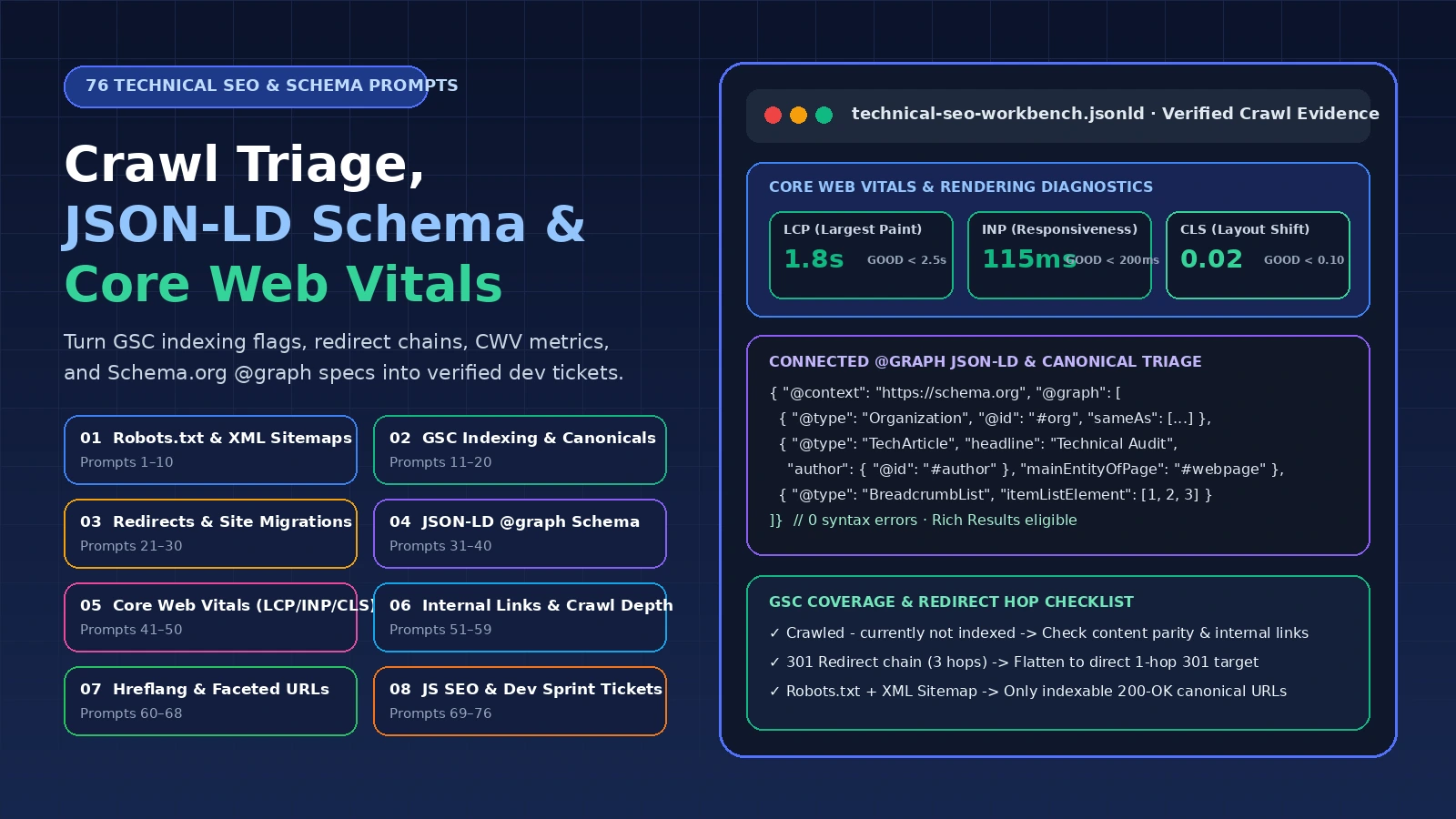
Turn noisy crawl data into verified engineering actions
An AI assistant cannot crawl your live website—and asking it to “audit my URL” without supplying evidence leads to generic checklists. Where AI excels is interpreting the actual evidence you paste in: `robots.txt` rules, GSC Page Indexing exports, multi-hop redirect chains, broken JSON-LD scripts, and PageSpeed Insights traces.
These 76 prompts separate confirmed observations from hypotheses that need verification, helping you generate production-ready server redirect rules, valid `@graph` JSON-LD, and reproduction-ready Jira/Linear tickets for your engineering team.
Fast Technical Audit Path: Start with Prompt 1 (Robots.txt Audit), triage unindexed pages with Prompt 11 (Crawled - Currently Not Indexed), flatten legacy hops with Prompt 21 (Redirect Chain Flattener), generate connected schema with Prompt 31 (@graph JSON-LD Template), and fix speed bottlenecks with Prompt 41 (LCP Sub-Part Diagnostics).
Three principles of reliable Technical SEO
- Principle 1
Never send conflicting signals
Ensure your XML sitemaps, internal links, rel=canonical tags, and hreflang annotations all point directly to 200-OK canonical URLs.
- Principle 2
Serve critical HTML & schema on the server
Render titles, meta robots, canonicals, headings, internal links, and JSON-LD in the initial server HTML response.
- Principle 3
Prioritize by revenue & crawl impact
Separate harmless GSC exclusions (like intentional noindex tags or old 301s) from issues blocking money pages or Core Web Vitals.
76 Technical SEO, Schema & Core Web Vitals prompts by workflow
Select the technical workflow you need—from `robots.txt` and XML sitemap architecture to Google Search Console indexing triage, 301 redirect rules, JSON-LD `@graph` schema, Core Web Vitals (`LCP`, `INP`, `CLS`), and developer sprint tickets.
Customize your shared technical audit brief (Updates all 76 prompts)
Enter your site stack, observed crawl/GSC evidence, and priority templates once below to pre-fill all 76 prompts. Paste specific `robots.txt` files, redirect chains, or JSON-LD blocks inside any individual prompt card.
76 of 76 prompts shown. Click any prompt card to customize, copy, or open it in ChatGPT.
Crawlability, robots.txt directives & XML sitemap architecture
Audit and write clean robots.txt rules, AI crawler governance directives, segmented XML sitemaps, and IndexNow ping workflows without blocking critical CSS/JS rendering assets.
Open companion studio: Robots.txt Generator & AI Crawler Checker ↗1Audit a robots.txt file for accidental render-blocking or crawl traps
Review the supplied robots.txt file and identify any Disallow rules that accidentally block CSS/JS rendering bundles, canonical URLs, or high-value folders, plus missingDisallow rules for infinite search/filter URLs.
Prepare: Current robots.txt file contents and URL folder structure.
Act as a Principal Technical SEO Architect and Web Performance Engineer. Work on this specific task using only the supplied technical evidence.

Site stack, CMS & scale: {{Site}}
Observed crawl, GSC & CWV evidence: {{Findings}}
Priority templates & constraints: {{Goals}}
Specific inputs: [Current robots.txt file contents and URL folder structure: paste here]

Task
Review the supplied robots.txt file and identify any Disallow rules that accidentally block CSS/JS rendering bundles, canonical URLs, or high-value folders, plus missingDisallow rules for infinite search/filter URLs.

Output
Return Line-by-line robots.txt risk report + corrected production robots.txt file.

Technical SEO & engineering boundaries
- Separate confirmed crawl/GSC observations from hypotheses that require verification.
- Never claim to have crawled a live URL yourself; rely strictly on the supplied headers, HTML, schema, or crawl exports.
- Ensure all JSON-LD, robots.txt, hreflang, and redirect rules follow official RFC, W3C, Schema.org, and Google Search Central specifications.Expected output: Line-by-line robots.txt risk report + corrected production robots.txt file.
2Design segmented XML Sitemaps by page type and update cadence
Plan a multi-sitemap index architecture (`sitemap_index.xml`) separating core commercial pages, blog articles, programmatic templates, and images/videos so Google Search Console indexing rates can be tracked per template.
Prepare: List of site URL patterns, total page counts, and update frequency.
Act as a Principal Technical SEO Architect and Web Performance Engineer. Work on this specific task using only the supplied technical evidence.

Site stack, CMS & scale: {{Site}}
Observed crawl, GSC & CWV evidence: {{Findings}}
Priority templates & constraints: {{Goals}}
Specific inputs: [List of site URL patterns, total page counts, and update frequency: paste here]

Task
Plan a multi-sitemap index architecture (`sitemap_index.xml`) separating core commercial pages, blog articles, programmatic templates, and images/videos so Google Search Console indexing rates can be tracked per template.

Output
Return Segmented XML sitemap architecture blueprint + `<sitemapindex>` XML template.

Technical SEO & engineering boundaries
- Separate confirmed crawl/GSC observations from hypotheses that require verification.
- Never claim to have crawled a live URL yourself; rely strictly on the supplied headers, HTML, schema, or crawl exports.
- Ensure all JSON-LD, robots.txt, hreflang, and redirect rules follow official RFC, W3C, Schema.org, and Google Search Central specifications.Expected output: Segmented XML sitemap architecture blueprint + `<sitemapindex>` XML template.
3Clean non-200, redirected, and non-canonical URLs from an XML Sitemap
Analyze the supplied sitemap URL export and crawl status list to flag every 301/302 redirect, 404, noindex, or canonicalized URL that must be removed so the XML sitemap contains strictly 100% 200-OK indexable canonicals.
Prepare: Sitemap URL list with HTTP status codes and canonicals.
Act as a Principal Technical SEO Architect and Web Performance Engineer. Work on this specific task using only the supplied technical evidence.

Site stack, CMS & scale: {{Site}}
Observed crawl, GSC & CWV evidence: {{Findings}}
Priority templates & constraints: {{Goals}}
Specific inputs: [Sitemap URL list with HTTP status codes and canonicals: paste here]

Task
Analyze the supplied sitemap URL export and crawl status list to flag every 301/302 redirect, 404, noindex, or canonicalized URL that must be removed so the XML sitemap contains strictly 100% 200-OK indexable canonicals.

Output
Return Filtered sitemap cleanup list + engineering rule to prevent dirty URLs entering the feed.

Technical SEO & engineering boundaries
- Separate confirmed crawl/GSC observations from hypotheses that require verification.
- Never claim to have crawled a live URL yourself; rely strictly on the supplied headers, HTML, schema, or crawl exports.
- Ensure all JSON-LD, robots.txt, hreflang, and redirect rules follow official RFC, W3C, Schema.org, and Google Search Central specifications.Expected output: Filtered sitemap cleanup list + engineering rule to prevent dirty URLs entering the feed.
4Write a granular AI Crawler vs. Search Engine robots.txt policy
Create a clear robots.txt configuration that separates traditional search crawlers (`Googlebot`, `Bingbot`), live AI search citation bots (`OAI-SearchBot`, `PerplexityBot`), and model training scrapers (`GPTBot`, `CCBot`, `Google-Extended`).
Prepare: Company policy on AI search citations vs. LLM training scraping.
Act as a Principal Technical SEO Architect and Web Performance Engineer. Work on this specific task using only the supplied technical evidence.

Site stack, CMS & scale: {{Site}}
Observed crawl, GSC & CWV evidence: {{Findings}}
Priority templates & constraints: {{Goals}}
Specific inputs: [Company policy on AI search citations vs. LLM training scraping: paste here]

Task
Create a clear robots.txt configuration that separates traditional search crawlers (`Googlebot`, `Bingbot`), live AI search citation bots (`OAI-SearchBot`, `PerplexityBot`), and model training scrapers (`GPTBot`, `CCBot`, `Google-Extended`).

Output
Return Copy-paste robots.txt user-agent blocks with inline documentation comments.

Technical SEO & engineering boundaries
- Separate confirmed crawl/GSC observations from hypotheses that require verification.
- Never claim to have crawled a live URL yourself; rely strictly on the supplied headers, HTML, schema, or crawl exports.
- Ensure all JSON-LD, robots.txt, hreflang, and redirect rules follow official RFC, W3C, Schema.org, and Google Search Central specifications.Expected output: Copy-paste robots.txt user-agent blocks with inline documentation comments.
5Audit `<lastmod>` timestamps in XML Sitemaps for credibility
Evaluate how your CMS currently populates `<lastmod>` in XML sitemaps and write a developer specification so `<lastmod>` updates only on substantive content changes rather than every build or footer tweak.
Prepare: Sample XML sitemap entries and current CMS build behavior.
Act as a Principal Technical SEO Architect and Web Performance Engineer. Work on this specific task using only the supplied technical evidence.

Site stack, CMS & scale: {{Site}}
Observed crawl, GSC & CWV evidence: {{Findings}}
Priority templates & constraints: {{Goals}}
Specific inputs: [Sample XML sitemap entries and current CMS build behavior: paste here]

Task
Evaluate how your CMS currently populates `<lastmod>` in XML sitemaps and write a developer specification so `<lastmod>` updates only on substantive content changes rather than every build or footer tweak.

Output
Return Audit of `<lastmod>` accuracy + engineering logic for real content-change detection.

Technical SEO & engineering boundaries
- Separate confirmed crawl/GSC observations from hypotheses that require verification.
- Never claim to have crawled a live URL yourself; rely strictly on the supplied headers, HTML, schema, or crawl exports.
- Ensure all JSON-LD, robots.txt, hreflang, and redirect rules follow official RFC, W3C, Schema.org, and Google Search Central specifications.Expected output: Audit of `<lastmod>` accuracy + engineering logic for real content-change detection.
6Set up an IndexNow instant indexing workflow for new and updated URLs
Design an IndexNow key verification and webhook trigger workflow that notifies Bing, Yandex, and participating engines only when canonical 200-OK pages are published or materially updated.
Prepare: Hosting stack/CMS and publishing workflow.
Act as a Principal Technical SEO Architect and Web Performance Engineer. Work on this specific task using only the supplied technical evidence.

Site stack, CMS & scale: {{Site}}
Observed crawl, GSC & CWV evidence: {{Findings}}
Priority templates & constraints: {{Goals}}
Specific inputs: [Hosting stack/CMS and publishing workflow: paste here]

Task
Design an IndexNow key verification and webhook trigger workflow that notifies Bing, Yandex, and participating engines only when canonical 200-OK pages are published or materially updated.

Output
Return IndexNow key file setup steps + JSON payload specification and trigger guardrails.

Technical SEO & engineering boundaries
- Separate confirmed crawl/GSC observations from hypotheses that require verification.
- Never claim to have crawled a live URL yourself; rely strictly on the supplied headers, HTML, schema, or crawl exports.
- Ensure all JSON-LD, robots.txt, hreflang, and redirect rules follow official RFC, W3C, Schema.org, and Google Search Central specifications.Expected output: IndexNow key file setup steps + JSON payload specification and trigger guardrails.
7Diagnose 'Blocked by robots.txt' vs. 'Indexed, though blocked by robots.txt'
Explain the technical difference between a URL blocked in robots.txt and a URL marked `noindex`, and provide the exact sequence to remove an unwanted URL from Google's index when it is currently blocked by robots.txt.
Prepare: Affected URL patterns and whether they should be deindexed or crawled.
Act as a Principal Technical SEO Architect and Web Performance Engineer. Work on this specific task using only the supplied technical evidence.

Site stack, CMS & scale: {{Site}}
Observed crawl, GSC & CWV evidence: {{Findings}}
Priority templates & constraints: {{Goals}}
Specific inputs: [Affected URL patterns and whether they should be deindexed or crawled: paste here]

Task
Explain the technical difference between a URL blocked in robots.txt and a URL marked `noindex`, and provide the exact sequence to remove an unwanted URL from Google's index when it is currently blocked by robots.txt.

Output
Return Step-by-step remediation sequence (unblock -> expose noindex/410 -> verify removal).

Technical SEO & engineering boundaries
- Separate confirmed crawl/GSC observations from hypotheses that require verification.
- Never claim to have crawled a live URL yourself; rely strictly on the supplied headers, HTML, schema, or crawl exports.
- Ensure all JSON-LD, robots.txt, hreflang, and redirect rules follow official RFC, W3C, Schema.org, and Google Search Central specifications.Expected output: Step-by-step remediation sequence (unblock -> expose noindex/410 -> verify removal).
8Write wildcard and `$` end-anchor rules in robots.txt for URL parameters
Construct precise `Disallow` and `Allow` patterns using `*` wildcards and `$` end anchors to block sort, session, and calendar trap parameters without blocking legitimate subpaths.
Prepare: List of problematic parameter URLs and legitimate URLs that share prefixes.
Act as a Principal Technical SEO Architect and Web Performance Engineer. Work on this specific task using only the supplied technical evidence.

Site stack, CMS & scale: {{Site}}
Observed crawl, GSC & CWV evidence: {{Findings}}
Priority templates & constraints: {{Goals}}
Specific inputs: [List of problematic parameter URLs and legitimate URLs that share prefixes: paste here]

Task
Construct precise `Disallow` and `Allow` patterns using `*` wildcards and `$` end anchors to block sort, session, and calendar trap parameters without blocking legitimate subpaths.

Output
Return Tested robots.txt wildcard rules + positive/negative URL match test table.

Technical SEO & engineering boundaries
- Separate confirmed crawl/GSC observations from hypotheses that require verification.
- Never claim to have crawled a live URL yourself; rely strictly on the supplied headers, HTML, schema, or crawl exports.
- Ensure all JSON-LD, robots.txt, hreflang, and redirect rules follow official RFC, W3C, Schema.org, and Google Search Central specifications.Expected output: Tested robots.txt wildcard rules + positive/negative URL match test table.
9Build an Image and Video XML Sitemap extension for media-heavy pages
Generate valid `<image:image>` and `<video:video>` sitemap extension entries for key landing pages where visual assets drive Google Images or Video tab traffic.
Prepare: Page URLs, image/video CDN URLs, titles, and durations.
Act as a Principal Technical SEO Architect and Web Performance Engineer. Work on this specific task using only the supplied technical evidence.

Site stack, CMS & scale: {{Site}}
Observed crawl, GSC & CWV evidence: {{Findings}}
Priority templates & constraints: {{Goals}}
Specific inputs: [Page URLs, image/video CDN URLs, titles, and durations: paste here]

Task
Generate valid `<image:image>` and `<video:video>` sitemap extension entries for key landing pages where visual assets drive Google Images or Video tab traffic.

Output
Return Valid XML sitemap snippet with image and video namespace extensions.

Technical SEO & engineering boundaries
- Separate confirmed crawl/GSC observations from hypotheses that require verification.
- Never claim to have crawled a live URL yourself; rely strictly on the supplied headers, HTML, schema, or crawl exports.
- Ensure all JSON-LD, robots.txt, hreflang, and redirect rules follow official RFC, W3C, Schema.org, and Google Search Central specifications.Expected output: Valid XML sitemap snippet with image and video namespace extensions.
10Create a pre-release staging environment deindexing safeguard checklist
Design a layered safeguard for staging and preview environments (`staging.example.com`, Vercel preview URLs) using HTTP authentication, `X-Robots-Tag: noindex`, without accidentally shipping `noindex` to production.
Prepare: Deployment pipeline and preview URL structure.
Act as a Principal Technical SEO Architect and Web Performance Engineer. Work on this specific task using only the supplied technical evidence.

Site stack, CMS & scale: {{Site}}
Observed crawl, GSC & CWV evidence: {{Findings}}
Priority templates & constraints: {{Goals}}
Specific inputs: [Deployment pipeline and preview URL structure: paste here]

Task
Design a layered safeguard for staging and preview environments (`staging.example.com`, Vercel preview URLs) using HTTP authentication, `X-Robots-Tag: noindex`, without accidentally shipping `noindex` to production.

Output
Return Environment-aware `X-Robots-Tag` header rule + pre-deploy CI/CD assertion check.

Technical SEO & engineering boundaries
- Separate confirmed crawl/GSC observations from hypotheses that require verification.
- Never claim to have crawled a live URL yourself; rely strictly on the supplied headers, HTML, schema, or crawl exports.
- Ensure all JSON-LD, robots.txt, hreflang, and redirect rules follow official RFC, W3C, Schema.org, and Google Search Central specifications.Expected output: Environment-aware `X-Robots-Tag` header rule + pre-deploy CI/CD assertion check.
Google Search Console indexing triage & canonical consolidation
Diagnose 'Crawled - currently not indexed', 'Discovered - currently not indexed', soft 404s, and conflicting rel=canonical tags using real URL inspection evidence.
Open companion studio: On-Page AI SEO & Technical Inspector ↗11Triage Google Search Console 'Crawled - currently not indexed' URLs
Categorize the supplied list of 'Crawled - currently not indexed' URLs by root cause (thin/duplicate template, orphaned internal linking, outdated content, or parameter junk) and assign the exact fix for each bucket.
Prepare: GSC export of 'Crawled - currently not indexed' URLs with word count and incoming links.
Act as a Principal Technical SEO Architect and Web Performance Engineer. Work on this specific task using only the supplied technical evidence.

Site stack, CMS & scale: {{Site}}
Observed crawl, GSC & CWV evidence: {{Findings}}
Priority templates & constraints: {{Goals}}
Specific inputs: [GSC export of 'Crawled - currently not indexed' URLs with word count and incoming links: paste here]

Task
Categorize the supplied list of 'Crawled - currently not indexed' URLs by root cause (thin/duplicate template, orphaned internal linking, outdated content, or parameter junk) and assign the exact fix for each bucket.

Output
Return Bucketed root-cause table + action plan (enrich, merge/301, noindex, or link internally).

Technical SEO & engineering boundaries
- Separate confirmed crawl/GSC observations from hypotheses that require verification.
- Never claim to have crawled a live URL yourself; rely strictly on the supplied headers, HTML, schema, or crawl exports.
- Ensure all JSON-LD, robots.txt, hreflang, and redirect rules follow official RFC, W3C, Schema.org, and Google Search Central specifications.Expected output: Bucketed root-cause table + action plan (enrich, merge/301, noindex, or link internally).
12Diagnose 'Discovered - currently not indexed' bottlenecks on large sites
Analyze why Google knows about these URLs (via sitemaps or links) but delays crawling them, checking internal link depth, server response times, and low-value crawl bloat.
Prepare: Affected URL folder patterns, sitemap counts, and internal click depth.
Act as a Principal Technical SEO Architect and Web Performance Engineer. Work on this specific task using only the supplied technical evidence.

Site stack, CMS & scale: {{Site}}
Observed crawl, GSC & CWV evidence: {{Findings}}
Priority templates & constraints: {{Goals}}
Specific inputs: [Affected URL folder patterns, sitemap counts, and internal click depth: paste here]

Task
Analyze why Google knows about these URLs (via sitemaps or links) but delays crawling them, checking internal link depth, server response times, and low-value crawl bloat.

Output
Return Diagnostic checklist + crawl priority and internal hub linking plan.

Technical SEO & engineering boundaries
- Separate confirmed crawl/GSC observations from hypotheses that require verification.
- Never claim to have crawled a live URL yourself; rely strictly on the supplied headers, HTML, schema, or crawl exports.
- Ensure all JSON-LD, robots.txt, hreflang, and redirect rules follow official RFC, W3C, Schema.org, and Google Search Central specifications.Expected output: Diagnostic checklist + crawl priority and internal hub linking plan.
13Resolve 'Duplicate, Google chose different canonical than user' conflicts
Inspect the user-declared canonical URL alongside the Google-selected canonical URL to identify conflicting signals (internal links pointing to non-canonical, sitemap mismatch, hreflang conflict, or near-identical regional copy).
Prepare: User-declared canonical URL, Google-selected canonical URL, and page notes.
Act as a Principal Technical SEO Architect and Web Performance Engineer. Work on this specific task using only the supplied technical evidence.

Site stack, CMS & scale: {{Site}}
Observed crawl, GSC & CWV evidence: {{Findings}}
Priority templates & constraints: {{Goals}}
Specific inputs: [User-declared canonical URL, Google-selected canonical URL, and page notes: paste here]

Task
Inspect the user-declared canonical URL alongside the Google-selected canonical URL to identify conflicting signals (internal links pointing to non-canonical, sitemap mismatch, hreflang conflict, or near-identical regional copy).

Output
Return Signal conflict matrix + step-by-step alignment fix.

Technical SEO & engineering boundaries
- Separate confirmed crawl/GSC observations from hypotheses that require verification.
- Never claim to have crawled a live URL yourself; rely strictly on the supplied headers, HTML, schema, or crawl exports.
- Ensure all JSON-LD, robots.txt, hreflang, and redirect rules follow official RFC, W3C, Schema.org, and Google Search Central specifications.Expected output: Signal conflict matrix + step-by-step alignment fix.
14Audit Soft 404 flags on e-commerce out-of-stock or zero-result pages
Review pages flagged as Soft 404 in Google Search Console (such as empty category filters, expired job listings, or out-of-stock products) and choose the right lifecycle handling (200 with related alternatives, 301 to parent category, or 404/410).
Prepare: Sample Soft 404 URLs and business inventory/listing rules.
Act as a Principal Technical SEO Architect and Web Performance Engineer. Work on this specific task using only the supplied technical evidence.

Site stack, CMS & scale: {{Site}}
Observed crawl, GSC & CWV evidence: {{Findings}}
Priority templates & constraints: {{Goals}}
Specific inputs: [Sample Soft 404 URLs and business inventory/listing rules: paste here]

Task
Review pages flagged as Soft 404 in Google Search Console (such as empty category filters, expired job listings, or out-of-stock products) and choose the right lifecycle handling (200 with related alternatives, 301 to parent category, or 404/410).

Output
Return Page-lifecycle decision matrix for active, temporarily unavailable, and permanently retired URLs.

Technical SEO & engineering boundaries
- Separate confirmed crawl/GSC observations from hypotheses that require verification.
- Never claim to have crawled a live URL yourself; rely strictly on the supplied headers, HTML, schema, or crawl exports.
- Ensure all JSON-LD, robots.txt, hreflang, and redirect rules follow official RFC, W3C, Schema.org, and Google Search Central specifications.Expected output: Page-lifecycle decision matrix for active, temporarily unavailable, and permanently retired URLs.
15Standardize trailing slash, lowercase, and HTTPS/www canonical normalization
Audit URL variations (`http` vs `https`, `www` vs non-`www`, `/page` vs `/page/`, uppercase vs lowercase) and write a single-hop canonical normalization specification.
Prepare: Current URL variations observed in crawl or GSC.
Act as a Principal Technical SEO Architect and Web Performance Engineer. Work on this specific task using only the supplied technical evidence.

Site stack, CMS & scale: {{Site}}
Observed crawl, GSC & CWV evidence: {{Findings}}
Priority templates & constraints: {{Goals}}
Specific inputs: [Current URL variations observed in crawl or GSC: paste here]

Task
Audit URL variations (`http` vs `https`, `www` vs non-`www`, `/page` vs `/page/`, uppercase vs lowercase) and write a single-hop canonical normalization specification.

Output
Return Canonical URL standard + server normalization rule and self-referencing canonical check.

Technical SEO & engineering boundaries
- Separate confirmed crawl/GSC observations from hypotheses that require verification.
- Never claim to have crawled a live URL yourself; rely strictly on the supplied headers, HTML, schema, or crawl exports.
- Ensure all JSON-LD, robots.txt, hreflang, and redirect rules follow official RFC, W3C, Schema.org, and Google Search Central specifications.Expected output: Canonical URL standard + server normalization rule and self-referencing canonical check.
16Audit `X-Robots-Tag` HTTP headers vs. HTML `<meta name='robots'>` directives
Compare HTTP response headers and HTML meta robots tags across HTML pages, PDFs, and API routes to spot conflicting `noindex`, `nofollow`, or `nosnippet` directives.
Prepare: Sample HTTP response headers and `<head>` meta tags.
Act as a Principal Technical SEO Architect and Web Performance Engineer. Work on this specific task using only the supplied technical evidence.

Site stack, CMS & scale: {{Site}}
Observed crawl, GSC & CWV evidence: {{Findings}}
Priority templates & constraints: {{Goals}}
Specific inputs: [Sample HTTP response headers and `<head>` meta tags: paste here]

Task
Compare HTTP response headers and HTML meta robots tags across HTML pages, PDFs, and API routes to spot conflicting `noindex`, `nofollow`, or `nosnippet` directives.

Output
Return Conflict audit + recommended HTTP header and HTML meta tag configuration.

Technical SEO & engineering boundaries
- Separate confirmed crawl/GSC observations from hypotheses that require verification.
- Never claim to have crawled a live URL yourself; rely strictly on the supplied headers, HTML, schema, or crawl exports.
- Ensure all JSON-LD, robots.txt, hreflang, and redirect rules follow official RFC, W3C, Schema.org, and Google Search Central specifications.Expected output: Conflict audit + recommended HTTP header and HTML meta tag configuration.
17Fix accidental canonical tags pointing to the homepage or paginated root
Identify templates where a broken variable causes subpages or paginated views (`/blog?page=2`) to canonicalize to `/` or page 1, and provide the corrected self-referencing canonical logic.
Prepare: Template HTML `<head>` snippet and sample affected URLs.
Act as a Principal Technical SEO Architect and Web Performance Engineer. Work on this specific task using only the supplied technical evidence.

Site stack, CMS & scale: {{Site}}
Observed crawl, GSC & CWV evidence: {{Findings}}
Priority templates & constraints: {{Goals}}
Specific inputs: [Template HTML `<head>` snippet and sample affected URLs: paste here]

Task
Identify templates where a broken variable causes subpages or paginated views (`/blog?page=2`) to canonicalize to `/` or page 1, and provide the corrected self-referencing canonical logic.

Output
Return Root-cause explanation + corrected dynamic canonical code snippet.

Technical SEO & engineering boundaries
- Separate confirmed crawl/GSC observations from hypotheses that require verification.
- Never claim to have crawled a live URL yourself; rely strictly on the supplied headers, HTML, schema, or crawl exports.
- Ensure all JSON-LD, robots.txt, hreflang, and redirect rules follow official RFC, W3C, Schema.org, and Google Search Central specifications.Expected output: Root-cause explanation + corrected dynamic canonical code snippet.
18Evaluate syndicated or cross-posted article canonical & noindex rules
Determine the safest canonical or `noindex` setup when republishing articles on partner sites, Medium, Substack, or secondary brand domains.
Prepare: Original URL, syndication partner capabilities, and publication timing.
Act as a Principal Technical SEO Architect and Web Performance Engineer. Work on this specific task using only the supplied technical evidence.

Site stack, CMS & scale: {{Site}}
Observed crawl, GSC & CWV evidence: {{Findings}}
Priority templates & constraints: {{Goals}}
Specific inputs: [Original URL, syndication partner capabilities, and publication timing: paste here]

Task
Determine the safest canonical or `noindex` setup when republishing articles on partner sites, Medium, Substack, or secondary brand domains.

Output
Return Cross-domain `rel=canonical` specification + fallback attribution block when partners don't support canonical headers.

Technical SEO & engineering boundaries
- Separate confirmed crawl/GSC observations from hypotheses that require verification.
- Never claim to have crawled a live URL yourself; rely strictly on the supplied headers, HTML, schema, or crawl exports.
- Ensure all JSON-LD, robots.txt, hreflang, and redirect rules follow official RFC, W3C, Schema.org, and Google Search Central specifications.Expected output: Cross-domain `rel=canonical` specification + fallback attribution block when partners don't support canonical headers.
19Audit parameter-driven duplicate URLs (`?utm_`, `?ref=`, `?fbclid=`, `?sort=`)
Ensure marketing tracking parameters and UI state query strings consolidate cleanly to the clean base URL via self-referencing canonicals and internal link hygiene.
Prepare: List of query parameters appearing in Google Search Console or analytics.
Act as a Principal Technical SEO Architect and Web Performance Engineer. Work on this specific task using only the supplied technical evidence.

Site stack, CMS & scale: {{Site}}
Observed crawl, GSC & CWV evidence: {{Findings}}
Priority templates & constraints: {{Goals}}
Specific inputs: [List of query parameters appearing in Google Search Console or analytics: paste here]

Task
Ensure marketing tracking parameters and UI state query strings consolidate cleanly to the clean base URL via self-referencing canonicals and internal link hygiene.

Output
Return Parameter handling table + canonical and internal link stripping checklist.

Technical SEO & engineering boundaries
- Separate confirmed crawl/GSC observations from hypotheses that require verification.
- Never claim to have crawled a live URL yourself; rely strictly on the supplied headers, HTML, schema, or crawl exports.
- Ensure all JSON-LD, robots.txt, hreflang, and redirect rules follow official RFC, W3C, Schema.org, and Google Search Central specifications.Expected output: Parameter handling table + canonical and internal link stripping checklist.
20Build a quarterly Google Search Console Page Indexing hygiene scorecard
Turn raw GSC Page Indexing counts (Indexed vs. Not Indexed by reason) into an executive scorecard that separates benign exclusions (expected 301s, intentional noindex) from revenue-impacting errors.
Prepare: GSC Page Indexing summary table (Reason, Source, Pages count).
Act as a Principal Technical SEO Architect and Web Performance Engineer. Work on this specific task using only the supplied technical evidence.

Site stack, CMS & scale: {{Site}}
Observed crawl, GSC & CWV evidence: {{Findings}}
Priority templates & constraints: {{Goals}}
Specific inputs: [GSC Page Indexing summary table (Reason, Source, Pages count): paste here]

Task
Turn raw GSC Page Indexing counts (Indexed vs. Not Indexed by reason) into an executive scorecard that separates benign exclusions (expected 301s, intentional noindex) from revenue-impacting errors.

Output
Return Classified GSC Indexing Table (Benign & Intentional vs. Action Required) with top 3 priorities.

Technical SEO & engineering boundaries
- Separate confirmed crawl/GSC observations from hypotheses that require verification.
- Never claim to have crawled a live URL yourself; rely strictly on the supplied headers, HTML, schema, or crawl exports.
- Ensure all JSON-LD, robots.txt, hreflang, and redirect rules follow official RFC, W3C, Schema.org, and Google Search Central specifications.Expected output: Classified GSC Indexing Table (Benign & Intentional vs. Action Required) with top 3 priorities.
Redirect chains, 404/410 status codes & site migration checklists
Flatten multi-hop 301 redirect chains, decide between 301, 404, and 410 status codes, generate server redirect rules, and execute zero-drop domain or URL migrations.
Open companion studio: Redirect Rule Generator (Nginx, Apache, Vercel, Cloudflare) ↗21Flatten 301/302 redirect chains and loops into single-hop 301s
Analyze the supplied redirect chain export (`URL A -> URL B -> URL C`) and generate a flattened 1-to-1 redirect table plus instructions to update internal links pointing to legacy hops.
Prepare: Crawl export of redirect chains (Start URL, Hop 1, Hop 2, Final Destination URL).
Act as a Principal Technical SEO Architect and Web Performance Engineer. Work on this specific task using only the supplied technical evidence.

Site stack, CMS & scale: {{Site}}
Observed crawl, GSC & CWV evidence: {{Findings}}
Priority templates & constraints: {{Goals}}
Specific inputs: [Crawl export of redirect chains (Start URL, Hop 1, Hop 2, Final Destination URL): paste here]

Task
Analyze the supplied redirect chain export (`URL A -> URL B -> URL C`) and generate a flattened 1-to-1 redirect table plus instructions to update internal links pointing to legacy hops.

Output
Return Flattened 1-hop 301 mapping table + internal link replacement list.

Technical SEO & engineering boundaries
- Separate confirmed crawl/GSC observations from hypotheses that require verification.
- Never claim to have crawled a live URL yourself; rely strictly on the supplied headers, HTML, schema, or crawl exports.
- Ensure all JSON-LD, robots.txt, hreflang, and redirect rules follow official RFC, W3C, Schema.org, and Google Search Central specifications.Expected output: Flattened 1-hop 301 mapping table + internal link replacement list.
22Map 1-to-1 URL redirects for a site redesign or CMS migration
Match legacy URLs to their closest semantic equivalent on the new site structure—avoiding lazy bulk redirects to the homepage that trigger Soft 404 treatment.
Prepare: Old URL list (with titles/traffic) and New URL list.
Act as a Principal Technical SEO Architect and Web Performance Engineer. Work on this specific task using only the supplied technical evidence.

Site stack, CMS & scale: {{Site}}
Observed crawl, GSC & CWV evidence: {{Findings}}
Priority templates & constraints: {{Goals}}
Specific inputs: [Old URL list (with titles/traffic) and New URL list: paste here]

Task
Match legacy URLs to their closest semantic equivalent on the new site structure—avoiding lazy bulk redirects to the homepage that trigger Soft 404 treatment.

Output
Return 1-to-1 redirect mapping table + flagged orphan pages that need a dedicated destination.

Technical SEO & engineering boundaries
- Separate confirmed crawl/GSC observations from hypotheses that require verification.
- Never claim to have crawled a live URL yourself; rely strictly on the supplied headers, HTML, schema, or crawl exports.
- Ensure all JSON-LD, robots.txt, hreflang, and redirect rules follow official RFC, W3C, Schema.org, and Google Search Central specifications.Expected output: 1-to-1 redirect mapping table + flagged orphan pages that need a dedicated destination.
23Generate production redirect rules for Nginx, Apache `.htaccess`, Vercel, or Cloudflare
Convert a list of old-to-new URL paths and regex patterns into clean, loop-safe server redirect configuration syntax for your exact hosting platform.
Prepare: Redirect pairs/patterns and target hosting platform (Nginx, Apache, Next.js/Vercel, Cloudflare).
Act as a Principal Technical SEO Architect and Web Performance Engineer. Work on this specific task using only the supplied technical evidence.

Site stack, CMS & scale: {{Site}}
Observed crawl, GSC & CWV evidence: {{Findings}}
Priority templates & constraints: {{Goals}}
Specific inputs: [Redirect pairs/patterns and target hosting platform (Nginx, Apache, Next.js/Vercel, Cloudflare): paste here]

Task
Convert a list of old-to-new URL paths and regex patterns into clean, loop-safe server redirect configuration syntax for your exact hosting platform.

Output
Return Copy-paste server redirect configuration + curl test commands to verify status codes.

Technical SEO & engineering boundaries
- Separate confirmed crawl/GSC observations from hypotheses that require verification.
- Never claim to have crawled a live URL yourself; rely strictly on the supplied headers, HTML, schema, or crawl exports.
- Ensure all JSON-LD, robots.txt, hreflang, and redirect rules follow official RFC, W3C, Schema.org, and Google Search Central specifications.Expected output: Copy-paste server redirect configuration + curl test commands to verify status codes.
24Decide between 301 Redirect, 404 Not Found, and 410 Gone for deleted pages
Evaluate a list of discontinued products, expired events, or pruned thin posts using traffic, backlinks, and replacement relevance to assign 301, 404, or 410 accurately.
Prepare: List of candidate URLs to retire with backlink counts, organic sessions, and closest surviving URL.
Act as a Principal Technical SEO Architect and Web Performance Engineer. Work on this specific task using only the supplied technical evidence.

Site stack, CMS & scale: {{Site}}
Observed crawl, GSC & CWV evidence: {{Findings}}
Priority templates & constraints: {{Goals}}
Specific inputs: [List of candidate URLs to retire with backlink counts, organic sessions, and closest surviving URL: paste here]

Task
Evaluate a list of discontinued products, expired events, or pruned thin posts using traffic, backlinks, and replacement relevance to assign 301, 404, or 410 accurately.

Output
Return URL retirement decision table (301 vs. 404 vs. 410) with technical rationale.

Technical SEO & engineering boundaries
- Separate confirmed crawl/GSC observations from hypotheses that require verification.
- Never claim to have crawled a live URL yourself; rely strictly on the supplied headers, HTML, schema, or crawl exports.
- Ensure all JSON-LD, robots.txt, hreflang, and redirect rules follow official RFC, W3C, Schema.org, and Google Search Central specifications.Expected output: URL retirement decision table (301 vs. 404 vs. 410) with technical rationale.
25Audit 302 Temporary vs. 307/308/301 Permanent redirects across your site
Review all non-301 redirects found in a crawl and identify where accidental 302/307 redirects are preventing canonical URL consolidation.
Prepare: List of 302/307 redirects and their intended purpose.
Act as a Principal Technical SEO Architect and Web Performance Engineer. Work on this specific task using only the supplied technical evidence.

Site stack, CMS & scale: {{Site}}
Observed crawl, GSC & CWV evidence: {{Findings}}
Priority templates & constraints: {{Goals}}
Specific inputs: [List of 302/307 redirects and their intended purpose: paste here]

Task
Review all non-301 redirects found in a crawl and identify where accidental 302/307 redirects are preventing canonical URL consolidation.

Output
Return Redirect status code audit + recommended changes to 301/308.

Technical SEO & engineering boundaries
- Separate confirmed crawl/GSC observations from hypotheses that require verification.
- Never claim to have crawled a live URL yourself; rely strictly on the supplied headers, HTML, schema, or crawl exports.
- Ensure all JSON-LD, robots.txt, hreflang, and redirect rules follow official RFC, W3C, Schema.org, and Google Search Central specifications.Expected output: Redirect status code audit + recommended changes to 301/308.
26Build a pre-launch, launch-day, and post-launch SEO migration checklist
Create a phase-by-phase technical SEO migration runbook covering benchmark crawls, staging validation, TTL lowering, live redirect testing, GSC Change of Address, and 30-day log monitoring.
Prepare: Migration type (domain change, CMS replatform, URL structure change, or site merge).
Act as a Principal Technical SEO Architect and Web Performance Engineer. Work on this specific task using only the supplied technical evidence.

Site stack, CMS & scale: {{Site}}
Observed crawl, GSC & CWV evidence: {{Findings}}
Priority templates & constraints: {{Goals}}
Specific inputs: [Migration type (domain change, CMS replatform, URL structure change, or site merge): paste here]

Task
Create a phase-by-phase technical SEO migration runbook covering benchmark crawls, staging validation, TTL lowering, live redirect testing, GSC Change of Address, and 30-day log monitoring.

Output
Return Chronological migration runbook (T-14 days, Launch Window, T+24h, T+7d, T+30d).

Technical SEO & engineering boundaries
- Separate confirmed crawl/GSC observations from hypotheses that require verification.
- Never claim to have crawled a live URL yourself; rely strictly on the supplied headers, HTML, schema, or crawl exports.
- Ensure all JSON-LD, robots.txt, hreflang, and redirect rules follow official RFC, W3C, Schema.org, and Google Search Central specifications.Expected output: Chronological migration runbook (T-14 days, Launch Window, T+24h, T+7d, T+30d).
27Reclaim lost backlink equity from broken 404 URLs (`Broken Backlink Triage`)
Inspect 404 URLs that have external referring domains and map each one to either a restored page or a relevant 301 destination.
Prepare: 404 URLs with referring domains, anchor text, and original topic.
Act as a Principal Technical SEO Architect and Web Performance Engineer. Work on this specific task using only the supplied technical evidence.

Site stack, CMS & scale: {{Site}}
Observed crawl, GSC & CWV evidence: {{Findings}}
Priority templates & constraints: {{Goals}}
Specific inputs: [404 URLs with referring domains, anchor text, and original topic: paste here]

Task
Inspect 404 URLs that have external referring domains and map each one to either a restored page or a relevant 301 destination.

Output
Return Prioritized 404 backlink recovery table with target 301 URLs.

Technical SEO & engineering boundaries
- Separate confirmed crawl/GSC observations from hypotheses that require verification.
- Never claim to have crawled a live URL yourself; rely strictly on the supplied headers, HTML, schema, or crawl exports.
- Ensure all JSON-LD, robots.txt, hreflang, and redirect rules follow official RFC, W3C, Schema.org, and Google Search Central specifications.Expected output: Prioritized 404 backlink recovery table with target 301 URLs.
28Write regex redirect rules for blog date-slug removal (`/2023/05/post` -> `/blog/post`)
Write a safe regular expression redirect rule that strips `/YYYY/MM/` date prefixes from blog URLs without breaking archive pages or assets.
Prepare: Current date-based URL pattern and target clean URL pattern.
Act as a Principal Technical SEO Architect and Web Performance Engineer. Work on this specific task using only the supplied technical evidence.

Site stack, CMS & scale: {{Site}}
Observed crawl, GSC & CWV evidence: {{Findings}}
Priority templates & constraints: {{Goals}}
Specific inputs: [Current date-based URL pattern and target clean URL pattern: paste here]

Task
Write a safe regular expression redirect rule that strips `/YYYY/MM/` date prefixes from blog URLs without breaking archive pages or assets.

Output
Return Regex redirect rule + edge-case test cases.

Technical SEO & engineering boundaries
- Separate confirmed crawl/GSC observations from hypotheses that require verification.
- Never claim to have crawled a live URL yourself; rely strictly on the supplied headers, HTML, schema, or crawl exports.
- Ensure all JSON-LD, robots.txt, hreflang, and redirect rules follow official RFC, W3C, Schema.org, and Google Search Central specifications.Expected output: Regex redirect rule + edge-case test cases.
29Diagnose sudden organic traffic drops after a site migration or deploy
Run a structured post-migration triage comparing pre- and post-launch status codes, canonicals, robots directives, internal links, and rendered HTML parity.
Prepare: Observed traffic/ranking drop details, affected templates, and recent deploy changes.
Act as a Principal Technical SEO Architect and Web Performance Engineer. Work on this specific task using only the supplied technical evidence.

Site stack, CMS & scale: {{Site}}
Observed crawl, GSC & CWV evidence: {{Findings}}
Priority templates & constraints: {{Goals}}
Specific inputs: [Observed traffic/ranking drop details, affected templates, and recent deploy changes: paste here]

Task
Run a structured post-migration triage comparing pre- and post-launch status codes, canonicals, robots directives, internal links, and rendered HTML parity.

Output
Return Prioritized diagnostic checklist to isolate the exact migration regression.

Technical SEO & engineering boundaries
- Separate confirmed crawl/GSC observations from hypotheses that require verification.
- Never claim to have crawled a live URL yourself; rely strictly on the supplied headers, HTML, schema, or crawl exports.
- Ensure all JSON-LD, robots.txt, hreflang, and redirect rules follow official RFC, W3C, Schema.org, and Google Search Central specifications.Expected output: Prioritized diagnostic checklist to isolate the exact migration regression.
30Design a helpful, high-converting custom 404 error page
Plan a custom 404 page that returns a real HTTP `404` status code (never redirecting to `/404` with a `200` status) while guiding lost visitors to top categories, search, and popular tools.
Prepare: Primary site categories, top tools/guides, and brand voice.
Act as a Principal Technical SEO Architect and Web Performance Engineer. Work on this specific task using only the supplied technical evidence.

Site stack, CMS & scale: {{Site}}
Observed crawl, GSC & CWV evidence: {{Findings}}
Priority templates & constraints: {{Goals}}
Specific inputs: [Primary site categories, top tools/guides, and brand voice: paste here]

Task
Plan a custom 404 page that returns a real HTTP `404` status code (never redirecting to `/404` with a `200` status) while guiding lost visitors to top categories, search, and popular tools.

Output
Return Custom 404 page wireframe copy + technical HTTP status verification check.

Technical SEO & engineering boundaries
- Separate confirmed crawl/GSC observations from hypotheses that require verification.
- Never claim to have crawled a live URL yourself; rely strictly on the supplied headers, HTML, schema, or crawl exports.
- Ensure all JSON-LD, robots.txt, hreflang, and redirect rules follow official RFC, W3C, Schema.org, and Google Search Central specifications.Expected output: Custom 404 page wireframe copy + technical HTTP status verification check.
JSON-LD Schema markup (@graph, Article, FAQPage, Product & Organization)
Author and debug valid Schema.org JSON-LD markup connected via persistent @id nodes that match visible HTML content and Google Rich Result eligibility rules.
Open companion studio: JSON-LD Schema Markup Generator ↗31Build a connected `@graph` JSON-LD template (`Organization` + `WebSite` + `WebPage` + `Article`)
Create a unified JSON-LD `@graph` block where `Article` references `Person` (`#author`), `Organization` (`#publisher`), `WebPage` (`#webpage`), and `BreadcrumbList` (`#breadcrumb`) via persistent `@id` URIs.
Prepare: Page URL, headline, author details, organization details, and publish/modified dates.
Act as a Principal Technical SEO Architect and Web Performance Engineer. Work on this specific task using only the supplied technical evidence.

Site stack, CMS & scale: {{Site}}
Observed crawl, GSC & CWV evidence: {{Findings}}
Priority templates & constraints: {{Goals}}
Specific inputs: [Page URL, headline, author details, organization details, and publish/modified dates: paste here]

Task
Create a unified JSON-LD `@graph` block where `Article` references `Person` (`#author`), `Organization` (`#publisher`), `WebPage` (`#webpage`), and `BreadcrumbList` (`#breadcrumb`) via persistent `@id` URIs.

Output
Return Validated copy-paste JSON-LD `@graph` script block.

Technical SEO & engineering boundaries
- Separate confirmed crawl/GSC observations from hypotheses that require verification.
- Never claim to have crawled a live URL yourself; rely strictly on the supplied headers, HTML, schema, or crawl exports.
- Ensure all JSON-LD, robots.txt, hreflang, and redirect rules follow official RFC, W3C, Schema.org, and Google Search Central specifications.Expected output: Validated copy-paste JSON-LD `@graph` script block.
32Debug Schema.org validation errors & Google Rich Results warnings
Inspect the supplied JSON-LD snippet and error messages (missing required fields, invalid ISO 8601 dates, wrong property types, or unescaped quotes) and output the corrected JSON-LD.
Prepare: Broken JSON-LD snippet and Rich Results Test / Validator error log.
Act as a Principal Technical SEO Architect and Web Performance Engineer. Work on this specific task using only the supplied technical evidence.

Site stack, CMS & scale: {{Site}}
Observed crawl, GSC & CWV evidence: {{Findings}}
Priority templates & constraints: {{Goals}}
Specific inputs: [Broken JSON-LD snippet and Rich Results Test / Validator error log: paste here]

Task
Inspect the supplied JSON-LD snippet and error messages (missing required fields, invalid ISO 8601 dates, wrong property types, or unescaped quotes) and output the corrected JSON-LD.

Output
Return Root-cause fix explanation + clean, valid JSON-LD markup.

Technical SEO & engineering boundaries
- Separate confirmed crawl/GSC observations from hypotheses that require verification.
- Never claim to have crawled a live URL yourself; rely strictly on the supplied headers, HTML, schema, or crawl exports.
- Ensure all JSON-LD, robots.txt, hreflang, and redirect rules follow official RFC, W3C, Schema.org, and Google Search Central specifications.Expected output: Root-cause fix explanation + clean, valid JSON-LD markup.
33Generate `Product` + `Offer` + `AggregateRating` + `MerchantReturnPolicy` JSON-LD
Write comprehensive e-commerce or SaaS `Product` JSON-LD including pricing, currency, availability, SKU, shipping/return policy nodes, and verified customer rating counts.
Prepare: Product name, SKU, price, availability, review count/rating, and return policy details.
Act as a Principal Technical SEO Architect and Web Performance Engineer. Work on this specific task using only the supplied technical evidence.

Site stack, CMS & scale: {{Site}}
Observed crawl, GSC & CWV evidence: {{Findings}}
Priority templates & constraints: {{Goals}}
Specific inputs: [Product name, SKU, price, availability, review count/rating, and return policy details: paste here]

Task
Write comprehensive e-commerce or SaaS `Product` JSON-LD including pricing, currency, availability, SKU, shipping/return policy nodes, and verified customer rating counts.

Output
Return Complete `Product` JSON-LD compliant with Google Merchant listing structured data rules.

Technical SEO & engineering boundaries
- Separate confirmed crawl/GSC observations from hypotheses that require verification.
- Never claim to have crawled a live URL yourself; rely strictly on the supplied headers, HTML, schema, or crawl exports.
- Ensure all JSON-LD, robots.txt, hreflang, and redirect rules follow official RFC, W3C, Schema.org, and Google Search Central specifications.Expected output: Complete `Product` JSON-LD compliant with Google Merchant listing structured data rules.
34Generate `SoftwareApplication` / `WebApplication` JSON-LD for an interactive tool
Create accurate `SoftwareApplication` or `WebApplication` JSON-LD specifying `applicationCategory`, `operatingSystem`, `featureList`, and `offers` (including free tier `0` price).
Prepare: Tool name, URL, category, key features, and pricing model.
Act as a Principal Technical SEO Architect and Web Performance Engineer. Work on this specific task using only the supplied technical evidence.

Site stack, CMS & scale: {{Site}}
Observed crawl, GSC & CWV evidence: {{Findings}}
Priority templates & constraints: {{Goals}}
Specific inputs: [Tool name, URL, category, key features, and pricing model: paste here]

Task
Create accurate `SoftwareApplication` or `WebApplication` JSON-LD specifying `applicationCategory`, `operatingSystem`, `featureList`, and `offers` (including free tier `0` price).

Output
Return Valid `WebApplication` / `SoftwareApplication` JSON-LD snippet.

Technical SEO & engineering boundaries
- Separate confirmed crawl/GSC observations from hypotheses that require verification.
- Never claim to have crawled a live URL yourself; rely strictly on the supplied headers, HTML, schema, or crawl exports.
- Ensure all JSON-LD, robots.txt, hreflang, and redirect rules follow official RFC, W3C, Schema.org, and Google Search Central specifications.Expected output: Valid `WebApplication` / `SoftwareApplication` JSON-LD snippet.
35Generate `FAQPage` JSON-LD that strictly mirrors visible on-page Q&As
Convert your visible on-page FAQ section into clean `FAQPage` JSON-LD without adding hidden questions or promotional HTML links that violate structured data guidelines.
Prepare: Visible on-page Questions and Answers.
Act as a Principal Technical SEO Architect and Web Performance Engineer. Work on this specific task using only the supplied technical evidence.

Site stack, CMS & scale: {{Site}}
Observed crawl, GSC & CWV evidence: {{Findings}}
Priority templates & constraints: {{Goals}}
Specific inputs: [Visible on-page Questions and Answers: paste here]

Task
Convert your visible on-page FAQ section into clean `FAQPage` JSON-LD without adding hidden questions or promotional HTML links that violate structured data guidelines.

Output
Return Compliant `FAQPage` JSON-LD script block.

Technical SEO & engineering boundaries
- Separate confirmed crawl/GSC observations from hypotheses that require verification.
- Never claim to have crawled a live URL yourself; rely strictly on the supplied headers, HTML, schema, or crawl exports.
- Ensure all JSON-LD, robots.txt, hreflang, and redirect rules follow official RFC, W3C, Schema.org, and Google Search Central specifications.Expected output: Compliant `FAQPage` JSON-LD script block.
36Write `Person` & Reviewer `reviewedBy` JSON-LD for E-E-A-T author profiles
Create detailed `Person` schema for an article author and medical/financial/technical reviewer, including `jobTitle`, `knowsAbout`, `alumniOf`, `worksFor`, and `sameAs` profile links.
Prepare: Author and reviewer bios, credentials, and external profile URLs.
Act as a Principal Technical SEO Architect and Web Performance Engineer. Work on this specific task using only the supplied technical evidence.

Site stack, CMS & scale: {{Site}}
Observed crawl, GSC & CWV evidence: {{Findings}}
Priority templates & constraints: {{Goals}}
Specific inputs: [Author and reviewer bios, credentials, and external profile URLs: paste here]

Task
Create detailed `Person` schema for an article author and medical/financial/technical reviewer, including `jobTitle`, `knowsAbout`, `alumniOf`, `worksFor`, and `sameAs` profile links.

Output
Return Connected `Person` and `reviewedBy` JSON-LD nodes.

Technical SEO & engineering boundaries
- Separate confirmed crawl/GSC observations from hypotheses that require verification.
- Never claim to have crawled a live URL yourself; rely strictly on the supplied headers, HTML, schema, or crawl exports.
- Ensure all JSON-LD, robots.txt, hreflang, and redirect rules follow official RFC, W3C, Schema.org, and Google Search Central specifications.Expected output: Connected `Person` and `reviewedBy` JSON-LD nodes.
37Generate `BreadcrumbList` JSON-LD matching your URL hierarchy
Create a clean `BreadcrumbList` JSON-LD array reflecting the exact breadcrumb trail shown to users on the page.
Prepare: Breadcrumb trail labels and URLs from Home to current page.
Act as a Principal Technical SEO Architect and Web Performance Engineer. Work on this specific task using only the supplied technical evidence.

Site stack, CMS & scale: {{Site}}
Observed crawl, GSC & CWV evidence: {{Findings}}
Priority templates & constraints: {{Goals}}
Specific inputs: [Breadcrumb trail labels and URLs from Home to current page: paste here]

Task
Create a clean `BreadcrumbList` JSON-LD array reflecting the exact breadcrumb trail shown to users on the page.

Output
Return Valid `BreadcrumbList` JSON-LD snippet.

Technical SEO & engineering boundaries
- Separate confirmed crawl/GSC observations from hypotheses that require verification.
- Never claim to have crawled a live URL yourself; rely strictly on the supplied headers, HTML, schema, or crawl exports.
- Ensure all JSON-LD, robots.txt, hreflang, and redirect rules follow official RFC, W3C, Schema.org, and Google Search Central specifications.Expected output: Valid `BreadcrumbList` JSON-LD snippet.
38Generate `VideoObject` & `Clip` key-moments JSON-LD for embedded videos
Build `VideoObject` structured data with `thumbnailUrl`, `uploadDate`, `duration` (ISO 8601), `embedUrl`, and `hasPart` `Clip` timestamps so Google can display Key Moments in search.
Prepare: Video title, description, thumbnail URL, upload date, duration, and chapter timestamps.
Act as a Principal Technical SEO Architect and Web Performance Engineer. Work on this specific task using only the supplied technical evidence.

Site stack, CMS & scale: {{Site}}
Observed crawl, GSC & CWV evidence: {{Findings}}
Priority templates & constraints: {{Goals}}
Specific inputs: [Video title, description, thumbnail URL, upload date, duration, and chapter timestamps: paste here]

Task
Build `VideoObject` structured data with `thumbnailUrl`, `uploadDate`, `duration` (ISO 8601), `embedUrl`, and `hasPart` `Clip` timestamps so Google can display Key Moments in search.

Output
Return Complete `VideoObject` + `Clip` JSON-LD markup.

Technical SEO & engineering boundaries
- Separate confirmed crawl/GSC observations from hypotheses that require verification.
- Never claim to have crawled a live URL yourself; rely strictly on the supplied headers, HTML, schema, or crawl exports.
- Ensure all JSON-LD, robots.txt, hreflang, and redirect rules follow official RFC, W3C, Schema.org, and Google Search Central specifications.Expected output: Complete `VideoObject` + `Clip` JSON-LD markup.
39Generate `ItemList` & `CollectionPage` JSON-LD for category or hub pages
Mark up a directory, prompt hub, or tool collection page with `CollectionPage` and an ordered `ItemList` pointing to each child URL.
Prepare: Hub page title/URL and list of child items (name, URL, position).
Act as a Principal Technical SEO Architect and Web Performance Engineer. Work on this specific task using only the supplied technical evidence.

Site stack, CMS & scale: {{Site}}
Observed crawl, GSC & CWV evidence: {{Findings}}
Priority templates & constraints: {{Goals}}
Specific inputs: [Hub page title/URL and list of child items (name, URL, position): paste here]

Task
Mark up a directory, prompt hub, or tool collection page with `CollectionPage` and an ordered `ItemList` pointing to each child URL.

Output
Return Valid `CollectionPage` + `ItemList` JSON-LD block.

Technical SEO & engineering boundaries
- Separate confirmed crawl/GSC observations from hypotheses that require verification.
- Never claim to have crawled a live URL yourself; rely strictly on the supplied headers, HTML, schema, or crawl exports.
- Ensure all JSON-LD, robots.txt, hreflang, and redirect rules follow official RFC, W3C, Schema.org, and Google Search Central specifications.Expected output: Valid `CollectionPage` + `ItemList` JSON-LD block.
40Audit structured data for spammy or ineligible schema policy violations
Review your current JSON-LD implementation against Google's General Structured Data Guidelines to catch self-serving reviews on third-party pages, invisible markup, or mismatched `@type` claims.
Prepare: Current JSON-LD code and summary of what is visibly rendered on the page.
Act as a Principal Technical SEO Architect and Web Performance Engineer. Work on this specific task using only the supplied technical evidence.

Site stack, CMS & scale: {{Site}}
Observed crawl, GSC & CWV evidence: {{Findings}}
Priority templates & constraints: {{Goals}}
Specific inputs: [Current JSON-LD code and summary of what is visibly rendered on the page: paste here]

Task
Review your current JSON-LD implementation against Google's General Structured Data Guidelines to catch self-serving reviews on third-party pages, invisible markup, or mismatched `@type` claims.

Output
Return Policy compliance audit + corrected JSON-LD.

Technical SEO & engineering boundaries
- Separate confirmed crawl/GSC observations from hypotheses that require verification.
- Never claim to have crawled a live URL yourself; rely strictly on the supplied headers, HTML, schema, or crawl exports.
- Ensure all JSON-LD, robots.txt, hreflang, and redirect rules follow official RFC, W3C, Schema.org, and Google Search Central specifications.Expected output: Policy compliance audit + corrected JSON-LD.
Core Web Vitals (LCP, INP, CLS), asset loading & rendering speed
Turn PageSpeed Insights, CrUX, and Chrome DevTools traces into concrete fixes for Largest Contentful Paint (LCP), Interaction to Next Paint (INP), and Cumulative Layout Shift (CLS).
Open companion studio: Core Web Vitals Diagnostics Studio ↗41Diagnose Largest Contentful Paint (`LCP > 2.5s`) bottlenecks from a PageSpeed trace
Break down an LCP delay into its four sub-parts (TTFB, Resource Load Delay, Resource Load Duration, Element Render Delay) and prescribe the exact HTML/CSS/CDN fix.
Prepare: LCP element HTML, PageSpeed sub-part timings, and image/font details.
Act as a Principal Technical SEO Architect and Web Performance Engineer. Work on this specific task using only the supplied technical evidence.

Site stack, CMS & scale: {{Site}}
Observed crawl, GSC & CWV evidence: {{Findings}}
Priority templates & constraints: {{Goals}}
Specific inputs: [LCP element HTML, PageSpeed sub-part timings, and image/font details: paste here]

Task
Break down an LCP delay into its four sub-parts (TTFB, Resource Load Delay, Resource Load Duration, Element Render Delay) and prescribe the exact HTML/CSS/CDN fix.

Output
Return 4-part LCP breakdown + prioritized code fixes (`fetchpriority='high'`, preload, WebP/AVIF, SSR).

Technical SEO & engineering boundaries
- Separate confirmed crawl/GSC observations from hypotheses that require verification.
- Never claim to have crawled a live URL yourself; rely strictly on the supplied headers, HTML, schema, or crawl exports.
- Ensure all JSON-LD, robots.txt, hreflang, and redirect rules follow official RFC, W3C, Schema.org, and Google Search Central specifications.Expected output: 4-part LCP breakdown + prioritized code fixes (`fetchpriority='high'`, preload, WebP/AVIF, SSR).
42Diagnose Interaction to Next Paint (`INP > 200ms`) main-thread blocking scripts
Analyze long tasks in Chrome DevTools / PageSpeed Insights during click or keydown interactions (Input Delay, Processing Time, Presentation Delay) and recommend yielding, code-splitting, or third-party script deferral.
Prepare: Slow interaction target, blocking JS scripts, and task durations.
Act as a Principal Technical SEO Architect and Web Performance Engineer. Work on this specific task using only the supplied technical evidence.

Site stack, CMS & scale: {{Site}}
Observed crawl, GSC & CWV evidence: {{Findings}}
Priority templates & constraints: {{Goals}}
Specific inputs: [Slow interaction target, blocking JS scripts, and task durations: paste here]

Task
Analyze long tasks in Chrome DevTools / PageSpeed Insights during click or keydown interactions (Input Delay, Processing Time, Presentation Delay) and recommend yielding, code-splitting, or third-party script deferral.

Output
Return INP optimization plan with JS yielding (`scheduler.yield` / `requestAnimationFrame`) and script deferral steps.

Technical SEO & engineering boundaries
- Separate confirmed crawl/GSC observations from hypotheses that require verification.
- Never claim to have crawled a live URL yourself; rely strictly on the supplied headers, HTML, schema, or crawl exports.
- Ensure all JSON-LD, robots.txt, hreflang, and redirect rules follow official RFC, W3C, Schema.org, and Google Search Central specifications.Expected output: INP optimization plan with JS yielding (`scheduler.yield` / `requestAnimationFrame`) and script deferral steps.
43Eliminate Cumulative Layout Shift (`CLS > 0.10`) from images, fonts & dynamic banners
Inspect the shifting DOM elements reported in PageSpeed Insights and provide exact CSS/HTML fixes (`width`/`height` attributes, `aspect-ratio`, `font-display: optional/swap` with size-adjust, and reserved ad/banner slots).
Prepare: List of shifting DOM selectors and layout shift scores.
Act as a Principal Technical SEO Architect and Web Performance Engineer. Work on this specific task using only the supplied technical evidence.

Site stack, CMS & scale: {{Site}}
Observed crawl, GSC & CWV evidence: {{Findings}}
Priority templates & constraints: {{Goals}}
Specific inputs: [List of shifting DOM selectors and layout shift scores: paste here]

Task
Inspect the shifting DOM elements reported in PageSpeed Insights and provide exact CSS/HTML fixes (`width`/`height` attributes, `aspect-ratio`, `font-display: optional/swap` with size-adjust, and reserved ad/banner slots).

Output
Return Element-by-element CLS fix guide with HTML/CSS code snippets.

Technical SEO & engineering boundaries
- Separate confirmed crawl/GSC observations from hypotheses that require verification.
- Never claim to have crawled a live URL yourself; rely strictly on the supplied headers, HTML, schema, or crawl exports.
- Ensure all JSON-LD, robots.txt, hreflang, and redirect rules follow official RFC, W3C, Schema.org, and Google Search Central specifications.Expected output: Element-by-element CLS fix guide with HTML/CSS code snippets.
44Audit third-party scripts (GTM, analytics, chat widgets, pixels) for main-thread impact
Review all third-party scripts loading on your page and create a governance plan to remove dead tags, delay chat widgets until user interaction, and load non-critical pixels via Web Workers or `defer`.
Prepare: List of third-party scripts, transfer sizes, and main-thread blocking time.
Act as a Principal Technical SEO Architect and Web Performance Engineer. Work on this specific task using only the supplied technical evidence.

Site stack, CMS & scale: {{Site}}
Observed crawl, GSC & CWV evidence: {{Findings}}
Priority templates & constraints: {{Goals}}
Specific inputs: [List of third-party scripts, transfer sizes, and main-thread blocking time: paste here]

Task
Review all third-party scripts loading on your page and create a governance plan to remove dead tags, delay chat widgets until user interaction, and load non-critical pixels via Web Workers or `defer`.

Output
Return Third-party script keep/delay/remove matrix + loading strategy.

Technical SEO & engineering boundaries
- Separate confirmed crawl/GSC observations from hypotheses that require verification.
- Never claim to have crawled a live URL yourself; rely strictly on the supplied headers, HTML, schema, or crawl exports.
- Ensure all JSON-LD, robots.txt, hreflang, and redirect rules follow official RFC, W3C, Schema.org, and Google Search Central specifications.Expected output: Third-party script keep/delay/remove matrix + loading strategy.
45Optimize hero images and responsive `<picture>` / Next.js `<Image>` attributes
Generate optimal HTML `<img>` or Next.js `<Image>` markup for above-the-fold hero images vs. below-the-fold images—preventing the common mistake of adding `loading='lazy'` to the LCP image.
Prepare: Hero image dimensions, format, and viewport placement.
Act as a Principal Technical SEO Architect and Web Performance Engineer. Work on this specific task using only the supplied technical evidence.

Site stack, CMS & scale: {{Site}}
Observed crawl, GSC & CWV evidence: {{Findings}}
Priority templates & constraints: {{Goals}}
Specific inputs: [Hero image dimensions, format, and viewport placement: paste here]

Task
Generate optimal HTML `<img>` or Next.js `<Image>` markup for above-the-fold hero images vs. below-the-fold images—preventing the common mistake of adding `loading='lazy'` to the LCP image.

Output
Return Production HTML / Next.js `<Image>` snippet with `priority` / `fetchpriority='high'` and `sizes`.

Technical SEO & engineering boundaries
- Separate confirmed crawl/GSC observations from hypotheses that require verification.
- Never claim to have crawled a live URL yourself; rely strictly on the supplied headers, HTML, schema, or crawl exports.
- Ensure all JSON-LD, robots.txt, hreflang, and redirect rules follow official RFC, W3C, Schema.org, and Google Search Central specifications.Expected output: Production HTML / Next.js `<Image>` snippet with `priority` / `fetchpriority='high'` and `sizes`.
46Reduce Time to First Byte (`TTFB > 800ms`) via caching, CDN & database tuning
Analyze slow server response times across static, ISR, and dynamic SSR routes and outline `Cache-Control`, `stale-while-revalidate`, CDN edge caching, and query optimizations.
Prepare: TTFB timings by template, hosting stack, and current `Cache-Control` headers.
Act as a Principal Technical SEO Architect and Web Performance Engineer. Work on this specific task using only the supplied technical evidence.

Site stack, CMS & scale: {{Site}}
Observed crawl, GSC & CWV evidence: {{Findings}}
Priority templates & constraints: {{Goals}}
Specific inputs: [TTFB timings by template, hosting stack, and current `Cache-Control` headers: paste here]

Task
Analyze slow server response times across static, ISR, and dynamic SSR routes and outline `Cache-Control`, `stale-while-revalidate`, CDN edge caching, and query optimizations.

Output
Return TTFB reduction roadmap + recommended `Cache-Control` header rules.

Technical SEO & engineering boundaries
- Separate confirmed crawl/GSC observations from hypotheses that require verification.
- Never claim to have crawled a live URL yourself; rely strictly on the supplied headers, HTML, schema, or crawl exports.
- Ensure all JSON-LD, robots.txt, hreflang, and redirect rules follow official RFC, W3C, Schema.org, and Google Search Central specifications.Expected output: TTFB reduction roadmap + recommended `Cache-Control` header rules.
47Optimize web font loading (`WOFF2`, subsetting, preloading & fallback metrics)
Audit custom font loading to stop Flash of Unstyled Text (FOUT) and Flash of Invisible Text (FOIT) from hurting LCP and CLS.
Prepare: Current `@font-face` CSS or Google Fonts embed code.
Act as a Principal Technical SEO Architect and Web Performance Engineer. Work on this specific task using only the supplied technical evidence.

Site stack, CMS & scale: {{Site}}
Observed crawl, GSC & CWV evidence: {{Findings}}
Priority templates & constraints: {{Goals}}
Specific inputs: [Current `@font-face` CSS or Google Fonts embed code: paste here]

Task
Audit custom font loading to stop Flash of Unstyled Text (FOUT) and Flash of Invisible Text (FOIT) from hurting LCP and CLS.

Output
Return Optimized self-hosted `WOFF2` `@font-face` + `<link rel='preload'>` and fallback metric overrides.

Technical SEO & engineering boundaries
- Separate confirmed crawl/GSC observations from hypotheses that require verification.
- Never claim to have crawled a live URL yourself; rely strictly on the supplied headers, HTML, schema, or crawl exports.
- Ensure all JSON-LD, robots.txt, hreflang, and redirect rules follow official RFC, W3C, Schema.org, and Google Search Central specifications.Expected output: Optimized self-hosted `WOFF2` `@font-face` + `<link rel='preload'>` and fallback metric overrides.
48Reduce DOM size (`> 1,500 nodes`) on heavy mega-menus, tables & carousels
Identify templates with excessive DOM depth or node counts that slow down style recalculations and INP, and propose cleaner HTML structures.
Prepare: Total DOM node count, deepest nesting level, and heaviest component HTML.
Act as a Principal Technical SEO Architect and Web Performance Engineer. Work on this specific task using only the supplied technical evidence.

Site stack, CMS & scale: {{Site}}
Observed crawl, GSC & CWV evidence: {{Findings}}
Priority templates & constraints: {{Goals}}
Specific inputs: [Total DOM node count, deepest nesting level, and heaviest component HTML: paste here]

Task
Identify templates with excessive DOM depth or node counts that slow down style recalculations and INP, and propose cleaner HTML structures.

Output
Return DOM simplification plan + refactored lightweight HTML structure.

Technical SEO & engineering boundaries
- Separate confirmed crawl/GSC observations from hypotheses that require verification.
- Never claim to have crawled a live URL yourself; rely strictly on the supplied headers, HTML, schema, or crawl exports.
- Ensure all JSON-LD, robots.txt, hreflang, and redirect rules follow official RFC, W3C, Schema.org, and Google Search Central specifications.Expected output: DOM simplification plan + refactored lightweight HTML structure.
49Compare CrUX Field Data vs. Lighthouse Lab Data discrepancies
Explain why your Lighthouse lab score differs from your 28-day CrUX real-user field data (device mix, network throttling, warm cache, or post-load interactions) and where to focus.
Prepare: CrUX 75th percentile metrics vs. Lighthouse Lab metrics.
Act as a Principal Technical SEO Architect and Web Performance Engineer. Work on this specific task using only the supplied technical evidence.

Site stack, CMS & scale: {{Site}}
Observed crawl, GSC & CWV evidence: {{Findings}}
Priority templates & constraints: {{Goals}}
Specific inputs: [CrUX 75th percentile metrics vs. Lighthouse Lab metrics: paste here]

Task
Explain why your Lighthouse lab score differs from your 28-day CrUX real-user field data (device mix, network throttling, warm cache, or post-load interactions) and where to focus.

Output
Return Diagnostic comparison + real-user monitoring (RUM) action plan.

Technical SEO & engineering boundaries
- Separate confirmed crawl/GSC observations from hypotheses that require verification.
- Never claim to have crawled a live URL yourself; rely strictly on the supplied headers, HTML, schema, or crawl exports.
- Ensure all JSON-LD, robots.txt, hreflang, and redirect rules follow official RFC, W3C, Schema.org, and Google Search Central specifications.Expected output: Diagnostic comparison + real-user monitoring (RUM) action plan.
50Write a Core Web Vitals regression budget for CI/CD pull requests
Define enforceable performance budgets (max LCP, max CLS, max JS bundle KB, max third-party requests) so new features don't silently degrade Core Web Vitals.
Prepare: Current baseline metrics and frontend framework.
Act as a Principal Technical SEO Architect and Web Performance Engineer. Work on this specific task using only the supplied technical evidence.

Site stack, CMS & scale: {{Site}}
Observed crawl, GSC & CWV evidence: {{Findings}}
Priority templates & constraints: {{Goals}}
Specific inputs: [Current baseline metrics and frontend framework: paste here]

Task
Define enforceable performance budgets (max LCP, max CLS, max JS bundle KB, max third-party requests) so new features don't silently degrade Core Web Vitals.

Output
Return Performance budget specification table for Lighthouse CI / GitHub Actions.

Technical SEO & engineering boundaries
- Separate confirmed crawl/GSC observations from hypotheses that require verification.
- Never claim to have crawled a live URL yourself; rely strictly on the supplied headers, HTML, schema, or crawl exports.
- Ensure all JSON-LD, robots.txt, hreflang, and redirect rules follow official RFC, W3C, Schema.org, and Google Search Central specifications.Expected output: Performance budget specification table for Lighthouse CI / GitHub Actions.
Site architecture, internal link depth, orphan pages & cannibalization
Reduce click depth to money pages, rescue orphaned URLs, audit internal anchor text distribution, and resolve keyword cannibalization across competing URLs.
Open companion studio: Internal Link Anchor & Cannibalization Auditor ↗51Rescue orphaned pages (`0 incoming internal links`) found in a site crawl
Review a list of orphaned indexable URLs (present in XML sitemaps or analytics but receiving zero internal links) and map 3 contextual internal link placements for each.
Prepare: List of orphaned URLs and list of relevant hub/pillar pages.
Act as a Principal Technical SEO Architect and Web Performance Engineer. Work on this specific task using only the supplied technical evidence.

Site stack, CMS & scale: {{Site}}
Observed crawl, GSC & CWV evidence: {{Findings}}
Priority templates & constraints: {{Goals}}
Specific inputs: [List of orphaned URLs and list of relevant hub/pillar pages: paste here]

Task
Review a list of orphaned indexable URLs (present in XML sitemaps or analytics but receiving zero internal links) and map 3 contextual internal link placements for each.

Output
Return Orphan rescue mapping table (Orphan URL, Source Hub Page, Suggested Anchor Text).

Technical SEO & engineering boundaries
- Separate confirmed crawl/GSC observations from hypotheses that require verification.
- Never claim to have crawled a live URL yourself; rely strictly on the supplied headers, HTML, schema, or crawl exports.
- Ensure all JSON-LD, robots.txt, hreflang, and redirect rules follow official RFC, W3C, Schema.org, and Google Search Central specifications.Expected output: Orphan rescue mapping table (Orphan URL, Source Hub Page, Suggested Anchor Text).
52Flatten click depth so all priority pages sit within 3 clicks of the homepage
Analyze crawl depth distribution (Click Depth 1 to 6+) and design HTML hub modules, category cross-links, and breadcrumbs to pull deep pages closer to `/ `.
Prepare: Click depth distribution table and list of important pages at depth 4+.
Act as a Principal Technical SEO Architect and Web Performance Engineer. Work on this specific task using only the supplied technical evidence.

Site stack, CMS & scale: {{Site}}
Observed crawl, GSC & CWV evidence: {{Findings}}
Priority templates & constraints: {{Goals}}
Specific inputs: [Click depth distribution table and list of important pages at depth 4+: paste here]

Task
Analyze crawl depth distribution (Click Depth 1 to 6+) and design HTML hub modules, category cross-links, and breadcrumbs to pull deep pages closer to `/ `.

Output
Return Architecture flattening plan + hub-to-spoke linking rules.

Technical SEO & engineering boundaries
- Separate confirmed crawl/GSC observations from hypotheses that require verification.
- Never claim to have crawled a live URL yourself; rely strictly on the supplied headers, HTML, schema, or crawl exports.
- Ensure all JSON-LD, robots.txt, hreflang, and redirect rules follow official RFC, W3C, Schema.org, and Google Search Central specifications.Expected output: Architecture flattening plan + hub-to-spoke linking rules.
53Audit internal anchor text for generic 'click here' or cannibalized anchors
Inspect internal link anchor text pointing to your core pages to replace vague anchors ('read more', 'this page') and resolve instances where two different URLs receive the exact same commercial anchor.
Prepare: Internal link export (Source URL, Target URL, Anchor Text).
Act as a Principal Technical SEO Architect and Web Performance Engineer. Work on this specific task using only the supplied technical evidence.

Site stack, CMS & scale: {{Site}}
Observed crawl, GSC & CWV evidence: {{Findings}}
Priority templates & constraints: {{Goals}}
Specific inputs: [Internal link export (Source URL, Target URL, Anchor Text): paste here]

Task
Inspect internal link anchor text pointing to your core pages to replace vague anchors ('read more', 'this page') and resolve instances where two different URLs receive the exact same commercial anchor.

Output
Return Internal anchor optimization table + cannibalization conflict fixes.

Technical SEO & engineering boundaries
- Separate confirmed crawl/GSC observations from hypotheses that require verification.
- Never claim to have crawled a live URL yourself; rely strictly on the supplied headers, HTML, schema, or crawl exports.
- Ensure all JSON-LD, robots.txt, hreflang, and redirect rules follow official RFC, W3C, Schema.org, and Google Search Central specifications.Expected output: Internal anchor optimization table + cannibalization conflict fixes.
54Diagnose and resolve Keyword Cannibalization between two competing URLs
Compare two or more internal URLs swapping positions in Google Search Console for the same query and decide whether to differentiate their intent, merge + 301 redirect, or re-anchor internal links.
Prepare: Competing URLs, shared queries, impressions/clicks, and page summaries.
Act as a Principal Technical SEO Architect and Web Performance Engineer. Work on this specific task using only the supplied technical evidence.

Site stack, CMS & scale: {{Site}}
Observed crawl, GSC & CWV evidence: {{Findings}}
Priority templates & constraints: {{Goals}}
Specific inputs: [Competing URLs, shared queries, impressions/clicks, and page summaries: paste here]

Task
Compare two or more internal URLs swapping positions in Google Search Console for the same query and decide whether to differentiate their intent, merge + 301 redirect, or re-anchor internal links.

Output
Return Cannibalization resolution blueprint (Merge & 301 vs. Refocus Intent & Re-Anchor).

Technical SEO & engineering boundaries
- Separate confirmed crawl/GSC observations from hypotheses that require verification.
- Never claim to have crawled a live URL yourself; rely strictly on the supplied headers, HTML, schema, or crawl exports.
- Ensure all JSON-LD, robots.txt, hreflang, and redirect rules follow official RFC, W3C, Schema.org, and Google Search Central specifications.Expected output: Cannibalization resolution blueprint (Merge & 301 vs. Refocus Intent & Re-Anchor).
55Design a Hub-and-Spoke URL folder taxonomy for a growing tool or content site
Plan a scalable, human-readable URL path hierarchy (`/tools/[slug]`, `/prompts/[slug]`, `/guides/[category]/[slug]`) that avoids brittle deep nesting.
Prepare: Site content types, categories, and future expansion plans.
Act as a Principal Technical SEO Architect and Web Performance Engineer. Work on this specific task using only the supplied technical evidence.

Site stack, CMS & scale: {{Site}}
Observed crawl, GSC & CWV evidence: {{Findings}}
Priority templates & constraints: {{Goals}}
Specific inputs: [Site content types, categories, and future expansion plans: paste here]

Task
Plan a scalable, human-readable URL path hierarchy (`/tools/[slug]`, `/prompts/[slug]`, `/guides/[category]/[slug]`) that avoids brittle deep nesting.

Output
Return URL taxonomy specification + slug naming rules.

Technical SEO & engineering boundaries
- Separate confirmed crawl/GSC observations from hypotheses that require verification.
- Never claim to have crawled a live URL yourself; rely strictly on the supplied headers, HTML, schema, or crawl exports.
- Ensure all JSON-LD, robots.txt, hreflang, and redirect rules follow official RFC, W3C, Schema.org, and Google Search Central specifications.Expected output: URL taxonomy specification + slug naming rules.
56Audit header mega-menu and footer links for crawl equity & relevance
Review every link inside your global header navigation and footer to balance user discovery with focused link equity—removing bloated 200-link footers.
Prepare: Current header and footer link list.
Act as a Principal Technical SEO Architect and Web Performance Engineer. Work on this specific task using only the supplied technical evidence.

Site stack, CMS & scale: {{Site}}
Observed crawl, GSC & CWV evidence: {{Findings}}
Priority templates & constraints: {{Goals}}
Specific inputs: [Current header and footer link list: paste here]

Task
Review every link inside your global header navigation and footer to balance user discovery with focused link equity—removing bloated 200-link footers.

Output
Return Streamlined global navigation blueprint + HTML semantic structure check.

Technical SEO & engineering boundaries
- Separate confirmed crawl/GSC observations from hypotheses that require verification.
- Never claim to have crawled a live URL yourself; rely strictly on the supplied headers, HTML, schema, or crawl exports.
- Ensure all JSON-LD, robots.txt, hreflang, and redirect rules follow official RFC, W3C, Schema.org, and Google Search Central specifications.Expected output: Streamlined global navigation blueprint + HTML semantic structure check.
57Eliminate internal links pointing to 301 redirects or 404 pages
Turn a crawl export of broken or redirected internal links into a direct replacement batch so Googlebot and users go straight to the 200-OK destination.
Prepare: Crawl export of internal links pointing to 3xx/4xx URLs.
Act as a Principal Technical SEO Architect and Web Performance Engineer. Work on this specific task using only the supplied technical evidence.

Site stack, CMS & scale: {{Site}}
Observed crawl, GSC & CWV evidence: {{Findings}}
Priority templates & constraints: {{Goals}}
Specific inputs: [Crawl export of internal links pointing to 3xx/4xx URLs: paste here]

Task
Turn a crawl export of broken or redirected internal links into a direct replacement batch so Googlebot and users go straight to the 200-OK destination.

Output
Return Direct link replacement table sorted by template vs. in-body editorial links.

Technical SEO & engineering boundaries
- Separate confirmed crawl/GSC observations from hypotheses that require verification.
- Never claim to have crawled a live URL yourself; rely strictly on the supplied headers, HTML, schema, or crawl exports.
- Ensure all JSON-LD, robots.txt, hreflang, and redirect rules follow official RFC, W3C, Schema.org, and Google Search Central specifications.Expected output: Direct link replacement table sorted by template vs. in-body editorial links.
58Design automated 'Related Tools / Related Guides' internal linking logic
Specify deterministic matching rules (shared primary category, topic tag, and complementary workflow step) for 'Related Items' cards so every page receives balanced internal links.
Prepare: Catalog metadata fields (category, topic, tags) and total item count.
Act as a Principal Technical SEO Architect and Web Performance Engineer. Work on this specific task using only the supplied technical evidence.

Site stack, CMS & scale: {{Site}}
Observed crawl, GSC & CWV evidence: {{Findings}}
Priority templates & constraints: {{Goals}}
Specific inputs: [Catalog metadata fields (category, topic, tags) and total item count: paste here]

Task
Specify deterministic matching rules (shared primary category, topic tag, and complementary workflow step) for 'Related Items' cards so every page receives balanced internal links.

Output
Return Deterministic related-items algorithm spec that avoids orphaned tail items.

Technical SEO & engineering boundaries
- Separate confirmed crawl/GSC observations from hypotheses that require verification.
- Never claim to have crawled a live URL yourself; rely strictly on the supplied headers, HTML, schema, or crawl exports.
- Ensure all JSON-LD, robots.txt, hreflang, and redirect rules follow official RFC, W3C, Schema.org, and Google Search Central specifications.Expected output: Deterministic related-items algorithm spec that avoids orphaned tail items.
59Audit HTML `<a href>` crawlability vs. non-crawlable `<button onClick>` navigation
Check whether internal navigation links use real `<a href='/path'>` elements that Googlebot can follow rather than JavaScript `router.push` buttons or `span` click handlers.
Prepare: Component code snippets for cards, tabs, and pagination links.
Act as a Principal Technical SEO Architect and Web Performance Engineer. Work on this specific task using only the supplied technical evidence.

Site stack, CMS & scale: {{Site}}
Observed crawl, GSC & CWV evidence: {{Findings}}
Priority templates & constraints: {{Goals}}
Specific inputs: [Component code snippets for cards, tabs, and pagination links: paste here]

Task
Check whether internal navigation links use real `<a href='/path'>` elements that Googlebot can follow rather than JavaScript `router.push` buttons or `span` click handlers.

Output
Return Crawlable `<a href>` refactoring guide preserving client-side transitions.

Technical SEO & engineering boundaries
- Separate confirmed crawl/GSC observations from hypotheses that require verification.
- Never claim to have crawled a live URL yourself; rely strictly on the supplied headers, HTML, schema, or crawl exports.
- Ensure all JSON-LD, robots.txt, hreflang, and redirect rules follow official RFC, W3C, Schema.org, and Google Search Central specifications.Expected output: Crawlable `<a href>` refactoring guide preserving client-side transitions.
International SEO (hreflang), pagination & faceted URL parameters
Build bidirectional hreflang XML/HTML maps with x-default fallbacks, control faceted e-commerce filter bloat, and structure crawlable pagination.
Open companion studio: Hreflang Tag & XML Map Generator ↗60Generate bidirectional `hreflang` tags with `x-default` for multi-region sites
Create valid HTML `<link rel='alternate' hreflang='...'>` or XML sitemap annotations for regional and language variations (`en-us`, `en-gb`, `en-au`, `de-de`, `x-default`), ensuring strict reciprocity.
Prepare: List of regional URLs and target language-country ISO codes.
Act as a Principal Technical SEO Architect and Web Performance Engineer. Work on this specific task using only the supplied technical evidence.

Site stack, CMS & scale: {{Site}}
Observed crawl, GSC & CWV evidence: {{Findings}}
Priority templates & constraints: {{Goals}}
Specific inputs: [List of regional URLs and target language-country ISO codes: paste here]

Task
Create valid HTML `<link rel='alternate' hreflang='...'>` or XML sitemap annotations for regional and language variations (`en-us`, `en-gb`, `en-au`, `de-de`, `x-default`), ensuring strict reciprocity.

Output
Return Reciprocal `hreflang` HTML tags and XML sitemap block with ISO code validation.

Technical SEO & engineering boundaries
- Separate confirmed crawl/GSC observations from hypotheses that require verification.
- Never claim to have crawled a live URL yourself; rely strictly on the supplied headers, HTML, schema, or crawl exports.
- Ensure all JSON-LD, robots.txt, hreflang, and redirect rules follow official RFC, W3C, Schema.org, and Google Search Central specifications.Expected output: Reciprocal `hreflang` HTML tags and XML sitemap block with ISO code validation.
61Debug broken `hreflang` implementations (non-200 targets, missing return links & invalid codes)
Inspect `hreflang` errors (such as using `en-uk` instead of `en-gb`, pointing `hreflang` to redirected/non-canonical URLs, or missing return tags) and output the fix.
Prepare: Current hreflang tags and crawl error report.
Act as a Principal Technical SEO Architect and Web Performance Engineer. Work on this specific task using only the supplied technical evidence.

Site stack, CMS & scale: {{Site}}
Observed crawl, GSC & CWV evidence: {{Findings}}
Priority templates & constraints: {{Goals}}
Specific inputs: [Current hreflang tags and crawl error report: paste here]

Task
Inspect `hreflang` errors (such as using `en-uk` instead of `en-gb`, pointing `hreflang` to redirected/non-canonical URLs, or missing return tags) and output the fix.

Output
Return Hreflang error audit + corrected bidirectional tag matrix.

Technical SEO & engineering boundaries
- Separate confirmed crawl/GSC observations from hypotheses that require verification.
- Never claim to have crawled a live URL yourself; rely strictly on the supplied headers, HTML, schema, or crawl exports.
- Ensure all JSON-LD, robots.txt, hreflang, and redirect rules follow official RFC, W3C, Schema.org, and Google Search Central specifications.Expected output: Hreflang error audit + corrected bidirectional tag matrix.
62Design a Faceted Navigation SEO governance matrix (`Index` vs. `Canonical` vs. `Noindex` vs. `Disallow`)
Classify e-commerce or directory filter combinations (single high-demand attribute like `/shoes/running` vs. multi-select price/size/sort filters) so valuable long-tail pages rank while infinite combinations don't burn crawl budget.
Prepare: Available filter facets (category, brand, color, size, price, sort) and URL format.
Act as a Principal Technical SEO Architect and Web Performance Engineer. Work on this specific task using only the supplied technical evidence.

Site stack, CMS & scale: {{Site}}
Observed crawl, GSC & CWV evidence: {{Findings}}
Priority templates & constraints: {{Goals}}
Specific inputs: [Available filter facets (category, brand, color, size, price, sort) and URL format: paste here]

Task
Classify e-commerce or directory filter combinations (single high-demand attribute like `/shoes/running` vs. multi-select price/size/sort filters) so valuable long-tail pages rank while infinite combinations don't burn crawl budget.

Output
Return Faceted navigation rule matrix (Crawlable Indexable URL vs. Noindex vs. Blocked/No-href).

Technical SEO & engineering boundaries
- Separate confirmed crawl/GSC observations from hypotheses that require verification.
- Never claim to have crawled a live URL yourself; rely strictly on the supplied headers, HTML, schema, or crawl exports.
- Ensure all JSON-LD, robots.txt, hreflang, and redirect rules follow official RFC, W3C, Schema.org, and Google Search Central specifications.Expected output: Faceted navigation rule matrix (Crawlable Indexable URL vs. Noindex vs. Blocked/No-href).
63Implement SEO-safe Pagination (`?page=2`, Load More & Infinite Scroll)
Audit how paginated series are rendered so Googlebot can discover every item via crawlable `<a href='?page=2'>` links with self-referencing canonicals on each page.
Prepare: Current pagination UI (numbered, Load More button, or infinite scroll) and canonical setup.
Act as a Principal Technical SEO Architect and Web Performance Engineer. Work on this specific task using only the supplied technical evidence.

Site stack, CMS & scale: {{Site}}
Observed crawl, GSC & CWV evidence: {{Findings}}
Priority templates & constraints: {{Goals}}
Specific inputs: [Current pagination UI (numbered, Load More button, or infinite scroll) and canonical setup: paste here]

Task
Audit how paginated series are rendered so Googlebot can discover every item via crawlable `<a href='?page=2'>` links with self-referencing canonicals on each page.

Output
Return Crawlable pagination specification (`<a href>`, self-canonical, and History API pushState).

Technical SEO & engineering boundaries
- Separate confirmed crawl/GSC observations from hypotheses that require verification.
- Never claim to have crawled a live URL yourself; rely strictly on the supplied headers, HTML, schema, or crawl exports.
- Ensure all JSON-LD, robots.txt, hreflang, and redirect rules follow official RFC, W3C, Schema.org, and Google Search Central specifications.Expected output: Crawlable pagination specification (`<a href>`, self-canonical, and History API pushState).
64Compare ccTLDs (`.co.uk`) vs. Subdirectories (`/uk/`) vs. Subdomains (`uk.`) for international expansion
Evaluate the technical maintenance, link equity consolidation, hosting, and local trust trade-offs of ccTLDs, subdirectories, and subdomains for your target markets.
Prepare: Target countries, engineering resources, and current domain authority.
Act as a Principal Technical SEO Architect and Web Performance Engineer. Work on this specific task using only the supplied technical evidence.

Site stack, CMS & scale: {{Site}}
Observed crawl, GSC & CWV evidence: {{Findings}}
Priority templates & constraints: {{Goals}}
Specific inputs: [Target countries, engineering resources, and current domain authority: paste here]

Task
Evaluate the technical maintenance, link equity consolidation, hosting, and local trust trade-offs of ccTLDs, subdirectories, and subdomains for your target markets.

Output
Return International URL structure decision matrix + implementation checklist.

Technical SEO & engineering boundaries
- Separate confirmed crawl/GSC observations from hypotheses that require verification.
- Never claim to have crawled a live URL yourself; rely strictly on the supplied headers, HTML, schema, or crawl exports.
- Ensure all JSON-LD, robots.txt, hreflang, and redirect rules follow official RFC, W3C, Schema.org, and Google Search Central specifications.Expected output: International URL structure decision matrix + implementation checklist.
65Prevent IP-based auto-redirects from blocking US-based Googlebot crawls
Audit geo-IP redirection or locale popups to ensure Googlebot (crawling primarily from US IPs alongside local IPs) is never forced via 302 redirect away from regional pages.
Prepare: Current geo-IP routing logic or middleware code.
Act as a Principal Technical SEO Architect and Web Performance Engineer. Work on this specific task using only the supplied technical evidence.

Site stack, CMS & scale: {{Site}}
Observed crawl, GSC & CWV evidence: {{Findings}}
Priority templates & constraints: {{Goals}}
Specific inputs: [Current geo-IP routing logic or middleware code: paste here]

Task
Audit geo-IP redirection or locale popups to ensure Googlebot (crawling primarily from US IPs alongside local IPs) is never forced via 302 redirect away from regional pages.

Output
Return Bot-safe locale banner specification replacing forced geo-IP redirects.

Technical SEO & engineering boundaries
- Separate confirmed crawl/GSC observations from hypotheses that require verification.
- Never claim to have crawled a live URL yourself; rely strictly on the supplied headers, HTML, schema, or crawl exports.
- Ensure all JSON-LD, robots.txt, hreflang, and redirect rules follow official RFC, W3C, Schema.org, and Google Search Central specifications.Expected output: Bot-safe locale banner specification replacing forced geo-IP redirects.
66Optimize internal site search result pages (`/search?q=`) to prevent index bloat
Review how internal search result URLs are handled and enforce `noindex` or `robots.txt` rules to stop spammy user-generated search URLs from getting indexed.
Prepare: Internal search URL pattern and current meta robots / robots.txt setup.
Act as a Principal Technical SEO Architect and Web Performance Engineer. Work on this specific task using only the supplied technical evidence.

Site stack, CMS & scale: {{Site}}
Observed crawl, GSC & CWV evidence: {{Findings}}
Priority templates & constraints: {{Goals}}
Specific inputs: [Internal search URL pattern and current meta robots / robots.txt setup: paste here]

Task
Review how internal search result URLs are handled and enforce `noindex` or `robots.txt` rules to stop spammy user-generated search URLs from getting indexed.

Output
Return Site search protection rule + curated static topic page alternative.

Technical SEO & engineering boundaries
- Separate confirmed crawl/GSC observations from hypotheses that require verification.
- Never claim to have crawled a live URL yourself; rely strictly on the supplied headers, HTML, schema, or crawl exports.
- Ensure all JSON-LD, robots.txt, hreflang, and redirect rules follow official RFC, W3C, Schema.org, and Google Search Central specifications.Expected output: Site search protection rule + curated static topic page alternative.
67Handle multi-currency and localized pricing on shared-language regional pages (`US` vs. `UK` vs. `CA`)
Structure near-identical English pages across the US, UK, Canada, and Australia using `hreflang`, localized `Offer` currency schema, and regional terminology so they don't fold as duplicates.
Prepare: Regional URLs, currencies, and local differences.
Act as a Principal Technical SEO Architect and Web Performance Engineer. Work on this specific task using only the supplied technical evidence.

Site stack, CMS & scale: {{Site}}
Observed crawl, GSC & CWV evidence: {{Findings}}
Priority templates & constraints: {{Goals}}
Specific inputs: [Regional URLs, currencies, and local differences: paste here]

Task
Structure near-identical English pages across the US, UK, Canada, and Australia using `hreflang`, localized `Offer` currency schema, and regional terminology so they don't fold as duplicates.

Output
Return Regional differentiation + `hreflang` and `Offer` schema checklist.

Technical SEO & engineering boundaries
- Separate confirmed crawl/GSC observations from hypotheses that require verification.
- Never claim to have crawled a live URL yourself; rely strictly on the supplied headers, HTML, schema, or crawl exports.
- Ensure all JSON-LD, robots.txt, hreflang, and redirect rules follow official RFC, W3C, Schema.org, and Google Search Central specifications.Expected output: Regional differentiation + `hreflang` and `Offer` schema checklist.
68Audit URL query parameter ordering & canonicalization on filterable directories
Write a canonical URL builder rule that sorts allowed query parameters alphabetically and strips empty or tracking parameters so `?b=2&a=1` and `?a=1&b=2` never create duplicate pages.
Prepare: Allowed vs. ignored URL query parameters.
Act as a Principal Technical SEO Architect and Web Performance Engineer. Work on this specific task using only the supplied technical evidence.

Site stack, CMS & scale: {{Site}}
Observed crawl, GSC & CWV evidence: {{Findings}}
Priority templates & constraints: {{Goals}}
Specific inputs: [Allowed vs. ignored URL query parameters: paste here]

Task
Write a canonical URL builder rule that sorts allowed query parameters alphabetically and strips empty or tracking parameters so `?b=2&a=1` and `?a=1&b=2` never create duplicate pages.

Output
Return Deterministic URL parameter normalization specification + unit test cases.

Technical SEO & engineering boundaries
- Separate confirmed crawl/GSC observations from hypotheses that require verification.
- Never claim to have crawled a live URL yourself; rely strictly on the supplied headers, HTML, schema, or crawl exports.
- Ensure all JSON-LD, robots.txt, hreflang, and redirect rules follow official RFC, W3C, Schema.org, and Google Search Central specifications.Expected output: Deterministic URL parameter normalization specification + unit test cases.
JavaScript SEO parity, log file analysis & engineering sprint tickets
Compare raw server HTML against hydrated DOM output, interpret Googlebot server log hits, and write reproduction-ready Jira/Linear tickets for developers.
Open companion studio: Structured Data & Technical Validator ↗69Audit Server-Side Rendered (SSR) HTML vs. Client-Side Hydrated DOM parity
Compare the initial `curl` / View-Source HTML response against the post-JavaScript rendered DOM to verify that `<title>`, `<meta name='description'>`, `rel='canonical'`, JSON-LD, H1–H3 headings, and body links are present in raw HTML.
Prepare: Raw server HTML snippet vs. rendered DOM snippet and framework (Next.js, Nuxt, SPA).
Act as a Principal Technical SEO Architect and Web Performance Engineer. Work on this specific task using only the supplied technical evidence.

Site stack, CMS & scale: {{Site}}
Observed crawl, GSC & CWV evidence: {{Findings}}
Priority templates & constraints: {{Goals}}
Specific inputs: [Raw server HTML snippet vs. rendered DOM snippet and framework (Next.js, Nuxt, SPA): paste here]

Task
Compare the initial `curl` / View-Source HTML response against the post-JavaScript rendered DOM to verify that `<title>`, `<meta name='description'>`, `rel='canonical'`, JSON-LD, H1–H3 headings, and body links are present in raw HTML.

Output
Return SSR vs. CSR parity audit table + fixes for client-only metadata or content.

Technical SEO & engineering boundaries
- Separate confirmed crawl/GSC observations from hypotheses that require verification.
- Never claim to have crawled a live URL yourself; rely strictly on the supplied headers, HTML, schema, or crawl exports.
- Ensure all JSON-LD, robots.txt, hreflang, and redirect rules follow official RFC, W3C, Schema.org, and Google Search Central specifications.Expected output: SSR vs. CSR parity audit table + fixes for client-only metadata or content.
70Analyze Googlebot & AI Bot server log files by status code and template
Interpret server access log summaries showing Googlebot and AI crawler hits by URL folder, HTTP status code (`200`, `301`, `304`, `404`, `500`), and crawl frequency to spot wasted crawl budget.
Prepare: Server log summary by folder/template and status code.
Act as a Principal Technical SEO Architect and Web Performance Engineer. Work on this specific task using only the supplied technical evidence.

Site stack, CMS & scale: {{Site}}
Observed crawl, GSC & CWV evidence: {{Findings}}
Priority templates & constraints: {{Goals}}
Specific inputs: [Server log summary by folder/template and status code: paste here]

Task
Interpret server access log summaries showing Googlebot and AI crawler hits by URL folder, HTTP status code (`200`, `301`, `304`, `404`, `500`), and crawl frequency to spot wasted crawl budget.

Output
Return Crawl budget efficiency report + actions to cut wasted 404/parameter hits.

Technical SEO & engineering boundaries
- Separate confirmed crawl/GSC observations from hypotheses that require verification.
- Never claim to have crawled a live URL yourself; rely strictly on the supplied headers, HTML, schema, or crawl exports.
- Ensure all JSON-LD, robots.txt, hreflang, and redirect rules follow official RFC, W3C, Schema.org, and Google Search Central specifications.Expected output: Crawl budget efficiency report + actions to cut wasted 404/parameter hits.
71Ensure accordions, tabs, and expandable FAQs are indexable in initial HTML
Inspect how interactive tabs and `<details>` / accordion components mount in the DOM so hidden tab content is present in the server HTML rather than fetched or mounted only on click.
Prepare: Accordion or tab component code snippet.
Act as a Principal Technical SEO Architect and Web Performance Engineer. Work on this specific task using only the supplied technical evidence.

Site stack, CMS & scale: {{Site}}
Observed crawl, GSC & CWV evidence: {{Findings}}
Priority templates & constraints: {{Goals}}
Specific inputs: [Accordion or tab component code snippet: paste here]

Task
Inspect how interactive tabs and `<details>` / accordion components mount in the DOM so hidden tab content is present in the server HTML rather than fetched or mounted only on click.

Output
Return SEO-friendly `<details>` / CSS-toggled DOM implementation guide.

Technical SEO & engineering boundaries
- Separate confirmed crawl/GSC observations from hypotheses that require verification.
- Never claim to have crawled a live URL yourself; rely strictly on the supplied headers, HTML, schema, or crawl exports.
- Ensure all JSON-LD, robots.txt, hreflang, and redirect rules follow official RFC, W3C, Schema.org, and Google Search Central specifications.Expected output: SEO-friendly `<details>` / CSS-toggled DOM implementation guide.
72Diagnose intermittent `5xx` server errors and crawl rate drops in Google Search Console
Investigate spikes in `500`/`502`/`503`/`504` errors reported in GSC Crawl Stats (such as uncached database queries, edge timeouts, or WAF rate-limiting verified Googlebot IPs).
Prepare: GSC Crawl Stats 5xx spike timestamps, affected URLs, and WAF/CDN setup.
Act as a Principal Technical SEO Architect and Web Performance Engineer. Work on this specific task using only the supplied technical evidence.

Site stack, CMS & scale: {{Site}}
Observed crawl, GSC & CWV evidence: {{Findings}}
Priority templates & constraints: {{Goals}}
Specific inputs: [GSC Crawl Stats 5xx spike timestamps, affected URLs, and WAF/CDN setup: paste here]

Task
Investigate spikes in `500`/`502`/`503`/`504` errors reported in GSC Crawl Stats (such as uncached database queries, edge timeouts, or WAF rate-limiting verified Googlebot IPs).

Output
Return 5xx root-cause checklist + reverse-DNS / IP verification rule for real Googlebot.

Technical SEO & engineering boundaries
- Separate confirmed crawl/GSC observations from hypotheses that require verification.
- Never claim to have crawled a live URL yourself; rely strictly on the supplied headers, HTML, schema, or crawl exports.
- Ensure all JSON-LD, robots.txt, hreflang, and redirect rules follow official RFC, W3C, Schema.org, and Google Search Central specifications.Expected output: 5xx root-cause checklist + reverse-DNS / IP verification rule for real Googlebot.
73Audit Open Graph (`og:`) & X/Twitter Card tags for social and Slack unfurling
Check that `og:title`, `og:description`, `og:image` (absolute HTTPS URL, `1200x630`), `og:url`, and `twitter:card` are rendered in initial server `<head>` HTML.
Prepare: Current `<head>` Open Graph and Twitter meta tags.
Act as a Principal Technical SEO Architect and Web Performance Engineer. Work on this specific task using only the supplied technical evidence.

Site stack, CMS & scale: {{Site}}
Observed crawl, GSC & CWV evidence: {{Findings}}
Priority templates & constraints: {{Goals}}
Specific inputs: [Current `<head>` Open Graph and Twitter meta tags: paste here]

Task
Check that `og:title`, `og:description`, `og:image` (absolute HTTPS URL, `1200x630`), `og:url`, and `twitter:card` are rendered in initial server `<head>` HTML.

Output
Return Validated Open Graph & Twitter Card tag block.

Technical SEO & engineering boundaries
- Separate confirmed crawl/GSC observations from hypotheses that require verification.
- Never claim to have crawled a live URL yourself; rely strictly on the supplied headers, HTML, schema, or crawl exports.
- Ensure all JSON-LD, robots.txt, hreflang, and redirect rules follow official RFC, W3C, Schema.org, and Google Search Central specifications.Expected output: Validated Open Graph & Twitter Card tag block.
74Audit image lazy-loading & IntersectionObserver for Googlebot viewport rendering
Verify that below-the-fold images use native `loading='lazy'` with standard `src` / `srcset` attributes rather than custom JS scroll listeners that fail when Googlebot expands the viewport instead of scrolling.
Prepare: Image component markup and lazy-loading implementation.
Act as a Principal Technical SEO Architect and Web Performance Engineer. Work on this specific task using only the supplied technical evidence.

Site stack, CMS & scale: {{Site}}
Observed crawl, GSC & CWV evidence: {{Findings}}
Priority templates & constraints: {{Goals}}
Specific inputs: [Image component markup and lazy-loading implementation: paste here]

Task
Verify that below-the-fold images use native `loading='lazy'` with standard `src` / `srcset` attributes rather than custom JS scroll listeners that fail when Googlebot expands the viewport instead of scrolling.

Output
Return Googlebot-safe image markup fix.

Technical SEO & engineering boundaries
- Separate confirmed crawl/GSC observations from hypotheses that require verification.
- Never claim to have crawled a live URL yourself; rely strictly on the supplied headers, HTML, schema, or crawl exports.
- Ensure all JSON-LD, robots.txt, hreflang, and redirect rules follow official RFC, W3C, Schema.org, and Google Search Central specifications.Expected output: Googlebot-safe image markup fix.
75Convert a raw Technical SEO audit into prioritized Jira / Linear engineering tickets
Transform a list of technical SEO findings into developer-ready tickets with clear Reproduction Steps, Current Behavior, Expected Behavior, Code Example, Verification Test, and Business Impact.
Prepare: Raw list of technical SEO findings and stack context.
Act as a Principal Technical SEO Architect and Web Performance Engineer. Work on this specific task using only the supplied technical evidence.

Site stack, CMS & scale: {{Site}}
Observed crawl, GSC & CWV evidence: {{Findings}}
Priority templates & constraints: {{Goals}}
Specific inputs: [Raw list of technical SEO findings and stack context: paste here]

Task
Transform a list of technical SEO findings into developer-ready tickets with clear Reproduction Steps, Current Behavior, Expected Behavior, Code Example, Verification Test, and Business Impact.

Output
Return Prioritized sprint tickets (P0 Blocker, P1 High, P2 Medium) ready for Jira/Linear.

Technical SEO & engineering boundaries
- Separate confirmed crawl/GSC observations from hypotheses that require verification.
- Never claim to have crawled a live URL yourself; rely strictly on the supplied headers, HTML, schema, or crawl exports.
- Ensure all JSON-LD, robots.txt, hreflang, and redirect rules follow official RFC, W3C, Schema.org, and Google Search Central specifications.Expected output: Prioritized sprint tickets (P0 Blocker, P1 High, P2 Medium) ready for Jira/Linear.
76Build a 30-60-90 Day Technical SEO Roadmap sorted by impact vs. engineering effort
Organize all crawl, indexing, schema, Core Web Vitals, and architecture findings into a 30-60-90 day execution roadmap with clear validation metrics.
Prepare: Complete list of technical audit findings and engineering bandwidth.
Act as a Principal Technical SEO Architect and Web Performance Engineer. Work on this specific task using only the supplied technical evidence.

Site stack, CMS & scale: {{Site}}
Observed crawl, GSC & CWV evidence: {{Findings}}
Priority templates & constraints: {{Goals}}
Specific inputs: [Complete list of technical audit findings and engineering bandwidth: paste here]

Task
Organize all crawl, indexing, schema, Core Web Vitals, and architecture findings into a 30-60-90 day execution roadmap with clear validation metrics.

Output
Return 30-60-90 day technical SEO roadmap table with impact, effort, owner, and verification check.

Technical SEO & engineering boundaries
- Separate confirmed crawl/GSC observations from hypotheses that require verification.
- Never claim to have crawled a live URL yourself; rely strictly on the supplied headers, HTML, schema, or crawl exports.
- Ensure all JSON-LD, robots.txt, hreflang, and redirect rules follow official RFC, W3C, Schema.org, and Google Search Central specifications.Expected output: 30-60-90 day technical SEO roadmap table with impact, effort, owner, and verification check.
 Do It With AI Tools · Technical SEO & Schema Studios
GENERATE & VALIDATE YOUR CONFIGURATIONS
Build robots.txt, XML sitemaps, redirect rules & JSON-LD schema
Pair these 76 technical prompts with our interactive generators and validators to test your configurations before deploying.
Technical SEO audit, schema & Core Web Vitals FAQs
What is the difference between blocking a URL in robots.txt and adding a noindex tag?
A `Disallow` rule in `robots.txt` stops crawlers from fetching the page, but if other pages link to that URL, Google can still index the URL without seeing its contents. To remove an already-indexed URL from Google Search, allow crawling in `robots.txt` and serve `<meta name='robots' content='noindex'>` (or HTTP `404`/`410`) so Googlebot can read the directive (Prompts 1–10).
How do I fix 'Crawled - currently not indexed' in Google Search Console?
'Crawled - currently not indexed' means Googlebot fetched the page cleanly but decided it did not add enough unique value compared to existing pages on your site or the web. Group the affected URLs by template: prune or `noindex` thin filter/tag pages, merge overlapping stubs via `301` redirect, and add original data + contextual internal links to priority pages (Prompts 11–20).
When should I use a 301 redirect vs. a 404 or 410 status code?
Use a `301` permanent redirect only when a close 1-to-1 replacement page exists (or when the retired URL has valuable referring domains relevant to a parent category). Redirecting unrelated deleted pages in bulk to your homepage causes Google to treat them as Soft 404s. If a page is permanently gone with no equivalent replacement and no backlinks, serve a clean `404` or `410` (Prompts 21–30).
Why should my JSON-LD schema use a connected @graph with @id URIs?
Instead of outputting four disconnected `<script type='application/ld+json'>` islands on the same page, a single `@graph` array lets your `Article`, `WebPage`, `BreadcrumbList`, `Person` (`#author`), and `Organization` (`#publisher`) cross-reference each other unambiguously via persistent `@id` URIs (Prompts 31–40).
Why does adding loading='lazy' to every image on my page hurt Core Web Vitals?
Adding `loading='lazy'` to your above-the-fold hero image delays browser discovery of the Largest Contentful Paint (LCP) element until layout is calculated. Always eager-load your LCP hero image with `fetchpriority='high'` (or `priority` in Next.js `<Image>`) and reserve `loading='lazy'` for below-the-fold images (Prompts 41–50).
Related prompt guides to continue your workflow
91 AI Search, AEO, GEO & LLM Citation Prompts
Configure /llms.txt, OAI-SearchBot robots.txt rules, and connected @graph entity schema.
94 Topic Clustering & Topical Authority Prompts
Eliminate keyword cannibalization, rescue orphaned URLs, and flatten internal click depth.
84 On-Page SEO, Headings & Readability Prompts
Pair clean technical indexing with strong H1–H3 hierarchy, E-E-A-T proof, and snippet blocks.
79 Local SEO & Google Business Profile Prompts
Generate valid LocalBusiness, GeoCoordinates, and multi-location JSON-LD schema.