
AI Tools Expert & Founder
Table of Contents
Every year, over 2.5 billion blog posts are published, meaning your content is constantly competing with millions of other voices for just a few seconds of attention.
In such a saturated market, mastering the art of the engaging introduction is no longer optional; it is your only chance to stop people from scrolling and force them to actually read your work.
But this is not just about writing. It is about understanding the psychology of the modern reader.
Research shows that 55% of visitors spend less than 15 seconds on a page before deciding to stay or leave.
If your introduction fails in that moment, everything else fails with it.
Your best ideas,
Your research.
Your efforts
All went unnoticed simply because the "hook" wasn't strong enough to stop the scroll.
As we navigate 2026, there is another challenge we can no longer ignore: you are no longer writing for just one audience.
Today, you must satisfy human readers, traditional Google search engines, and a third, powerful group: AI Search Engine.
Modern chatbots and platforms like Google’s AI Overviews, ChatGPT, and Perplexity are designed to scan your opening lines immediately to decide if your content is high-quality enough to summarize or cite for others.
In this guide, we will examine the introduction from every critical angle: the user, Google, and AI.
We will comprehensively cover proven formulas that capture user attention, the latest SEO best practices, and the best specialized AI writing tools, alongside practical ChatGPT, to help you write compelling blog introductions every single time
By the end of this article, you will have the complete knowledge to master the art of the introduction in 2026 that not only captures human attention but also satisfies the complex algorithms of AI and Google.
How AI and Search Engines Read Your Introduction (Complete Hierarchy Guide)
Here's something important before you even start writing:
Your introduction doesn't exist in a vacuum in modern SEO content structure
It's part of a larger system. Both search engines and AI systems read your content in a specific order, and understanding that order reveals exactly why your introduction matters so much.
Think of it like a ladder. Each rung depends on the one below it.
Let's walk through how search engines and AI systems actually approach your article:
First: The Entry Point — Your Slug URL
This is the web address of your page. For example:/write-introduction-with-ai/
It is usually short, around two to seven words. This is the first signal you send to search engines and AI systems about your topic.
Simple way to understand it:
Your slug URL is like labeling a folder before opening it.
Learn how to write slug URLs with AI to get this first signal right.
Second: The First Impression — Meta Titles and Descriptions
This is the headline people see in search results. It usually stays within 50 to 60 characters.
Here, you make a clear promise to the reader about what they will get.
Simple way to understand it:
Your meta title works like a book cover on a shelf. It helps people decide whether to click.
For deeper optimization, read our guide on writing meta titles with AI.
Third: The Machine Interpreter — Schema Markup
This is the hidden structure behind your content. It helps search engines understand what type of content you have created.
It adds context in a structured way.
Simple way to understand it:
Schema markup is like background labels that help systems understand your content better.
For complete implementation, see our schema markup optimization guide.
Fourth: The Semantic Confirmation — Your H1 Heading
This is the main heading of your article. It should include your main keyword and clearly explain the topic.
It sets the expectation for everything that follows.
Simple way to understand it:
Your H1 is like a chapter title. It tells readers what they are about to read.
For detailed optimization, check our H1 heading optimization guide
Fifth: The Human Connection — The Introduction as the Final Gatekeeper
Now the system reaches your introduction, and this is where things change.
All the previous elements are limited in space. Your slug, meta title, description, H1, and schema together only give a short explanation of your content.
Your introduction is the first place where you can fully explain your topic.
This is very important.
Each step builds on the previous one:
- Your slug shows the topic
- Your title makes a promise
- Your description explains it
- Your H1 strengthens it
- Your schema supports it
Then your introduction must deliver on all of it.
If your introduction fails to engage the reader, everything else loses value. People leave quickly. Your rankings drop. Your content gets lost among billions of other posts.
Building a Strong Content Structure Before Writing Introductions
Before you can master writing great introductions, you need to master the elements that come before them.
Each component of your article's structure supports your introduction. When you optimize your slug, meta title, meta description, H1, and schema markup with AI tools, you build a strong foundation.
That strong foundation makes your introduction more powerful.
This is why it's important to master all these elements together. They work as a team, and your introduction is the captain of that team.
Now that you understand this hierarchy, you're ready to learn how to write introductions that actually work.
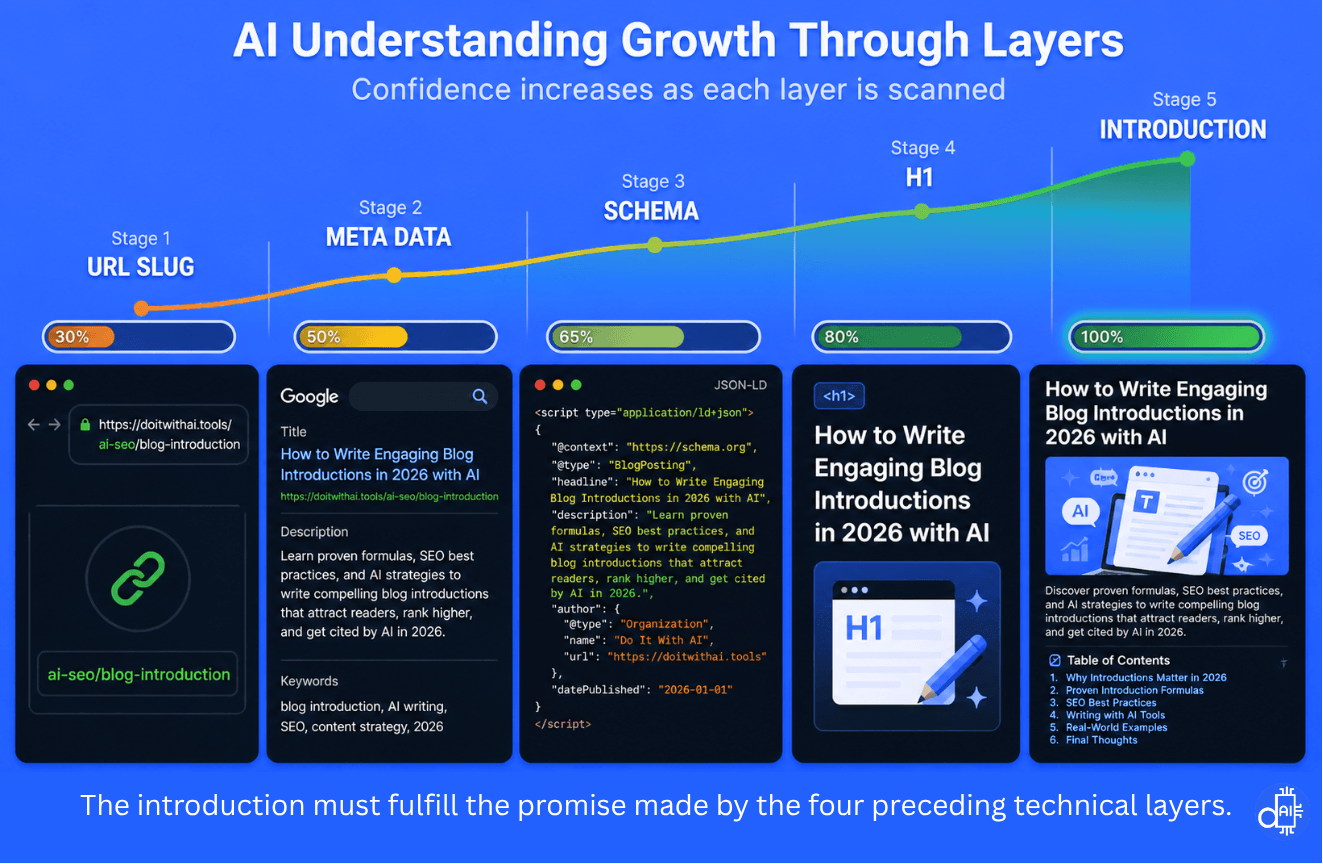
From 30% to 100%: See the 5-stage technical "ladder" AI crawlers use to gain full confidence in your content topic.
WHAT EXACTLY IS AN INTRODUCTION TO A BLOG/ARTICLE?
An introduction is the opening section of your content. It appears right after your H1 heading. It is the first real content your reader sees.
Its role is simple but powerful. It needs to:
- Grab attention
- Explain what the article covers
- Give a clear reason to keep reading
Most high-quality articles follow a simple structure:
| Section | Purpose |
|---|---|
| Introduction | Hooks the reader and sets expectations |
| Body | Explains the topic in detail |
| Conclusion | Wraps up ideas and guides the next step |
Wraps up ideas and guides the next step
Your introduction usually takes 10 to 20% of the total article length.
That may sound small. But it carries the most weight.
If this section fails, everything else becomes useless.
Think of it like starting a conversation.
You have a few seconds to prove you are worth listening to. If you fail here:
- Your best ideas will not be read
- Your detailed research will be ignored
- Your conclusion will never be seen
A weak introduction ends the journey before it even begins.
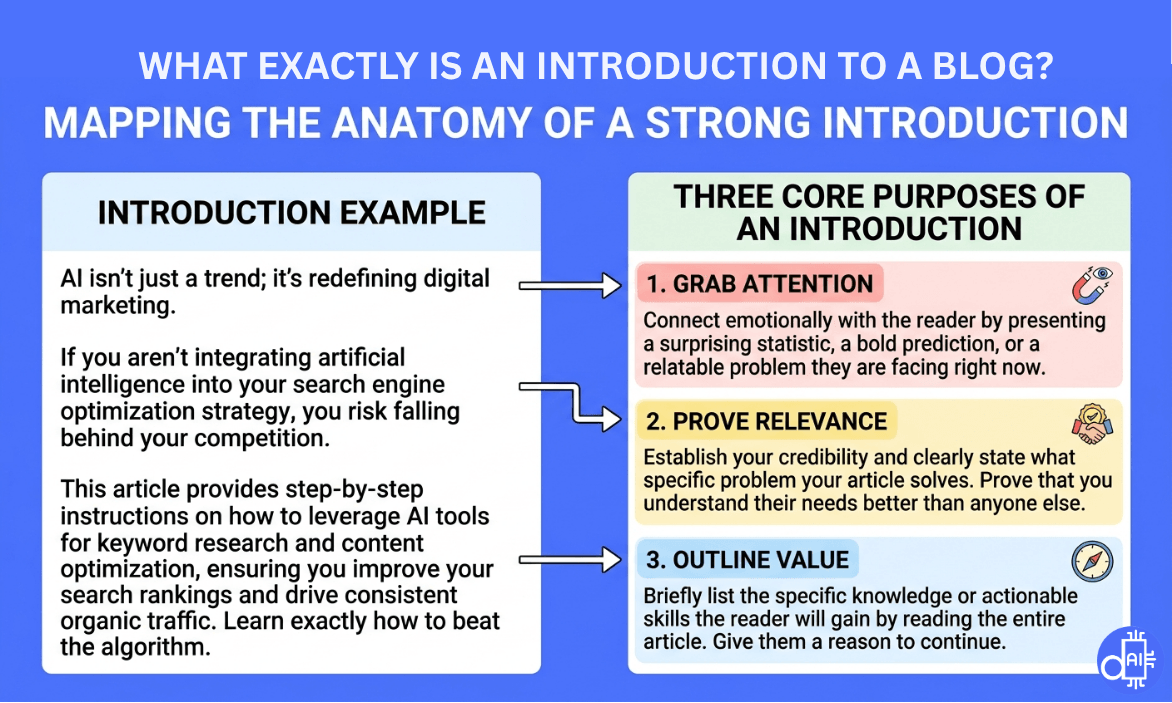
A powerful introduction serves as a roadmap for the reader's journey by combining an emotional hook with a clear promise of value, ensuring your audience stays engaged from the first sentence to the final word.
Why Introductions Matter: For Humans, SEO, and AI Search
Your introduction does not serve just one purpose.
It works on three levels at the same time:
- Human readers
- Search engines like Google
- AI systems like ChatGPT and Perplexity
Understanding this helps you write introductions that actually perform.
How Your Blog Introductions Matter to Human Readers
According to psychology research, humans form their initial opinion about content within milliseconds.
This is known as the primacy effect.
It means people remember the first thing they see more than anything that comes later.
When someone lands on your page, their brain quickly decides the following:
- Is this content useful?
- Can I trust this writer?
- Should I keep reading?
This decision happens almost instantly.
Your introduction is either
- Builds trust and keeps them reading
- Or pushes them to leave
That is why your introduction directly affects engagement and retention.
How Introductions Matter to Google’s Algorithm
According to Google's official documentation, Google uses an AI system called RankBrain that helps understand how words are related to concepts.
RankBrain does not just look for keywords. It looks for meaning and relevance.
Here is what happens when Google reads your introduction:
- It checks if your topic matches the search query
- It looks for clear and relevant signals
- It tries to understand the intent behind your content
If your introduction is clear and focused:
- Google understands your content better
- Your chances of ranking improve
If your introduction is vague:
- Google gets confused
- Your rankings may drop
Your introduction helps Google decide where your content belongs.
How Introductions Matter to AI Systems
According to OpenAI's official documentation, ChatGPT is designed to understand and respond by learning patterns from large amounts of information, and it analyzes relationships within data to understand how words typically appear together in context.
AI systems read your introduction to understand:
- What your content is about
- Whether it is structured well
- If it is useful enough to reference
A strong introduction sends clear signals:
- Your content is organized
- Your topic is well-defined
- Your information is reliable
This directly impacts visibility in AI search tools.
Platforms like ChatGPT and Perplexity now decide which content gets:
- Summarized
- Referenced
- Recommended
If your introduction is strong and clear, your chances of being cited increase.
This Means:
Your introduction is no longer just a hook.
It is a multi-purpose system that
- Engages human readers
- Signals relevance to Google
- Helps AI systems understand and trust your content
When done right, your introduction becomes one of the most powerful parts of your entire article.
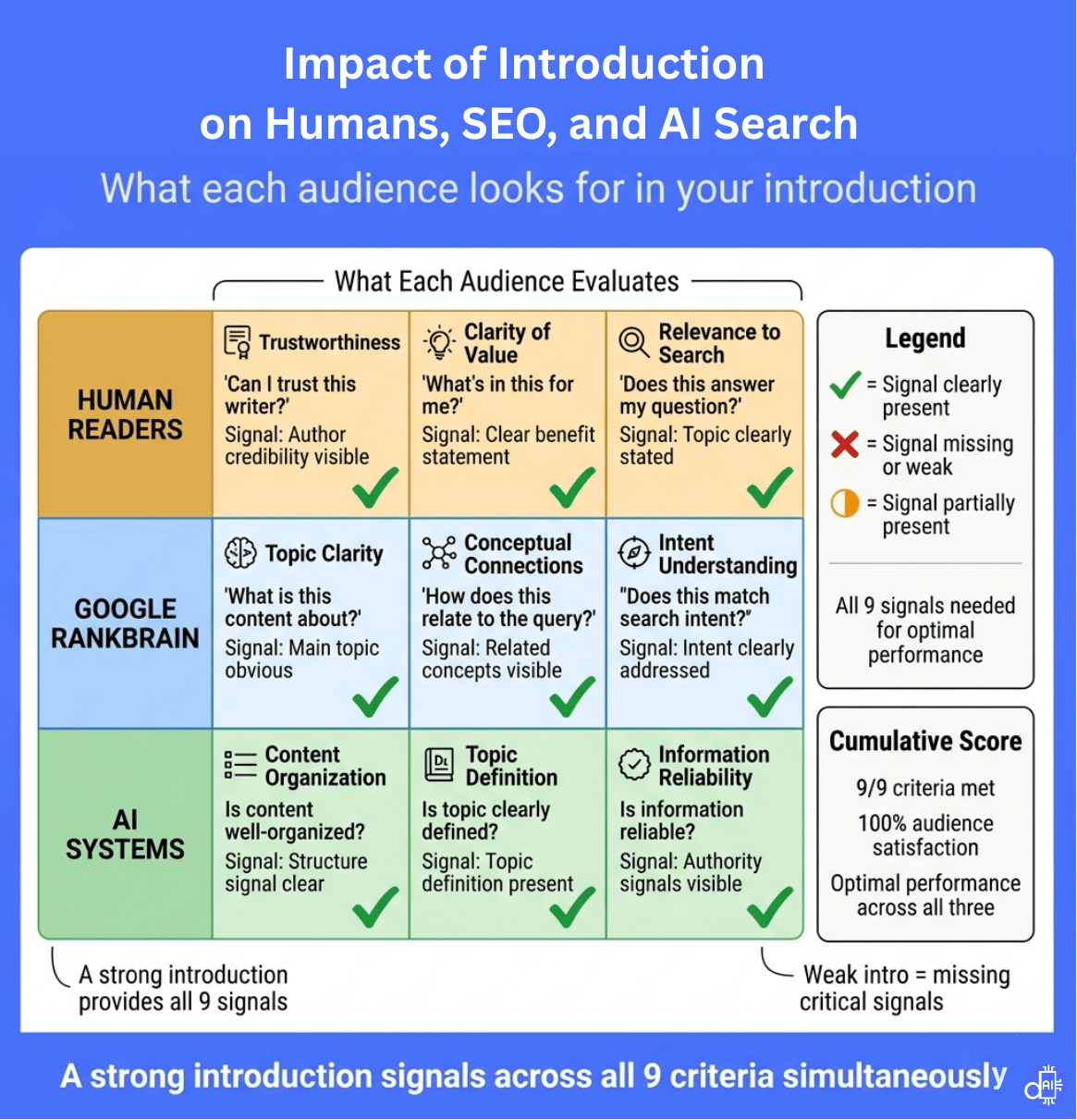
By providing all nine critical signals in your opening lines, you ensure your content satisfies the immediate emotional needs of readers while simultaneously meeting the complex data requirements of search algorithms and AI crawlers.
The 3 Elements That Make Your Introduction Impossible to Ignore
A powerful introduction is not random. It follows a clear structure.
It has three main parts:
- The Hook
- The Connection (Bridge)
- The Roadmap
Each part has a specific role. When they work together, they create an introduction that keeps readers engaged and signals clarity to AI systems.
Part 1: The Hook: Your First Point of Contact with the Reader
The hook is your opening sentence. It is the first moment of contact between your reader and your content.
This matters more than most creators think.
A great hook makes someone pause and promises quality content. It decides whether the reader stays or leaves.
Many creators focus on the body content. They think the real value is there. But the truth is simple:
Once you master a strong hook, you win 90% of the attention battle.
Everything after that just delivers on the promise.
There is also a clear chain reaction:
- Stronger hook → Higher engagement
- Higher engagement → More time on page
- More time on page → Lower bounce rate
This is why professional writers spend more time on the first sentence than any other part.
The Most Effective Types of Hooks You Can Use
Not every hook works the same way. Different topics need different approaches.
Here are the most effective ones:
- Question Hook: Engaging the Reader Through Curiosity
- This hook asks a question that makes the reader think.
- Example:
- "What if everything you know about writing introductions is wrong?"
- Why it works:
- Questions force the brain to engage, preventing the reader from staying passive while triggering the curiosity needed to pull them into the answer.
- Questions force the brain to engage, preventing the reader from staying passive while triggering the curiosity needed to pull them into the answer.
- Statistic Hook: Capturing Attention with Data
- This hook uses surprising data or an unexpected truth.
- Example:
- "According to Nielsen Norman Group, 55% of visitors spend less than 15 seconds on a page. Your introduction has to work fast."
- Why it works:
- Surprising facts trigger curiosity instantly because the brain naturally reacts to unexpected information while viewing statistics as credible markers of trust.
- Surprising facts trigger curiosity instantly because the brain naturally reacts to unexpected information while viewing statistics as credible markers of trust.
- Contrarian Hook: Challenging Common Beliefs
- This hook challenges a common belief or assumption.
- Example:
- "Most people think the body of an article is where readers decide. They're wrong. It happens in the first sentence."
- Why it works:
- It creates a knowledge gap by making readers question their existing beliefs, which creates a curiosity that pushes them to continue reading.
- It creates a knowledge gap by making readers question their existing beliefs, which creates a curiosity that pushes them to continue reading.
- Story Hook: Drawing Readers in with Real Situations
- This hook starts with a short story or real-life scenario.
- Example:
- "I once spent three hours writing a blog post. It was detailed and well-researched. But nobody read past the first paragraph. That changed everything for me."
- Why it works:
- Stories activate multiple areas of the brain.
- They are easier to remember than facts.
- They create emotional connection and relatability.
- In Media Res Hook: Starting in the Middle of the Action
This hook drops the reader directly into a conversation, a conflict, or a specific moment without a formal introduction.- Example:
- "So there I was, staring at a bounce rate of 85% and wondering where exactly my strategy had collapsed. I had the keywords. I had the backlinks. But I was missing the one thing that actually keeps a human being on the page: a reason to care."
- Why it works:
- This "narrative jump" breaks predictable AI patterns and creates an immediate information gap that forces the reader to mentally catch up, driving deep engagement from the very first word.
- Example:
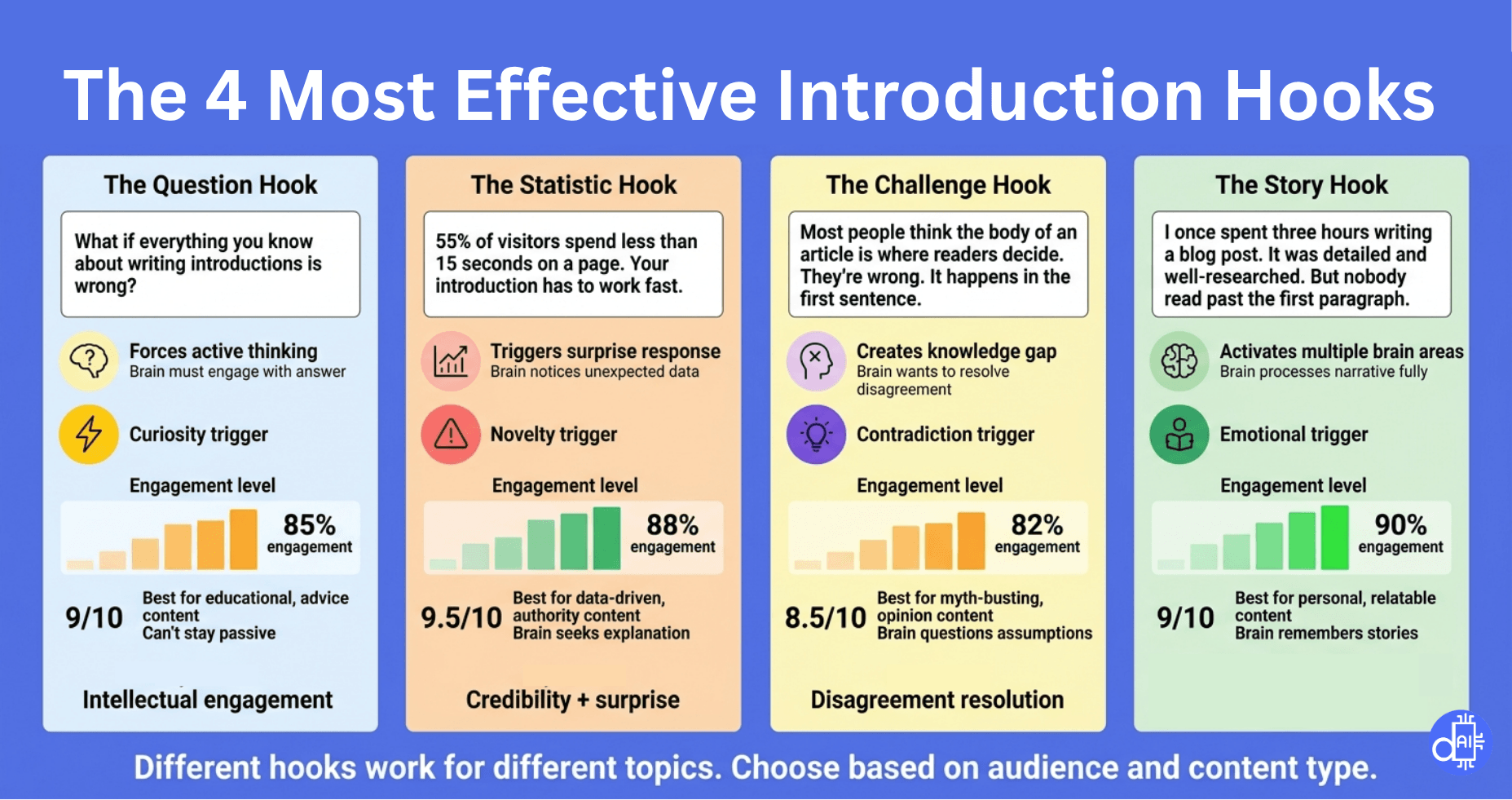
Choose a hook based on your content type to trigger the right psychological response and instantly turn passive readers into engaged participants.
Part 2: The Bridge: Connecting the Hook to Your Message
After the hook, you need to build a bridge.
This part connects your opening to the rest of your content. It creates emotional connections and explains why your article matters.
The bridge has four key components.
- Empathy Statement: Showing You Understand the Reader
- Definition: This is where you immediately show the reader that you understand their struggle or challenge right after the hook.
- Example: "If you've struggled to write introductions that keep people reading, you're not alone. Most creators face this exact problem."
- Why it works: Building an emotional connection with customers creates trust and lays the foundation for long-term relationships. This makes the content feel personal instead of generic and helps establish trust from the very beginning.
- Problem-Solution Shift: Highlighting What Is Not Working
- Definition: This part explains why traditional methods are failing and identifies the "gap" between the reader's current results and their goals.
- Example: "Most templates tell you to start with a hook and slowly lead into the topic. While this works for humans, AI systems need clarity immediately. You are currently stuck between two different audiences."
- Why it works: It creates urgency by showing the reader that their current approach is missing something important, motivating them to find a better way.
- The “Doing It With AI” Context: Establishing Authority
- Definition: This is where you explain why your specific approach is the solution and what makes your guide different from others.
- Example: "This guide is built for modern creators. It shows you how to write introductions for both humans and AI using specific prompts for ChatGPT and Gemini. You get a repeatable system you can use today."
- Why it works: It positions you as an authority. By showing you have solved the problem using modern tools, you give the reader a strong reason to trust your advice.
- The Value Proposition: Answering the “So What?”
- Definition: This final piece of the bridge clearly states exactly what the reader will gain by finishing the article.
- Example: "Imagine publishing an article that ranks on Google and gets cited by AI systems. Imagine having a system that helps you write strong introductions in minutes instead of hours."
- Why it works: Readers need to see the "ROI" (Return on Investment) for their time. This makes the specific benefits of your content crystal clear before they dive into the main body.
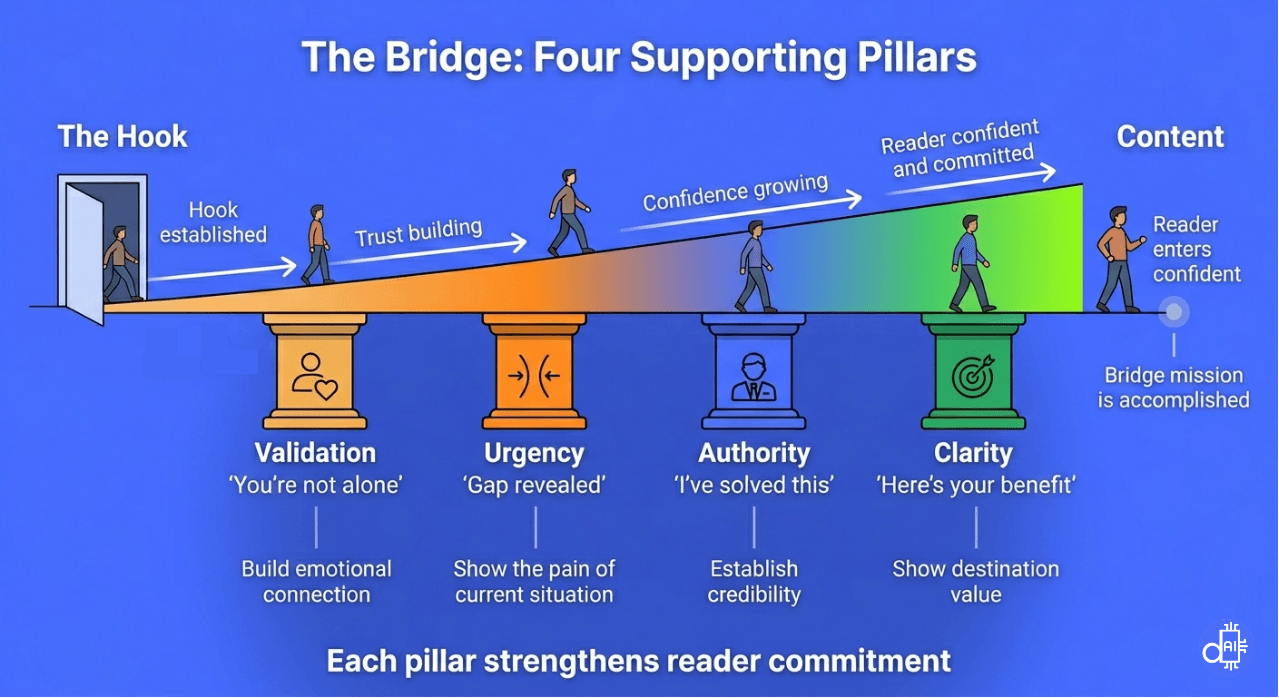
The bridge section uses four strategic pillars to transform initial curiosity into total reader commitment, ensuring your audience feels confident in your solution.
Part 3: The Roadmap: Outlining What Comes Next (Article Overview)
The final part of your introduction is the roadmap.
This section tells readers what they will learn and what to expect. It also includes a promise line at the end that commits to the reader’s success.
It does two important things:
- It manages expectations — readers know exactly what’s coming.
- It helps both humans and AI systems understand the full scope of your article.
A Clear Example of a Strong Introduction Roadmap
"In this guide, you'll learn the four types of hooks that work. You'll see real examples. You'll get prompts for ChatGPT and Gemini. You'll understand the Bridge component that separates good introductions from great ones. And you'll get a checklist to evaluate your introductions. By the end of this article, you'll have a complete system for writing introductions that rank and convert."
The Promise Line: Defining the Final Outcome
The final sentence is critical.
"By the end of this article, you'll..."
This line tells the reader what transformation they will get.
It tells readers exactly what transformation they’ll experience. It holds you accountable and gives readers a clear reason to keep reading.
Why This Structure Matters
AI systems use structure and organization to determine content relevance and quality. A clear roadmap with a promise line signals to AI systems that your content is organized, complete, and trustworthy.
How These Three Parts Work Together
Each part plays a role:
- Hook captures attention through surprise or emotion.
- Bridge validates your reader’s struggle, explains why it matters, and positions you as the solution.
- Roadmap sets clear expectations and promises a transformation.
This three-part structure works because it follows human psychology and AI requirements simultaneously.
When you use all three together, your introduction becomes clear, engaging, and effective for both audiences.
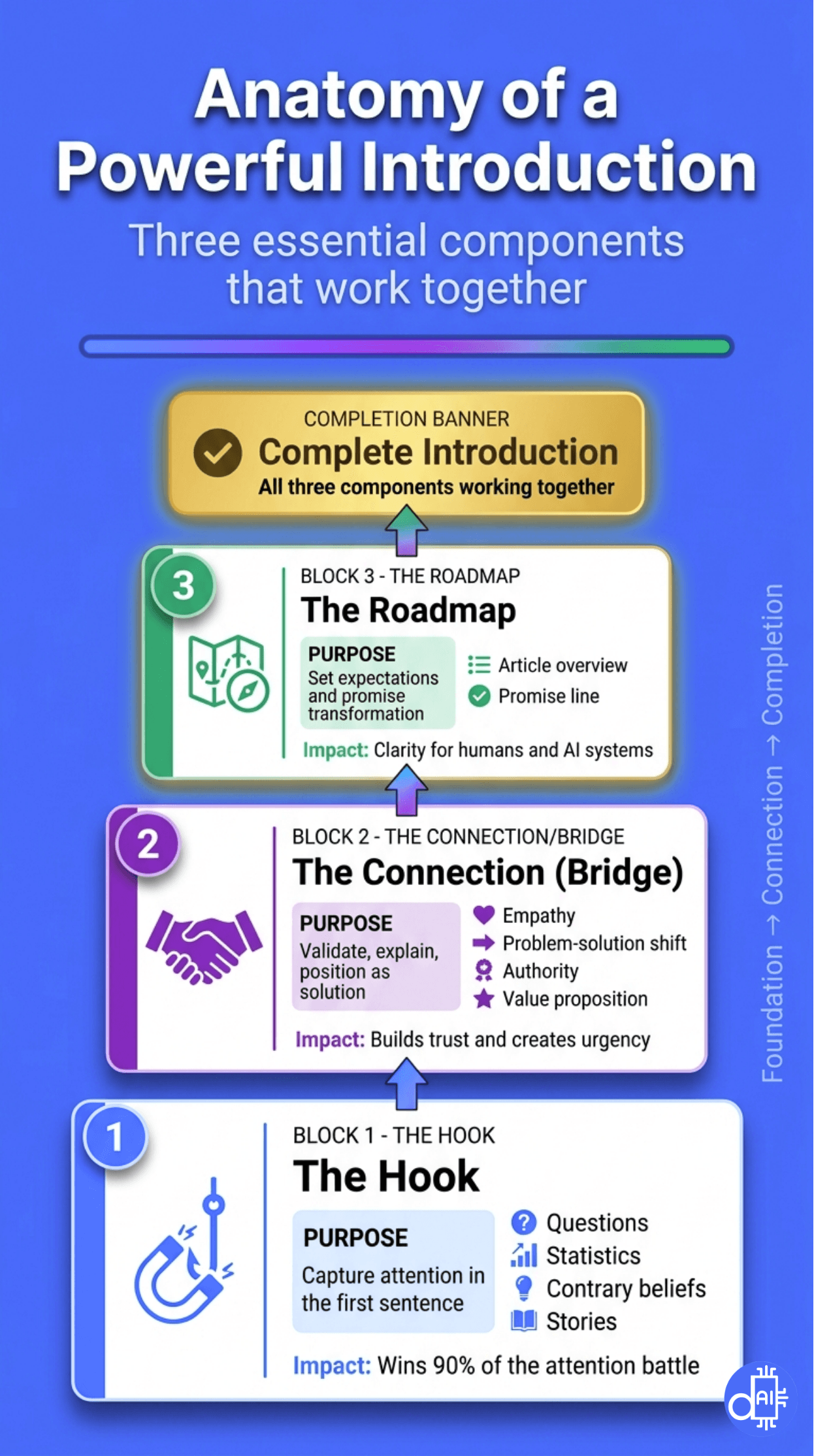
Combining these three essential blocks creates a complete introduction that wins the user's attention battle while also satisfying the structural requirements of modern AI systems.
Best Practices for Writing Introductions That Keep Readers Reading
Writing a strong introduction is not about luck. It follows a few simple practices that improve clarity, engagement, and SEO at the same time.
When you apply these consistently, your introductions become easier to read and more effective.
The Ideal Length for a Blog Introduction in 2026
One of the most common questions is:
How long should your introduction be?
In 2026, the answer is not about fixed numbers. It is about balance.
You need to align with user experience, SEO, and AI reading behavior at the same time.
What Google Says About Introduction Length
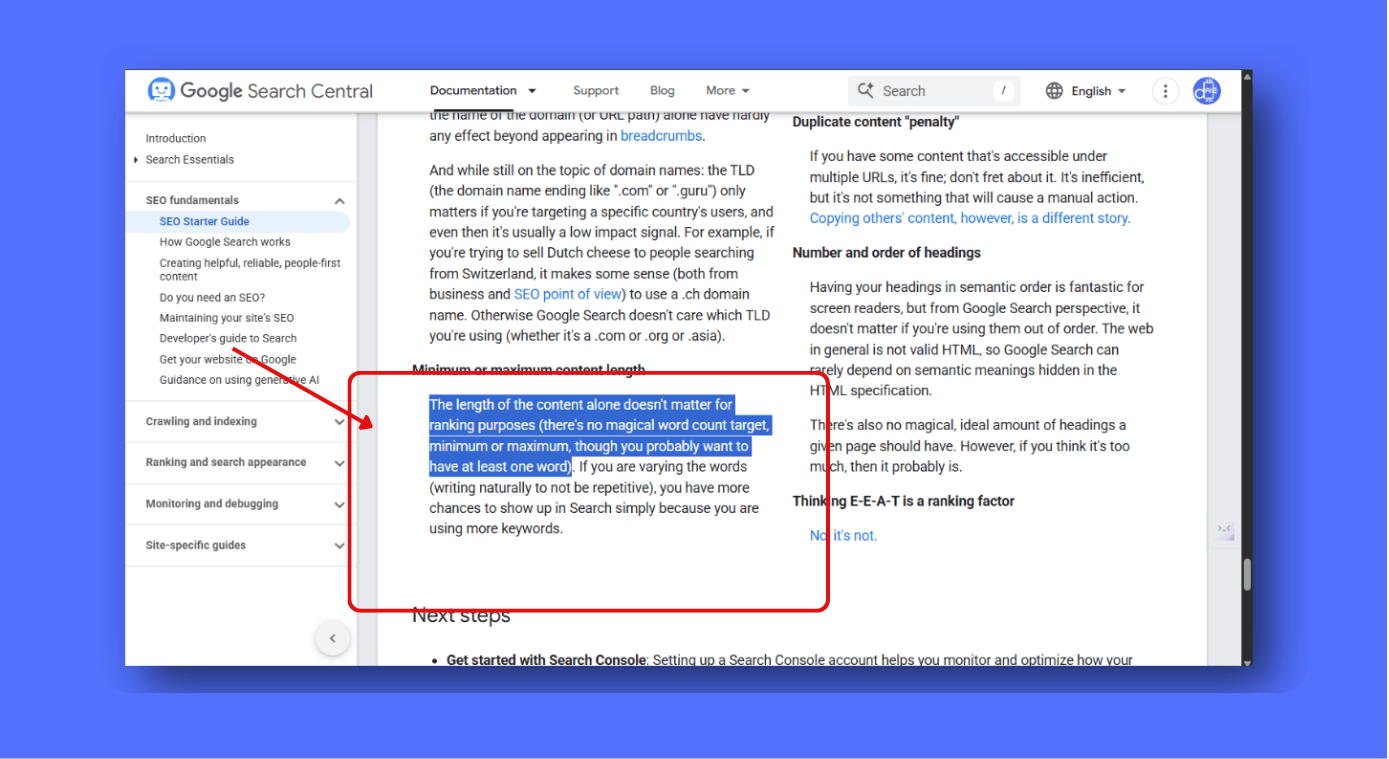
Official Google guidelines confirm that quality and natural keyword usage take priority over rigid word counts, reinforcing the importance of value over length.
Google does not rank content based on length.
It focuses on:
- Content quality
- Relevance to the topic
- Ability to satisfy user intent
The idea is simple.
- If you can explain your value in 50 words, that is enough
- If your topic needs 200 words, that is also fine
Clarity always matters more than length.
The Sweet Spot for Modern Blog Introductions
Even though there is no strict rule, real-world data gives us a useful range.
Studies from platforms like Semrush suggest a practical target:
100 to 250 words
This range works well for most modern blog introductions.
Importance of the First 100 Words in an Introduction
Your first 100 words are critical.
This is where you should:
- Mention your primary keyword
- Explain your core value
- Show what the article is about
AI systems and search engines often focus more on the beginning of your content.
They try to understand your topic as early as possible.
This is why your introduction should be clear from the start.
How Mobile Screens Affect Introduction Length
Most users today read on mobile devices.
On a phone screen, even a 200-word introduction can feel long.
So the strategy is not just about word count. It is about presentation.
To improve readability:
- Use short paragraphs
- Keep 2 to 3 sentences per paragraph
- Avoid large text blocks
This makes your content feel lighter and easier to read.
Choosing the Right Introduction Length for Each Article
Your introduction length should match your article type.
Here is a simple guideline used by SEO experts like Backlinko:
Article Type
Recommended Intro Length
Recommended Introduction Length by Article Type
| Article Type | Long guides | Recommended Intro Length |
|---|---|---|
| Short articles | Long guides | In-depth pillar content |
| 75 to 125 words | 200 to 250 words | 200 to 300 words |
Short content needs a quick entry.
Long content needs more context and setup.
Eliminating Unnecessary Sentences in Introductions
Every sentence in your introduction should have a purpose.
It should do one of these:
- Act as a hook
- Build the bridge
- Provide the roadmap
If a sentence does not serve one of these roles, remove it.
In 2026, unnecessary content hurts performance.
AI tools can summarize long introductions anyway.
So do not rely on AI to fix weak writing.
Write clean, focused introductions from the start.
Final Takeaway
There is no perfect number.
But there is a clear principle:
Write as much as needed, and not a word more.
That is the real “sweet spot.”
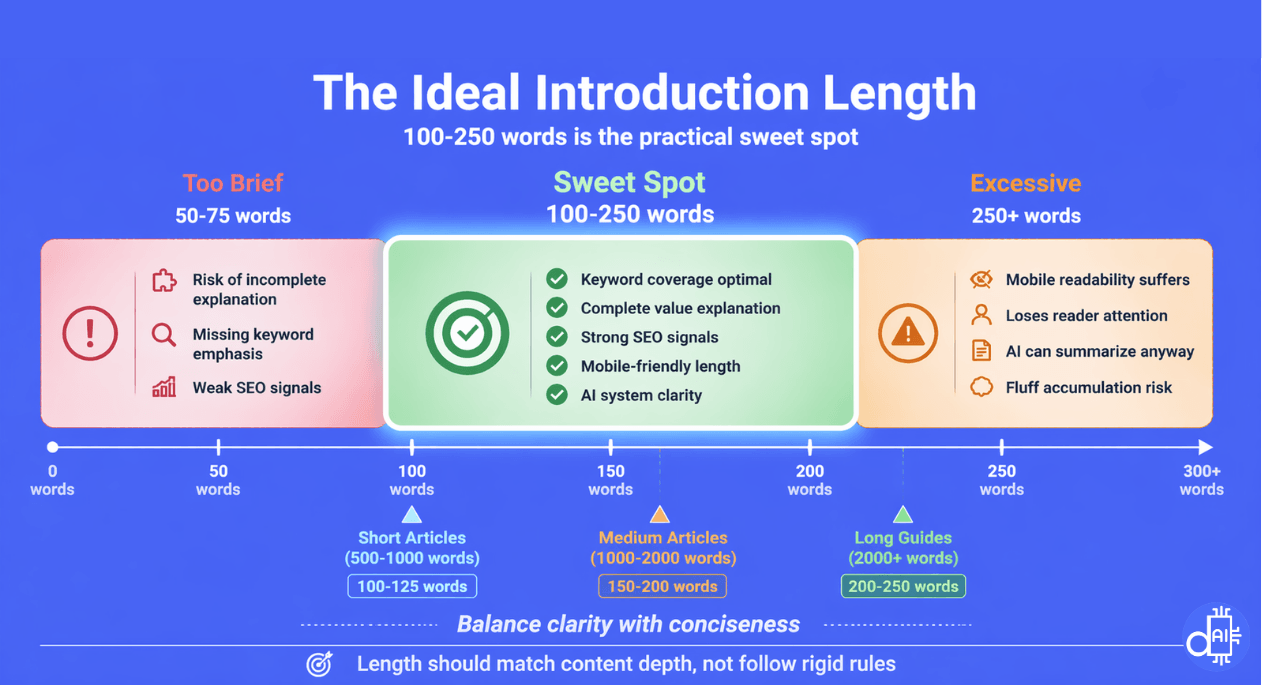
Aim for the 100-250 word sweet spot to ensure your introduction remains mobile-friendly while providing enough depth for AI crawlers to summarize.
Place Your Primary Keyword Early in the Introduction for Better SEO Signals
Place your main keyword near the beginning of your introduction.
Do not force it. It should feel natural inside the sentence.
This helps search engines understand your topic quickly.
Example:
“How to write introductions with AI has become essential in 2026.”
A clear keyword early in the introduction sends a strong relevance signal.
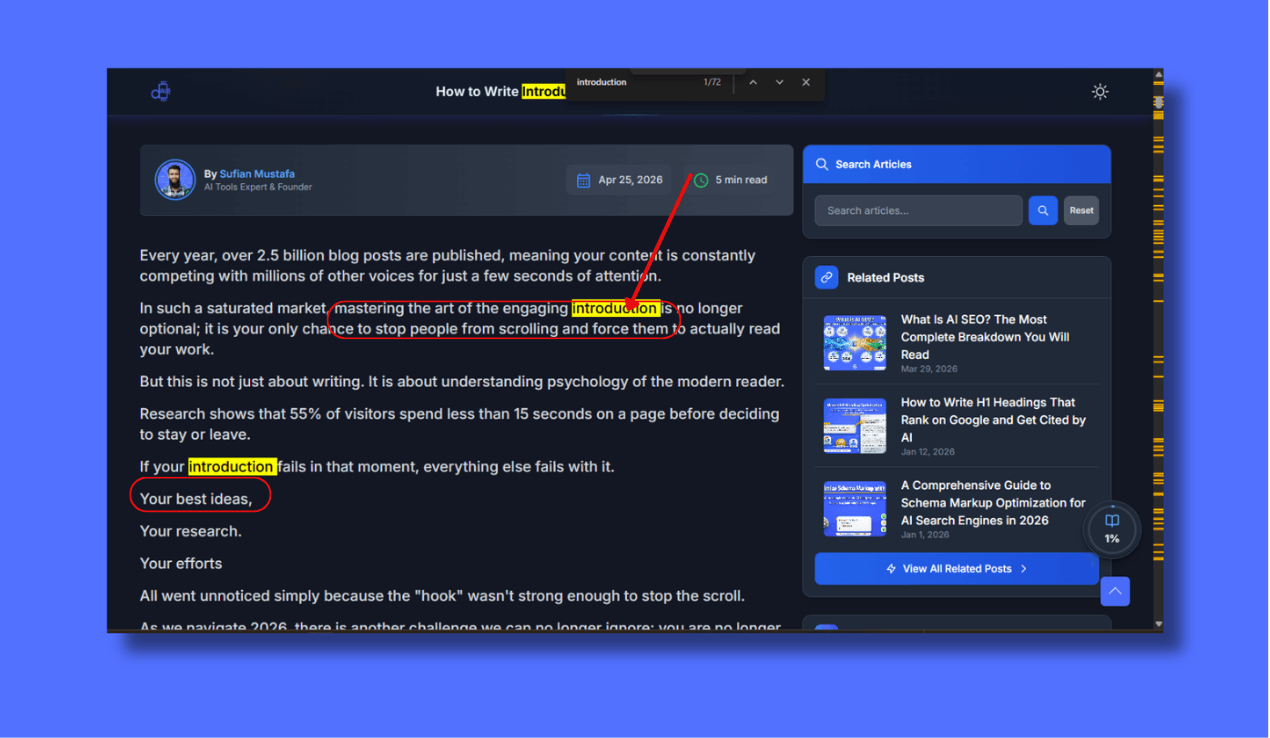
Placing your primary keyword within the first few lines of your introduction establishes immediate topical relevance for search engines without disrupting the natural flow for readers.
Build Trust in Your Introduction Using Specific Details and Real Proof (E-E-A-T)
Google evaluates content based on Experience, Expertise, Authoritativeness, and Trustworthiness (E-E-A-T).
Your introduction should show that you know what you are talking about.
You can do this by:
- Sharing real experience
- Adding specific results
- Mentioning relevant work or achievements
- Referring to trusted sources
Example:
“I have helped 500+ creators write introductions that rank in the top 10. Here is what actually works.”
However, remember that keywords only work if you have chosen the right ones. To ensure your content is targeting what people are actually searching for, you can learn more about mastering keyword research with AI to align your intro with the right search intent.
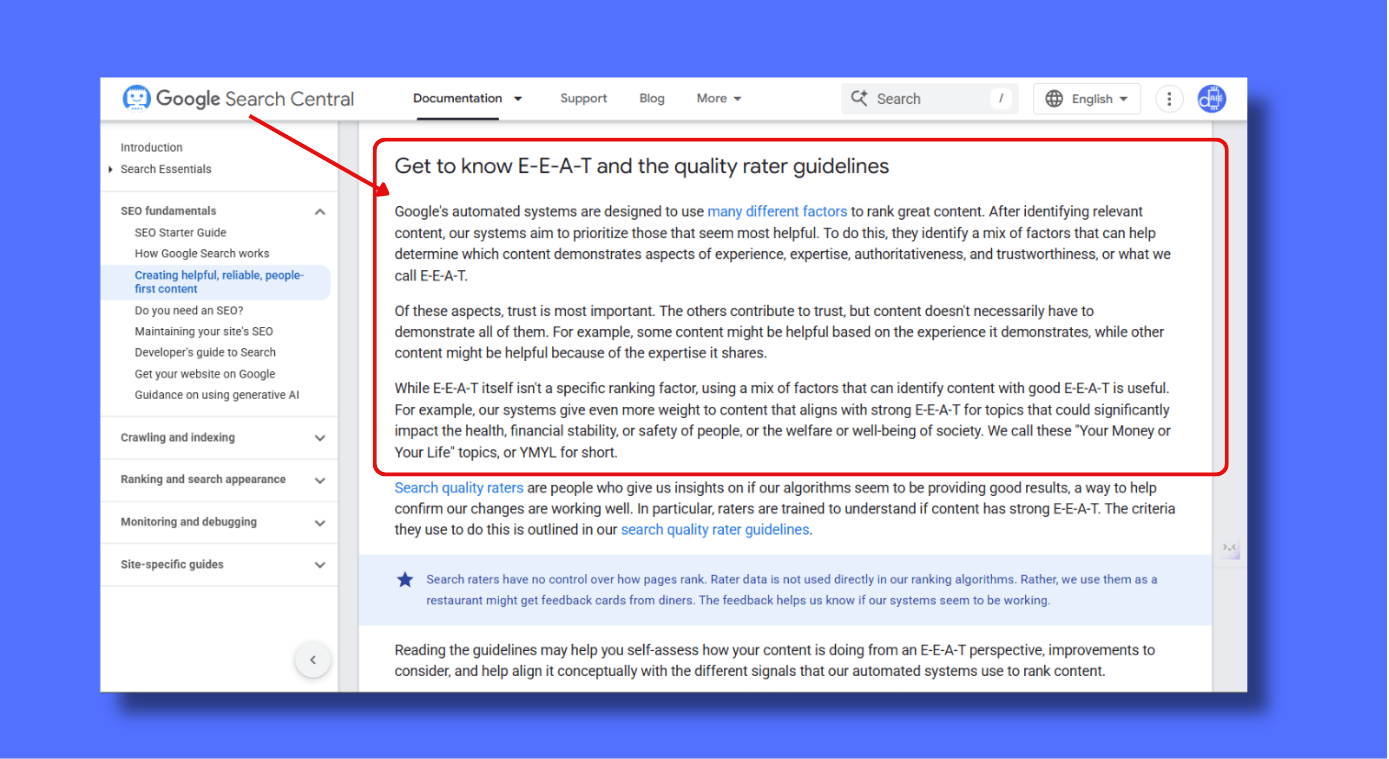
Aligning your introduction with Google's E-E-A-T guidelines ensures your content is recognized as helpful, reliable, and trustworthy by both automated systems and human readers.
Prioritize Readability in Your Introduction Using Simple and Clear Language
Your introduction should be easy to read for anyone.
- Use simple, everyday words
- Avoid jargon and complex phrases
- Keep sentences short and clear
Short sentences feel stronger. They are easier to process and more engaging.
You can vary sentence length slightly, but keep the average short.
Remember the 15-second rule. If your content feels hard to read, people leave.
Keep the format of Your Introduction Clean
Keep your introduction in clean paragraph format only.
Avoid:
- Bullet points
- H3 subheadings
- Tables
- Highlighted boxes
Formatting inside the introduction can distract from the core message and disrupt the natural reading flow.
If you want to improve both readability and formatting, you can use AI tools to simplify your writing, refine sentence structure, and organize content more effectively.

Use these top-rated AI tools and specialized prompts to instantly simplify your writing and polish your content structure for a better user experience.
Focus on the Reader in Your Introduction Using the “You” Ratio Strategy
Your introduction should be about the reader, not about you.
Pay attention to your language:
- Use more “you” and “your”
- Reduce “I,” “me,” and “my”
This keeps the focus on the reader’s problem and needs.
When readers feel the content is written for them, they stay longer.
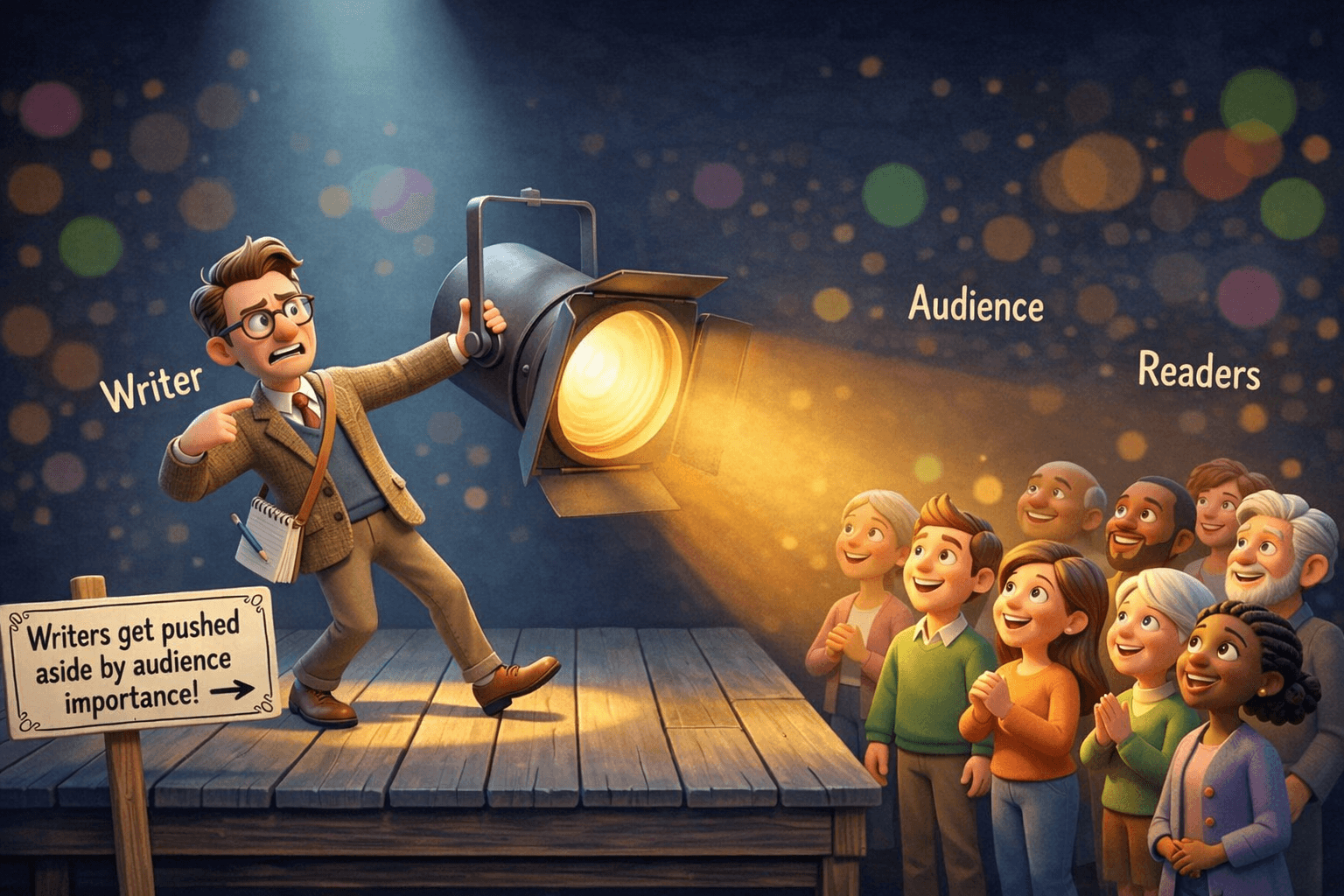
Don't let your ego steal the show; turn the spotlight on your readers by using more "you" and "your" to address their specific needs and goals. :))
Match Your Introduction Tone to Your Target Audience for Better Connection
Always adjust your tone based on who you are writing for. To do this effectively, you must first have a clear understanding of your readers' needs and pain points. You can use AI to research your target audience and create detailed buyer personas, which makes it much easier to choose the right language for your introduction.
Once you know your audience, use these guidelines:
- For beginners → Use simple, friendly language that explains concepts clearly.
- For experts → You can be more technical, direct, and skip the basic definitions.
Consistency in tone builds trust and improves the reading experience. When the language matches the reader's level of expertise, they are much more likely to stay and finish the article.

Use AI-driven audience research to pinpoint your readers' specific needs and pain points, allowing you to match your introduction's tone perfectly to their expertise level.
Write Your Blog Introduction Last for Better Clarity and Structure
This might sound counterintuitive, but it’s one of the biggest secrets used by top creators.
Write the full article first. Fully explore the topic. Then return to craft or polish your introduction.
This helps you:
- Understand your topic fully
- Set accurate expectations
- Write a more focused introduction
You can also draft a rough introduction first, then refine it after finishing the article.
Both approaches work, but the key idea is the same.
A strong introduction comes from full clarity of the topic.
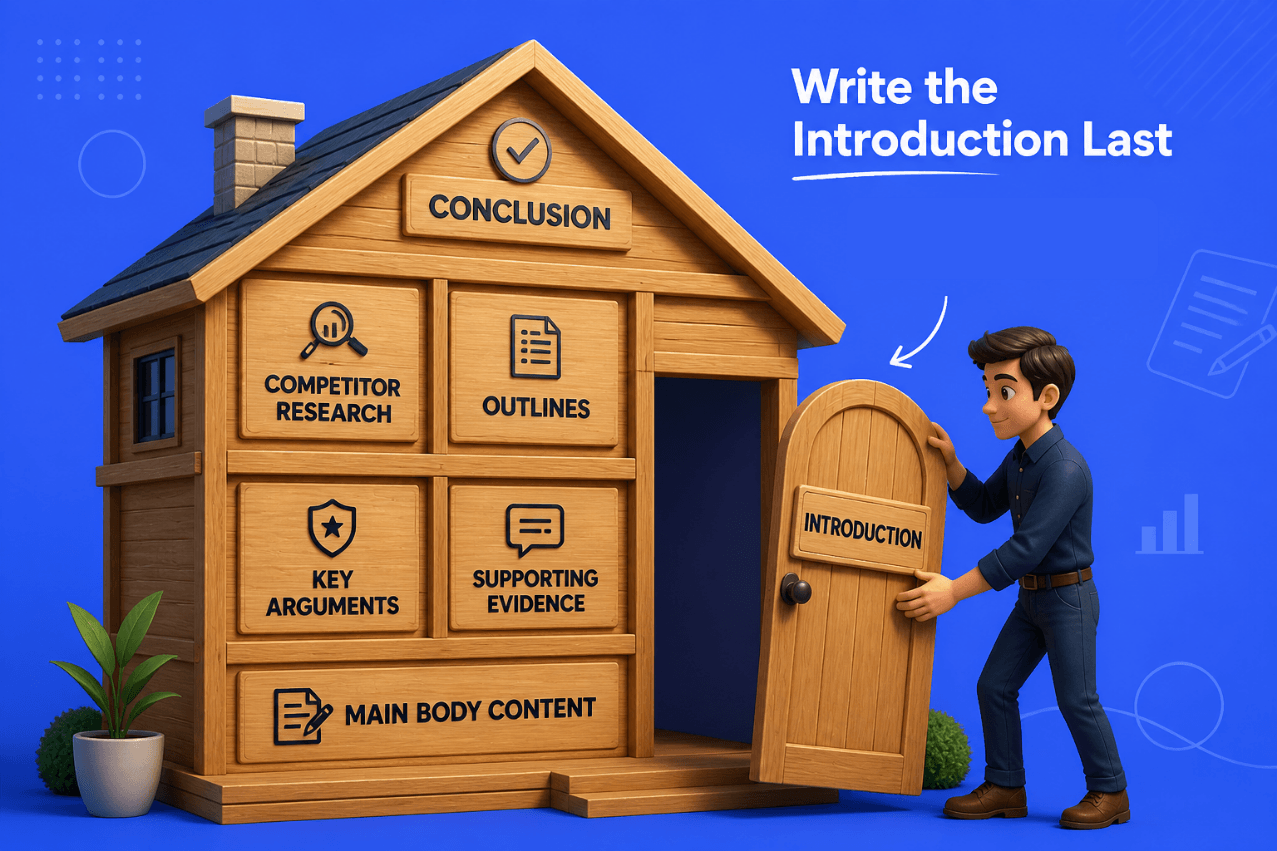
You wouldn't hang a front door before the foundation is set—mastering your blog's entry point starts by building your core arguments first.
Critical Pitfalls: What to Avoid in 2026 Blog Introductions
The introduction is your content's ultimate gatekeeper, directly influencing both reader retention and search engine performance. In 2026, you must be ten times more meticulous here to ensure your opening satisfies complex AI algorithms while maintaining a genuine human connection.
- Prioritizing Keywords Over Intent: Stop "keyword stuffing" for rankings; 2026 SEO is an intent-based game where failing to address the user's specific query leads to immediate penalties.
- Poor Keyword Placement: Never bury your primary keyword; for optimal visibility, it must appear naturally within the first two lines immediately following your hook.
- Extreme Reliance or Total AI Avoidance: Avoid the mistake of using 100% raw AI output, which creates "thin," generic content, but also refrain from ignoring AI entirely and missing out on essential data-driven optimizations.
- Improper Introduction Length: Stay away from intros that are too short to provide value or too long and rambling, as both extremes trigger high bounce rates in 2026.
- Ignoring or Fabricating E-E-A-T Signals: Do not fail to establish your authority or, worse, make false claims about your experience; search engines now prioritize verified expertise and transparency from the very first paragraph.
- Missing the Bridge Element: Avoid jumping straight from a hook to technical details without a "Bridge" that connects the reader's emotional pain point to your solution.
- Vague or Generic Hooks: Refrain from clichés or fluff that fails to offer immediate value, as a weak opening will cause readers to abandon your article before reaching the roadmap.
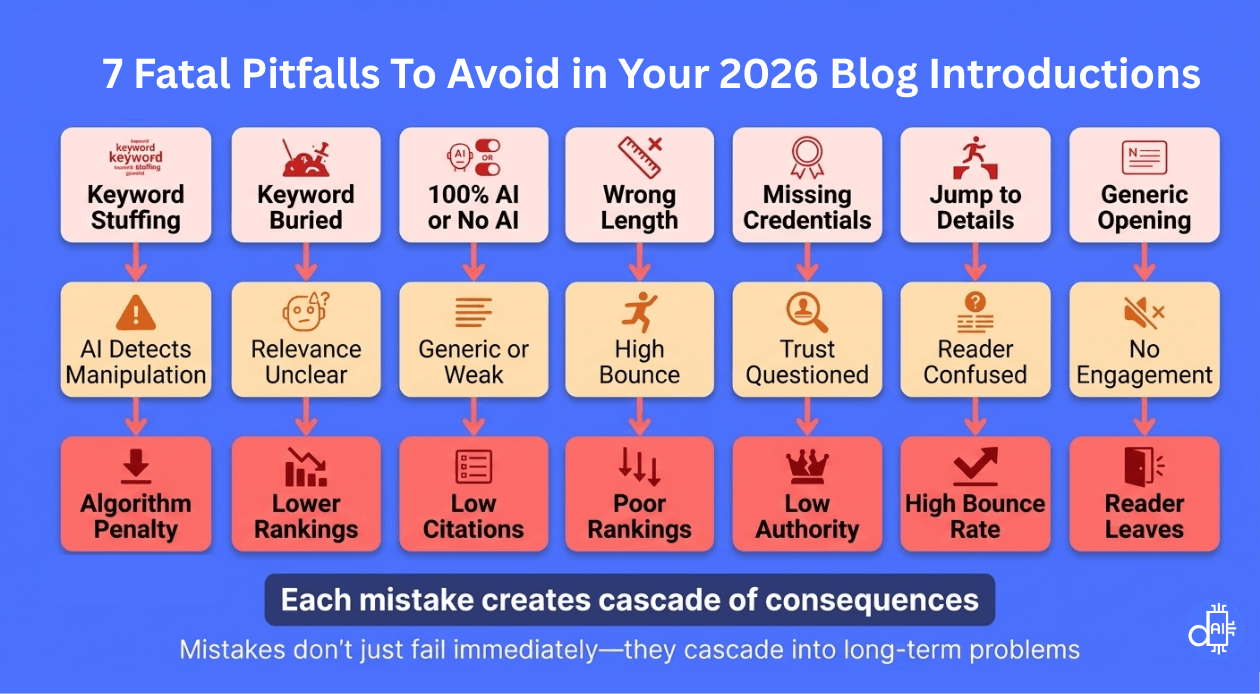
One wrong turn in your opening paragraph can trigger a cascade of SEO and engagement failures—here’s how to spot and stop them before they hurt your rankings.
Where to Place Your Introduction and Table of Contents for Better SEO
This is more important than it seems.
The placement of your table of contents affects both user engagement and SEO performance.
The Short Answer
Your table of contents should come after the introduction.
This is the approach used by most high-performing blogs today.
Why the Introduction Should Appear Before the Table of Contents
The top section of your page is called “above the fold.”
This is the part users see before they scroll. It is the most valuable space on your page.
This area should include:
- Your H1 headline
- Your hook
- Your introduction
The table of contents comes after this.
There is a clear reason for this structure.
Your introduction gives a compact summary of your topic. It includes important keywords and context.
When AI systems and search engines read your page, they use this section to understand:
- What your article is about
- How relevant is it to a search query
If you place the table of contents first, the system sees a list of links before it sees real content.
This delays understanding.
Your introduction should always deliver context first.
The User Experience Reason
Think about how people read.
When someone lands on your page, they expect:
- A clear headline
- A strong opening
- A quick understanding of what they will learn
They are not looking for navigation immediately.
The table of contents is helpful, but only after interest is created.
If you place it too early, it acts like a barrier instead of a guide.
When the introduction comes first:
- The reading flow feels natural.
- The message is clear.
- The reader stays engaged
Navigation that doesn't block entry improves engagement and reduces bounce rates.
The Recommended Structure
Follow this simple order:
Hook → H1 → Introduction → Table of Contents → Body Content
This structure works because:
- It matches how humans consume content
- It aligns with how AI systems process information
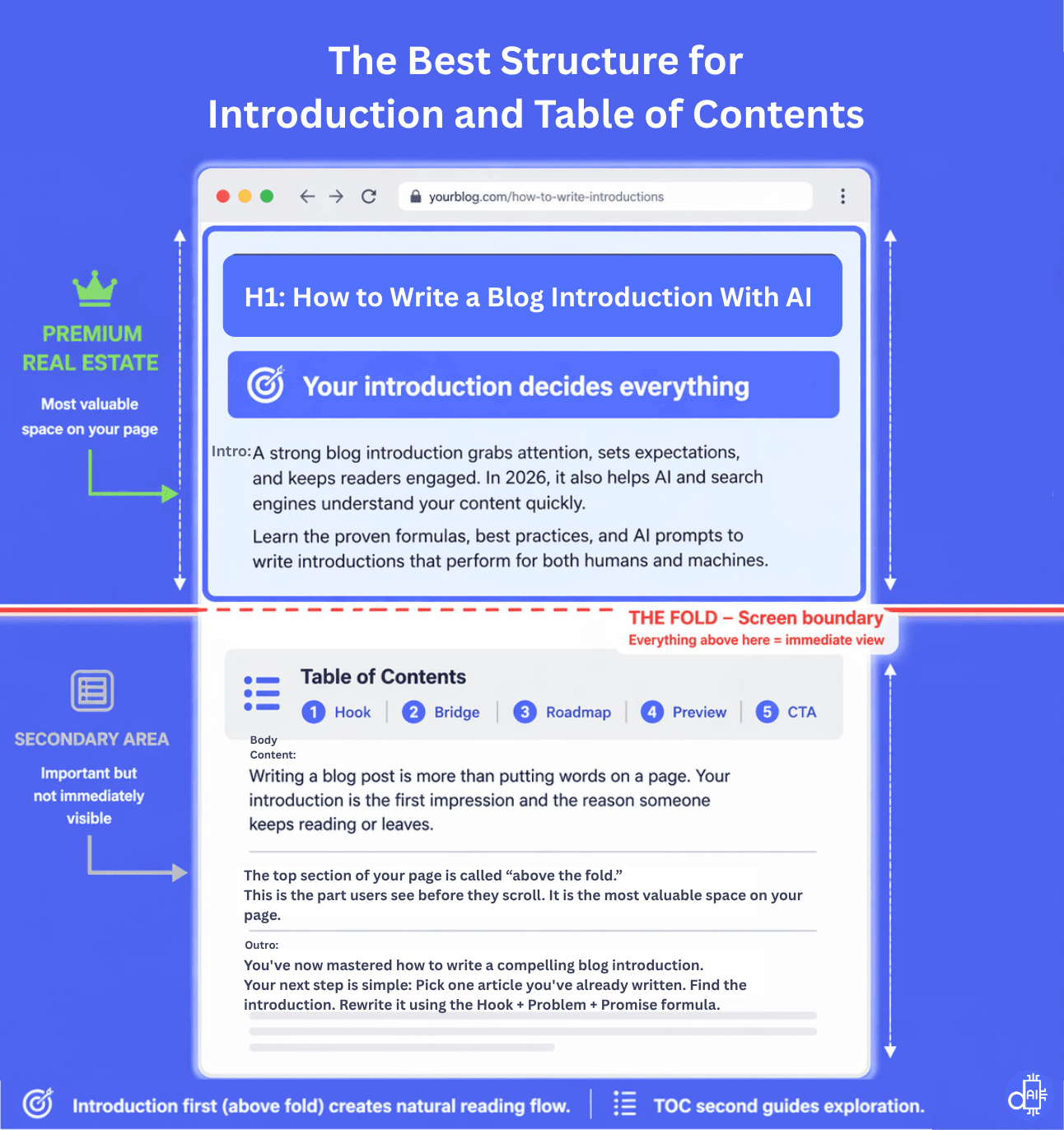
To maximize engagement, place your introduction "Above the Fold" where it is immediately visible without scrolling, followed by a Table of Contents to guide further exploration.
5 Proven AI Introduction Formulas That Work for Any Content
Not all introductions are built the same way. Different topics need different approaches. These five formulas work across every type of content.
:::
- Formula 1: Hook + Problem + Promise
- The Breakdown: Open with an attention-grabber, identify the specific problem the article solves, and close with the primary benefit.
- Example: "Most blog introductions fail because they're too slow. Your reader bounces before learning why they should care. This guide teaches you how to hook them in the first sentence."
- Core Strength: Creates immediate relevance by addressing a pain point and offering a solution.
- Formula 2: Direct Answer + Context + Deeper Dive
- The Breakdown: Provide the answer to the reader's question immediately, add context, and promise a more detailed exploration below.
- Example: "The best introductions are under 100 words. But it's not about length—it's about delivering on a promise immediately. Here's how to do both."
- Core Strength: Satisfies user intent instantly while encouraging them to stay for the full explanation.
- Formula 3: Question + Insight + Solution Path
- The Breakdown: Start with a thought-provoking question, share a surprising insight, and outline the journey the reader will take.
- Example: "Did you know that AI-generated introductions have a 40% higher engagement rate than manually written ones? Not because AI is better, but because it forces clarity. Let me show you why."
- Core Strength: Engages the reader's critical thinking and builds curiosity through data-backed insights.
- Formula 4: Story + Relevance + Takeaway
- The Breakdown: Begin with a short, relatable narrative, connect that story to the reader's current situation, and end with the learning objective.
- Example: "I spent two hours writing an introduction last week. It was perfect. Nobody read past the first line. That's when I realized my approach was completely wrong."
- Core Strength: Builds an emotional connection and makes the advice feel human and authentic.
- Formula 5: Data + Implication + Article Value
- The Breakdown: Lead with a striking statistic, explain the real-world impact of that data, and prove why your article is the essential next step.
- Example: According to Semrush, over 2.5 billion blog posts are published every year. Your introduction has seconds to prove your content is worth reading. This guide shows you exactly how."
- Core Strength: Establishes authority and creates a sense of urgency through factual evidence.
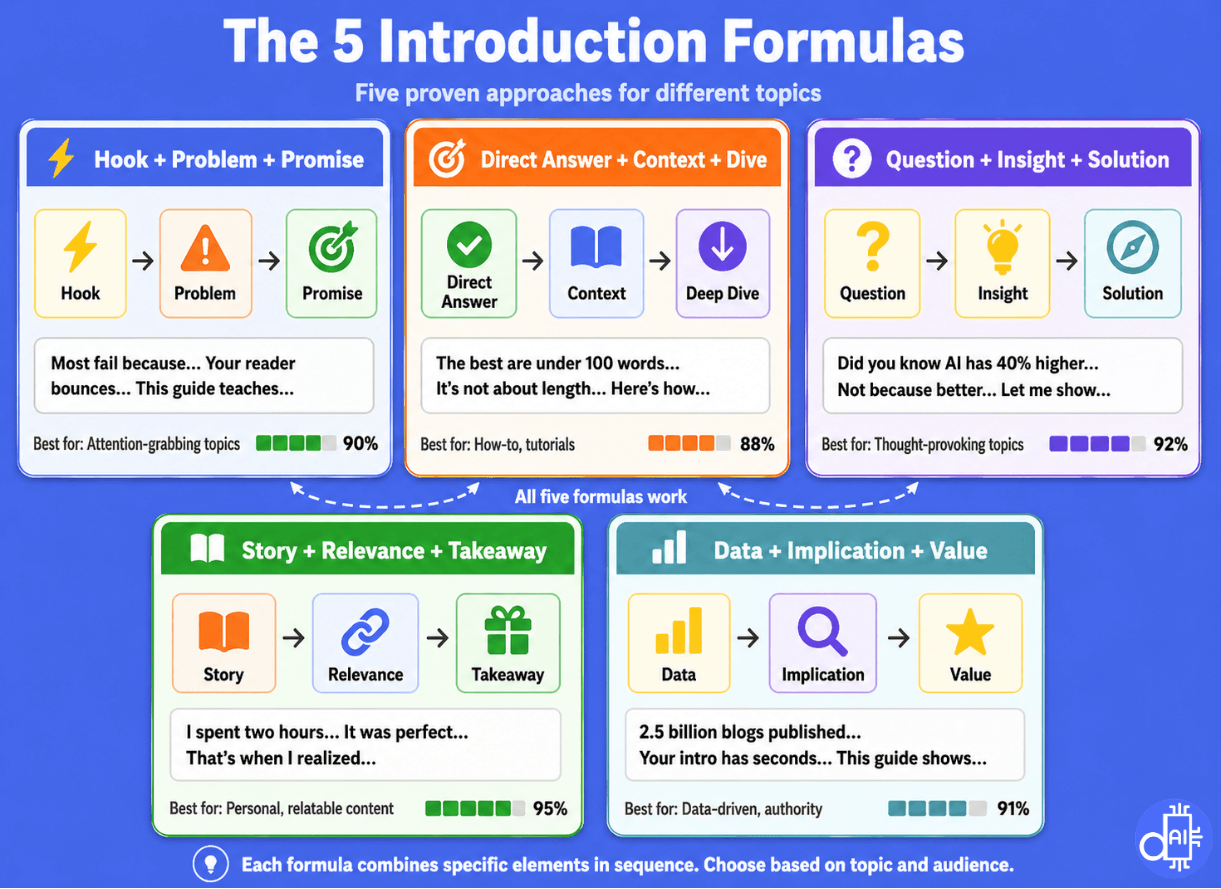
Utilizing these five proven formulas allows you to structure your introduction with mathematical precision, ensuring every sentence serves a specific purpose for your audience.
How to Write Blog Introductions With AI Using Proven ChatGPT Prompts
Now we move from theory to practice.
This is where you start using AI to create introductions that actually work.
Before we get into prompts, one thing is important.
You can use any modern AI tool. It can be ChatGPT, Google Gemini, Claude, or Grok.
The principles stay the same.
All these tools process language in similar ways. What matters is how you guide them.
Why Use AI to Write Blog Introductions?
AI is not just about speed. It improves your entire writing process.
Here is what it helps you do:
- Save time
Generate multiple introduction ideas in minutes - Stay consistent
Follow the same structure and framework every time - Beat writer’s block
Get instant starting points instead of staring at a blank screen
According to industry data, over 70% of content creators now use AI tools for writing support.
So, this is no longer optional. It is part of modern content creation.
Important Honesty Between Manual Writing and AI Assistance
There are two ways to use AI here.
The best approach is:
- Write your introduction manually
- Then refine it using AI
This gives you control and keeps your content natural.
But if you want AI to generate the full introduction, that also works.
You just need the right prompts and structure.
A Quick Note on AI Detection and Content Quality
Many creators worry about AI detection tools.
Here is the reality.
Using AI does not automatically mean low-quality content.
According to Google, not all AI uses are spam. Their systems focus on content quality and usefulness, not the method used to create it.
Search engines care about:
- Originality
- Clarity
- Value
- Trust
As long as your content is written for people and provides real value, it can perform well, even if AI is part of the process.
If your introduction is helpful and well-written, you are safe.
AI is just a tool. The quality still depends on how you use it.
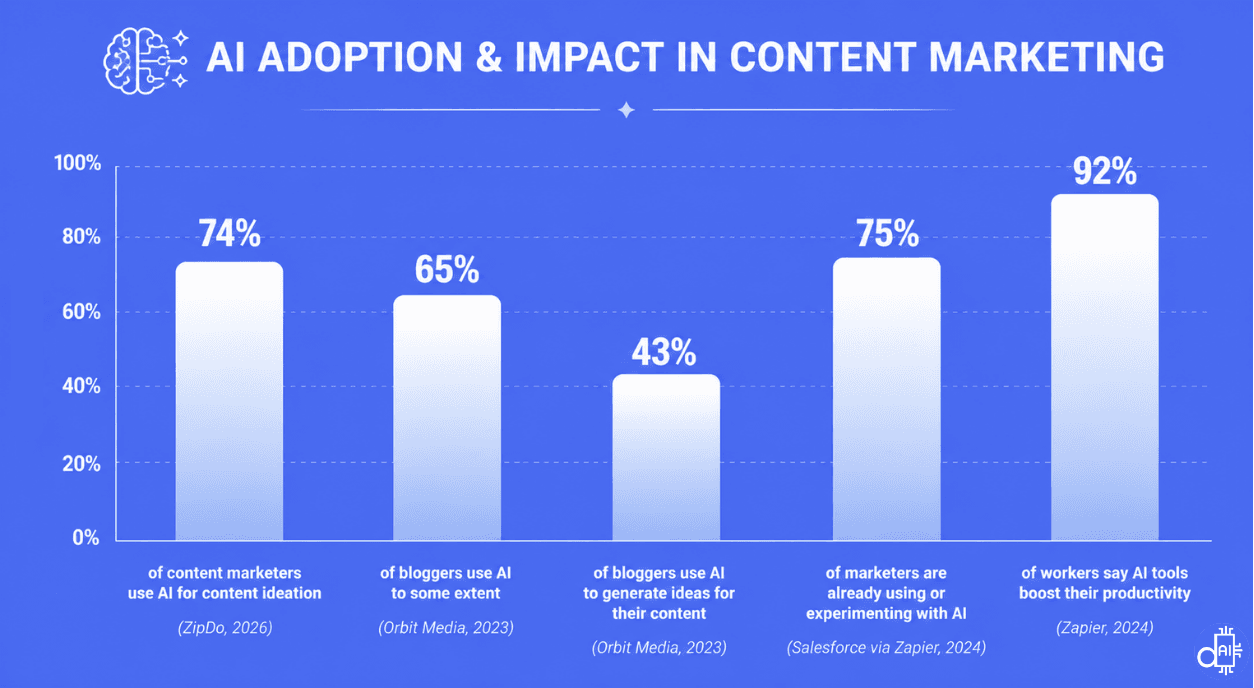
With over 70% of creators now integrating AI into their workflows, mastering these tools is no longer a competitive advantage but a fundamental requirement for modern content success.
(Sources: ZipDo, Orbit Media, Salesforce, and Zapier).
Two Practical Ways to Use AI in Your Introduction Writing Workflow
You can use AI in two simple ways.
Choose the one that fits your workflow.
Approach 1: Refining Your Existing Introduction
If you have already written your introduction, this is the fastest method.
You use AI to improve what you already have.
How it works:
- Copy your introduction
- Paste it into your AI tool
- Use a refinement prompt
Prompt Example:
1
2
3
4
5
6
7
8
9
10
11
12
13
14
15
16
17
18
19
20
21
22
23
24
25
26
27
28
29
30
31
32
33
I have written an introduction for my article about [TOPIC]. Please perform a complete audit of this introduction against the best practices for introductions in 2026.
First, analyze and audit: Does my introduction fulfill ALL of these requirements?

Does it have a strong hook (question, statistic, story, or contrary statement)?
Does it establish the reader's problem clearly?
Does it show why the reader should care (relevance)?
Does it build trust and authority (E-E-A-T)?
Does it include a clear roadmap of what the reader will learn?
Does it end with a promise of transformation or outcome?
Are all sentences under 20 words?
Does it naturally include the primary keyword [PRIMARY KEYWORD]?
Is the introduction 100-250 words?
Does it use only paragraph format (no bullet points, tables, or formatting)?

If YES to all: Tell me what's working well and why.
If NO: Highlight specific weaknesses and compare my introduction against each best practice.
Then provide FIVE completely new introduction variations, each using a different formula:
Formula 1: Hook + Problem + Promise
Formula 2: Direct Answer + Context + Deeper Dive
Formula 3: Question + Insight + Solution Path
Formula 4: Story + Relevance + Takeaway
Formula 5: Data + Implication + Article Value
For each variation:

Keep sentences short and engaging (under 20 words)
Include the primary keyword naturally
Maintain clean paragraph formatting with line breaks between sections
Make the structure obvious (hook, bridge, roadmap clearly separated)

After all 5 variations, identify WHICH formula is the strongest fit for [TOPIC] and WHY.
Explain: Why does this particular formula work best for this topic? What about [TOPIC] demands this specific approach?
My introduction to audit:
[PASTE YOUR INTRODUCTION HERE]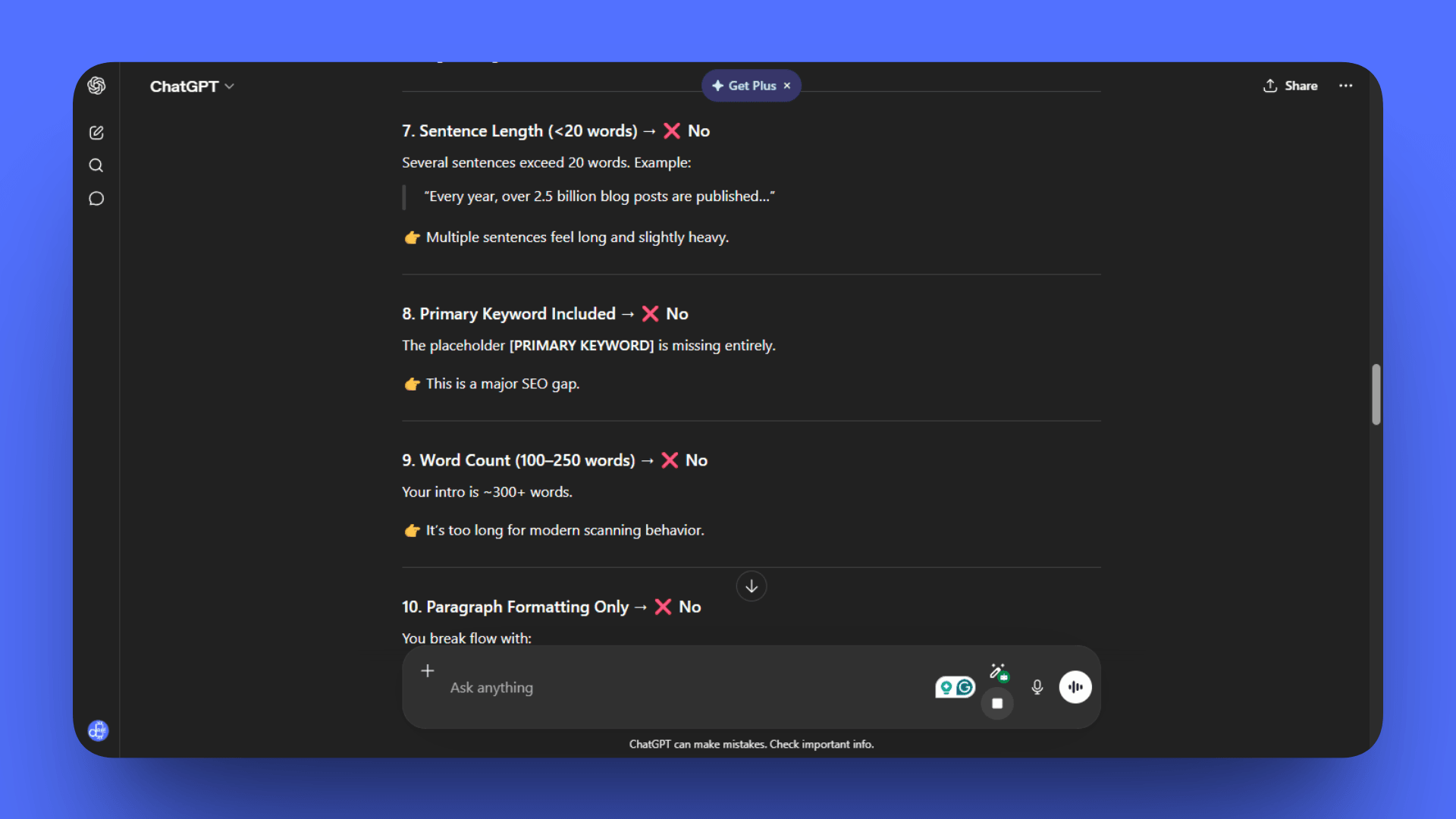
This approach keeps your voice while improving clarity and structure.
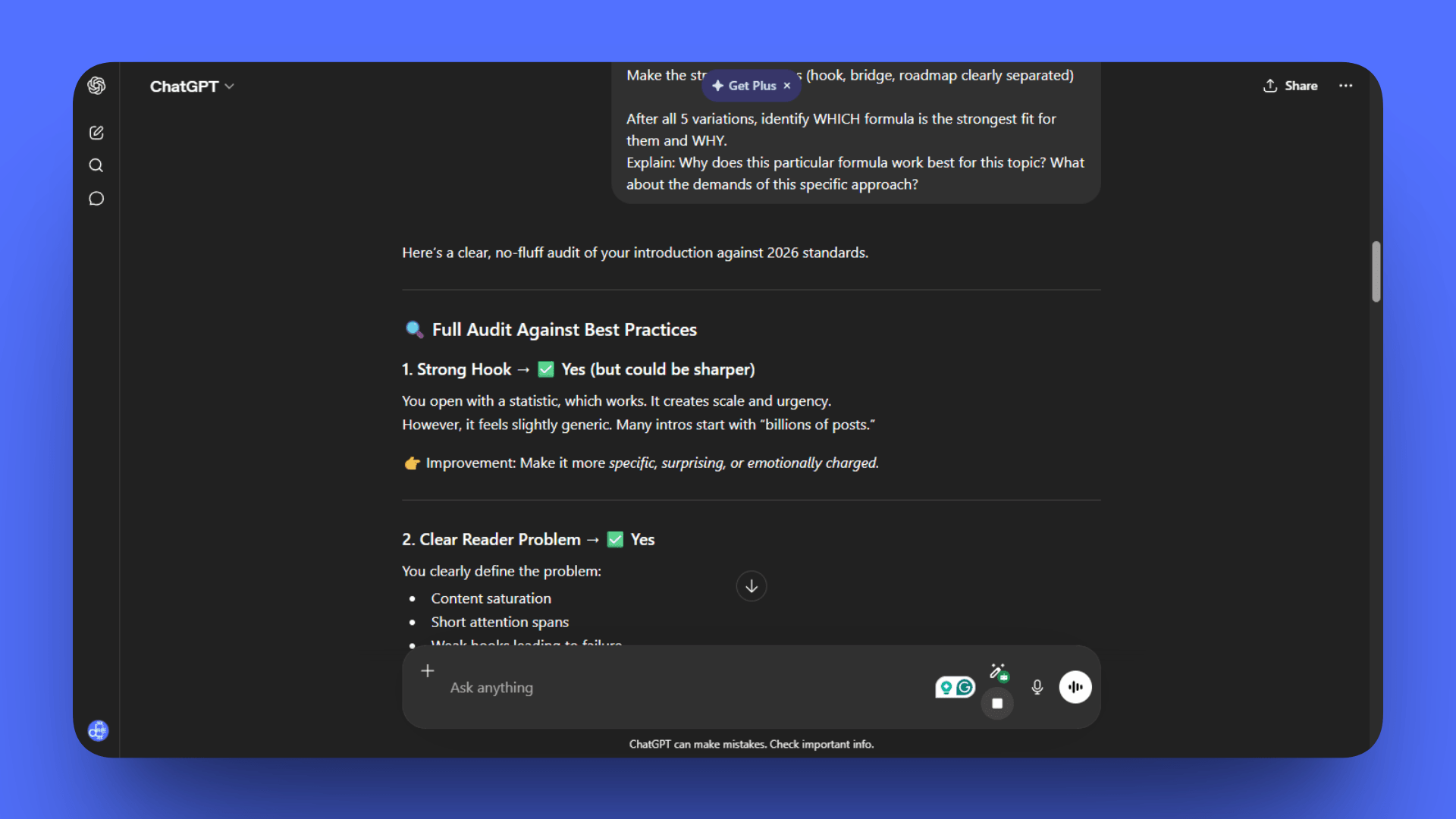
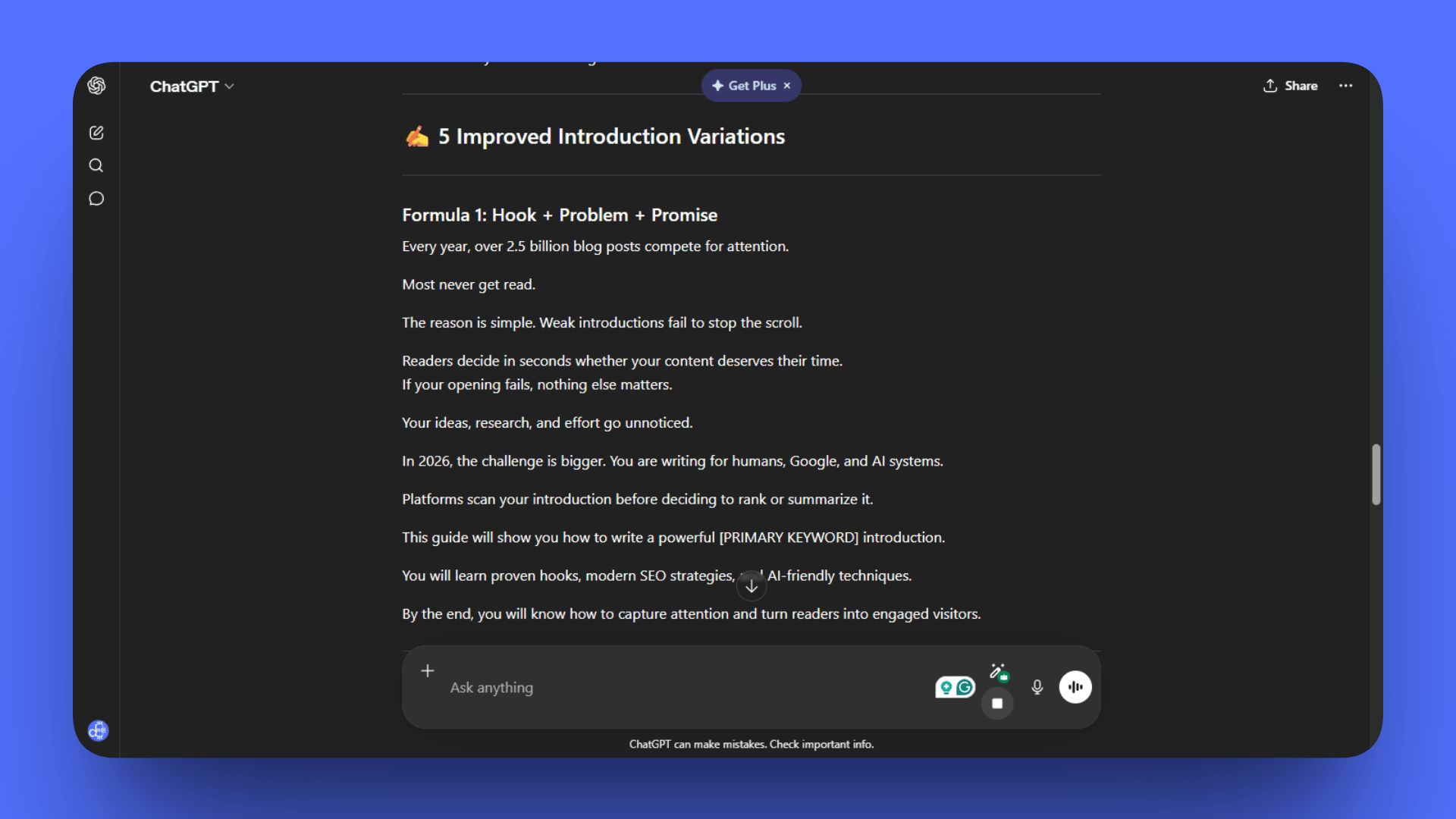
Approach 2: Writing Your Introduction From Scratch
If you want AI to handle everything, you can start from zero.
In this case, your prompt becomes very important.
You need to clearly define:
- Topic
- Target audience
- Tone
- Structure
- Expected outcome
A strong prompt gives you much better results.
1
2
3
4
5
6
7
8
9
10
11
12
13
14
15
16
17
18
19
20
21
22
23
24
25
26
27
28
29
30
31
32
33
34
35
36
37
38
39
40
41
42
43
44
45
46
47
48
49
50
51
52
53
54
55
56
57
58
59
60
61
62
63
64
65
66
67
68
69
70
71
72
73
74
75
76
77
78
79
80
81
82
83
84
85
86
87
88
89
90
91
92
93
94
95
96
97
98
99
100
101
102
103
104
105
106
107
108
109
110
111
You are an expert content strategist specializing in introductions that work for both human readers and AI systems.
I need you to create an exceptional introduction for my article about [TOPIC].
Article Details:
Topic: [TOPIC]
Article Type: [BLOG POST/TUTORIAL/CASE STUDY/GUIDE/PRODUCT REVIEW/NEWS/OTHER]
Primary Keyword: [YOUR PRIMARY KEYWORD]
Target Audience: [DESCRIBE YOUR READER: Who are they? What's their knowledge level? What's their main pain point?]
Article Goal: [What do you want readers to do? Learn? Decide? Take action?]
Tone: [PROFESSIONAL/CONVERSATIONAL/EDUCATIONAL/INSPIRATIONAL/OTHER]
Step 1: Audience Research
First, perform target audience research. Tell me:

Who is my ideal reader?
What problem do they face that my article solves?
What emotional triggers might appeal to them?
What language and tone will resonate most?

Step 2: Create 5 Formula Variations
Now create FIVE introduction variations using these formulas. For each variation:
Formula 1: Hook + Problem + Promise

Start with attention-grabbing hook (stat, question, story, or contrary belief)
Identify specific problem reader faces
Promise clear outcome and value

Formula 2: Direct Answer + Context + Deeper Dive

Answer the core question immediately
Provide context or backstory
Promise deeper exploration and insight

Formula 3: Question + Insight + Solution Path

Open with thought-provoking question
Provide surprising insight or data
Show the path reader will take to solution

Formula 4: Story + Relevance + Takeaway

Start with short, relatable story or scenario
Connect story directly to reader's situation
Transition to what they'll learn

Formula 5: Data + Implication + Article Value

Open with compelling statistic or research
Explain what that data means for the reader
Show why this article matters now

For EACH variation, follow these best practices:

Keep all sentences under 20 words (maximum)
Use simple, everyday language (no jargon)
Include primary keyword [PRIMARY KEYWORD] naturally in first or second paragraph
Establish trust through specificity (not generic claims)
Focus on reader benefits, not author credentials
Write in paragraph format only (no bullets, tables, or formatting)
Match length to article complexity (longer guides need 200-250 words; shorter articles need 100-150 words)
End with a clear promise or transformation statement

Step 3: Identify the Best Formula
After providing all 5 variations, analyze which formula fits BEST for [TOPIC].
Tell me:

Which formula should be used for this topic?
Why does this formula work best here?
What makes [TOPIC] suited for this specific approach?
What would happen if we used a different formula instead?

Step 4: Performance Report
For the winning introduction, provide a detailed report showing:
HOOK COMPONENT

What is the hook?
What type of hook is it (statistic, question, story, contrary)?
Why does this hook work for [TOPIC]?

BRIDGE COMPONENT (Connection)

What problem is identified?
How is relevance established?
What E-E-A-T signal is included?
What is the value proposition?

ROADMAP COMPONENT

What will the reader learn?
What is the transformation promised?
Are there specific article sections referenced?

BEST PRACTICES CHECKLIST
Verify and show which best practices are implemented:
✓ All sentences under 20 words
✓ Primary keyword naturally placed
✓ Paragraph format only
✓ Mobile-friendly (short paragraphs)
✓ E-E-A-T established
✓ Reader-focused (not author-focused)
✓ Clear value proposition
✓ Appropriate length for article type
Step 5: Improvement Recommendations
Ask me: Do you have any specific points or sections you want mentioned in the roadmap? Any additional angles or data you want highlighted? This helps me refine the introduction to match your article's actual structure.
Important notes:

After using this introduction, review it again once you complete your full article.
Check if the roadmap matches what you actually covered.
Verify all facts and claims are accurate.
Consider if any new improvements can be made based on your final article content.
This introduction is your starting point, not your final draft.

Now create the introduction using all these guidelines.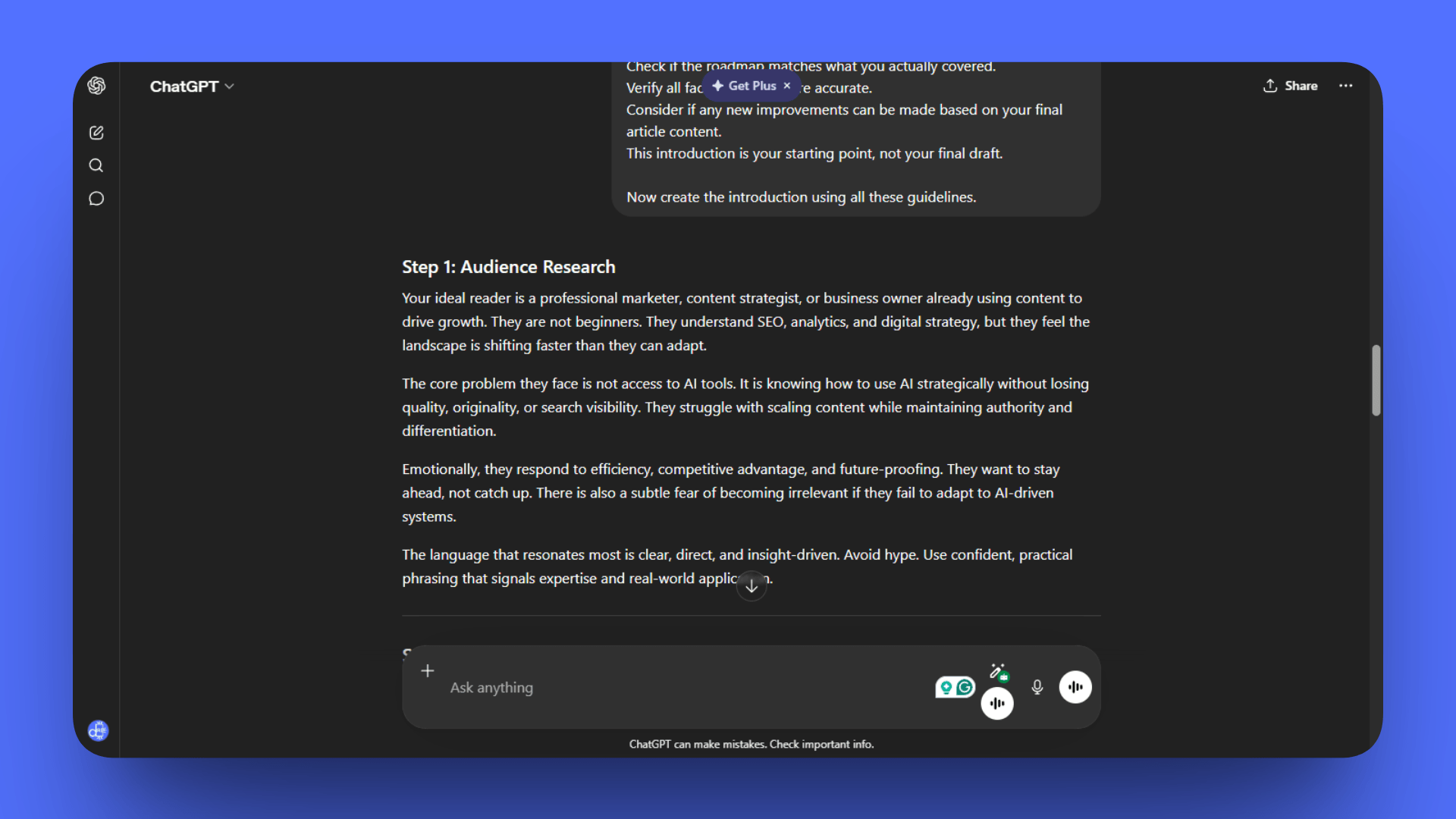
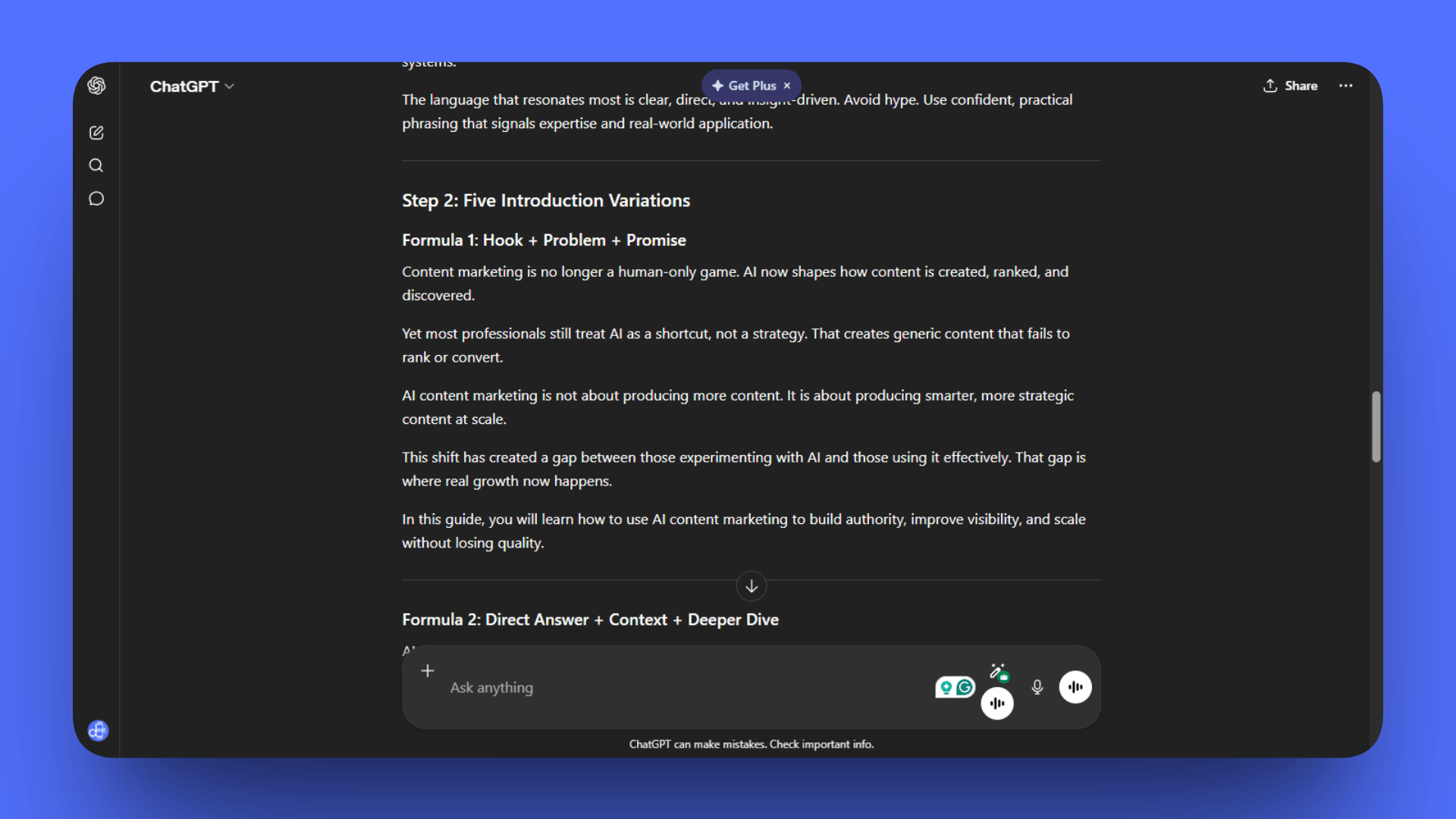
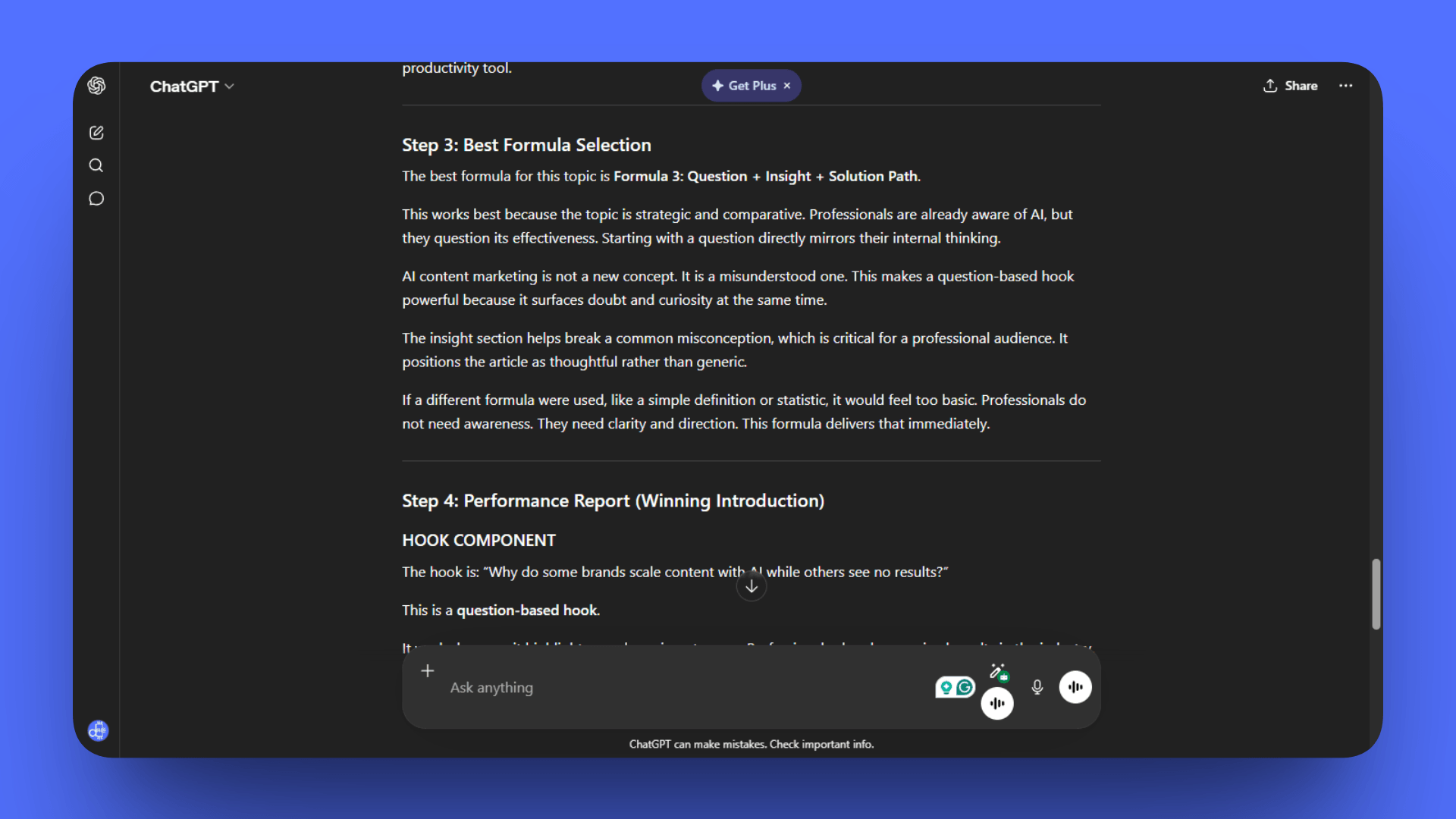
5 Important Points for Working With AI-Generated Content
Once AI gives you introduction options, your work is not finished.
This is the stage where you turn raw output into a strong final introduction.
1. Review What AI Created to Identify the Best Ideas and Gaps
Start by carefully reading the results.
AI can give you different types of outputs:
- Some ideas will be very strong
- Some will need improvement
- Some will not fit your tone at all
This is completely normal.
Think of AI as a starting point, not the final writer.
Sometimes you will find a great idea in the first draft. Other times, you will need to adjust it slightly.
2. Refine and Improve the Output with Better Prompts
Do not accept the first version as final.
Instead, refine it based on your needs.
You can improve your results by:
- Asking for different tones
- Requesting stronger hooks
- Adding more clarity or detail
- Making it more specific to your topic
AI responds well to clear instructions.
The more precise your feedback, the better your next version will be.
3. Always Double-Check AI-Generated Introductions Before Publishing
Before you finalize your introduction, review everything carefully.
Check for:
- Factual accuracy
- Clear messaging
- Logical flow
- Relevance to your article
AI tools can sometimes make mistakes or add generic statements.
Your job is to ensure everything actually matches your content.
4. AI Content Is Not a Problem If It Is High-Quality and Helpful
A common concern is whether AI-generated content gets penalized.
The simple answer is no, if the content is high-quality.
Search engines focus on:
- Helpfulness
- Clarity
- Relevance
- User experience
The method of creation is not the issue. The quality of the output is what matters.
5. Avoid Over-Humanizing Your AI-generated Text
Do not try to force your AI-generated introduction to sound overly “human” using external tools.
This often creates problems like:
- Broken sentence flow
- Confusing structure
- Unnatural language
If your introduction is already clear and readable, there is no need to over-edit it.
What matters most is this:
Readers prefer clarity over forced human tone.
If your content is easy to understand, users will not care whether AI helped create it.
But if your writing becomes confusing, they will leave immediately.
AI is a powerful assistant, but not a replacement for your judgment.
Your role is to guide, refine, and improve.
That is how you turn AI output into high-performing introductions.
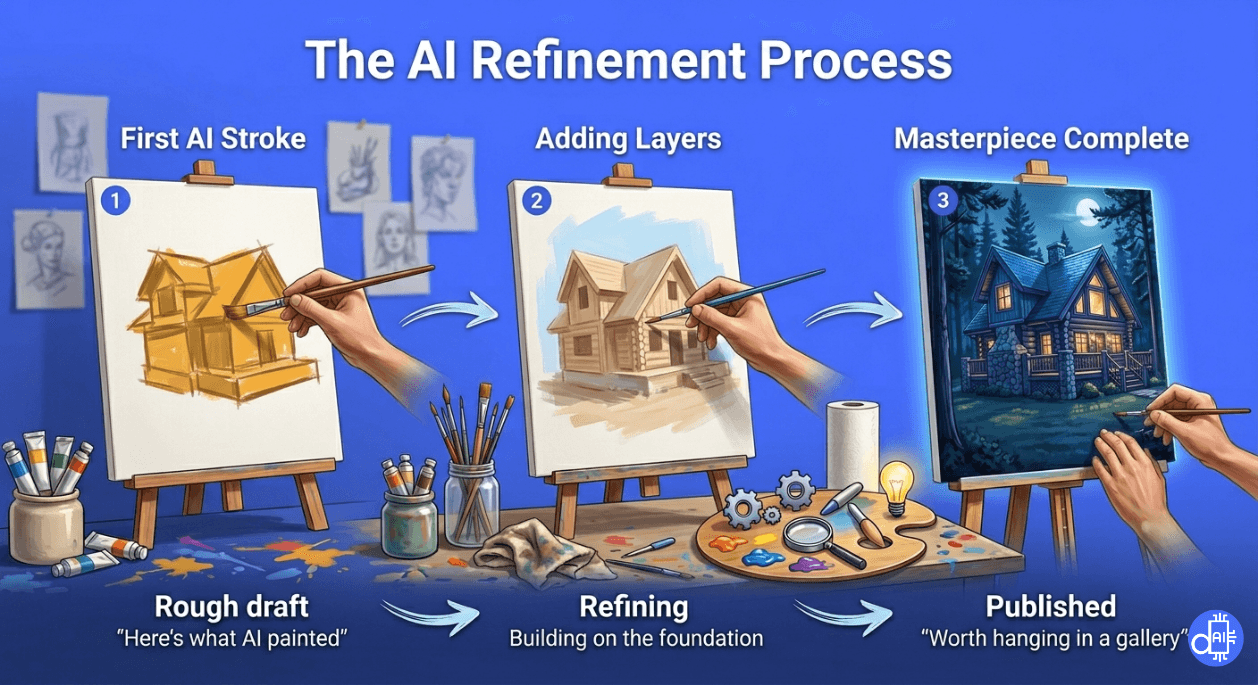
Don't settle for the "First AI Stroke." Use a structured refinement process to turn a rough AI draft into a polished masterpiece.
Practical Introduction Examples & Templates
Now let’s bring everything together.
Below are real introduction examples that show how all the principles work in practice.
Each example includes a breakdown so you can understand exactly what is happening.
Example 1: The Blog Writing Masterclass
To show you exactly how this works in practice, let’s start with a live example from this very article. The introduction you read just a few moments ago was carefully crafted using the exact frameworks we've discussed to keep you on the page.
Focus: Using Data and Emotional Pain Points
The Intro: “Over 2.5 billion blog posts are published every year. Most of them disappear into the internet without ever being read. The difference between a blog that gets thousands of views and one that gets zero often comes down to one thing: the introduction. In this guide, you will learn the exact formulas used by top creators to write introductions that keep readers engaged and rank on both Google and AI search engines. By the end, you will have a system you can use for every article you write.”
Strategic Breakdown:
- The Hook: “Over 2.5 billion blog posts...” (A shocking statistic that grabs attention immediately).
- The Problem: “Most of them disappear...” (Highlights a relatable pain point).
- The Authority: “The difference... comes down to one thing...” (Explains why the topic matters and builds importance).
- The Roadmap: “In this guide, you will learn the exact formulas...” (Sets clear expectations).
- The Promise: “By the end, you will have a system...” (Gives a clear outcome and motivates the reader).
Why This Works:
- Immediate Scale: The stat creates a sense of competition.
- Clarity: The reader knows exactly what they are getting into.
- Motivation: It transforms a daunting task into a manageable system.
Example 2: The SaaS Decision Guide
Focus: Efficiency and Transformation
The Intro: “Most teams spend weeks choosing project management software and still end up frustrated. They select based on features, not on what actually solves their core problem. That is why 40% of new software purchases are abandoned within the first year. This guide cuts through the noise. You will learn the exact criteria enterprise teams use to evaluate project management tools, plus a step-by-step framework for making your decision. By the time you finish reading, you will have a comparison methodology that takes hours, not days.”
Why This Works:
- Strong Problem ID: Directly addresses the frustration of a wasted software search.
- Credibility: Uses a clear statistic (40% abandonment) to validate the problem.
- Correction: Explains the common mistake (features vs. problems) to show expertise.
- Transformation: Ends with a promise of saving time ("hours, not days").
Example 3: The Technical "How-To" Tutorial
Focus: Personal Experience and Authority (E-E-A-T)
The Intro: “I tested seventeen AI writing tools last month to see which one could actually write a blog introduction. Only three of them produced something I would publish without heavy edits. That is when I realized most creators do not know how to use these tools correctly. They are like giving someone a Ferrari but not showing them how to drive it. This guide teaches you exactly how to prompt AI tools so they produce introductions that engage readers and rank. You will get copy-paste prompts you can use today, plus the reasoning behind why they work. Stop wasting hours editing AI content. Learn to get it right the first time.”
Why This Works:
- Personal Experience: "I tested seventeen..." immediately builds trust and authority.
- Curiosity Trigger: The "Only three..." result makes the reader want to know which ones worked.
- Relatable Analogy: The Ferrari analogy simplifies a complex technical problem.
- Practical Value: Promises actionable "copy-paste prompts."
Final Takeaway: The Universal Structure
Regardless of your niche—whether it's SaaS, personal blogging, or technical tutorials—every high-performing introduction follows this core architecture:
- Hook: To capture attention and stop the scroll.
- Bridge: To create a human connection and establish relevance.
- Roadmap: To set professional expectations.
- Promise: To drive the motivation to finish the piece.
Pro Tip: Go back to the beginning of this article. You will notice that it follows this exact system in real time. Consistency across your own content is the fastest way to build a loyal audience.
Best AI Tools to Create Engaging and SEO-Friendly Blog Introductions
The right AI tool makes writing introductions faster and more strategic. Here are the tools that deliver results.
AI Chatbots: Your Best Choice for Full Control
For maximum flexibility and control, use ChatGPT, Gemini, Claude, or Grok. These chatbots remain your best choice for writing introductions because you control every word, tweak prompts endlessly, and get the exact introduction you need—not a template. All these models process language the same way, so pick the one you prefer and use the prompts from this guide.
- Pro Tip: Instead of switching between different tabs, you can use Merlin AI as your all-in-one AI platform to access all of these models in a single place.

AI Writing Platforms with Multi-Purpose Features
These are comprehensive, "all-in-one" environments designed for scale. They don’t just write introductions; they handle SEO research, brand voice alignment, and one-click blog generation to streamline your entire production cycle.
SEO Writing AI Streamlines Keyword Research and Introduction Writing in One Workflow
With its one-click blog generation feature, SEO Writing AI allows you to transform complex keyword research into fully optimized introductions and articles instantly. It specializes in high-speed, SEO-driven content creation, offering a "Humanizer Tool" that refines your opening lines to ensure they feel natural and engaging for readers while satisfying search engine requirements. The platform supports 48 languages and even generates AI images with SEO-friendly alt text, providing a complete, effortless publishing workflow directly to WordPress.
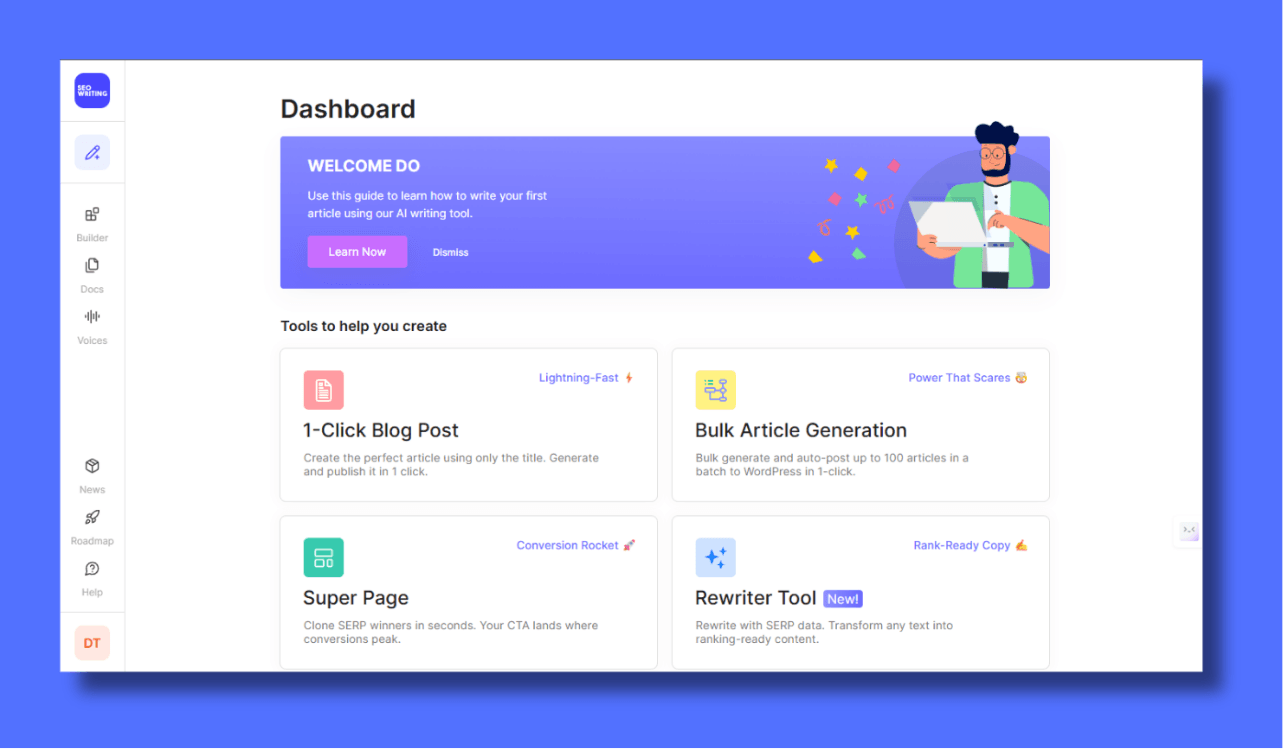
Use SEO Writing AI to transform keyword research into high-ranking content instantly with its 1-click blog generation.
Junia AI: The Powerhouse for Data-Backed Introductions
Junia AI stands out by blending deep research with creative execution, making it an essential tool for crafting high-impact introductions.
Before you write a single word, it provides real-time Google Trends data and exact search volumes, allowing you to identify and place high-impact keywords strategically within your opening lines.
Beyond just keyword placement, it offers a real-time SEO score and a "Humanized Content Generator" to ensure your intro remains conversational and relatable. It’s an all-in-one assistant that ensures your introduction is data-driven, perfectly optimized, and technically flawless.
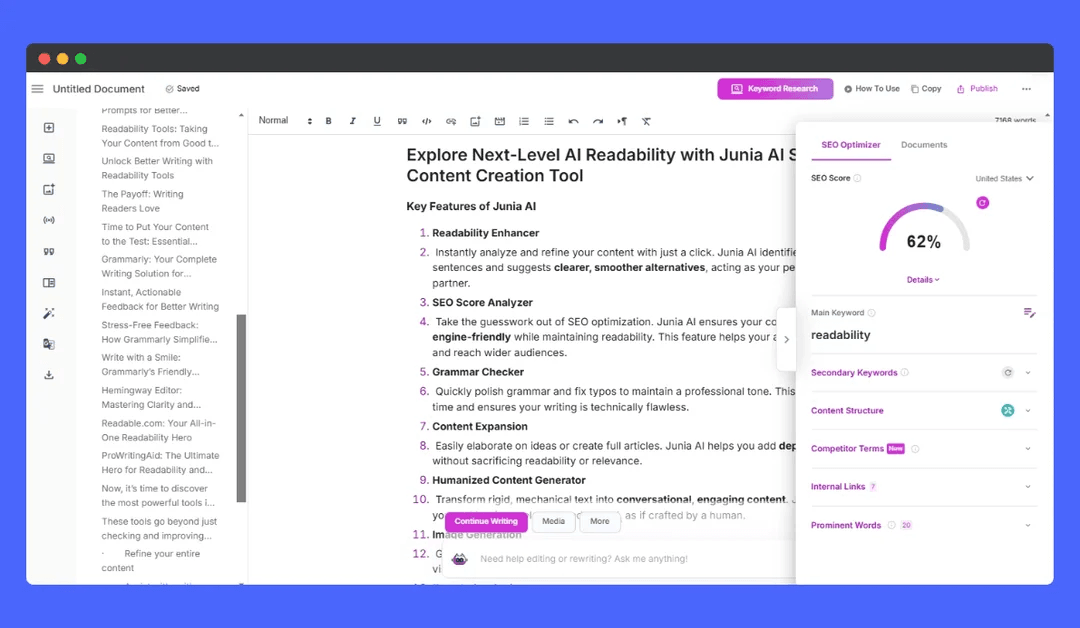
Craft data-backed opening lines with Junia AI, an all-in-one assistant that integrates real-time Google Trends data and keyword volume directly into your introductions
Writesonic Helps You Create SEO-Optimized Introductions With AI
If you want your introduction structurally optimized for Google, Writesonic combines AI writing with SEO optimization by adding keyword analysis alongside generation. It handles long-form content well and includes collaboration features for teams, with a free trial available to test it out.
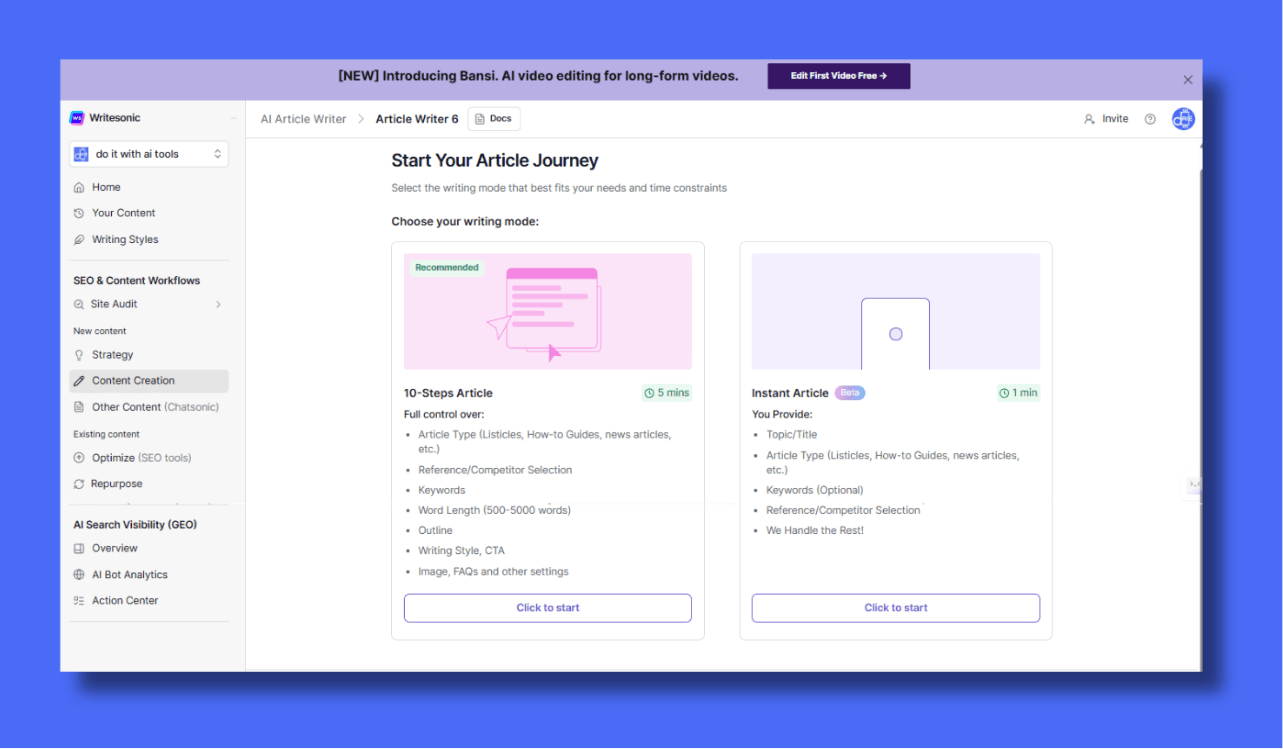
Use Writesonic to combine high-quality AI writing with deep SEO optimisation.
Rytr AI: The Go-To Tool for Personalized and Efficient Introductions
Rytr AI excels at making content creation fast and deeply personal, ensuring your introductions mirror your unique brand voice rather than sounding like a generic machine. It offers a highly user-friendly interface where you can effortlessly select your preferred language and tone, or even provide writing samples so the AI can analyze and match your specific style. Trusted by over 8 million users, Rytr includes a versatile Chrome extension and a rich text editor, allowing you to generate plagiarism-free, SEO-optimized openings across any platform you use to write.
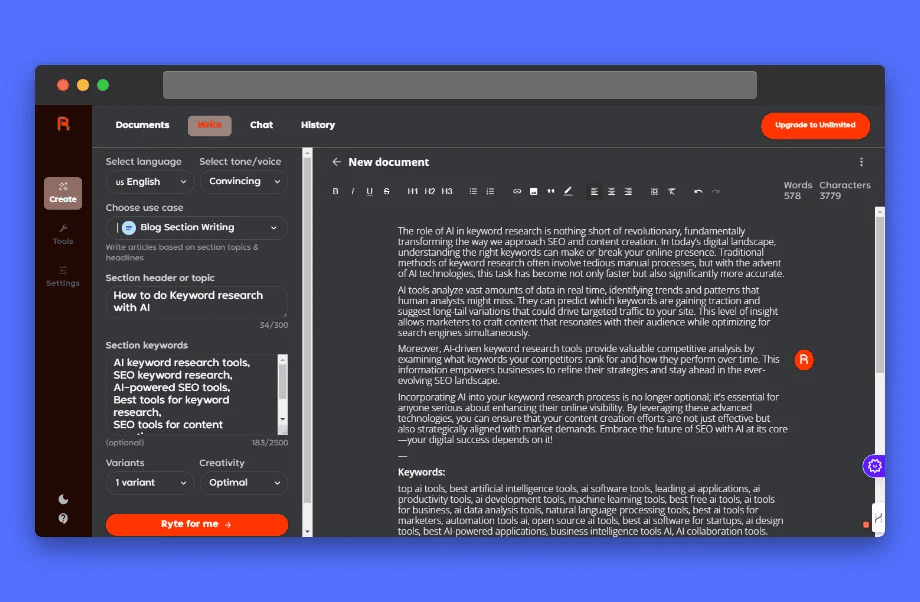
Leverage Rytr AI to create deeply personalized and SEO-optimized introductions.
Semrush SEO Writing Assistant: The Gold Standard for Strategy and Authority
As a product of one of the world’s most trusted SEO authorities, the Semrush SEO Writing Assistant is the ultimate tool for engineering introductions that rank.
It goes beyond simple writing by providing real-time feedback on how well your opening lines align with your target keywords and the search intent of your top-ranking competitors. Its "Smart Writer" capabilities allow you to expand or rephrase your hook instantly while ensuring your tone remains consistent with your brand.
By using this tool, you aren’t just writing an introduction; you are building a data-backed entry point that carries the technical authority needed to perform in 2026’s competitive search landscape.
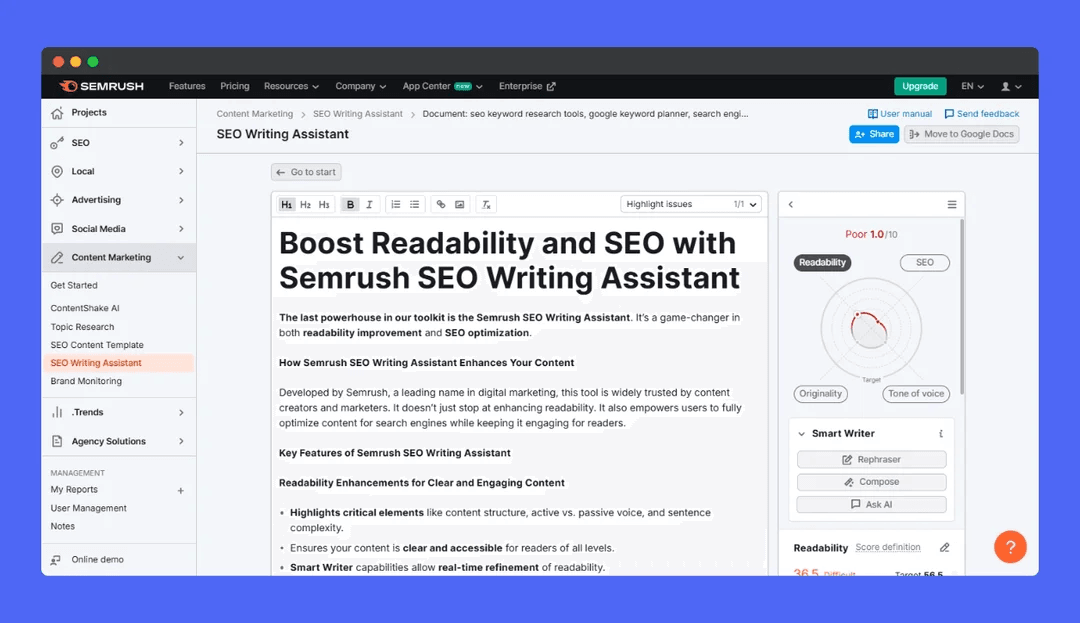
Engineer high-ranking introductions with the Semrush SEO Writing Assistant, a professional-grade audit tool that provides real-time feedback on readability, keyword alignment, and search intent.
Free AI Introduction Generators
Sometimes, you don’t need a complex suite of features—you just need a quick, high-quality starting point. These tools operate on a similar user-friendly principle: you provide the context, and they provide the opening.
Frase AI: The Data-Driven Powerhouse for Content Research and AI Visibility
Frase AI acts as a comprehensive SEO audit tool that analyzes your content's visibility for both Google and AI search citations while identifying exactly how your top competitors are ranking.
It combines over 80 specialized writing skills into a single platform, helping you research and draft high-performing introductions for blog posts, guides, or pillar pages based on real-time search data.
By pinpointing SEO gaps and technical issues in its free audit reports, Frase ensures your introduction is engineered from the ground up to outperform the competition in 2026.
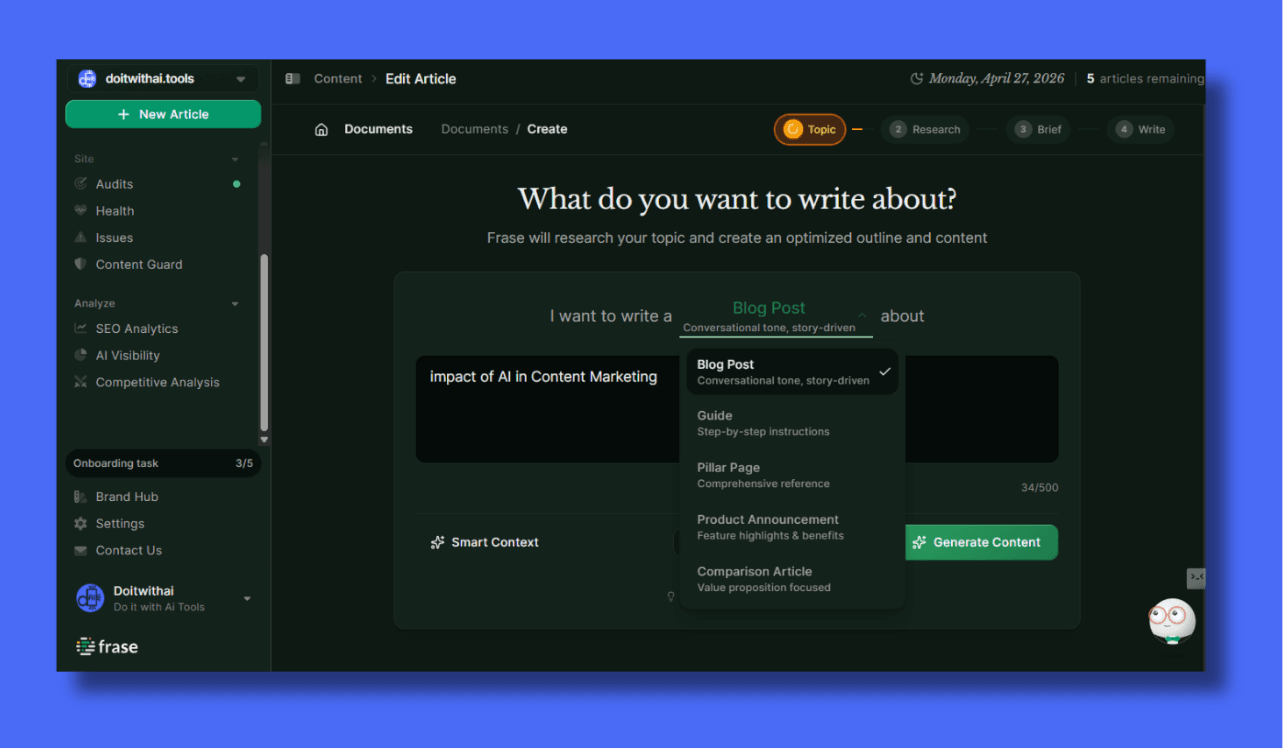
Frase AI allows you to engineer introductions that are structurally optimised for both Google Search and AI-powered citations.
Scalenut: The Fastest Free AI Introduction Generator
Scalenut provides one of the quickest ways to draft a professional opening without the friction of a sign-up process. By simply entering your topic, target audience, and preferred tone, the tool instantly generates multiple unique, plagiarism-free introduction options.
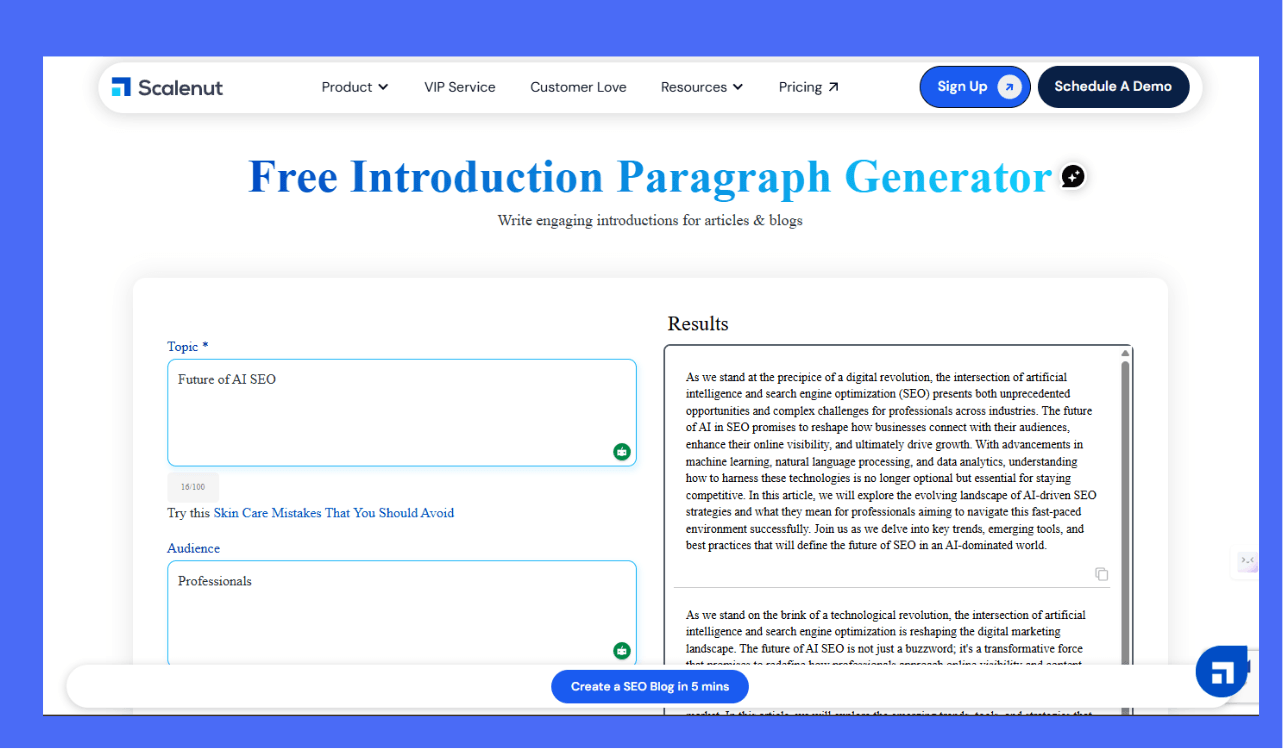
Streamline your drafting phase with the Scalenut Free Introduction Paragraph Generator, which instantly provides unique, plagiarism-free opening variations based on your specific topic and target audience without requiring a sign-up.
Enrich Labs Generates Instant Introductions from Your Article Title
While similar to Scalenut in speed, Enrich Labs AI Blog Introduction Generatorallows for deeper relevance. Instead of just a title, you provide a brief description of your article, your target audience, and the specific problem you are solving. This extra detail allows the AI to generate a highly relevant introduction that hits the right pain points immediately.
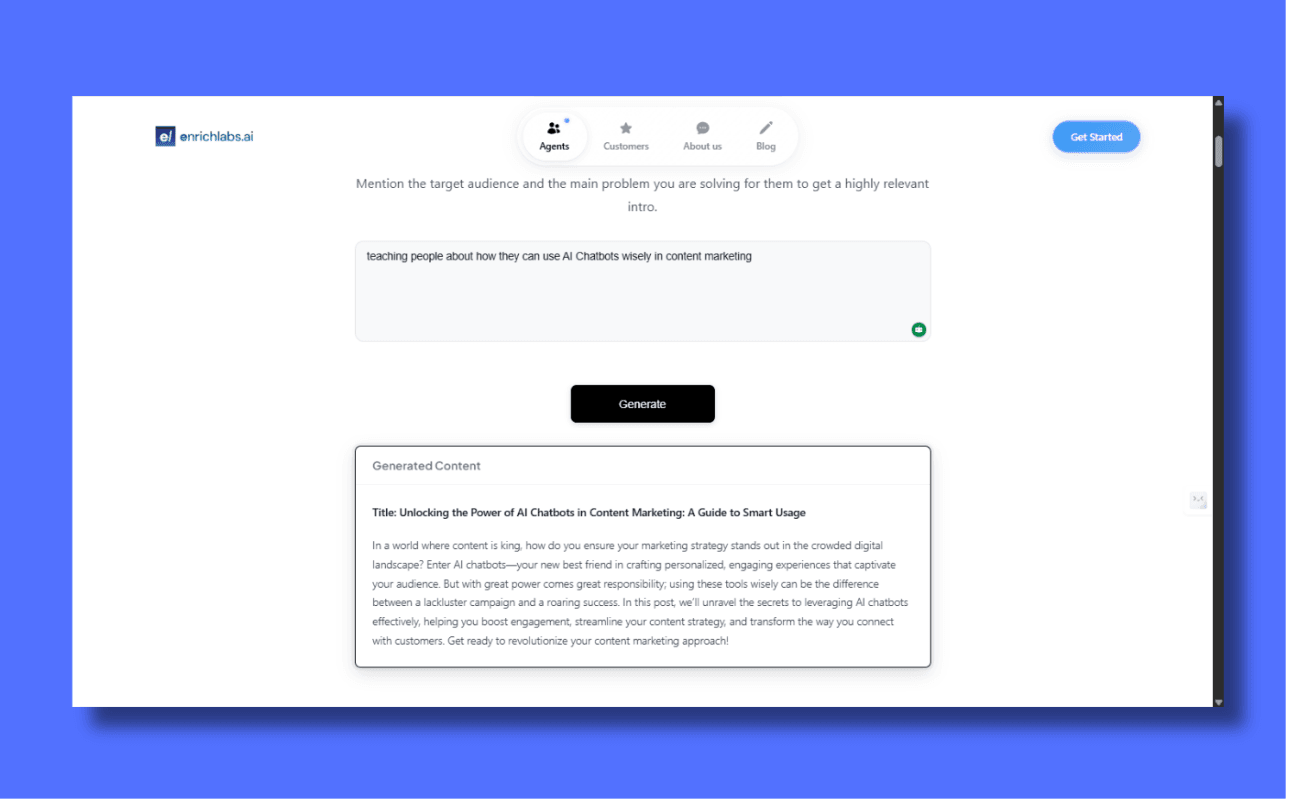
Use the Enrich Labs AI Blog Introduction Generator to create high-relevance openings by defining your target audience and core problem
NeuralText Creates Introduction Ideas Directly From Your Title Input
Following the same straightforward approach as the previous tools, NeuralText is built for absolute simplicity. It only requires your article title to generate a variety of introduction ideas, making it the perfect choice when you want instant results without the need for complex configurations or lengthy inputs.
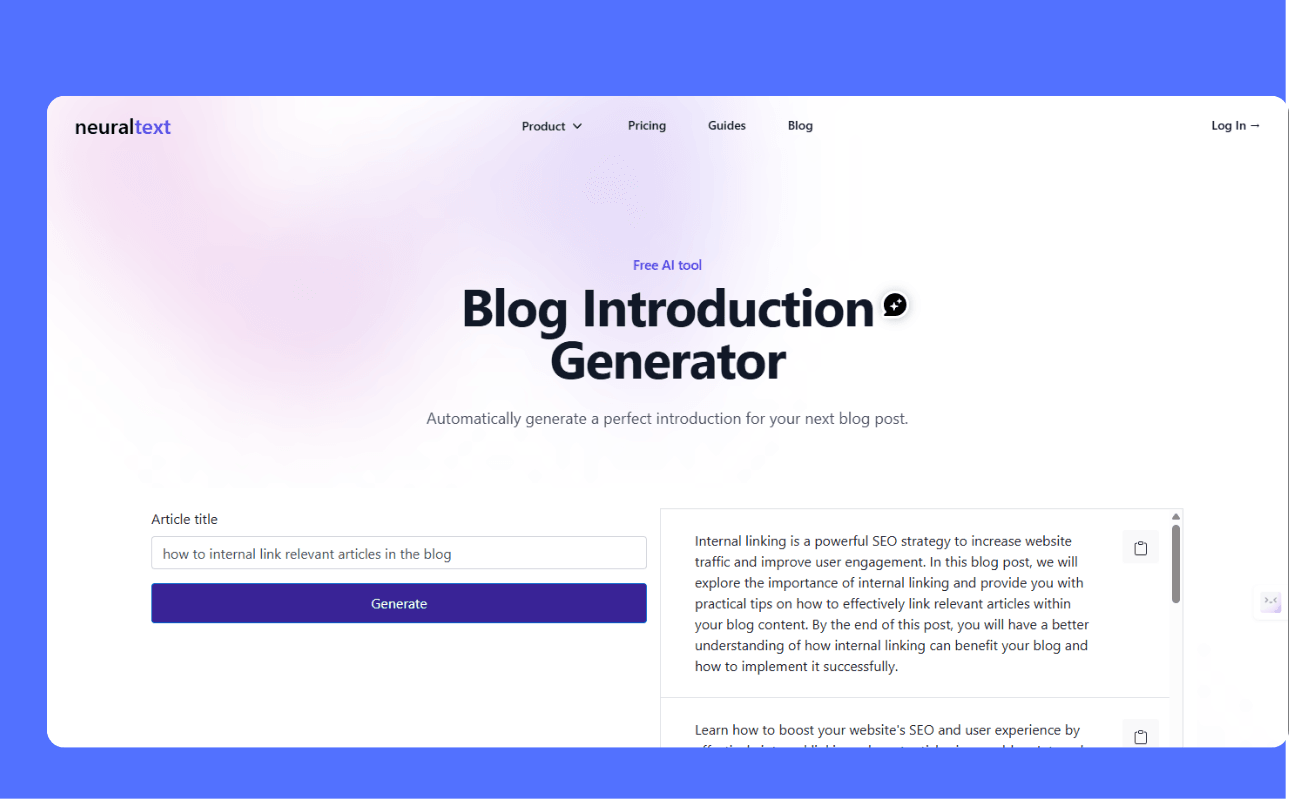
Use the NeuralText Blog Introduction Generator for high-speed content creation; simply enter your article title to receive instant, multiple introduction options that require zero complex configuration.
AI Hook Generators: Winning the Attention Battle
A great introduction is nothing without a strong opening line. These tools specialize in the "psychology of the click," helping you craft high-engagement hooks that stop the scroll.
Ahrefs Free AI Hook Generator: Simple, Fast, and SEO-Focused
Built by one of the most trusted names in SEO, the Ahrefs Hook Generator is the perfect "no-fuss" solution for creators who need high-quality options in seconds. It strips away the complexity, focusing on speed and relevance to help you get past writer's block instantly.
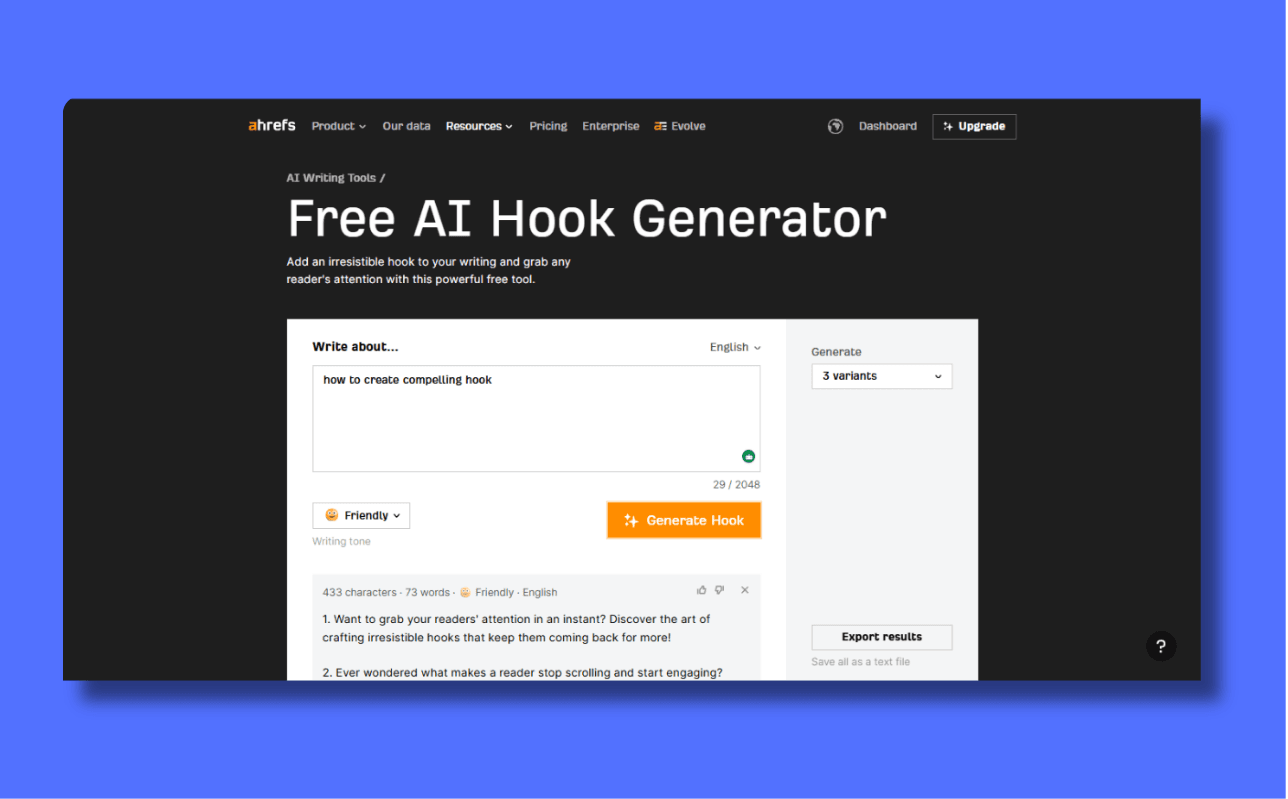
Accelerate your brainstorming process with the Ahrefs Free AI Hook Generator, a fast and SEO-focused tool that provides multiple irresistible hook options in seconds to help you overcome writer's block.
Stop-The-Scroll Hooks for Engagement with Copy.ai Hook Generator
The Copy.ai Hook Generator is specifically engineered to help you win the battle for a reader's attention in the first three seconds.
By simply entering your Topic Description, defining your Content Goal (such as driving sales or building curiosity), and choosing the Number of Variations you want to see, the tool instantly generates a variety of scroll-stopping opening lines.
Whether you need a provocative question, a bold statement, or a surprising statistic, this generator provides multiple "catchy" options that let you A/B-test different angles until you find the perfect hook for your brand.
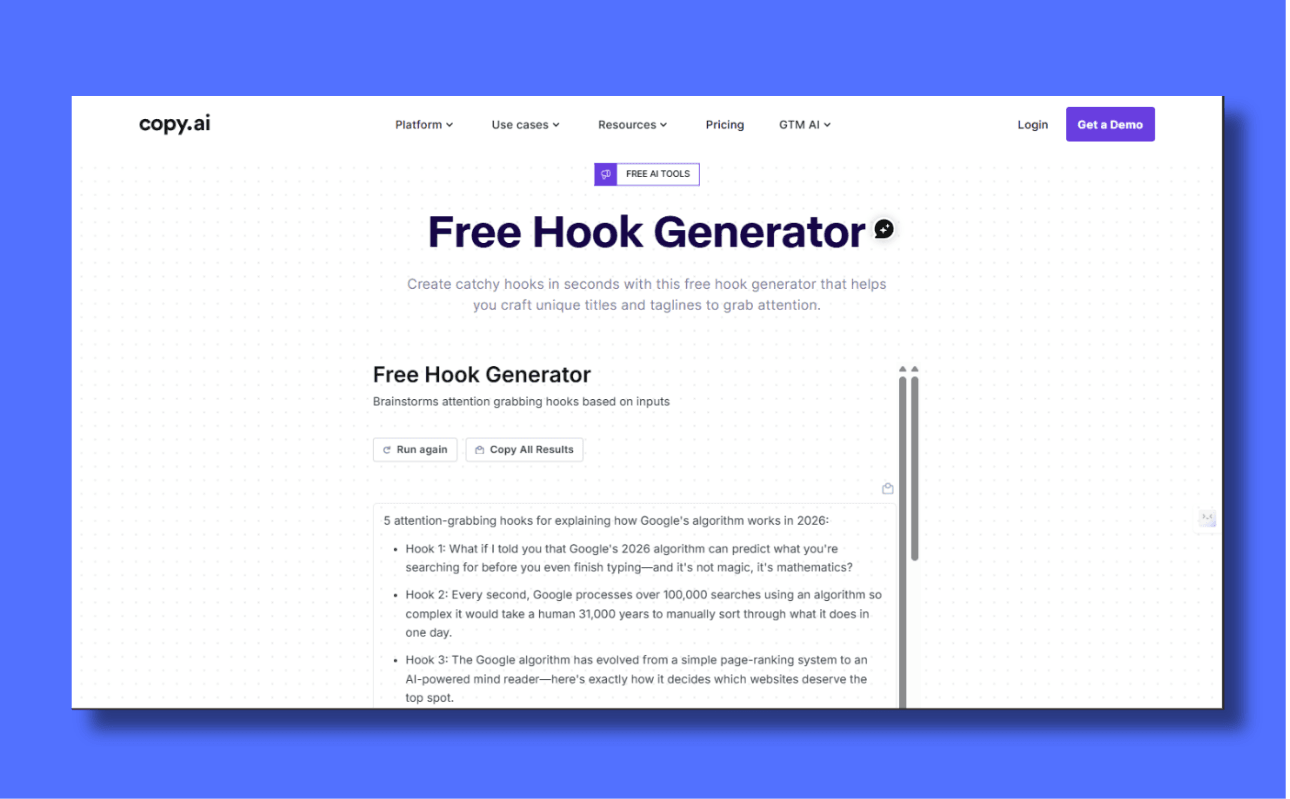
Win the battle for your reader's attention within the first three seconds by using the Copy.ai Hook Generator to brainstorm provocative questions, bold statements, and scroll-stopping opening lines tailored to your specific content goals.
Originality.ai Hook Generator: The Ultimate Multi-Dimensional Opening Tool
If you are looking for a tool that offers deep customization and structural precision, the Originality.ai Hook Generator is one of the most comprehensive options available. It allows you to go beyond simple keywords by providing a highly detailed setup for your opening line:
- Precision Inputs: Simply enter your Topic or Main Keyword to give the AI its foundation.
- Targeted Hook Types: You can select the specific framework discussed in this article, whether you want a Question, Statistical, Definition, Quote, or even an Anecdote.
- Genre & Format Control: Tailor the output to your specific project by selecting a Hook Genre such as Essay, Speech, Report, Thesis, or Blog Post.
- Persona & Audience Alignment: Choose from 11 different Tones (Formal, Informal, Friendly, Analytical, etc.) and specify your Target Audience, with options ranging from General Public and Seniors to College Students and Parents.
- Global Reach: Ensure your hook resonates internationally with multilingual support for English, Italian, Russian, Japanese, Spanish, Korean, and many more.
This level of detail ensures that your hook isn't just "catchy"—it's strategically engineered for your specific reader and medium.
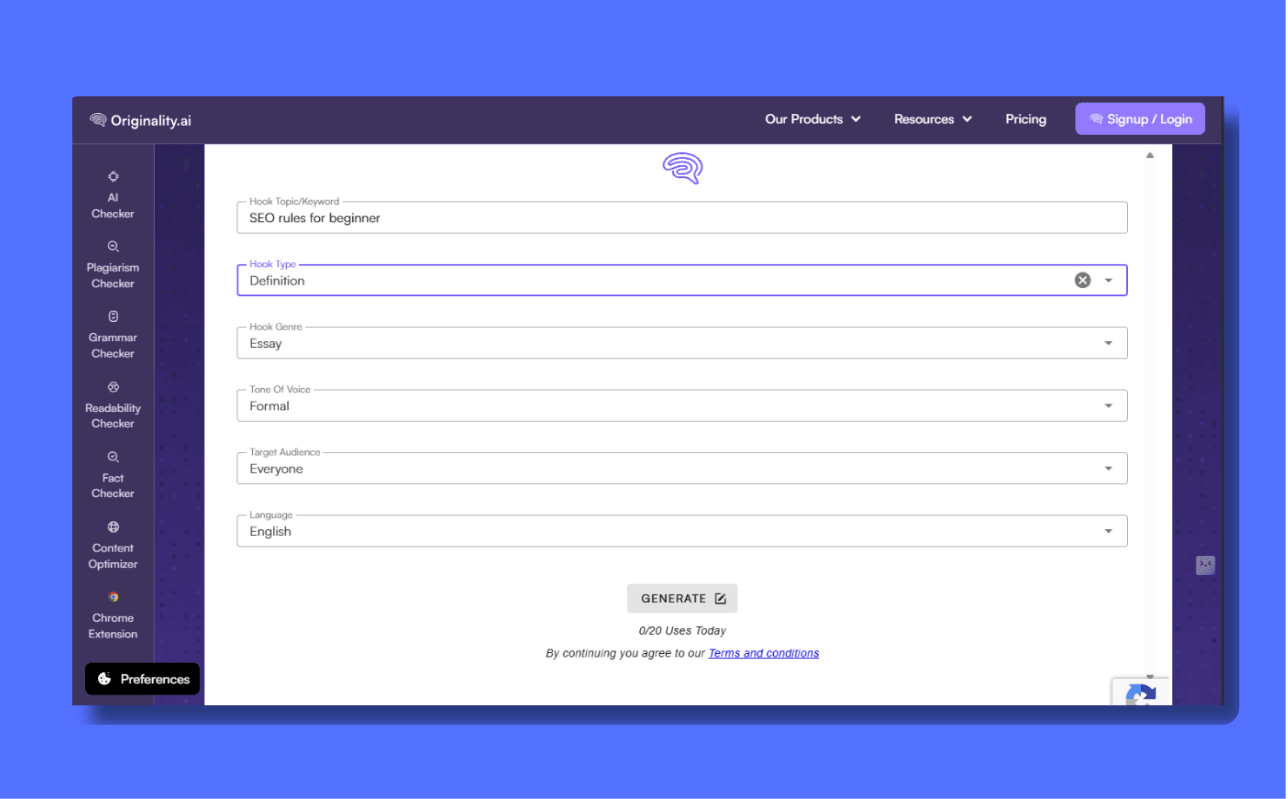
Master the art of structural precision with the Originality.ai Hook Generator, an advanced platform that allows you to specify exact hook types, genres, and audience personas to engineer a data-backed opening line tailored to any medium.
Ahrefs Hook Generator Helps You Create SEO-Focused Opening Hooks
Ahrefs Writing Tools Hook Generator creates various hook types from questions to statistics, built by a trusted SEO platform that understands ranking. When your hook generator comes from an authority on search rankings, you know it's built for performance.
Accelerate your brainstorming process with the Ahrefs Free AI Hook Generator, a fast and SEO-focused tool that provides multiple irresistible hook options in seconds to help you overcome writer's block.
Supporting Tools for Refinement & AI Detection
Use these tools to refine, improve clarity, and ensure your introduction is polished before publishing.
QuillBot Helps You Refine and Humanize AI-Generated Introductions
Use QuillBot after generating your introduction to verify whether your content appears AI-generated, and rephrase sentences while maintaining meaning. This multi-purpose tool also offers plagiarism checking and paraphrasing capabilities, making it essential for post-generation refinement.
Grammarly Improves Grammar Tone and Readability in Your Introductions
Grammarly polishes grammar, tone, and readability after generating your introduction by catching subtle mistakes AI models might miss. The free version will be enough for you.
Hemingway Editor Simplifies Your Introduction for Better Readability
Paste your AI-generated introduction into the Hemingway Editor to simplify complex sentences and ensure every sentence is clear and punchy. The free web version is instantly accessible, making it a quick refinement step.
Use Our AI Keyword Research Tools to Strengthen Your Introductions
To craft introductions that target the right keywords, you need solid research first. We've compiled a complete list of the best AI tools for keyword research in our detailed guide.
You can use them to find the keywords you should naturally include in your introduction for maximum SEO impact.
Master the first step of content optimization by exploring our curated list of Top 9 Free AI-Powered Keyword Research Tools to identify the high-impact terms that will make your introductions rank and resonate.
Final Thoughts: Your Introduction is Your Digital Handshake
In 2026, the first few sentences of your blog post carry massive weight. They are no longer just a lead-in; they are your first and best chance to prove to both human readers and AI crawlers that your content is worth the time.
We’ve taught you exactly how to use this chance effectively, building a comprehensive masterpiece you won’t find anywhere else.
Our goal at doitwithai.tools is to make you a total master of every single element of content writing—starting with the most critical part: the introduction.
We wanted to provide a full spectrum of knowledge, from basic concepts to advanced strategies, tools, and real-world examples, so you never have to go anywhere else for answers.
If you’ve read through this carefully, you have everything you need to master your introductions right here.
From psychological formulas and data-backed templates to the exact AI prompts and specialized tools used by top pros, we’ve given you the blueprint for compelling blog openings that resonate with both human readers and AI systems.
What should be your next move?
Knowledge is only power when it’s applied. Don't let these insights go to waste—start your practical journey today. Here is your immediate action plan:
- Pick a Post: Choose one article you’ve already published or are currently drafting.
- Apply the Formula: Rewrite the introduction using the Hook + Problem + Promise formula we covered.
- Refine for Impact: Keep your sentences under 20 words to boost readability and ensure your primary keyword is included naturally.
- Analyze the Results: Update your content, hit publish, and watch your engagement metrics improve.
The tools are in your hands, and the strategy is in your head.
Now, go out there and write introductions that demand to be read!